I met Isabella Fontaine on a Tuesday in June, six years ago, in a free clinic in the North End, and the first thing she ever said to me was, "Sit down, stop bleeding on my floor, and tell me who did this to you."
I had walked in with a split knuckle and blood on my shirt, and she had taken one look at me and decided I was exactly the kind of trouble she did not have time for. She was twenty-five years old, a nursing student volunteering her evenings at the clinic, with dark brown hair pulled back in a messy ponytail and tired eyes and ink on her fingers from the charts she had been filling out. She wore a faded blue scrub top and sneakers with a hole in the left toe, and she was the most beautiful woman I had ever seen.
"Who did this to you?" she asked again, snapping on gloves.
"A door," I said.
"A door," she repeated, in the flat voice of a woman who has heard every lie in the book and is not impressed by any of them.
"A heavy door," I said. "It swung back."
"Mm-hm." She cleaned the cut with something that stung, and I did not flinch, and she noticed that I did not flinch, and her eyes narrowed. "You don't feel pain like normal people."
"I feel it," I said. "I just don't advertise it."
She taped a butterfly bandage across my knuckle with quick, efficient fingers. "There. That door owes you an apology. Keep it clean, keep it dry, and if it gets hot or red, come back and let someone who actually went to medical school look at it."
"You're not a doctor," I said.
"I'm a nursing student," she said. "Which means I know enough to know when a man is lying to me about a door."
I laughed. I had not laughed, really laughed, in longer than I could remember. Men in my world did not make me laugh. They made me careful. They made me watch the exits. Isabella Fontaine made me laugh, standing there in her faded scrubs with ink on her fingers, and I knew before I walked out of that clinic that I would be back.
I came back the next Tuesday. And the Tuesday after that. I invented reasons: a bruised rib from "the gym," a headache that would not quit, a cut on my forearm from "a broken glass." She saw through every one of them, and she treated me anyway, and by the third week she was waiting for me with two cups of terrible clinic coffee and a look that said she had already decided I was hopeless.
"You're a terrible liar," she told me one evening, handing me a cup. "Whatever you're doing on Tuesdays that gets you hurt, you should stop doing it."
"And do what instead?" I asked.
"Something that doesn't bleed," she said.
"What if bleeding is the job?" I asked, and immediately wished I had not said it, because her face went very still.
"I know who you are, Dominic Moretti," she said quietly. "Everyone in this neighborhood knows who you are. My mother crosses herself when your cars go past. So let me ask you something, and I want the truth this time. Why are you really here?"
I could have lied. Lying was the thing I was best at. I had been lying since I was fourteen years old, lying to police, lying to rivals, lying to my own father. But sitting in that little clinic with the fluorescent lights buzzing overhead and her brown eyes fixed on mine, I found that I could not do it. Not to her.
"Because this is the only place in Boston where nobody wants anything from me," I said. "And because you look at me like I'm a person, not a name."
She was quiet for a long time. Then she said, "Then come back next Tuesday. But come back whole. I am tired of stitching you together."
So I did. I came back whole, week after week, and I learned that Isabella Fontaine was the bravest person I had ever met. She had grown up in a two-room apartment above a bakery in the North End, raised by her mother Rosa, a seamstress with a weak heart who had worked herself half to death to put her daughter through nursing school. Isabella had spent her childhood translating for her mother at doctor's appointments, holding her mother's hand through tests, learning the language of hospitals before she learned the language of anywhere else. She volunteered at the clinic because she believed that nobody in her neighborhood should have to choose between medicine and rent.
She told me all of this the way other people tell you the weather: plainly, without self-pity, as if it were simply a fact of the world. And I listened the way I had never listened to anyone. In my world, people talked to impress me, or to manipulate me, or to beg me. Isabella talked to me as if I were an ordinary man, and for the first time in my life, I wanted to be one.
By August, I was in love with her. I knew it the way a man knows he is falling off a cliff: too late to stop, too fast to think, and strangely unafraid. I told her on a warm night at the end of summer, walking her home from the clinic past the closed bakeries and the darkened windows of Hanover Street, with the smell of bread still hanging in the air.
"I love you," I said. "I know what I am. I know what my name means. But I love you, and I want you to know it before I ask you for anything."
She stopped walking. She looked at me for a long time, and I saw the fear in her eyes, and the hope, and the war between them.
"Do you know what you're asking?" she said. "Because if you love me, Dominic, you can't keep living the way you live. Sooner or later, your world comes for the people you love. That's how it works. Everyone in this neighborhood knows it."
"I know," I said. "That's why I'm telling you first. Before I do anything else, I need you to know."
She took my hand. Her fingers were warm and small, and they fit in mine as if they had been made for it.
"Then prove it," she said. "Not with words. With a life."
So I started to build one. Quietly, carefully, the way a man dismantles a bomb. I began moving my legitimate businesses into the light: the restaurants, the real estate, the shipping company. I started pulling back from the rooms where the real money changed hands. I told my father, Vittorio Moretti, that I intended to marry a nursing student from the North End, and I watched his face go hard and still in a way I had never seen before.
"She is not one of us," he said.
"That's the point," I said.
"You don't understand what you're doing," he said. "This family has enemies, Dominic. Enemies who would use a wife against you. Enemies who would use children against you."
"Then I'll protect them," I said.
"You can't protect anyone from this life," my father said. "You can only keep them out of it."
I should have listened to the warning inside his words. I should have heard what he was really telling me: that he would not allow it. But I was thirty-one years old, and I was in love, and I believed that wanting something badly enough was the same as being able to have it.
By the end of August, I had done something I had never done for any woman: I took her to Sunday lunch with my mother. Not my father. My mother, Angela Moretti, had been dead for fifteen years by then, and I had never once brought a woman to the family table. But Rosa Fontaine was not the family table. Rosa was a seamstress with a weak heart who lived in a two-room apartment above a bakery, and she made lunch on Sundays, and she had decided that she wanted to meet the man her daughter kept smiling about.
I arrived at her apartment with flowers and a bottle of wine, and I stood in the doorway feeling more nervous than I had ever felt walking into a room full of armed men. Rosa was small and gray-haired, with Isabella's brown eyes and a hand that trembled slightly when she shook mine.
"So," she said, looking me up and down. "You're the one."
"Yes, ma'am," I said.
"My daughter tells me you come to the clinic every Tuesday," she said. "She tells me you are always hurt."
"I've been more careful lately," I said.
"Good," Rosa said. "Because my daughter has spent her whole life stitching other people together, Mr. Moretti. I would hate for her to spend the rest of it stitching you."
Isabella laughed from the kitchen, and Rosa's stern face softened into a smile, and for the rest of the afternoon I sat at a small table covered in a plastic cloth and ate the best pasta I had ever tasted, and Rosa told me stories about Isabella as a little girl: how she had bandaged her dolls, how she had translated for her mother at the hospital when she was nine years old, how she had announced at twelve that she was going to be a nurse so that no one in their neighborhood would ever have to be afraid of a doctor again.
"She has a good heart," Rosa said quietly, when Isabella went to the kitchen for more bread. "A good heart is a dangerous thing in this world, Mr. Moretti. People take advantage of it. I am telling you this because you look like a man who knows what a good heart is worth."
"I do," I said. "That's why I'm here."
Rosa studied my face for a long moment. Then she nodded, once, the way a woman nods when she has made a decision she intends to keep.
"Then take care of it," she said. "That's all I ask."
That same week, something happened at the clinic that I have never forgotten. A man came in with a broken arm, a dockworker, and he took one look at me sitting in the waiting room and went pale. He knew my name. He knew what my name meant. He tried to leave, and Isabella stopped him at the door, and she said, in a voice I had never heard from her before, sharp and certain, "Sir, your arm is broken. You are going to sit down, and you are going to let me fix it, and you are not going to worry about who else is in this room. In this clinic, everyone is just a patient. Do you understand?"
He sat down. She set his arm. And when she was done, he looked at me, and he said, "You're a lucky man, Mr. Moretti," and he walked out.
Isabella turned to me, and her hands were shaking a little, and she said, "Was that all right? I didn't want him to be afraid."
"It was perfect," I said. "You were perfect."
She looked at me for a long moment, and then she smiled, and in that smile I saw the whole of my future: a small apartment, a window over the rooftops, Sunday lunch with her mother, and a woman who was not afraid of my name and not afraid of my world, who looked at both and decided, calmly, that they would not rule her.
In September, Isabella moved into a small apartment on the edge of the North End, a third-floor walk-up with a window that looked out over the rooftops. I helped her carry boxes up the stairs. I fixed the dripping faucet in her kitchen. I learned to cook pasta the way her mother taught her, with too much garlic and not enough patience. On Sunday mornings we went to the bakery below her building, and she would order in Italian, and the old men at the counter would nod at me with respect and a little fear, and for three months I lived a life I had never dared to imagine.
I was going to propose to her at Christmas. I had already bought the ring, a simple gold band with a single small diamond, nothing like the stone I would one day carry for Sloane Barrett. I had it hidden in my desk drawer. I had planned the words. I had even practiced them in the mirror like a boy.
Then, on a Friday in early November, she was gone.
I came to her apartment after a long day and found the door unlocked and the rooms empty. The furniture was there. Her clothes were there. Her nursing books were stacked neatly on the kitchen table. But her suitcase was gone, and her toothbrush was gone, and there was a note on the counter in her neat, careful handwriting.
"I'm sorry. I can't do this. Please don't look for me. — I."
That was all. No explanation. No fight. No goodbye. Just a note, and an empty apartment, and a silence that swallowed the whole building.
I did look for her. Of course I looked for her. I called her phone until it went dead. I went to the clinic, and the director told me she had resigned that morning without explanation. I went to her mother's apartment, and Rosa Fontaine opened the door a crack and looked at me with eyes full of tears and terror, and she said, "She's gone, Mr. Moretti. Please. Don't ask me where. I don't know. She wouldn't tell me. She said it was safer for everyone if I didn't know."
I believed her. I believed her because her hands were shaking and her face was gray, and I thought the shaking was grief. I understand now that it was fear. But in those days, I believed what I wanted to believe: that Isabella had looked at my world, looked at my name, and decided that the price of loving me was too high.
I went back to my life. I went back to the restaurants and the shipping and the rooms where the real money changed hands, and I told myself that she had made the right choice. I told myself that a woman like Isabella deserved a life without my shadow in it. I told myself that forgetting her was the last kind thing I could do for her.
I never forgot her. Not for a single day. I carried her in my chest like a wound that had healed over on the surface and never stopped bleeding underneath. I threw myself into work. I made the family richer and more powerful than it had ever been. My father was proud. The old men at the social club clapped me on the back. And somewhere along the way, Sloane Barrett came into my life, beautiful and polished and useful, and everyone told me she was perfect, and I said yes to a courtship I did not want because I had stopped believing that the thing I wanted was still in the world.
Six years. Six years of telling myself that Isabella Fontaine had chosen to leave me.
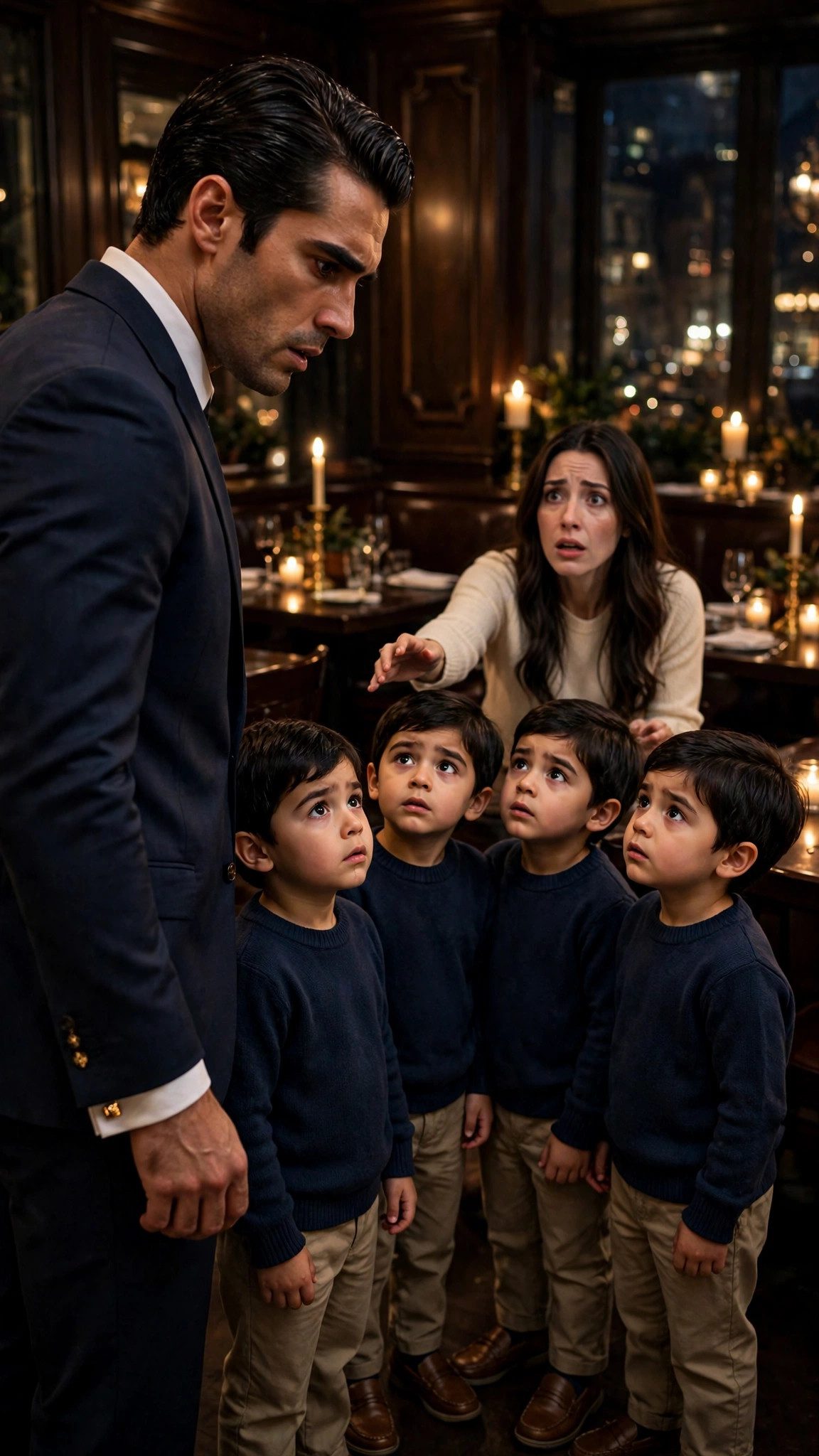
And then four little boys walked into a restaurant bathroom wearing my face, and I understood, standing there at the sink with my hands braced on cold marble, that I had never once asked the only question that mattered.
What if she hadn't chosen at all?