My father was fighting for his life in intensive care when my husband sent me exactly twenty-five dollars and wrote, "For nourishment."
I read the message twice, standing in the corridor outside the ICU at St. Mary's Hospital, with the smell of disinfectant in my nose and the sound of my father's ventilator sighing behind the glass. Twenty-five dollars. Twelve years of marriage, and that was what I was worth to Alexander Moretti — the price of a sandwich and a coffee, sent like a tip to a waitress.
He was punishing me. Three days earlier I had asked him, quietly, in our own kitchen, why his beautiful assistant needed to travel with him to a private island for her birthday. I had not raised my voice. I had not accused him of anything. I had only asked. And Alexander Moretti, the man all of Chicago feared, had answered me the way he answered everyone who questioned him: by making them smaller.
While my father died, Alexander was on that private island, celebrating Vivian Cross's birthday under palm trees, raising glasses of champagne that cost more than the twenty-five dollars he had sent his wife.
I did not cry in the corridor. I had learned, over twelve years, that tears in the Moretti house were a currency no one accepted. I put my phone in my pocket, went back into my father's room, and held his hand until the nurse came to change the IV bag. My father was a driver. He was not a soldier. He was not an executive, not a bodyguard, not anyone important. But one evening, eighteen years ago, he had taken a bullet that was meant for Alexander Moretti — and Alexander had come to his hospital bed the next morning and said, "When he's old enough, I will make sure his daughter is taken care of. I owe him my life."
My mother never told me the whole truth. But I remembered the day Alexander decided I would become his wife. My mother stood alone in our kitchen and cried the whole evening, her hands wrapped around a mug of tea that went cold. I was twenty years old and I thought she was crying because she would miss me. I understand now that she was crying because she knew what I did not: a marriage built on a debt is not a marriage at all. It is a receipt.
He promised me a life of luxury. He even had a palace built for me — a house on the lake with marble floors and a garden my mother could never have dreamed of, a house with more rooms than we had people to fill them. But he would spend my birthday at a beach on a private island with women in dresses that cost more than my father's car.
My name is Emma Moretti. For twelve years, I have been married to Alexander Moretti. A man everyone in Chicago feared.
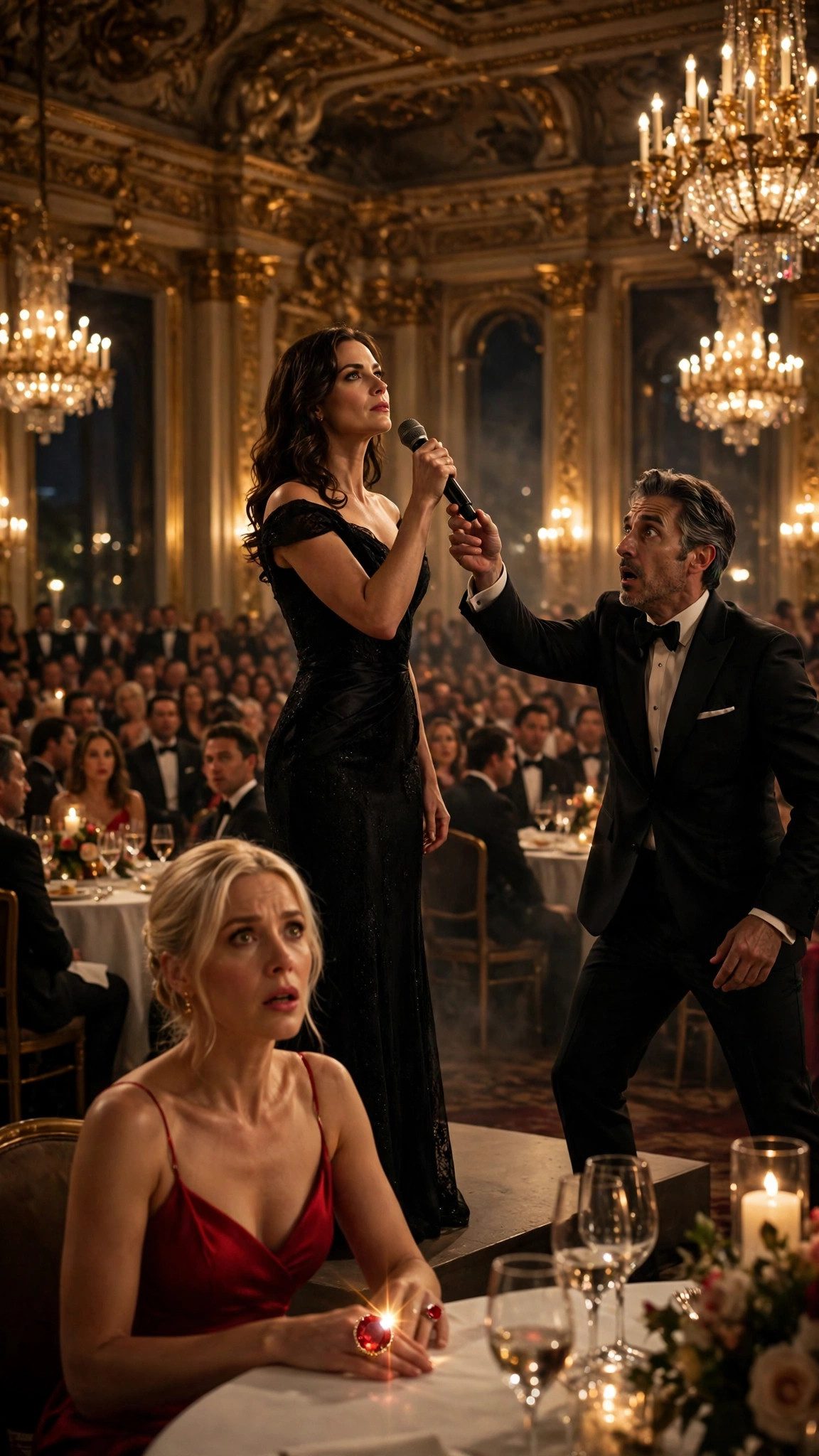
And four days after my father died, I stood in a ballroom full of hundreds of people at his company gala, wearing a black dress and a smile I had practiced in the mirror, and I watched my husband take a microphone and threaten to cut off my father's hospital money again — without realizing there was no father left to save.
He stood on the stage in his black tuxedo, handsome and untouchable, and he looked straight at me across the sea of white tablecloths and said, "My wife seems to have forgotten who pays for her father's care. Perhaps a reminder is in order. The money stops tonight unless she remembers her place."
The room went very quiet. Cameras turned toward me. I could feel three hundred pairs of eyes on my face, waiting to see the wife of Alexander Moretti break in public.
I saw a photo of my father in the hospital in my mind. He was connected to machines, breathing through a tube, his hand thin and cold in mine. And facing me was Alexander, one of the most powerful and feared men in Chicago, threatening me in front of hundreds of people. My father once saved his life, but he couldn't save me from him.
I stood up slowly. My chair scraped against the marble floor, and the sound carried through the whole hall. The entire room fell silent as the cameras turned toward me. I walked to the stage — I do not remember deciding to walk, I only remember the carpet under my heels and the chandeliers blurring above me — and I took the microphone from his hand.
Alexander stared at me. For the first time in twelve years, he looked surprised.
I turned to the room. I turned to Vivian Cross, sitting in the front row in a red dress, her blonde hair perfect, her hand resting on the table beside her wine glass, a ruby ring catching the light on her finger. I had seen that ring before — in the photographs from the island, in the photographs from the office Christmas party, in the photographs from every trip my husband had taken in the last two years. I had seen it and I had told myself I was imagining things.
I was not imagining things.
I lifted the microphone to my lips, and I said four words that made every executive, every guest, every associate, and Alexander himself go pale.
"Look at her hand!"
This was not over. Not even close. But to understand what happened in that ballroom — and what happened after — you have to understand the night my father took a bullet for a man who would one day own his daughter.
It began eighteen years ago, on a rainy October night, on a street in Chicago that no longer exists the way it did then. My father was driving Alexander Moretti home from a dinner that had run late. I was fourteen years old, asleep in my bed, dreaming about a geometry test. My mother was in the kitchen, ironing my father's shirts for the next day.
None of us knew that by morning, our lives would belong to Alexander Moretti.
The gunman came out of the dark between two parked cars. My father saw him first — saw the muzzle flash before he heard the shot, the way men who have driven through bad neighborhoods for twenty years learn to see danger a half-second before it arrives. He did not think. He did not hesitate. He threw the car door open and he put his body between the gunman and the back seat where Alexander sat.
The bullet was meant for Alexander Moretti. It found my father's chest instead, an inch from his heart.
Alexander told me once, years later, in one of the rare moments when he spoke to me honestly, that he had watched my father's blood spread across the leather seat and thought, in that moment, that he had finally run out of luck. He said my father's eyes had found his in the dark and my father had said, "Drive, Mr. Moretti. Drive."
So Alexander drove. He drove my father to the hospital himself, his hands on the wheel, my father's blood on his suit, and he stayed in the waiting room all night while the surgeons worked. And in the morning, when the doctors said my father would live — damaged, but alive — Alexander came to his bedside and made a promise.
"When he's old enough," he said — he meant me, though I was a girl of fourteen and he had barely looked at me — "I will make sure his daughter is taken care of. I owe him my life."
My mother stood in the doorway of that hospital room, holding her purse with both hands, and she said nothing. She said nothing for eighteen years, until the day she died, and I wish now — I wish with everything in me — that I had asked her what she was thinking in that doorway. Because I think she already knew. I think she saw it in Alexander's eyes that morning: he was not a man making a promise out of gratitude. He was a man buying something.
He was buying my father's life, and the price was me.
But I was fourteen, and my father was alive, and the world went back to normal. Or it seemed to. My father went back to driving, though he could never lift anything heavy again, though he tired easily, though the doctors said the bullet had nicked his heart and it would never be as strong as it was. He drove Alexander for four more years, and then he retired, and Alexander paid him a pension that was generous and silent, the way rich men pay for things they would rather not discuss.
I grew up. I went to college. I studied accounting because numbers made sense to me in a way people never did, because numbers did not lie and did not change their minds. I had a boyfriend for a while, a kind boy named Daniel who wanted to marry me and move to Milwaukee, and I almost said yes.
And then, on a Tuesday in June, when I was twenty years old, Alexander Moretti came to our house.
I remember the car first — black, long, silent, pulling up in front of our small brick house like a shark arriving at a pond. I remember my mother opening the door and her face going white. I remember Alexander stepping into our living room in a suit that cost more than our house, looking at the faded sofa and the photographs on the wall as if he were inspecting a property he had already decided to buy.
"I have come," he said, "to collect on my promise."
My father was in his chair by the window, his hand pressed to his chest the way he always did when he was tired. He looked at Alexander for a long moment, and then he looked at me, and I saw something in his eyes I had never seen before. Fear. Not for himself. For me.
"Emma," my father said, very quietly, "go to your room."
But Alexander smiled — a small, controlled smile, the smile of a man who is used to getting what he wants — and said, "No. Let her stay. She should hear this."
And that was the day Alexander Moretti decided I would become his wife.
My mother stood alone in our kitchen that evening and cried the whole night. I sat on my bed and listened to her crying through the wall, and I told myself she was crying because she would miss me. I told myself that for twelve years.
I know better now.
This is the story of a marriage that cost twenty-five dollars. This is the story of a debt, a ring, and a woman who finally learned the price of her own silence — and stopped paying it.
But before the gala, before the microphone, before the four words that changed everything — there was an afternoon in my bedroom in the palace on the lake, with the sun going down over the water, and Rosa standing in the doorway, watching me get ready.
Rosa had worked for the Moretti family for thirty years. She had seen wives come and go, she had seen men rise and fall, and she had learned, as I had learned, when to speak and when to stay silent. That afternoon, she did not stay silent.
"You are going to do something tonight," she said. It was not a question.
I looked at her in the mirror. I was putting on the black dress — the dress from my mother's funeral, the dress I had worn to every gala where I had smiled and been polite. My hands were shaking. I had not expected them to shake.
"I am going to tell the truth," I said.
Rosa nodded, slowly, the way she always did when she had made up her mind about something. She came into the room and she took the hairbrush from my hand, and she brushed my hair the way my mother used to do, long, slow strokes, and she said, "Your mother would be proud of you, Emma. She cried the night you were married, and I know why she cried. She cried because she knew you were too good for that house. And tonight, you are going to show them."
"Rosa," I said, "if this goes wrong — if Alexander — "
"It will not go wrong," Rosa said firmly. "The truth does not go wrong. It only goes where it is needed."
She helped me with the clasp of my necklace — a simple silver chain, my own, not one of Alexander's jewels — and she handed me my purse, and in my purse was the envelope with the twenty-five dollars, and my father's letter, folded soft as cloth.
The drive to the ballroom took forty minutes. The driver — a young man named Paolo, who had replaced my father years ago and who had never known him — did not speak. I watched the city go by through the window, the lights coming on, the people walking home with groceries and children, ordinary people living ordinary lives, and I thought about how strange it was that I had lived twelve years in a palace and had never once felt as free as those people looked, walking home in the rain with bags of bread.
When the car stopped in front of the hotel, I sat for a moment with my hand on the door handle, and I thought about my father, in the ICU, breathing through a tube. I thought about my mother, crying in our kitchen. I thought about the bullet, and the promise, and the debt, and the price. And I thought about the twenty-five dollars, sitting in my purse like a small, hard stone.
Then I opened the door, and I stepped out into the light, and I walked into the ballroom, and I did not look back.