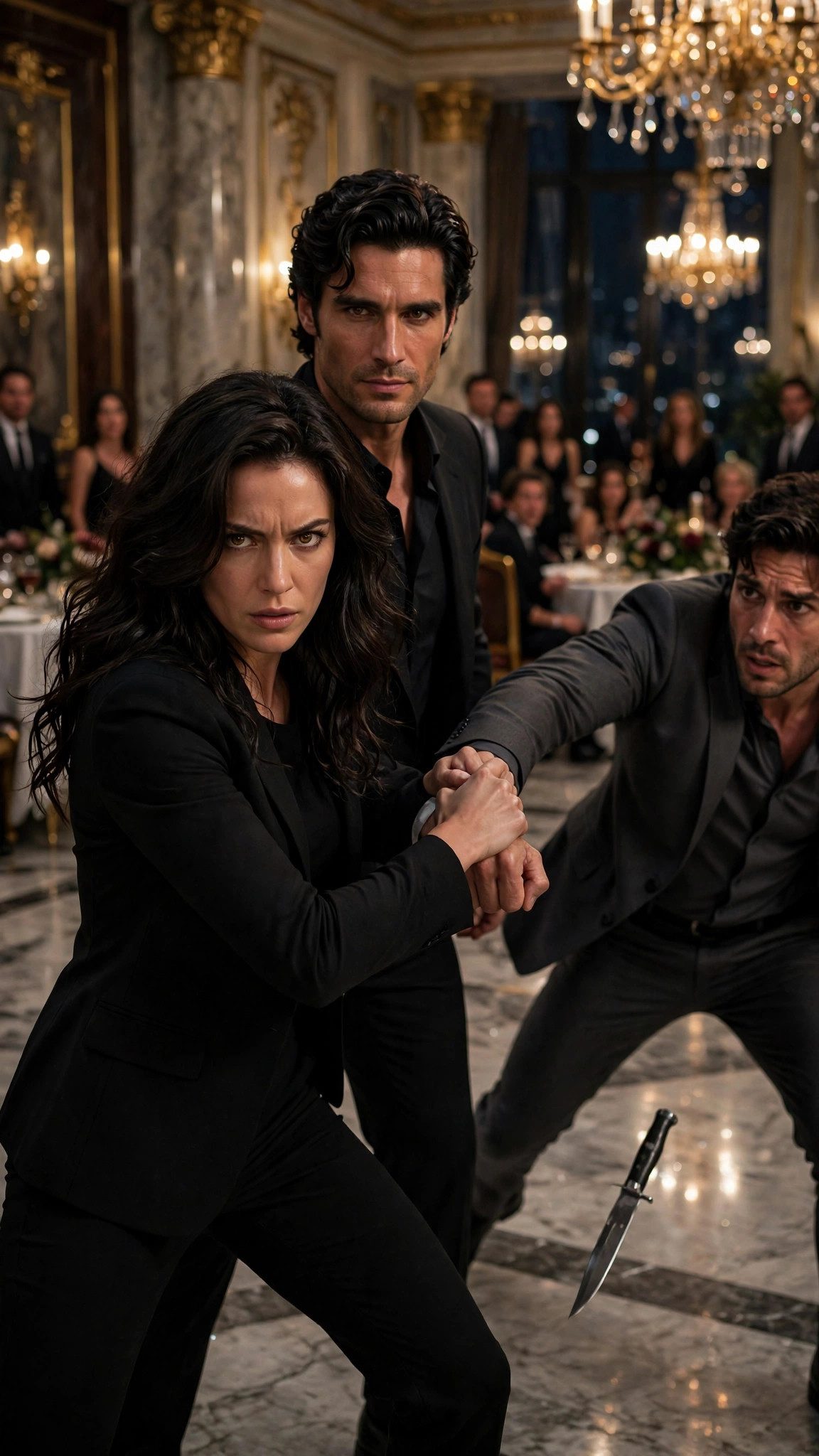
The man lunged at Leo Costello with a knife in his fist, and the whole grand hall of the Costello estate went silent at once, the way a room does when everyone realizes, in the same half second, that someone is about to die.
I was already moving.
I caught the attacker's wrist in mid-lunge and twisted it aside with one controlled motion, the way the Army had taught me a lifetime ago, and the knife clattered onto the polished marble floor and spun away under a table. The man stumbled backward one step, his arm bent at an angle that hurt to look at, and two of Leo's men closed in on him from either side.
"Get down, Costello!" the attacker shouted, his voice rough and shaking.
"Wrong move," I said.
Leo stood directly behind me, exactly where I had told him to stay, his dark eyes fixed on the man on the floor. He did not look frightened. Leo Costello never looked frightened. He looked like a man doing arithmetic.
"Quinn, behind me!" he said.
"Stay exactly where you are," I told him, without turning around.
"Who sent him?" Leo asked.
The attacker spat blood onto the marble. He looked up at Leo, and then at me, and something like a laugh moved across his face.
"Ask your lieutenant," he said.
Three weeks earlier, I had never heard the name Leo Costello. Three weeks earlier, I was a woman nobody looked at twice, working the door of a nightclub on the edge of the city, and I thought the most dangerous part of my life was already behind me.
I was wrong about that, the way I had been wrong about most things since the day my brother died.
My name is Quinn. I am thirty-two years old. I have long dark wavy hair and sharp hazel eyes, and on the night Leo Costello hired me I was wearing a fitted black blazer, a black top, and black trousers, because that was the uniform of the club where I worked security, and because black was the color I had worn, in one form or another, since the Army.
The club was called Halo. It was the kind of place where men in expensive suits drank too much and forgot, for a few hours, that they were supposed to be afraid of anything. My job was to stand near the door, watch the room, and make sure nobody did anything stupid. Most nights, nobody did. Most nights were boring, and boring was fine with me. Boring meant nobody bled. Boring meant I went home at three in the morning, slept until noon, and did not have to think about the fact that I had once been a soldier and now I was a woman who checked IDs for a living.
That Tuesday, a man came in with a gun under his jacket and a grudge against a woman at the bar, and boring ended.
I saw the shape of it before he even reached for it. The way his hand kept drifting toward his waist. The way his eyes stayed locked on one table. The way his shoulders were too tight for a man who was only there to drink. I moved toward him, calm and unhurried, because hurrying makes people panic, and panic makes fingers squeeze triggers.
"Evening," I said. "You need to leave the jacket open when you come in here. House rule."
He looked at me like I was a piece of furniture that had started talking.
"Get out of my way," he said.
"No," I said.
He reached for the gun. I caught his wrist before his fingers closed on it, twisted, and drove my knee into the side of his leg. He went down hard on the polished floor, and the gun skittered away across the tiles, and I had my boot on his wrist and my hand on the back of his neck before the bouncer at the far end of the room had even turned around.
"Stay down," I said. "Stay down and nobody gets hurt."
The woman at the bar was crying. The man under my boot was cursing. The music kept playing, because nobody had told the DJ to stop. And then a voice behind me said, very quietly, "Let him up. He's done."
I turned my head. A tall man stood three feet away, dark wavy hair, strong jaw, tailored black suit with an open-collar black shirt, watching me the way a man watches a horse he is thinking about buying. There was no fear in his face. There was interest, and something else underneath it that I could not name yet.
"Who are you?" I asked.
"Leo Costello," he said. "And you are hired."
I laughed. I actually laughed, right there with a man pinned under my boot.
"I have a job," I said.
"Not anymore," he said. "You work for me now. Starting tomorrow. My driver will pick you up at noon."
"I didn't agree to anything," I said.
"You will," he said, and he turned and walked back to his table, and the two men with him — one older, with silver at his temples, and one younger, with a scar through his left eyebrow — followed him without a word.
The older one was Marco. I did not know his name yet. I did not know that he was Leo Costello's most trusted lieutenant, or that he had been watching me that night with a face like a closed door. I only knew that he looked at me the way men look at a problem they have already decided how to solve, and that I did not like it.
The man under my boot said something I chose not to hear. I let him up, walked him to the door, and handed him to the police when they arrived twenty minutes later. Then I went back inside, finished my shift, and went home to my small apartment above a bakery, where the smell of bread came up through the floorboards every morning at five, and where my brother's photograph sat on the kitchen shelf, smiling at a camera that no longer existed.
Danny had been nineteen when he died. I had been twenty-four, stationed overseas, a military police officer who believed she could protect anyone except the one person she loved most. He had been driving home from his shift at a warehouse when a truck ran a red light and folded his car in half. The police said it was an accident. The driver said he never saw the light. I came home on emergency leave and buried my little brother in the rain, and when my enlistment ended six months later, I did not reenlist. I came back to the city, took the first job that would have me, and told myself that protecting strangers was enough.
It was not enough. It had never been enough. But it was all I had.
At noon the next day, a black car pulled up outside my building, and a driver in a dark suit opened the back door and waited. I stood on the sidewalk in my black blazer and black trousers and thought about all the reasons I should walk back inside and lock the door.
Then I thought about Danny, and about the way Leo Costello had looked at me in the club, like I was not a problem at all but an answer, and I got into the car.
The Costello estate sat behind high walls on the north side of the city, a house the size of a small hotel, with a grand hall that had a polished marble floor and golden chandeliers and windows that looked out over a garden I could not see the end of. The driver took me through a side entrance and up a staircase to a study lined with books nobody had read in years, and Leo Costello was standing by the window with his back to me, looking out at the garden.
"Miss Quinn," he said, without turning around. "Do you know what I do?"
"I know what people say you do," I said.
"And what do people say?"
"That you run this city," I said. "That your family has run it for forty years. That men who cross you disappear."
He turned around then, and he smiled, and the smile did not reach his eyes.
"People say a great many things," he said. "Most of them are true. Some of them are not. What matters is this: I need a bodyguard. Not a wall of muscle. Not a man with a gun who stands in the corner and waits for someone to shoot first. I need someone who sees the danger before it happens. Someone who moves before the gun comes out. Someone like you."
"Why me?" I asked. "You don't know anything about me."
"I know you saw a gun before it was drawn," he said. "I know you took a man down without hurting him more than necessary. I know you protected a stranger you owed nothing to. That is enough for me."
"And if I say no?"
"Then my driver takes you home," he said, "and you go back to checking IDs, and we never speak again."
I thought about the club. I thought about the long nights standing by a door, watching rich men drink themselves stupid. I thought about Danny, and about the hollow place in my chest that had never quite filled since the day I buried him, and about the way it felt, for three seconds in that club, to be exactly where I was supposed to be.
"How much?" I asked.
He named a figure that was three times what the club paid me. I did not blink.
"One condition," I said. "I don't carry a gun."
Something flickered in his face then. Surprise, maybe. Or respect.
"Why not?" he asked.
"Because the day I need a gun to do this job," I said, "is the day I've already failed at it."
He studied me for a long moment. Then he nodded, once, the way a man nods when he has made a decision he does not intend to revisit.
"Done," he said. "You start tonight. Marco will show you the house."
Marco was waiting in the hallway when I came out of the study. He was the older man from the club, silver at his temples, eyes like flat water, and he looked at me the way a landlord looks at a tenant he did not choose.
"So," he said. "The new bodyguard."
"So," I said.
"Leo has a habit of collecting strays," Marco said. "Dogs. Men. Now women. They all disappoint him eventually."
"I'll keep that in mind," I said.
He showed me the house in silence — the grand hall, the dining room, the corridors, the exits, the blind corners, the places a man could hide and the places a man could die. He did it thoroughly, I will give him that. He knew the house the way a man knows his own hands. But every time I asked a question, he answered it a beat too late, as if he were deciding how much of the truth I was allowed to have.
"How long have you worked for Leo?" I asked.
"Twenty years," he said. "Since before you were born, probably."
"I'm thirty-two," I said.
"Then since you were twelve," he said, and almost smiled. "I was there when his father died. I was there when he took the chair. I have kept this family alive through three wars with the Castellanos and two with the Morettis. I do not need a woman from nowhere telling me how to protect him."
"I wasn't planning to tell you anything," I said. "I was planning to watch."
"Watch, then," he said. "But understand this. In this house, loyalty is everything. And loyalty is earned, not hired."
He left me standing in the grand hall, under the golden chandeliers, on the polished marble floor where, three weeks later, a man would lunge at Leo Costello with a knife in his fist, and I would catch his wrist, and he would look up at us and say, "Ask your lieutenant."
That night, my first night, I stood in the corner of the dining room while Leo ate dinner with his captains, and I watched the room the way I had been trained to watch a room: doors first, then windows, then hands, then eyes. Marco sat at Leo's right hand, laughing at something one of the captains had said, and he looked, to anyone who did not know better, like the most loyal man in the world.
But I had spent two tours learning to read men who were lying, and Marco's laugh never reached his eyes either.
I wrote it down that night, in a small notebook I carried in my blazer pocket. Not because I knew anything yet. Only because something in my gut, the same instinct that had seen the gun before it was drawn, was already telling me that the most dangerous man in Leo Costello's life was not the one coming through the front door.
It was the one already sitting at his table.
Later that night, when the dinner was over and the captains had gone home, I walked the grounds alone, learning the shape of the estate the way a soldier learns a new post: the wall, the gate, the garden paths, the places where the light did not reach. The younger man from the club — the one with the scar through his left eyebrow — was smoking by the garage, and he nodded at me when I passed.
"Enzo," he said. "I drive for Mr. Costello. Twelve years now."
"Quinn," I said.
He looked at me for a moment, then flicked his cigarette into the dark. "A word of advice," he said. "Marco doesn't like you. He doesn't like anyone Leo trusts more than him. And Leo trusts you already. I saw it in his face tonight."
"Why are you telling me this?" I asked.
"Because I was the one who found his father's body," Enzo said quietly. "Vincent Costello. Heart attack, they said. I was the one who carried him down the stairs. And I have watched this family for twelve years, Miss Quinn. I know what loyalty looks like, and I know what it looks like when a man is only wearing it like a coat. Watch Marco. That's all I'm saying."
He went back inside, and I stood alone in the garden for a long time, listening to the city beyond the walls, and thinking about the notebook in my pocket and the name I had already written in it.
Marco.
I did not know then what he was planning. I did not know about the money moving through shell companies, or the phone calls made from a burner in the middle of the night, or the man named Castellano who had promised Marco a throne. I only knew that a woman who had been hired to protect Leo Costello was going to have to protect him from the people closest to him — and that the job I had taken for the money had already become something else entirely.
It had become the only thing that had made sense to me since my brother died.