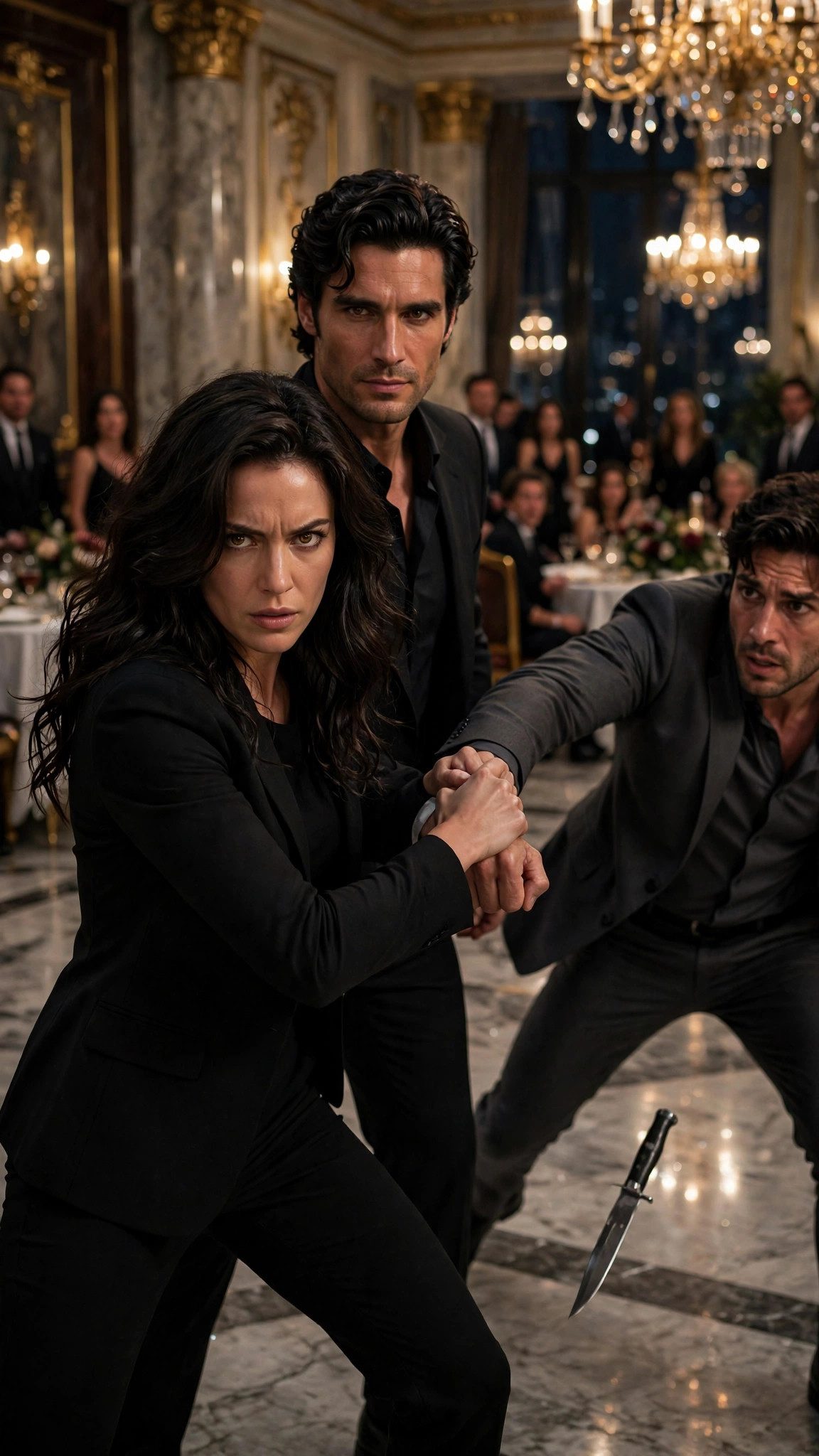
The first week, I learned Leo Costello's life the way a bodyguard learns a life: not from what he said about it, but from the shape of his days.
He woke at six, every morning, without an alarm. He ran five miles along the river before the city woke up, Enzo trailing him in the car at a respectful distance, and he came back sweating through a gray t-shirt, drank black coffee standing up in the kitchen, and read the newspaper the way other men read a weather report — quickly, and only to find out what was going to hit him.
He worked from the study until noon. Men came and went: accountants with leather folders, lawyers with tired eyes, captains with news from the docks and the clubs and the restaurants that flew the Costello name. Leo listened to all of them the same way, leaning back in his chair, fingers steepled, saying almost nothing. When he did speak, it was usually one sentence, and the sentence was usually the decision.
At noon he ate alone, unless there was a meeting. At three he walked the garden. At six he was wherever the family needed him to be: a restaurant opening, a charity dinner, a quiet word in a back room. He was home by midnight, and he slept with the door to his bedroom open and a light on in the hall, like a man who had learned, a long time ago, that the dark was where things happened.
My job was to be the shadow that moved before his shadow did. I stood where I could see the doors. I watched hands. I memorized faces. I learned the names of every man who came through the gate, and I wrote them in my notebook, and next to each name I wrote what my gut said about him.
Most of them were exactly what they looked like: tired men doing a hard job for a man they respected. A few of them were not. Marco was not.
Marco had been Leo's right hand for twenty years. He ran the docks, the trucks, the warehouses, the men who moved the family's goods through the night. He had a wife in the suburbs and a daughter in college, and he went to church on Sundays, and he was, by every measure I could see, a loyal man. But loyalty is not a thing you can see. It is a thing you can only watch over time, the way you watch a wall for cracks.
In my first week, I saw three cracks.
The first was small. On Wednesday, a delivery truck arrived at the warehouse on Pier 9 two hours late, and when Leo asked why, Marco said the driver had taken the wrong route. The driver, a nervous young man named Tommy, told me later, when Marco was not listening, that no one had given him a route at all. He had waited at the depot for forty minutes for instructions that never came.
The second was smaller. On Thursday, I noticed that the security camera over the east gate had been angled, just slightly, away from the road. When I asked the man who maintained the cameras, he said Marco had told him to adjust it, because the glare from a new streetlight was ruining the picture at night. I went out that night and looked at the streetlight. There was no new streetlight.
The third was not small at all. On Friday, Leo was supposed to meet a business associate — a legitimate man, a hotel owner named Frank Deluca — at a restaurant downtown at seven. At six-forty, Marco came to me in the hall and said the meeting had been moved to eight, and to a different restaurant across town. I checked with Leo. Leo knew nothing about any change. When I told Marco that, he smiled and said he must have misunderstood the message, and the meeting went ahead as planned, at seven, at the first restaurant.
Three cracks. None of them proof. All of them enough.
I wrote them in my notebook, in the small neat handwriting the Army had drilled into me, and I underlined Marco's name twice.
Leo noticed me watching. Of course he noticed. A man like Leo notices everything; it is why he is alive.
On Saturday morning, after his run, he found me in the kitchen, drinking coffee and reading the duty roster Enzo had taped to the refrigerator.
"You don't sleep much," he said.
"I sleep enough," I said.
"You've been here six days," he said. "Tell me what you've seen."
I hesitated. A bodyguard who accuses the boss's right hand of treason in her first week is a bodyguard who gets fired — or worse. But Leo was not asking for gossip. He was asking for what he had hired me to give him: the truth, before it was too late.
"Three things don't add up," I said, and I told him about the truck, and the camera, and the meeting. I kept my voice flat, the way I had been trained to report. Facts only. No conclusions.
Leo listened without moving. When I finished, he was quiet for a long time, staring out the kitchen window at the garden, where the morning light was coming up over the hedges.
"Marco has been with this family since I was eighteen," he said finally. "He carried my father's coffin. He taught me how to run the docks. If he wanted me dead, he has had twenty years to do it."
"I didn't say he wants you dead," I said. "I said three things don't add up."
"And what does your gut say?" he asked.
"That someone is testing the fences," I said. "Moving small pieces. Seeing what gets noticed and what doesn't. That's how you plan something big — you start by finding out where the blind spots are."
Leo turned to look at me then, and for the first time since I had met him, I saw something in his face that was not control. It was weariness. The weariness of a man who has spent years building an empire on the kind of calculated ruthlessness that leaves no room for mistakes, and who knows, better than anyone, how much it costs to hold it together.
"My father used to say that the most dangerous enemy is the one who has already been invited inside," Leo said. "He was right. But he was also wrong about one thing. He thought the answer was to trust no one. I have spent six years trying to prove him wrong."
"And has it worked?" I asked.
"So far," he said. "So far."
He picked up his coffee and went back to the study, and I went back to my post by the door, and I thought about my brother, and about the way Danny used to say that the only thing worse than being afraid was being afraid and doing nothing about it.
That afternoon, a car followed us.
We were driving back from a meeting at the docks — Leo in the back seat, Enzo driving, me in the front passenger seat — when I saw it in the side mirror. A gray sedan, two cars back, keeping pace with us through three turns. Not close enough to be obvious. Not far enough to lose us.
"Enzo," I said, quietly. "Gray sedan. Two back. Been with us since the bridge."
Enzo's eyes flicked to the mirror. "I see it."
"Don't speed up," I said. "Don't slow down. Take the next left, then the next right. If he's still there after the second turn, he's following us."
Enzo did exactly what I said. The sedan followed us through the left, and through the right, and then, at the next light, it turned away and disappeared down a side street.
"Probably nothing," Enzo said.
"Probably," I said. But I wrote the plate number in my notebook anyway, from memory, and when we got home I asked one of Leo's men to run it. The plate came back to a rental company. The rental had been paid for in cash, by a man who had given a false name.
Four cracks.
That night, Leo asked me to walk with him in the garden. It was the first time he had asked me to do anything that was not my job, and I did not know what to make of it. We walked between the hedges in the dark, and the city hummed beyond the walls, and for a while neither of us said anything.
"Why did you really take this job?" he asked at last.
I could have given him the easy answer. The money. The hours. The fact that the club was going to fire me anyway after the incident with the gun. All of those things were true. But none of them were the reason.
"My brother died when I was twenty-four," I said. "I was overseas. I couldn't protect him. I came home and I told myself that if I could protect strangers, it would mean something. It never did. Not really. But when I saw you in that club, and I saw the way you looked at me — like I was worth something — I thought, maybe this time it will."
Leo was quiet for a long time. Then he said, "My father died six years ago. Heart attack, they said. I was the one who found him in his study. He was fifty-nine years old, and he had built everything I have, and in the end it was his own heart that killed him. I have spent six years trying to be the man he was, and six years being afraid that I am not."
"You are," I said, before I could stop myself. "You're exactly the man he was. That's the problem."
He laughed at that — a real laugh, short and surprised, the first one I had heard from him.
"You're not like the others, Quinn," he said. "The others tell me what I want to hear. You tell me what I need to hear. Don't stop."
"I won't," I said.
We walked back to the house in silence, and I took up my post by the door, and I watched the dark beyond the gate, and I thought about the four cracks in the wall, and about the gray sedan, and about the man named Marco who had carried Leo's father's coffin and who smiled like a friend and watched me like a problem.
I did not know what he was planning. Not yet. But I knew, with the same certainty I had felt in the club when I saw the gun before it was drawn, that it was coming.
And I knew that when it came, I would be the only person standing between Leo Costello and whatever was on the other side of that door.
On Sunday morning, Marco came to find me in the security room, where I was reviewing the camera feeds from the night before. He stood in the doorway for a moment, watching me work, and then he said, in the pleasant voice of a man delivering bad news, "Leo wants you on the warehouse tonight. Pier 9. Night shift. One of the men called in sick."
I did not look up from the screen. "Leo didn't tell me that."
"Leo doesn't tell the staff everything," Marco said. "That's what I'm for. He trusts me to handle the details."
"Then he'll tell me himself," I said. "When he does, I'll go."
Marco's smile thinned. "You think you're special because he hired you himself. You're not. You're a bodyguard. Bodyguards go where they're told."
"Then tell Leo to tell me," I said.
He left without another word, and an hour later Leo came to the security room himself. He stood behind my chair and watched the camera feeds for a while — the gate, the garden, the long drive — and then he said, "Marco tells me you're refusing an assignment."
"Marco told me you wanted me at the warehouse tonight," I said. "I told him I'd go when you told me yourself."
Leo was quiet for a moment. "I never said that," he said.
"I know," I said.
He nodded, slowly, the way a man nods when a suspicion he has been carrying quietly for weeks suddenly has weight. "You're not going to the warehouse," he said. "You're staying here. With me. That's an order, and it comes from me, not from Marco."
After he left, I sat in the security room for a long time, watching the empty driveway on the screen, and thinking about the way Marco had looked at me in the doorway. It was not anger. It was something colder than anger. It was the look of a man who had just realized that the piece he had been trying to move off the board was not going to move.
That evening, on my one night off, I drove to the cemetery on the south side of the city, where Danny was buried under a plain gray stone with his name and two dates and nothing else. I sat on the grass beside him, the way I had sat there a hundred times before, and I told him about the job, and about Leo, and about the cracks in the wall.
"I don't know if I'm doing the right thing," I said. "I don't know if this man is worth protecting. But I know what it feels like to stand next to someone and decide that they don't die tonight. Not on my watch. That's the only thing I've ever been good at, Danny. And for the first time in a long time, someone needs me to be good at it."
The wind moved through the trees, and somewhere in the distance a car alarm went off and then stopped, and I sat there until the light went out of the sky. On the drive home, I stopped at my mother's house and had dinner with her — pot roast, the way she always made it — and she asked me about the new job, and I told her it was fine, and she looked at me the way mothers look at daughters who are lying, and she said, "Be careful, Quinn. Men like that don't hire people like us unless they need something."
"I know, Mom," I said. "That's why he hired me."
She did not argue. She just put more food on my plate, the way she had done since I was a child, and I ate it, and for a few hours I was not a bodyguard or a soldier or a woman with a notebook full of suspicions. I was just a daughter having dinner with her mother, and the world outside the kitchen window was quiet and ordinary and safe.
It would not stay that way for long.