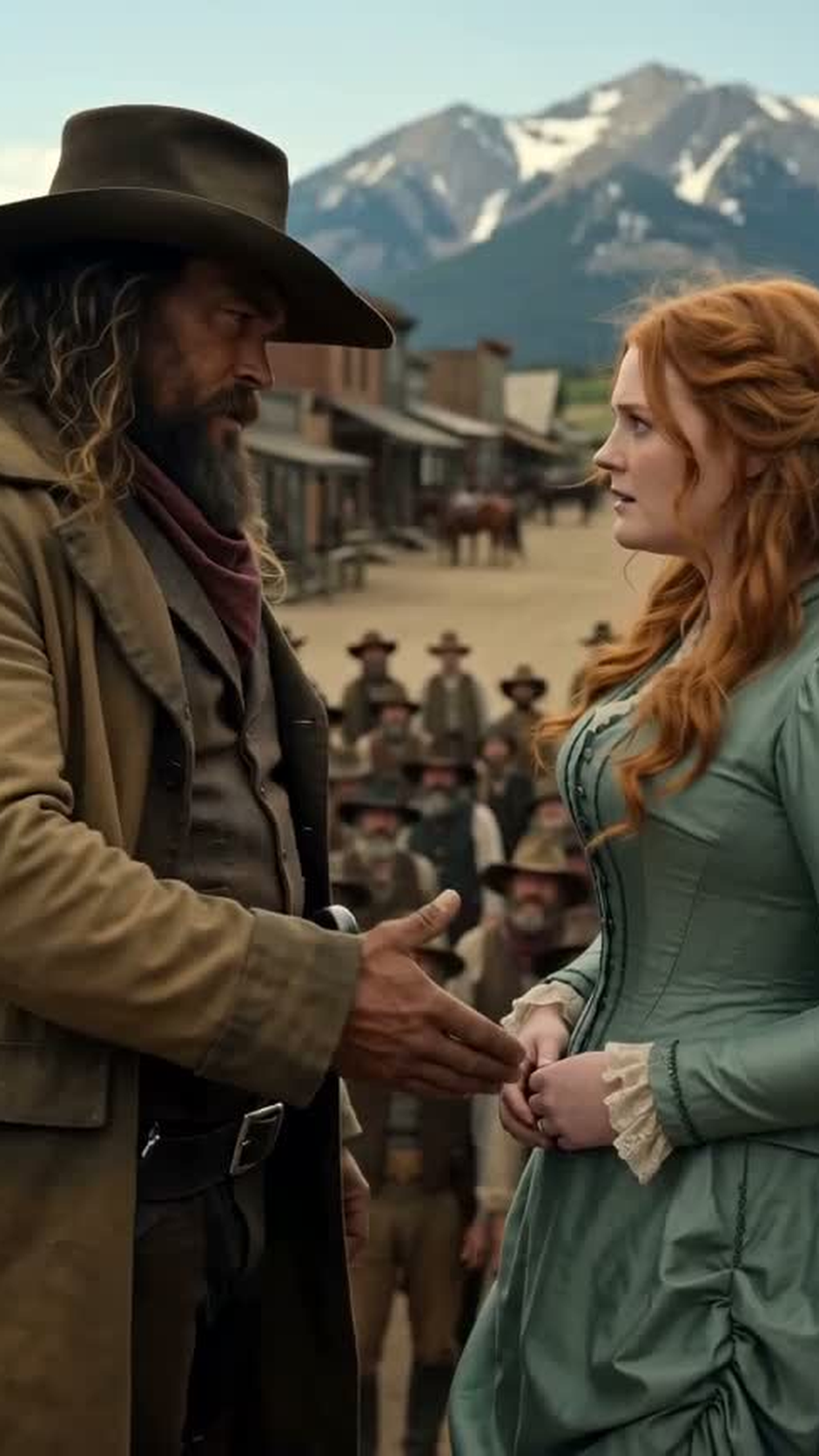
BANG!
The gavel struck the timber podium so hard that dust jumped from the planks, and Natalie Zimmerman flinched in spite of every promise she had made herself on the long stage ride into Willow Ford.
She would not flinch. She would not cry. She would not step backward.
"Fifty dollars!" the auctioneer cried, rolling the words out over the square like a man selling a mule. "Fifty dollars for a strong, healthy bride! Who'll give me fifty?"
Nobody raised a hand.
Natalie stood on the raised wooden platform in her finest dress — sage-green silk she had sewn herself over the winter, lace her mother had tatted before the fever took her, every stitch a small act of defiance — and she felt the whole town of Willow Ford, Idaho Territory, looking up at her and finding her too much. Too tall. Too broad. Too wide through the hip and too long through the leg. Nearly six feet of woman, standing above the crowd on a platform built for smaller brides, in the hard white sunlight of a September afternoon in 1878.
A man in the front rank of the crowd snickered behind his hand. Another one leaned toward his neighbor, not troubling to lower his voice.
"She could pull a plow herself."
The laughter came then, scattered and mean, the way laughter sounds when it is aimed at someone who cannot answer it.
Natalie's fingers pressed together against the green silk of her skirt until the knuckles ached. She lowered her eyes for one breath — one only — and then she raised them again and straightened her shoulders the way her father had taught her. A Zimmerman stands straight, her father used to say. The world will try to bend you into the shape it prefers. Stand straight anyway.
"The young lady cooks, sews, keeps a house—" the auctioneer began, a little desperately.
"Twenty-five!" an elderly farmer called, half raising his hand as if even that much embarrassed him.
"Thirty," said a voice from the back, bored.
The auctioneer's smile thinned to nothing. Natalie swallowed hard. Thirty dollars. Three other brides had gone before her that afternoon — a giggling girl of seventeen from Ohio had fetched one hundred and eighty, a widow with a sweet face had fetched one hundred and twenty — and Natalie Zimmerman, who could cook for twenty men, mend a fence, deliver a calf and keep a ledger in two languages, was going for thirty dollars to a man who sounded bored, while the town laughed at the size of her.
She was still standing straight when the hand rose out of the crowd.
It was not like other men's hands. It came up slow and enormous, weathered brown as old leather, above the hats of the townsmen the way a tree rises above brush. The laughter stopped the way a song stops when a string breaks. Men turned. Hats turned. The whole square turned to look at the man the hand belonged to, and Natalie looked too, and forgot — for the first time that endless afternoon — to be ashamed.
He stood head and shoulders above the tallest man around him. More than six and a half feet of him, broad as a doorframe, in a worn buckskin coat and a dark wide-brimmed hat that shadowed his eyes. Long dark hair, a thick beard, a burgundy neckerchief at his throat, a hunting knife at his belt. He did not look at the crowd. He did not look at the auctioneer. He looked at the platform. He looked at her.
"Five hundred," he said.
His voice was quiet. It carried anyway, the way deep water carries sound.
The auctioneer froze with his gavel suspended in the air. "Five — five hundred dollars?"
"In gold."
A merchant beside the mountain man actually took a step backward. Somebody whispered the name — Brennan — and the whisper ran through the square like wind through dry grass. Dominic Brennan. The man who lived alone somewhere up in the Sawtooths where no trail went, who came down twice a year with gold dust and furs and a face like a cliff, who had not spoken fifty words in Willow Ford in five years.
He had just spoken three, and they had cost five hundred dollars.
"Sold!" The gavel came down like a gunshot. "Sold to Dominic Brennan for five hundred dollars in gold!"
The square erupted — not in laughter now, but in the roar of people who had witnessed something they would be telling their grandchildren about. Natalie barely heard it. She gathered her long layered skirt in both hands and descended the wooden steps of the platform with all the care she had left in her, because she understood with perfect clarity that if she tripped now, if she fell now, the town would have its story complete: the giant bride, sold like a draft mare to the giant of the mountains.
She did not trip. She reached the ground, and Dominic Brennan stepped forward out of the crowd, and the men who had mocked her fell back from him the way water falls back from the bow of a boat.
She had expected him to look at what he had bought. Men who buy horses look at the teeth; men who buy brides at auction look at everything, and she had braced herself for it all the way down the steps. Instead, Dominic Brennan took off his hat.
He held it against his chest, in the dust of the square, in front of the whole laughing town, and he met her eyes — only her eyes — with a respect so plain and unadorned that her throat closed.
"Why me?" she asked, softly, because it was the only question in the world.
He glanced once at the men who had laughed at her. Then he looked back at her, and his expression softened by almost nothing, and somehow that almost-nothing undid her more than the laughter had.
"They don't know your worth," he said.
He extended his hand — palm up, motionless, in no hurry at all — and waited, the way a man waits at the edge of deep water, knowing the choice is not his to make.
Natalie looked down at his hand. It was the largest hand she had ever seen, scarred across the knuckles, and absolutely steady.
Her fingers began to move toward it—
* * *
But that is not where Natalie's story begins. It begins twenty-three years earlier and two thousand miles east, in a blacksmith's forge in Missouri, with a baby girl so long that the midwife laughed and said the child had been built for a bigger world than this one.
SIXTEEN YEARS BEFORE THE AUCTION — INDEPENDENCE, MISSOURI
Heinrich Zimmerman had come from Saxony with a hammer, a Bible, and eleven words of English, and by the time his daughter was born he had a forge of his own on a corner where the emigrant trails began, and a reputation from Independence to St. Joseph: the German could shoe a horse that no other man could hold. He was six feet four inches tall and built the way bears are built, and his wife Anna — a schoolmaster's daughter from Ohio, all of five feet two — used to stand on a stool to kiss him and say that God had clearly intended the two of them as a lesson in contrast.
Natalie got her father's height and her mother's hands, and for the first sixteen years of her life, she never once understood that this was a misfortune.
She grew the way corn grows in a wet year — alarmingly, and past all the marks on the doorframe, and past her father himself by the time she was fifteen, if you counted honestly, which he did, roaring with laughter and cutting a new mark higher. She worked in the forge from the time she could hold the small hammer. She pumped the bellows, she held the horses — restless, half-broke trail horses that quieted under her long hands as if they recognized something of their own scale in her — and in the evenings her mother taught her letters, and figures, and French, and the piano that she played with her knees practically under her chin.
"She will need a bigger life than this town," Anna Zimmerman said once, watching her daughter carry two full water buckets up the yard without spilling, one in each hand, easy as teacups.
"She will need a bigger man," Heinrich said, "and they are scarce, wife. They are scarce as hens' teeth in Missouri."
It was said as a joke. In that house, in those years, everything was still said as a joke. Natalie's younger brother Karl was born when she was nine, a small, merry, ordinary-sized child whom she carried everywhere like a doll and adored without reservation. The forge prospered. The trail trade boomed. If the other girls at church socials were beginning to whisper about Natalie's height, and if the young men who came courting her friends somehow never stayed to talk to the blacksmith's enormous daughter, these were small shadows at the edge of a lit room, and Natalie — busy, useful, loved — barely noticed them.
Then, in the winter Natalie turned sixteen, the fever came through Independence the way it came through every river town in those years: quietly, and then all at once.
Anna Zimmerman was dead in four days.
She died on a Tuesday, in the small bedroom above the forge, with Heinrich holding one of her hands and Natalie holding the other, and her last sensible words were to her daughter, and Natalie carried them out of that room like a coal carried in bare hands. "Do not make yourself small, Liebling," her mother whispered. "Not for anybody. The Lord made the whole of you on purpose."
They buried her in the German cemetery on the hill. Heinrich cut the stone himself, at night, by lantern light, and would not let Natalie touch the chisel, though her hands were steadier than his by then.
Something went out of the forge after that winter, the way heat goes out of iron left too long from the fire. Heinrich still worked — a Zimmerman works — but he began to cough in the cold months, a deep forge-dust cough that he waved away, and he began, at odd moments, to look at his daughter with an expression she could not read: not sorrow, exactly. Arithmetic. A man adding up what he owed the world and what he had left to pay it with.
"You are thinking something, Father," she said one evening, when she was eighteen and taller than the doorframe of the kitchen, ducking through it out of habit.
"I am thinking," he said slowly, "that your brother will marry some small Missouri girl, and this house will get crowded the way houses do, and your mother was right. You need a bigger life than this town, Natalie." He turned his cup in his great scarred hands. "And bigger lives are not given, in this world. They are gone and gotten. Remember that, when the time comes."
She remembered it three years later, on the day the forge accident happened, when the time came all at once and wearing the worst face it owned.
A half-broke gelding, a thrown shoe, a kick that Heinrich Zimmerman — slowing, at fifty-one, with the cough deep in his chest — did not get out from under the way he had gotten out from under ten thousand kicks before. He lived until sundown. That was the mercy of it, the neighbors said: he lived until sundown, and his daughter was with him, and his mind was clear.
What he said to her, in that last hour, with her long hands wrapped around his, she would repeat to no living soul for the rest of her life. But this much of it she acted on, every day that followed, and it shaped everything that happened on a wooden platform in Idaho seven years later:
Stand straight. Do not make yourself small. Go and get the bigger life.
The gelding's owner paid for the coffin without being asked. The whole town came to the funeral of the blacksmith who could shoe any horse alive. And when it was over, Karl Zimmerman, nineteen years old and newly engaged to Clara Beecham, stood with his sister in the cold forge among the silent tools and said the thing that had been coming since the day of the new mark on the doorframe — said it kindly, said it reasonably, said it the way the world always says it:
"Natalie, you know there isn't room here. Not really. There never was."
She looked at the forge, and the bellows, and her father's hammer hanging in its place, too heavy for Karl's hands.
"No," she said. "I suppose there never was."
She did not yet know about the advertisement in the Kansas City newspaper, folded into the lining of a traveling salesman's sample case, that was even then making its slow way west toward her — an advertisement that promised respectable marriage, a good Christian home, and a new life in Idaho Territory to young ladies of good character willing to travel.
She did not know that the bigger life, when it came for her, would begin with her standing on a platform being sold.
But her father had told her to go and get it. And Natalie Zimmerman had never once, in all her life, failed to do what her father told her.