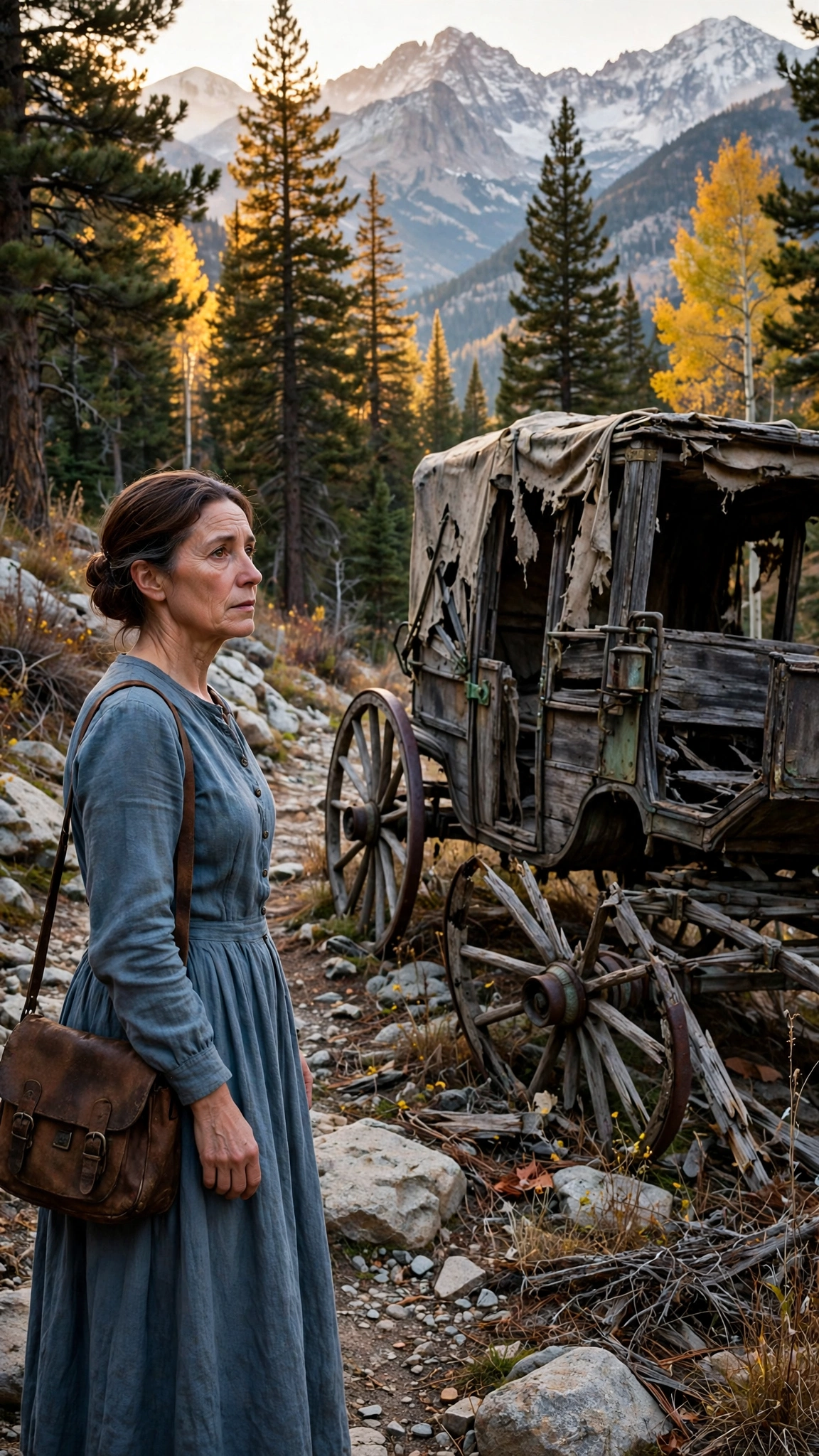
Claire read Ruth Ann Crowe's file three times before she allowed herself to believe what it said.
The first read was for the facts: sixty acres above Silverton, in the San Juan Mountains, held by the Crowe family since 1898, now claimed by San Juan Consolidated Mining on the strength of a transfer document dated 1899. The second read was for the gaps: the transfer had no signature from Elias Crowe, no witness, no record of payment. The third read was for the name written on the back of the claim certificate in faded ink — "Transferred to W. Mason, 1899. See file 27" — and for the cold feeling it left in her stomach, because W. Mason could only be one family, and that family was hers by marriage.
She told herself not to jump to conclusions. Mason was not an uncommon name. The San Juans had been full of Masons in the 1890s, men who came for silver and stayed for the mountains. But her husband's family had been in Colorado for five generations, and his father, Warren Mason, had kept the family papers in a locked cabinet in his study in Aurora, and Daniel had once told her, years ago, that the Mason money came from "mining, a long time ago, before it was respectable to talk about."
She drove to Aurora on a Tuesday afternoon, to the house where Warren Mason had lived until his death twenty-seven years earlier. Daniel's mother, Eleanor Mason, was eighty-one now, living alone in the big house with a housekeeper and a garden she could no longer tend. She welcomed Claire with tea and the particular warmth of a woman who has outlived almost everyone she loves.
"I've been thinking about your father's papers," Claire said, careful, easy. "The mining things. Do you still have them?"
Eleanor's hands tightened around her teacup. "Warren kept everything in the cabinet. Daniel has the key. I haven't opened it in years."
"Did Warren ever talk about a man named Elias Crowe?"
The old woman was quiet for a long moment. The clock in the hallway ticked. Outside, a gardener pushed a wheelbarrow past the window.
"Warren talked about a great many men," Eleanor said at last. "Most of them dead before I met him. He was a good man, Claire. Whatever you find in those papers — he was a good man."
That was not an answer, and they both knew it.
Claire went home and said nothing to Daniel. She was a lawyer. She knew how to hold a fact until she understood it. She spent the next week working Ruth Ann's case the way she worked every case: methodically, from the ground up. She pulled the county records in Silverton, the state mining registry, the old survey maps. The transfer document San Juan Consolidated relied on was a copy, not an original. The original, according to the county clerk's index, had been filed in 1899 and then — the clerk's note said — "removed for private custody, W. Mason."
She found the second thread on a Thursday, in the clinic's basement archive, where she kept her own files from a case she had handled a decade earlier, a dispute between two families over a water right. In the margin of an old surveyor's report, someone had sketched a small map: a ravine, a wagon road, and an X marked "carriage." She stared at it for a long time. It meant nothing, and it meant everything.
Daniel noticed the change in her before she noticed it in herself. He came home one evening and found her at the kitchen table with the file spread out, and he stood in the doorway for a moment too long, looking at the papers.
"Still working on the Silverton case?" he asked.
"Yes," she said. "It's interesting. The family's held that land since 1898."
He poured himself a glass of water. His hands were steady. "Old claims are like that. Half of them were filed by men who couldn't read. The other half were filed by men who could read too well."
"Do you know anything about the Mason connection?" she asked, and she watched his face the way she watched witnesses, for the small flinch that comes before the lie.
"I know the Mason name is on half the paper in this state," he said. "My father used to say the family owned a mountain once and lost it. He never said which mountain."
He changed the subject. He asked about her day. He was gentle, attentive, the husband she had married. And that night, lying awake beside him, Claire thought about the line on the back of the certificate — "See file 27" — and wondered what file 27 was, and where it was kept, and why a mining transfer from 1899 would reference a file numbered twenty-seven.
The answer came from the last place she expected: Ruth Ann Crowe herself, in a phone call on a Friday afternoon.
"My grandmother used to say something," Ruth Ann said. "When I was a girl, and she was telling me about the land. She said, 'Your great-grandfather Elias died in the mountains, and the Masons buried the truth with him.' I thought she meant it as a figure of speech. She was a dramatic woman."
"Did she say anything else?" Claire asked, her pen still over her notebook.
"She said the carriage was still up there. She said Elias drove a carriage into the San Juans in 1898 and never came back, and that the Masons knew where it was. She said my grandfather went looking for it once, in the seventies, and came back saying the road was gone."
Claire wrote it all down. Then she called the county clerk in Silverton and asked about file 27.
The clerk was a young man named Jesse, patient with out-of-town lawyers. "File 27," he said, "is a sealed estate file. Warren Mason, died 1999. The seal was requested by the family. I can't release it without a court order."
Warren Mason had died in 1999. Twenty-seven years ago. The number sat in Claire's notebook and would not leave her alone.
She drove home that evening through Denver's rush-hour traffic, and she thought about Warren Mason — a man she had known only briefly, in the last years of his life, a quiet man with large hands and a habit of looking out windows. He had died in a car accident on a mountain road, Daniel had told her, a heart attack at the wheel, the car going off the road near Silverton. She had attended the funeral. She had held Daniel's hand. She had never once questioned it.
That weekend, Daniel suggested the hike.
He brought it up on Saturday morning, over coffee, the way he brought up everything that mattered — casually, as if it had just occurred to him. "The San Juans," he said. "Before the snow. Just us. There's a trail my father used to take me on, up above Silverton. We could use a day out, Claire. We've both been working too hard."
She looked at him across the kitchen table. He was calm. He was kind. He was the man she had married. And somewhere underneath that, in the part of her that had spent twenty-one years learning to read people, something small and cold said: he knows.
She said yes anyway. She told herself she was being paranoid, that a husband suggesting a hike was not a conspiracy, that the file and the certificate and the number twenty-seven were a case, not a marriage. She told herself all of that, and she believed most of it.
The morning before the hike, Claire was at the clinic by seven, because a client named Mrs. Alvarez was being evicted on Monday and the paperwork had to be filed by noon. Mrs. Alvarez was sixty-three, a housekeeper, and she had lived in the same apartment for eleven years, and her landlord wanted her out so he could double the rent. Claire spent two hours on the phone with the landlord's lawyer, and then she wrote the response herself, because the young associate who usually drafted them was out sick, and when she finally looked up, Maggie was standing in her doorway with two cups of coffee.
"You're distracted," Maggie said. She had known Claire for twenty years, and she did not waste words. "You've been distracted since the Crowe woman came in. What's in that file?"
Claire told her about the certificate, and the line on the back, and the number twenty-seven, and Maggie listened, and then she said, "Mason. Your Mason?"
"I don't know yet," Claire said. "That's the problem. I don't know yet, and I'm afraid of what I'll find when I do."
Maggie set the coffee down. "Then find it. That's what we do. We find it, and then we decide what to do with it. Don't let it sit in a folder and grow teeth."
That night Claire stayed late at the clinic, long after Maggie had gone home, and read Ruth Ann's file a fourth time, slowly, with a yellow pencil in her hand. The rain came down outside the window in thin silver lines, and the office was quiet except for the hum of the heater and the occasional sigh of the old building settling. She copied the survey map onto a fresh sheet of paper, tracing the creek on the east and the wagon road on the west with a careful hand, and she thought about Elias Crowe, a young man with a mule, walking into those mountains in 1898 with a claim certificate in his pocket and never walking out again. She thought about her own mother, who had taught her that a lawyer's job was to read the paper properly, even when the paper was a hundred years old, and especially then.
That night, Daniel cooked dinner. He made pasta, which he did rarely, and he opened a bottle of wine, and he asked her about her week, and he listened, and for an hour it felt like the marriage she remembered from the early years, when they had talked about everything and the silence had not yet moved in. Then, over coffee, he asked about the Silverton case, in the same easy tone he had used all evening.
"How's the land dispute going? The one with the old papers."
"It's going," Claire said. "The family's held the land since 1898. The mining company has a transfer document from 1899 that doesn't hold up."
He nodded, and he did not ask another question, and he refilled her wine glass, and she watched his hand on the bottle, steady and sure, and she thought about the line on the back of the certificate, and she said nothing, because she was a lawyer, and she knew how to hold a fact until she understood it.
On Friday night, she packed her satchel while Daniel watched from the bedroom doorway. Water, a sandwich, her keys with the little folding pocketknife, a notebook. She left her jacket in the car because the afternoon was warm. She wore the dusty-blue dress because it was comfortable and because Daniel had once told her he liked the color on her. She tied her hair into a low bun, the way she always did.
"What's in the satchel?" Daniel asked, leaning against the doorframe, his arms crossed, his voice casual.
"Water. A sandwich. My keys," she said, and she did not look up, because if she had looked up she might have seen something in his face that she did not want to see. "The usual."
He nodded, and he went downstairs, and she stood in the bedroom for a moment with the satchel in her hands, and she thought about the file on her desk at the clinic, and the line on the back of the certificate, and the number twenty-seven, and she told herself that she was being foolish, that a husband asking about a satchel was not a reason to be afraid.
Daniel talked on the drive. He talked about his father, which he rarely did. He talked about the old mining roads, the carriage trails, the places where the wagons used to run before the railroads came. He talked about a ravine above Silverton where, he said, an old carriage had gone off the road a hundred years ago and nobody had ever bothered to haul it out.
"I've always wanted to see it," he said, smiling at her across the car. "Will you come with me? Just to look?"
She said yes. She held his hand on the trail. The air was cold and clean, and the pines smelled of resin, and the mountains stood around them in their late-afternoon light, and for a little while she believed that the day was exactly what he had said it was: a day out, a chance to clear the air, a husband and a wife walking together in the mountains.
Then they reached the ledge, and his fingers uncurled, and she understood that she had been wrong about everything.