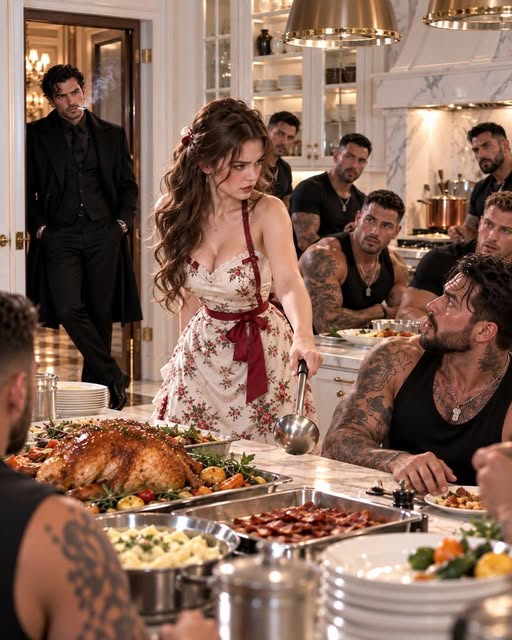
The trap worked beautifully, right up until the moment it nearly got us all killed.
Wednesday night at nine o'clock, Anton Karras's men hit Cole's depot run on the depot road — an empty van on a dead route, with Vincent and Bruno and four others waiting in the tree line with the engines off, the way Roman had laid it. It went the way Roman's things usually went: short, professional, and conclusive. They took two of Karras's men alive, and one of them, offered the choice between Roman Duca's questions and the police's hospitality, chose the police before the sentence was finished and started talking in the car.
But here's the thing nobody had planned for — the thing I have replayed more than any other night of my life. Karras was no fool. He'd sent the depot team as a probe with a payload: if the run was real, they took it; if it was bait, then Ravenwood would stand down by Christmas Eve believing the danger had passed — and the real team, the quiet one, would already be inside the wire.
They came over the north fence at ten o'clock on Christmas Eve, in the seam in the cameras Walter had reported twice, through the storm of questions nobody had asked about why the seam was there. Six men. And the seventh man of the team was already in the house.
Cole opened the service door for them.
I knew it because the kitchen was mine, and I had changed the code on the service door myself, and the only soul I'd given the new code to — standing in my pantry at six that evening asking where the good Barolo was kept for the Christmas table — was Cole. I heard the door's soft chime from the far end of the kitchen where I was basting the first of the turkeys, and I knew, the way you know a step on a stair in your own house, that it was wrong.
What happened next I did not plan. I want that understood. I am a cook. But the kitchen was full of people I loved — Mrs. Doyle with the good linen over her arm, Angelo come to steal a taste of stuffing, and Walter, down from the gatehouse with his keys in his breast pocket, bringing me the little tin of pepper he liked on his soup — and the first of the strangers came through my service door with a gun held low and easy, and my body decided before my mind caught up.
I hit the fire alarm with the heel of my hand. Then I threw the whole tray.
A sheet tray of parboiled potatoes and scalding fat will not stop an armed man. But it will make him dance, and swear, and fire at the ceiling instead of the room, and in a house like Ravenwood, a shot and an alarm are the same thing as a war bell. I got Mrs. Doyle and Angelo through the pantry door and the steel fire door barred behind them — "Bar it and do not open it for my voice, Angelo, only for Mr. Duca's, do you hear me" — and Walter, Walter Briggs, seventy-three years old, a man who had slept under a bus shelter three weeks before, picked up my cast-iron skillet off the range with his bare ruined hands and stood himself beside my door like a sentry at a post he'd been waiting thirty years to be given.
"You'll have to go through the cook's kitchen," he informed the second man through the doorway, in parade-ground tones, "and I don't rate your chances."
I don't remember all of it. I remember the sound the house made — that soldier-sound, fast and flat. I remember boiling stock and using it, God forgive me, the way it had to be used, over the pass, and the man who took it screaming and going down in a skid of flour from the sack I'd slit open on the floor — a white ghost of a man, blinded, who Bruno arrived to collect like a sack of laundry. I remember Cole in the doorway of my kitchen with his face finally, finally not smiling, and a gun in his hand pointed at the floor like he couldn't remember how it got there, saying, "Miss Maggie. Miss Maggie, I never — they have my brother, Miss Maggie. They took Danny in October. Every crate I signed, every date I sold — I was buying him back a week at a time. I never sold the house. I never sold the men. Just the schedules. Just the paper."
"You sold the paper," I said, "and the paper nearly killed them on the river road."
"I know it." His hand shook. "I know it. Tell me what to do. Tell me what to do and I'll do it, I swear to God."
Behind him the fight was ending the way floods end — all at once, and then the terrible quiet. I could hear Roman's voice in the hall, low and absolute, the voice that ended arguments and eras.
"Then do this," I said to Cole. "Put that on the floor. Kick it to me. And when Mr. Duca comes through that door, you tell him every word you just told me, and you start with your brother's name."
He did. He was on his knees among the flour and the wreckage of my Christmas Eve when Roman came into my kitchen with his coat torn and blood — not his — on his cuff, and stopped dead at the sight of us: Walter at his post with a skillet, me in my apron with a stock ladle still in my fist, and his driver of eleven years kneeling in the flour telling the truth at last.
Cole talked for an hour. He talked about Danny, nineteen, held in a Karras warehouse outside Baltimore as a living leash. He talked about Tomás before him, who'd run the same drip of thefts until his nerve broke. He talked about the camera seam on the north fence — his work — and the schedules, all of them, back to the spring.
And Roman listened the way he listened, completely, without moving. Then he did the thing I will carry to my grave.
Before he gave his verdict, Roman did something that no one in that kitchen had ever seen him do. He turned to me — flour to my elbows, apron ruined, a traitor kneeling between us — and he asked.
"If this were your kitchen alone," he said, "what would the sentence be?"
Cole's head came up. In that house, men had died for less paper than he'd sold. He knew it. I knew it. The whole ticking, radiator-warm kitchen knew it.
"It is my kitchen," I said. "You made it mine the first morning, in front of all of them. So I'll tell you what we do in my kitchen, Roman. We don't throw away a nineteen-year-old boy to pay for his brother's fear. We feed him. We bring him home. And the brother—" I looked down at Cole, at eleven years of pleasant smiles and signed crates, at a man who had been squeezed like a lemon by Anton Karras and had given up everything except the men themselves. He had sold schedules. He had never sold a name, a route's cargo, a guard rotation — the paper had been real, and the men on the river road had nearly died of it, and both of those things were true at once, the way most true things are. "The brother runs. Tonight. Not in a bag — on a bus, with his boy beside him, and if I ever hear he sold so much as a bus schedule again, I'll come and settle it myself, and I won't bring a ladle."
A sound came out of Cole that was half laugh and half ruin.
Roman looked at me for a long moment, and I watched the most feared man on the East Coast take instructions in a kitchen like a man being handed a family recipe.
"Then that's the sentence," he said. "God help anyone who appeals it."
He took out his phone, and he made two calls. The first was to Vincent: find the warehouse, tonight, quietly, and bring the boy out — alive, unhurt, and before midnight. The second — I watched a man who frightened senators do arithmetic with his own mercy — was to the state police captain whose number men like Roman keep for the nights when the law is a tool instead of a threat. Karras's taken men, and the depot, and the warehouse, all of it, gift-wrapped, if Danny came out of it breathing.
The boy's name was Danny Mercer — nobody to me, and everything to the man kneeling in my flour.
"You understand what you've done," Roman said at last, to Cole.
"Yes, boss."
"You understand you're finished here."
"Yes, boss." Cole's face crumpled. "The boy, boss. Just the boy."
"The boy will be home for Christmas," Roman said, "because she—" and he looked at me, standing there in my ruined apron in my wrecked and shining kitchen "—because she asked me at a bus shelter, three weeks ago, to get an old man a doctor and a hot meal before she'd take a thing for herself. That's the house she's built here while you were selling its paper. You get your brother. You don't get the house. When he's safe, you run, and you never come back to my state. Those are the terms."
Cole put his forehead down in the flour like a man at an altar, and wept.
Danny Mercer came home at two in the morning, thin as a rake and unhurt, in the back of Vincent's car, and I fed him Christmas dinner standing up in my kitchen at three a.m. because he couldn't stop shaking long enough to sit — fed him turkey and gravy and potatoes with my own hands while his brother watched from the doorway with his hat in his hands, an exile already. The state police took Anton Karras at his own Christmas table before dawn, with the depot team's testimony and Cole's records laid out like a place setting. The routes were safe. The ports were safe. The house was safe.
And when the last car had gone and the fortress stood quiet under a sky gone clear and full of stars, Roman found me where he always found me — in my kitchen, at my stove, making cocoa for the men on gate rotation because it was four in the morning and four degrees and that's what you do.
"You fed him," Roman said. "The traitor's brother. You fed Cole's whole treason, at my table, at three in the morning."
"He was hungry," I said. "And he was nineteen." I poured the cocoa into thermoses. "Your mother's rule, Mr. Duca. Anybody who sits down gets fed, and nobody's story is the price of the meal."
He was quiet a long moment. "I exile a man and arrest another, and you quote my mother at me over cocoa."
"She sounds like she was worth quoting."
"She was." His voice went somewhere I'd never heard it go. "Maggie. What you did tonight — the alarm, the door, Walter at his post with a frying pan like the honor guard of God—" He stopped. Started again, and Roman Duca, who never started again, said, "This house has been a fortress for eleven years. Nobody ever made it a home before. I don't think I knew the difference until you slammed a ladle down on my breakfast table and insulted my best man's hygiene."
"Bruno's hands were filthy, Mr. Duca."
"Roman," he said. "After tonight — Roman."
I screwed the last thermos shut. "Then you'd better call me Ma," I said, "before one of your thirty dangerous men beats you to it. They've been at it a week."