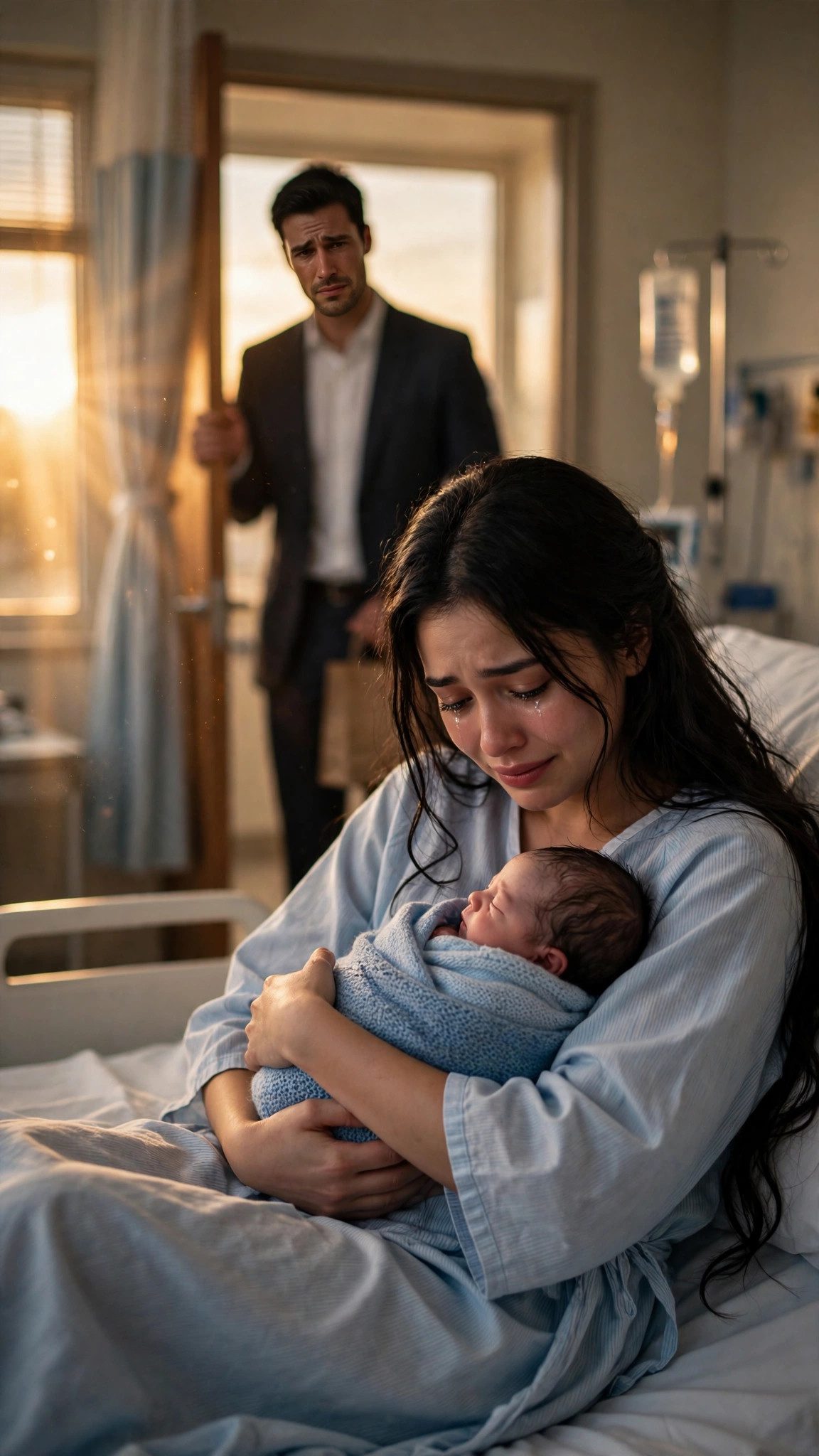
At 1:07 in the morning, a sharp pain tightened across my stomach, and I knew, the way a mother knows, that something was wrong.
I was twenty-nine weeks and four days pregnant. Our baby was not supposed to arrive for another ten weeks. I had spent the last two months doing everything the doctor told me to do. I rested. I drank water until I was sick of the taste of it. I stayed off my feet. I did all of it because Dr. Hayes had looked me in the eye at twenty-seven weeks and said the words no pregnant woman wants to hear: your body is trying to end this pregnancy early, and if it does, your baby may not survive.
I told myself the pain was nothing. I told myself it was a cramp, a false alarm, my body complaining about the weight it was carrying. Then another contraction came, harder than the first, and it squeezed the air out of my lungs.
At 1:19, my water broke.
At 1:24, I saw blood.
My hands shook so badly that I nearly dropped my phone. The bedroom was dark and too big and too empty. My husband's side of the bed was cold. It had been cold for three nights. Damian was in Capri. He had told me it was business. I had known for eight months that it was not business.
I called Damian eight times.
Seven calls went unanswered. On the eighth, he finally picked up.
"Claire?"
Behind his voice, I heard music. Ocean waves. Then a woman's laughter, light and careless, the kind of laughter that belongs to someone who has never once been afraid of losing anything.
My blood went cold. I recognized that laugh.
Alessia. The woman Damian had spent eight months insisting was nothing more than a friend.
"Damian," I whispered, gripping the edge of the bed so hard my knuckles went white. "I think I'm having the baby."
His voice immediately sharpened. "What? How many weeks?"
"Twenty-nine. Damian, there's blood."
"Where's the doctor?"
"Coming. Please, I'm scared."
For a moment, he said nothing. Then a woman's voice floated through the phone, bright and unbothered. "Damian, darling! Your champagne is getting warm!"
I closed my eyes. My husband wasn't attending some dangerous business meeting. He wasn't negotiating with enemies. He was in Capri, enjoying champagne with his mistress, while I was fighting to keep our child alive.
"Come home," I whispered.
"Claire, I'll call the pilot."
"Now, Damian."
"I need a little time."
Something inside me cracked. It was not a loud break. It was quiet, the way ice cracks on a lake in the middle of the night, a thin sound that means everything underneath is about to give way.
"You once woke fourteen men at three in the morning because a shipping container was delayed," I said.
Silence.
I swallowed against the pain. "I'm not asking for a mafia boss. I'm asking for my husband."
His breathing changed. I heard it catch, the way it used to catch when he looked at me across a crowded room and forgot, for one second, that he was supposed to be the most feared man in Chicago.
"I'll be there within eight hours. I promise."
I looked at the clock. 1:43 A.M. Then I looked down at my stomach, at the life moving inside me, too early, too small, too soon.
What if our baby didn't have eight hours?
By 2:58 A.M., doctors were rushing me into emergency surgery. Bright lights passed above my head. Someone told me to breathe. Someone else kept checking a monitor. I remember asking one question over and over, the same question, until my voice went hoarse.
"Is my baby going to live?"
Nobody gave me the answer I wanted.
At 3:17 A.M., my son was born. Two pounds, nine ounces. So tiny that I could hardly believe he was real. He didn't cry. I waited desperately for that first beautiful sound, the sound every mother waits her whole pregnancy to hear. Instead, I heard urgent instructions and hurried footsteps. They took him straight to the neonatal intensive care unit.
I hadn't touched his face. I hadn't kissed his forehead. I hadn't even seen his eyes. And his father was still somewhere across the ocean.
At 7:40 A.M., they finally allowed me to see my little boy. Nothing could have prepared me. He lay inside an incubator beneath a tiny white hat. A breathing tube covered part of his face. Thin wires surrounded his impossibly small body. I slipped one finger through the opening. His little hand curled weakly around it. I started crying.
"Hi, sweetheart. It's Mommy."
His fingers barely moved. But to me, that tiny movement meant everything.
I called Damian on video. When he answered, I turned the camera toward our son.
"Look at him, Damian. He looks just like you."
For several seconds, my husband couldn't speak. Then I heard him whisper, "Oh, God."
"He's beautiful, isn't he?"
"Claire…"
"Please hurry."
"I'm coming. I swear."
I wanted to believe him. I needed to believe him. Because every time I looked at our son's fragile chest rising and falling, I wondered how many breaths he had left.
At 11:08 A.M., his oxygen levels began dropping. A nurse gently moved me aside while the medical team worked around his incubator. I stood against the wall, pressing my hands over my mouth. I had never felt so helpless in my life.
At 12:22 P.M., a doctor explained that his lungs were dangerously weak. I asked whether he could survive. The doctor's expression told me more than his words ever could.
At 1:03 P.M., I called Damian again.
"Where are you?"
"The plane just took off."
For a moment, I thought I'd misunderstood. "Just took off? Damian, you promised you'd be here hours ago!"
"Claire, there were complications."
"What complications?"
Silence. Then I asked the question that had been burning inside me all day.
"Was it Alessia?"
He didn't answer. Not immediately. Not after I asked again. And somehow, that silence hurt worse than any confession. While our son was struggling to breathe, Damian had still been caught up in his life with another woman.
I slowly ended the call. For the first time in our marriage, I didn't wait for him to call back.
At 2:46 P.M., the doctor approached me. His eyes were gentle. Too gentle.
"Claire, would you like to hold your baby?"
My heart seemed to stop. I knew what he was really offering me. Not an ordinary first cuddle. A goodbye.
They wrapped my little boy in a soft blue blanket and carefully placed him against my chest. He was so light. So warm. So terribly small. I kissed his forehead.
"Hello, my beautiful boy."
My tears fell onto the blanket. "Mommy's here."
I rocked him gently, afraid that even the smallest movement might hurt him. Then I made the promise I had been making all morning.
"Daddy's coming home, sweetheart. He's just a little late."
At 3:16 P.M., I called Damian one last time.
"How much longer?"
"About two hours."
I looked toward the monitor. My throat tightened. "You're not going to make it."
"Claire, don't say that."
"Please. Just talk to your son."
I held the phone close to our baby's ear. Damian's voice trembled.
"Hey, little man. It's Daddy."
There was a pause.
"Just wait for me a little longer, okay?"
I closed my eyes. I wanted to scream at him. I wanted to beg. Instead, I whispered, "He can hear you."
But my son was slipping away.
At 3:23 P.M., the monitor changed. The doctor stepped closer. And the tiny heartbeat I'd spent months loving inside my body disappeared.
My son died in my arms. Twelve hours and six minutes. That was his entire life.
I held him long after the room became quiet. I kissed his forehead again and again. Then I whispered the words I knew his father would never hear him answer.
"I'm sorry, sweetheart. Mommy tried."
Nurse Elena Ruiz stayed with me. She was the same nurse who had moved me aside so gently at 11:08, the same nurse who had shown me how to slip my finger through the incubator's opening without disturbing the wires. She did not rush me. She did not use the bright, empty voice people use when they are afraid of grief. She sat down in the chair beside my bed and waited, and when I finally looked at her, she said, "Would you like to name him?"
I had not named him. Damian and I had argued about names for months, the way couples do, lightly, as if we had all the time in the world. Damian wanted a strong name, a family name. I wanted something soft. We had never decided. And now there was no more time to decide, and that felt like the cruelest part of all of it, that my son had lived twelve hours and six minutes and died without a name anyone had spoken out loud.
"Elias," I whispered. "Elias Moretti."
Elena wrote it down on the card, in careful, steady handwriting. Elias Moretti. Born 3:17 A.M. Died 3:23 P.M. Two pounds, nine ounces. Twelve hours and six minutes.
Dr. Hayes came in a little while later. He was the doctor who had warned me at twenty-seven weeks, the doctor who had told me to rest, who had looked at my chart and said, "Your body is trying to end this early, Claire. We need to buy time." He stood at the foot of my bed with his hands clasped in front of him, and he told me, in the quiet, precise voice of a man who has delivered this news too many times, that Elias's lungs had simply been too small, that his heart had worked as hard as a heart that size could work, that nothing I did or did not do in those twelve hours would have changed the ending. I wanted to believe him. Part of me did believe him. But another part of me kept hearing the phone ringing eight times in the dark, kept hearing the music and the laughter from Capri, kept thinking that if his father had been in the room, if his father had held him, maybe his tiny heart would have found one more reason to keep beating.
Elena helped me wash my face. She brought me tea I did not drink. She asked, gently, what I wanted to happen next, and I realized I had never thought about what happens next when a baby dies. There were papers. There were choices no mother should ever have to make in a hospital room while her body still ached from surgery. Burial or cremation. A service or no service. I chose cremation, because I could not bear the thought of leaving him in the cold ground of a cemetery while I went somewhere else, and I could not bear the thought of a small white coffin being lowered into the earth while his father was still somewhere over the Atlantic Ocean. I signed the papers with a hand that would not stop shaking, and Elena steadied the clipboard for me, the way she had steadied everything else that day.
I asked for a few minutes alone in the hospital chapel. It was a small room on the second floor, with a stained-glass window and six wooden pews and a silence that felt different from the silence of the NICU. In the NICU, the silence had been full of machines and waiting. In the chapel, the silence was just silence. I sat there with the small box they had given me, and I talked to my son. I told him about the nursery Damian and I had painted pale yellow, about the mobile with the wooden stars that hung above his crib, about the tiny blue blanket his grandmother had knitted before she died. I told him I was sorry his father had not been there. I told him I loved him, and that twelve hours and six minutes had been enough for me to love him completely, and that no one could ever take that away from me.
When I came back to Room 807, I knew what I had to do. I had spent three years waiting for Damian. I had waited through late nights and cancelled dinners and trips that stretched from two days into two weeks. I had waited while he built his empire and told me the empire was for us, for our family, for our future. And our future had lived twelve hours and six minutes and died in my arms while his father drank champagne with another woman. I was done waiting.
I packed the paper bag slowly, the way you pack something sacred. His tiny white hat. His NICU bracelet, still warm from his wrist. The photograph Elena had taken of me holding him, my face streaked with tears, his tiny hand curled against my chest. The card with his name on it, Elias Moretti, written in Elena's careful handwriting. And my old phone, with the fourteen-second video. I had recorded it at 7:52 that morning, when the light from the window fell across the incubator and his chest was rising and falling in a steady rhythm, and I had whispered, "Daddy's coming home to you." I had believed it when I said it. I had believed it all day, even when the calls went unanswered, even when the plane had only just taken off at one o'clock, even when the silence on the other end of the line told me everything I did not want to know.
I placed the letter underneath everything. I had written it in the chapel, on hospital stationery, in handwriting that shook so badly I could barely read it myself. I told Damian how I'd made that promise for twelve hours. How our baby had waited. How he had died without ever feeling his father's arms. And finally, I wrote: "I don't want to spend the rest of my life waiting for you, too."
I left the hospital carrying only my handbag and a small box containing my son's ashes.
At 6:05 P.M., Damian reached Room 807. I wasn't there. Our son wasn't there. Only the bag remained.
I later learned that Damian watched the video repeatedly, clutching our baby's hat in his trembling hands. Then he read my letter. And immediately ordered his security team to find me.
But something happened that Damian had never imagined possible. His own guards refused to obey him.
When he demanded an explanation, they reminded him of an order he'd personally given seven months earlier. An order he had completely forgotten.
But I remembered every word of it. And that forgotten command was the reason I'd been able to walk away from Chicago's most feared mafia boss without a single guard following me.