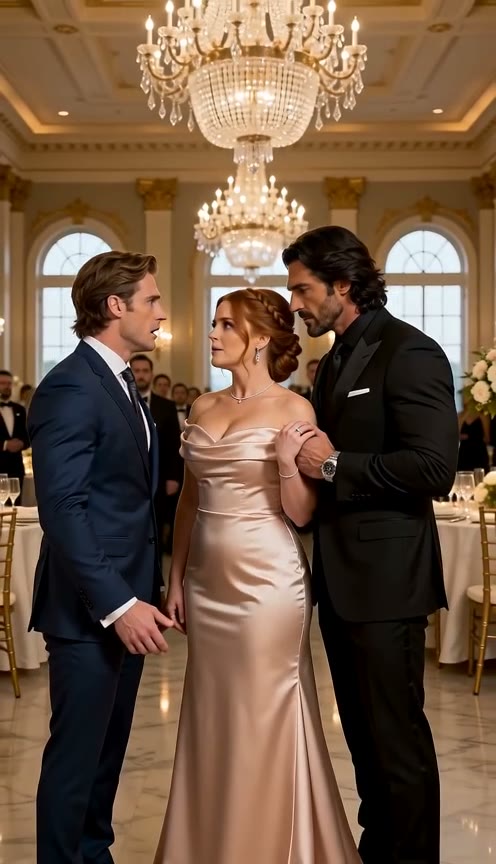
The ballroom of the St. Regis did not know it was a battlefield. It arrived at the evening the way it arrived at every evening: chandeliers blazing, marble gleaming, white roses breathing their expensive perfume into golden air. Six hundred Wexford alumni moved through it in black tie and silk, and Penelope Russo — Director of Events by trade, survivor by experience — did what she had done in ballrooms for a decade. She read it.
She read the seating politics in who stood where. She read the orchestra's timing. She read, with professional contempt, that the champagne was being poured too warm and the coat check was backing up. And she read the room's reaction to her — which was, for the first hour, the most interesting text of all.
Because the alumni of Wexford University had a long memory and a short imagination. She watched it happen in stages, all evening: the double-take, the whispered conference behind a program, the recalibration. That's Penelope Hart. Is it? It is. The scholarship girl. The catering years — no, wait, she ran The Meridian's events, my cousin's wedding— and then the name that traveled faster than all of it, passed mouth to mouth with the champagne: Russo. She's a Russo. She married that Russo. The girl Bradley Farnsworth had thrown away like a library book had come back to the centennial gala as the wife of the most quietly powerful man in New York, in a gown that cost more than her entire first year of tuition, wearing a wedding ring that made the chandeliers look underdressed.
She let them look. She had earned the looking.
At the top of the stairs, an old man in a dean's regalia of a suit took both her hands in his and held them, beaming — Professor Aldane, emeritus, who had written her scholarship recommendation twenty years of students ago and referred to the letter ever after as the best investment of his career. "Hart," he said, which was what the room still called her, and she did not correct him, because in his mouth it was not the old name, it was the first one. "I read the foundation's annual report. Cover to cover. Twice. My wife thinks I've taken up espionage." He surveyed the ballroom with the proprietary air of a man who had sent generations into it. "I put one line in that letter, did your mother ever tell you? 'This university will spend fifty years being proud it knew her first.'" He patted her hands. "The fifty years are going well, my dear. We're ahead of schedule." And Penelope — who had come braced for ghosts, for cropped photographs, for the fountain — stood in the golden doorway of the centennial gala with her old professor's blessing ringing in her ears like a bell, and understood that she had misremembered the past in one essential way: it had never been only Bradley's. There had always been other witnesses. She had simply been too busy surviving it to collect them.
She collected them now, all evening, like a woman harvesting. The class secretary who had worked the café shifts beside her and now ran a publishing house. The rowing captain, silver and kind, who introduced his husband. A girl — a woman, a judge now — who had once lent Penelope a statistics textbook and announced, delighted, to a circle of alumni that she had "known Penelope Hart when," and told the story of the library floor wrong, with Bradley edited entirely out, the way history improves all stories worth keeping. The room, in other words, had done what rooms do over eight years: it had grown up around the space where a cruel boy's version of events used to be, and filled it with truer furniture. She found her scholarship mentees — three of them, current Wexford girls, invited under her foundation's program, wide-eyed at the edges of the room exactly where she had once stood — and she spent twenty minutes doing the most radical thing in her arsenal: she introduced them to everyone, by name, with their achievements attached, as if their presence in that ballroom were the most natural thing in the world. Because it was. Because she had decided it would be.
The evening had its formalities first, and she survived those beautifully.
The association president — silver, sincere, a man who had clearly rehearsed in a mirror — gave the centennial address, and then introduced the evening's presenting donor, and Penelope watched Bradley Farnsworth take the podium in the golden light with the ease of a man being lowered into a warm bath. He was good. That was the unforgivable part; he had always been good in rooms. He thanked the university for "the best four years — the years that teach you who you are." He raised his glass. "We all had our college phases," he said, to appreciative laughter, his eyes traveling the room with a toastmaster's precision, "the causes, the crusades, the people—" a beat, a smile with a knife in it, pitched at exactly the alumni who remembered— "—we outgrow. To outgrowing."
The glass at Penelope's table went up with all the others, because she had not survived a decade of ballrooms by making scenes at toasts. She drank. The champagne was still too warm. She thought, with a clarity so total it was almost funny: He rehearsed that. He wrote it down. Somewhere in a penthouse, that sentence had been typed, revised, and practiced — a grenade with his initials on it, aimed at a girl who no longer existed, in case she had the poor taste to still be standing somewhere in his sightline eight years later. She set her glass down and waited to feel the wound, and what she felt instead was something clean and almost tender: pity, at room temperature. The toast wasn't power. The toast was a man still fighting a girl in a blue dress — still needing her small enough to justify the size he had been then.
Marcus Webb found her by the dessert table an hour into the evening — Marcus, who had been at the fountain. Marcus, who had laughed. He had gone soft and grey and kind in the intervening years, the way some men do when life has billed them, and he stood in front of her with his hands empty, a man without a single prop to hide behind.
"I was there," he said. "At the club. At the— I laughed, Penelope." She waited. Letting people finish was a discipline she had learned in a Brooklyn kitchen and a parking garage. "I've thought about it — God, I've thought about it more than any grown man should think about one minute of college. I taught my daughter about it. I used it as the example. 'Don't be the man laughing by the fountain.' That's what I told her." He exhaled. "I never said it to the person I owed. I'm saying it now. I'm sorry I laughed."
"Thank you, Marcus," she said, and meant it in a way that surprised them both, and watched him walk back into the golden crowd lighter than he'd arrived. It struck her, watching him go, that the past was not one man. It was a roomful — and the room, given eight years and enough light, was slowly, unevenly, doing its own accounting. All but one account. And that one was circling the champagne tables with a syndicate to charm and a toast already spent, looking for the money — and finding, instead of the money, her.
Vanessa got there first. She intercepted Penelope at the mirror in the ladies' lounge with the tactical calm of a woman who had also been planning, adjusting an earring the size of a chandelier's ambitions. "You're very brave," Vanessa said to the mirror, not to her — the ancestral echo of a country-club greeting, Mrs. Farnsworth's voice through younger lips. "Coming alone. Everyone's asking where he is. The mysterious husband." Her eyes found Penelope's in the glass. "Of course, everyone's also wondering if there is one. A ring can be—" she smiled— "aspirational."
Penelope dried her hands. She considered the girl she had been, who would have bled on this marble. She considered Rosa's voice: You do not go there to show them. You go because the room is yours.
"Vanessa," she said pleasantly, "we've known each other eight years and you've wished me invisible in at least four ballrooms. At some point a woman has to accept the evidence." She picked up her clutch. "He's on his way. Do enjoy the orchestra. I chose them — well. I chose the firm that chose them. Close enough for our purposes."
She left Vanessa standing at the mirror with her mouth open, and she did not hurry, and her hands — Rosa would have been proud — did not shake at all.
She was laughing at something the association president said, at the champagne table by the dance floor, when the temperature of the air behind her changed.
"Well. Penny Hart. As I live and breathe."
Eight years, and her body knew the voice before her mind permitted it. It went through her like a change in the weather. She set her glass down — carefully, she never dropped things — and turned.
Bradley Farnsworth stood in the golden light like a photograph of himself: navy suit cut to the millimeter, hair still perfect, smile deployed. But the photograph had aged in ways the magazines had airbrushed. There was a tightness at the corners of the eyes. The drink in his hand was not the first of the evening, and his performance of ease had a hairline crack in it she could see because she had once been fluent in him. Beside him, angled like a display, stood Vanessa Cole — older, sleeker, her engagement long since dissolved and her presence here plainly transactional: an ornament for the money men, a rumor of alliance. Her eyes swept Penelope's gown, her ring, her figure, and found — visibly, furiously — nothing to pity.
"Bradley," Penelope said. Evenly. "Vanessa."
"You look—" Bradley began, and his smile rebuilt itself into the old weapon, the one that used to fit her exactly. "Well. Expensive." His eyes moved, pointedly, to her left hand. "They told me you married. I laughed. I actually laughed out loud." He glanced around the growing edge of their audience — alumni who had slowed, turned, tuned in with the instinct of people who smell a scene — and raised his voice just enough to feed them. "Where's your husband, Penny?"
Penelope's fingers tightened around her clutch. Her ring caught the chandelier light and threw it.
"He's on his way," she said.
It came out quiet, and steady, and she was proud of it — and then ashamed of being proud, because pride meant some part of her was still keeping score in a language he had taught her. Bradley heard the steadiness and disliked it. She watched him decide to escalate. It was all there, the whole architecture of the boy she had loved: he could forgive her failure, but he could not forgive her composure.
"On his way," he repeated, and gave the small, contemptuous laugh that had been echoing in her head since a terrace in the rain. "Penny. Come on." He stepped closer, into the warmth of her personal space, the way men step when they have never been made to pay for it. "Who would marry you?"
Somewhere across twenty feet of marble, one of her scholarship girls made a small sound. Penelope heard it. She thought of the blue dress. She thought of the lemonade glasses, set down so carefully on the balustrade. She thought of all of it arriving here, to this exact circle of golden light, in front of these exact people, eight years later — and she understood, standing there with her chin up and her heart going like a struck bell, that she had not come to this ballroom to survive Bradley Farnsworth.
She had come to be witnessed not surviving him. There was a difference, and the difference was everything.
"Careful," she said, very quietly, so that only he could hear. "You don't know who you're talking to."
It was the wrong thing — or the right thing. His smile widened on the insult of it. "I know exactly—"
The great doors at the far end of the ballroom opened.
There was no announcement. There did not need to be. It moved through the room the way weather moves across water — conversation thinning table by table, the orchestra faltering half a beat, six hundred heads turning with one instinct — as a tall figure in an immaculate black three-piece suit stepped into the golden light and stopped, and looked across the whole expanse of the centennial gala directly at Penelope Russo, like the rest of the room was furniture.
Damian had come for his wife.
And Bradley Farnsworth — turning, mid-sentence, smile still armed, to see what had silenced six hundred people — saw him too.