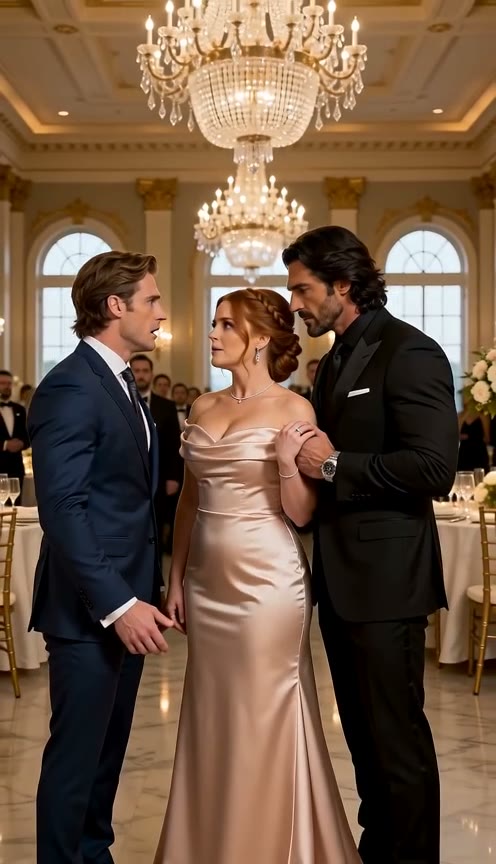
It took Bradley four seconds to understand, and Penelope would remember those four seconds on her deathbed.
She watched his face change the way you watch ice go on a lake — the smirk first, still pointed in the wrong direction; then confusion, as the crowd's reaction registered; then recognition, dawning like something rising out of deep water, as the face in the doorway assembled itself into a name every man in his world knew and no man in his world said casually; and then, last, the understanding that turned his knees to water: the direction of that gaze. The fact that Damian Russo was not looking at the room, or the podium, or the money.
He was looking at her.
Damian crossed the floor. Guests cleared from his path with the soft inevitability of a tide, and the distance between the door and the dance floor seemed to shrink around him. He stopped beside Penelope and laid his hand on her shoulder — large, warm, absolute — and his thumb moved once against the satin, a signal meant for one person only. Her breathing, which she had been governing all evening like a budget, simply — settled. She turned her face up to him and saw, in the dark of his eyes, the thing he never showed rooms: her. Only her. The rest of the evening was administration.
"You're late," she murmured.
"Chicago weather," he said, for her alone. "Forgive me." Then he looked at Bradley, and the murmur was gone, and so was every degree of warmth in the ballroom.
Bradley's pointing hand had drifted down. His glass had stopped midway to nowhere. His voice, when he found it, was barely a voice at all.
"Damian Russo…"
"You insulted my wife?"
Damian did not raise his voice. He did not need volume; he had the acoustics of the room and the attention of history. The question landed in the silence like a stone in still water, and the ripples went out to the farthest tables. Penelope placed her hand over his, where it rested on her shoulder, and looked at Bradley with eyes that were wet and entirely steady.
"Bradley," she said, softly, clearly, in front of everyone he had ever performed for, "meet my husband."
What followed was not a scene. Scenes were for lesser men. What followed was an audit.
"You came here tonight," Damian said, in the tone of a man reading a weather report, "hoping to meet the partners behind the syndicate considering your rescue placement." A pause. "Forty million dollars. Farnsworth Capital." Bradley's mouth opened. Nothing came out. "The lead partner in that syndicate is a Russo Holdings fund. My analysts completed their review three weeks ago." Damian's head tilted, very slightly, the way a scale settles. "Do you know what they found, Bradley?"
"I — there — the numbers were — it was a preliminary—"
"They found a second set of figures," Damian said. "For the bondholders. I was raised by a man who ran the kind of business where lying about money got people hurt, Bradley. I have spent twenty years building the kind where it merely gets people finished." He let that sit in the golden air. "The placement is declined. It was declined before you put on that suit. I am sorry you had to dress for it."
Vanessa Cole had gone very still — the particular stillness of a woman recalculating her entire evening at speed. Around them, six hundred alumni stood in the wreckage of the moment, and Penelope watched her former life perform its final act: Bradley Farnsworth, who had explained her to his friends by a fountain as a phase, a story, a kindness, turned from the most powerful man in the room to the woman he had thrown away, and put out both hands like a man falling.
"Penny— Penelope. Please. You don't understand what this means, the firm was my grandfather's, if the placement doesn't close by December the board will—" He was begging in front of the whole centennial class, and he didn't even care, and that was when she knew it was finally, completely over: because she felt no triumph. She felt the way you feel at the end of weather. "Tell him. Tell him it was one bad night, tell him we were— we were kids, Penelope, we were—"
"We were," she agreed gently. "And then we weren't. You taught me that, in the rain, in one sentence, and it was the most valuable lesson of my education." She looked at him — really looked, the way she had not in eight years — and her voice, when it came, was kind, and the kindness was the most devastating thing in the room. "I hope someday you become the man you've been telling everyone you are, Bradley. I truly do. It's a good speech. It deserves a true story under it."
Bradley, drowning, made the error drowning men make. He turned from her — from the woman, whom he still, in some cellar of himself, filed under persuadable — to the man, whom he filed under negotiable, and he put on the voice men of his training use in clubs and closing rooms, the voice of the fraternity beneath the world.
"Russo. Damian. Look — as one man to another. This—" he gestured at the wreckage of the evening as if it were weather, "—this is personal business getting in the way of professional business, and professionals don't—"
"Stop," Damian said. Not loudly. He was looking at Bradley the way an auditor looks at a page he has already finished with. "You are not speaking to me as one man to another. You are speaking to me as a man who has never paid for anything, asking the bill to be sent to the woman." He took half a step closer, and the whole ballroom leaned away. "You mocked my wife's body in front of six hundred people to feel tall at a fundraiser. Your fund lied to its bondholders. Those are the same act, Bradley. A man who takes what he hasn't earned and calls the taking charm." His voice dropped, and somehow grew. "I run clean books. I married a clean conscience. You were never going to be a partner of mine. You were only ever going to be a story she told me once — and do you know what she asked for, when she told it? Nothing. She asked for nothing to happen to you. The only mercy in this room tonight is hers, and you spent it on a toast."
At the edge of the circle, the evening finished its own arithmetic without them. Vanessa Cole gathered her wrap from a chair with the unhurried precision of a woman exiting a position, touched Bradley's arm once — the way one touches a door to check if it's hot — and said, distinctly, in a voice meant to be carried: "Bradley. Your driver is waiting." Then she walked, alone and very upright, toward the doors, and the alumni of Wexford parted for her with considerably less reverence than they had used for Damian. Two gray-haired men at the syndicate's table — the money Bradley had crossed the city to charm — were already on their feet, already buttoning jackets, already exchanging the small, final handshakes of men closing a book. One of them, passing, paused beside Damian and said, simply, "Our report goes to the board Monday. All of it." Damian inclined his head. "Send Mrs. Russo a copy," he said. "She likes the full file." And Marcus Webb — Marcus, who had laughed by a fountain eight years ago and apologized by a dessert table one hour ago — stood in the second row of witnesses with his daughter's lesson written all over his face, and did not laugh, and did not look away, and Penelope, catching his eye across the wreckage, understood that some debts get paid in full view, in gold light, by the simple refusal to be entertained.
Near the dance floor, her three scholarship girls stood in a row like a small honor guard, stunned and incandescent, watching the woman who funded their futures be chosen, out loud, in front of everyone — and Penelope thought: good. Let them have this story instead of the other one. Let them carry this one into their rooms.
She turned then — not away from him, which would have been about him, but toward her husband, which was about her — and Damian, reading her the way he read everything, offered his arm with the formality of a man at a coronation.
"My wife owes me a waltz," he announced, to no one, to everyone, "that Chicago weather tried to steal."
The orchestra, which had been holding its breath for ten minutes, understood its cue like a living thing, and the opening bars of a waltz rose into the chandeliers as Damian Russo led Penelope onto a dance floor that emptied for them as if by royal decree. Behind them, unnoticed by either, Bradley Farnsworth lowered himself into a gold chair at an empty table, set his unfinished drink down with exaggerated care — a man being careful with glass, at last, in his life — and put his face in his hands, alone in the middle of six hundred people.
But Penelope did not see that. Penelope was dancing — badly at first, laughing up at her husband because he counted under his breath like a man defusing something, and then not badly at all, her cheek against the black wool of his chest, in the center of the most beautiful room in New York, in front of everyone who had ever been told she was a phase.
"You're stepping on the beat," she informed him.
"I'm stepping where I want," Damian said. "It's my one flaw." His arm tightened around her, fractionally, and she felt his voice drop for her ears alone. "Tell me I arrived in time."
"You arrived," Penelope said, "exactly when the story needed you. It took eight years. But then — you always did make an entrance."
They danced the whole waltz, and then — because the orchestra had read the room the way orchestras do, and because a centennial class does not waste a floor that has just been christened by history — they danced the next one too, slower, as other couples began, cautiously and then with gathering joy, to join them. The ballroom reassembled itself around the dance, the way water closes over a stone. Professor Aldane cut in on no one and danced with the association president's wife like a man half his age. The scholarship girls were pulled onto the floor by gallant, terrified alumni sons and spun through the golden light with their name tags flying. Marcus Webb stood at the edge with his wife and raised his glass, once, in Penelope's direction — not a toast to the evening. A receipt. Paid.
"Your girls are crying," Damian observed, steering them past the fountain of champagne glasses with a competence that flatly contradicted his counting.
"Happy crying," Penelope said. "It's a technical category. I handle it professionally."
"And you?" He was looking down at her with the undivided attention that had once undone her in an empty ballroom smelling of Barolo and condemned fish. "What is the technical category of you, Mrs. Russo?"
"Also happy," she said. "With footnotes." She rested her forehead, briefly, against his shoulder, in front of everyone, because the whole point of everything was that she could. "I kept waiting — all night — to feel like her. The girl in the blue dress. I had lines prepared for her. Comforting ones. It turns out I didn't need them." She lifted her head. "She's not in the room, Damian. She didn't get an invitation. She became me years ago, in a warehouse, in the rain, on the stairs of a hotel — and tonight I finally got the memo." His arm tightened. The chandeliers turned, or the room did. "I don't feel avenged," she said wonderingly. "I feel finished. Like a building. Inspected and finished and open for business."
"Then the evening is a success," said Damian Russo, "and Chicago can keep its weather." The music softened toward its end. He turned her once more under the lights, with terrible formality and worse counting, and the class of Wexford — the whole glittering, chastened, grown-up room of them — applauded, not the dance, not the drama, but the plain extraordinary fact of a woman entirely at home in her own story, and Penelope laughed into her husband's shoulder with the orchestra's last note still hanging in the air like something blessed.