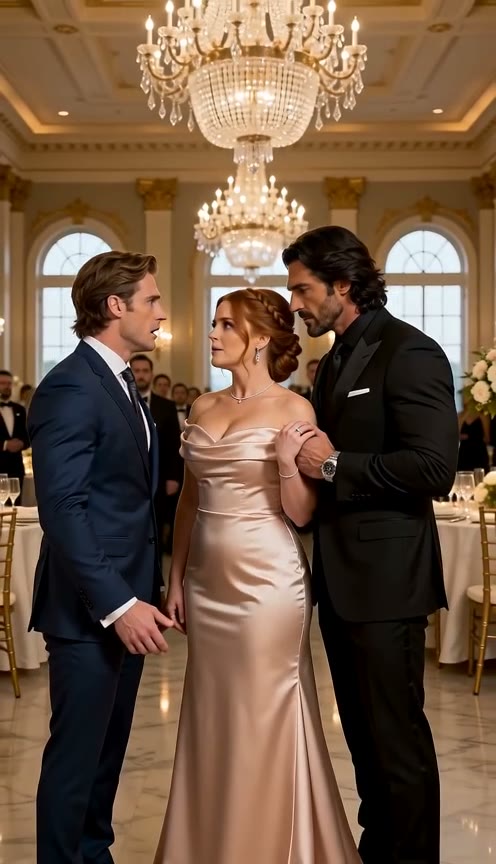
The story the city told itself afterward was simple, and mostly wrong, and Penelope never bothered to correct it.
The city said Damian Russo had destroyed Bradley Farnsworth in a ballroom to avenge an insult. The truth was quieter and far more total: Damian Russo had done almost nothing. He had declined a bad investment three weeks before the gala, in an office, on the merits. He had attended a party. He had danced with his wife. Everything else — the collapse, the headlines, the long public unspooling of Farnsworth Capital — Bradley had built himself, over years, out of cooked figures and contempt for anyone he thought was beneath the notice of history. The gala had simply been the first room with enough light in it.
By December, the board of Farnsworth Capital — acting with the desperate hygiene of men saving the furniture from a fire — announced an independent audit. By January, the audit found what Damian's analysts had found. By February, Bradley Farnsworth resigned "to spend time with family," in the ancient formula of his class, and Vanessa Cole gave an interview to a society magazine in which she described herself as "a longtime friend of the family" and the engagement-that-wasn't as "a youthful misunderstanding between households." Penelope read that line twice, in her office, with her shoes off and a cup of tea going cold, and laughed until her assistant knocked.
She did not hate him. That was the final luxury, the one she had not known she was saving for. Hate was a way of still living in his house. She had moved out so completely that when a journalist — fishing, at a foundation luncheon — asked her, sweetly venomous, whether she had "ever crossed paths with Bradley Farnsworth," Penelope smiled with total sincerity and said, "We were at school together. I hope he's well." and meant it enough that it bored the journalist into moving on.
Her own life, meanwhile, was compounding like interest.
The Russo Foundation's gala that spring — the first she ran as Executive Director rather than as hired hands — raised more in one evening than the previous five years combined, partly because her seating chart had become legend and partly because every hostess in Manhattan wanted to be able to say she had survived being audited by Penelope Russo's smile. She hired two of her Wexford scholarship girls into foundation fellowships. She endowed the program in perpetuity, first line of the budget, non-negotiable, and she named it with characteristic precision: The Second Look Fund, for the students everyone else had already finished seeing.
Rosa Russo, watching her daughter-in-law work a room of donors like a woman conducting weather, pronounced the family's final verdict at Sunday dinner, to her son, in front of the whole table: "I told you. Good hands. She stays. You — you are still doing the work?" And Damian, the most feared man in three states, submitted to cross-examination by a seventy-year-old with a serving spoon and answered, meekly, "Every day, Mamma," while Penelope hid her smile in her napkin.
There were, of course, ordinary miracles, which turned out to be the point of everything. A house in Connecticut with a library ladder, bought because Penelope had stood in the doorway of the library and gone quiet in a way Damian had learned to translate. Sunday mornings. His terrible waltzing, improving at the rate of geology. The annual argument about whether the foundation's office needed a dog (Penelope: yes; Damian: a dog is a security variable; the dog, eventually: a enormous, elderly rescue named Committee, who slept under Damian's desk and feared no one, including Damian, and was therefore the only creature in the Russo organization with total job security).
And in the second autumn, a daughter — Sofia — born on a rainy morning that Penelope privately considered the weather apologizing, with her father's dark eyes and a grip on Penelope's finger like she was holding a railing against a spectacular view. Damian held her for the first time with the stupefied reverence of a man whose entire life's work in control had been lovingly, permanently undone, and whispered to her, in Italian and then in English, in case she had a preference: "You will never have to wonder if you are wanted. Not one day. That account is paid in full, in advance, forever."
Rosa arrived at the hospital at dawn with soup for an army and a christening gown that three generations of Russo brides had embroidered, and she held her granddaughter with the composed ferocity of a woman receiving a head of state. "She has the hands," she announced, examining ten fingers with a jeweler's attention. "Good hands. She stays." Then she looked over the baby's head at her son, who was standing in the corner of the maternity room in a state of awed uselessness no syndicate had ever achieved, and her fierce old face softened into something Penelope had never seen directed at Damian by anyone but herself. "Your father," Rosa said, "the night you were born, tried to give the nurse instructions. A list. He had written a list of the man's duties to a son." She shook her head gently. "He loved by listing. You—" she nodded at Damian's empty, helpless, devoted hands— "you love by standing there. It is better. She will know the difference. They always know." And Damian Russo, who had ended arguments in three languages and once made a ballroom of six hundred people fall silent by entering it, stood in a room smelling of soup and new life and said, "Yes, Mamma," and cried without a sound, which his mother pretended not to see and his wife pretended not to have memorized for the rest of her life.
The spring gala of her own — the foundation's, hers now in truth — fell that year on the first warm night of April, and it was there, if anywhere, that the story completed its circle in public. Six hundred guests again, but a different six hundred: hospital boards and scholars, donors and dishwashers' daughters, the whole improbable architecture of the life she had built, eating at the same tables. Midway through the evening she took the podium to announce that the Second Look Fund had been endowed in perpetuity — first line of the budget, untouchable, forever — and six hundred people stood up, and among them, in the third row, stood the four girls of the first graduating class, and beside them their mothers. Penelope had prepared remarks. She delivered exactly one sentence of them ("This fund exists because a room once decided I was a phase, and I have decided to spend the rest of my life out-arguing rooms") before the applause made further remarks academic, and she stepped down into the arms of a receiving line of scholarship girls like a woman being passed hand to hand across a river, laughing, entirely undignified, entirely home.
Damian found her afterward on the terrace with her shoes off and her feet in the fountain's rim — a Director of Events to the last, cooling her heels in her own gala's water feature. "Your speechwriters are devastated," he said. "They wrote four pages." "They'll recover," she said. "Did you eat?" It was their whole marriage in one question — the checking of the furniture of each other. "Committee ate my dinner," he said. "He has developed opinions about the foundation's catering budget." Committee, asleep at that moment under the podium with a stolen bread roll, feared no auditor. "Then starve nobly," she said, and he sat down beside her on the fountain's edge in a suit that cost more than her first car, and put his shoes beside hers, and dangled his feet in the water of his own foundation's gala like a schoolboy, and the photographer who caught it sold the picture to a magazine that captioned it WRONG in every particular, and they framed it anyway, and it hung in the Connecticut library for forty years.
The library was where he gave her the book. Their fifth anniversary fell in November, on a grey, kind afternoon, and Damian — who observed anniversaries the way he observed everything, with total preparation and minimal announcement — set a parcel on her desk wrapped in brown paper, which in that house meant the contents mattered more than the presentation. Inside, in a cloth case, was a first-edition Keats. The anthology. The same edition, the same binding, as the copy a boy had once let a girl keep in a library, and another copy a girl had once wrapped in silver paper and left on a marble table between a Tiffany box and a vase of white roses, for a boy who was already gone.
"Open it," he said.
On the flyleaf, in handwriting she knew better than her own — because it signed her foundation's checks and her birthday cards and, once, a marriage license — was written: For the woman who kept the book. Everything started there. It still does. — D.
Penelope Russo, who did not drop things, held the book in both hands for a long time. "You can't replace it," she said at last. "That's not what this is. The other one— wherever it is, whoever read the inscription and wondered — it did its work. It told the truth to an empty room until the room was ready." She looked up at him, this man, this wall that had learned to be a door. "This one's for the shelf where true things live." And she stood, and put the Keats on the library shelf between the senator's wife's note — framed, because he had insisted, because he framed all evidence of her — and the photograph from the fountain, and the house in Connecticut settled around the four of them, woman and man and dog and book, like a held breath let go at last.
A year to the night after the gala, the Wexford Alumni Association held its winter dinner — smaller, in the same ballroom, beneath the same chandeliers.
Penelope stood at the edge of the dance floor in a midnight-blue gown, watching her mentees — fellows now, women with titles and budgets — work the room with their name tags straight and their chins at the angle she had taught them. At the champagne table, a nervous first-year scholarship girl stood alone with her clutch held like a shield, watching the room decide whether she existed. Penelope watched the girl's shoulders do the small, familiar arithmetic of making herself smaller.
She crossed the marble floor.
"I'm Penelope Russo," she said, and held out her hand. "Class of — a while ago. First in my family, scholarship, catering shifts, the whole blueprint." The girl's eyes widened. "You're not invisible," Penelope told her, in the tone of a woman passing on state secrets. "You're staff in your own head. It's different. Now — tell me what you're studying, and then I'm going to introduce you to the woman who runs the hospital board, and you are going to be so interesting that she forgets to eat her dinner. Ready?"
Behind her, she felt the room change key, the way it always did — a warmth at her shoulder, a hand settling there, large and certain, a thumb moving once against silk in a signal meant for one person only.
"Mrs. Russo," said Damian, in her ear, as the girl's face lit up like a window at dusk. "You're recruiting again."
"Always," Penelope said. She turned her face up to her husband — the man who had walked through a ballroom and a decade of other people's underestimations and found her, every time, exactly where she had been standing all along: holding up the seams of the evening, waiting for someone to notice that the person holding everything together was the whole point of the structure. "Dance with me first. Then I'll save the university."
"Your terms are acceptable," said Damian Russo, and offered his arm like a coronation.
And Penelope — scholarship girl, invisible woman, phase, footnote, the girl he threw away, none of which had ever once been true — put her hand in her husband's, and walked out onto the golden floor as what she had actually been all along.
The woman he chose. The woman who chose back. The author of the rest of the story.
THE END