The photographer came on a Saturday, in the golden hour before sunset, when the light lay low and warm across the grasslands and the ranch house threw a long shadow across the yard.
He came with a great wooden camera and a black cloth and a wagon full of glass plates, and he set the camera up on its tripod in the yard, and he looked at the house, and at the corral, and at the grasslands stretching away to the horizon, and he said, "This is a fine place for a portrait, Mr. Redmond. The light here is the best I've seen in the county."
The children had been preparing all day. Ruth had braided Clara's hair, and Clara had braided Grace's, and Grace had tried to braid Abigail's, with results that Mrs. O'Leary had diplomatically described as "spirited." Thomas had polished his boots until they shone, and Samuel had polished his, and Joseph had polished his, and then he had polished them again, because he was four years old and polishing boots was the finest work he had ever done. Evelyn had dressed them all in their best clothes, and she had dressed herself in a new lavender dress — good cloth this time, with no mending at the cuffs — and she had pinned her hair up the way she had worn it on her wedding day, and she had stood in front of the mirror for a long moment, looking at the woman she had become.
She was thirty-four years old. She had laugh lines at the corners of her eyes. Her hands were work-worn. There was flour on her sleeve that she had missed. And she had never, in her whole life, felt so beautiful.
Silas came into the bedroom in his charcoal suit, with his black cowboy hat in his hands, and he stood behind her, and he looked at her in the mirror, and he said, "You look lovely, Evelyn."
"Do I?" she said. "I feel like a woman with seven children and flour on her sleeve."
"You are a woman with seven children and flour on her sleeve," Silas said. "And you look lovely."
She laughed, and she took his arm, and they went downstairs together, to where the children were waiting in the parlour, fidgeting in their best clothes, and Mrs. O'Leary was wiping her eyes with her apron, and Dutch was standing in the doorway with his hat in his hands, grinning like a boy.
"Well," Dutch said. "Look at this family."
They went out into the yard, into the golden light, and the photographer arranged them the way he arranged all families: father standing, mother seated, children gathered around. Silas stood beside Evelyn's chair, in his charcoal suit and his black cowboy hat, with his hand resting protectively on her shoulder. Evelyn sat with Abigail on her lap and Grace at her knee. Thomas stood tall at Silas's side, thirteen years old, trying very hard not to smile, and failing. Ruth stood beside her mother, twelve, with her hair braided and her chin lifted, the way Evelyn had taught her. Samuel and Clara stood together, holding hands, five and four, solemn as judges. Joseph, four years old, sat on the grass at his father's feet, grinning, with his hair sticking up.
"Hold still," the photographer said, ducking under the black cloth. "And smile."
The shutter clicked. The family held still. The golden light fell over them, and the ranch house stood behind them, and the horses stood in the corral, and the grasslands stretched away to the horizon, and the whole of it — the house, the land, the children, the love — was caught in a single moment, on a single plate of glass, for ever.
Afterward, the neighbours came. Not the whole town — but more than Evelyn had expected. The stout woman from the church, with flour on her apron, brought a pie. The miller's widow brought a basket of apples. The schoolteacher — a young woman who had taken Thomas's old position — brought a book for Thomas, and one for Ruth. They stood in the yard, in the fading light, eating pie and talking about the weather and the cattle, and no one mentioned the warehouse, and no one mentioned the doctor, and no one mentioned the dollar.
And then, as the sun went down, a buggy came up the track, and Dr. Harlan climbed out of it, with his black bag, and his cold hands, and his careful voice, and he stood at the edge of the yard, uncertain, like a man who has come to a place where he is not sure he is welcome.
Evelyn saw him, and she felt the old cold go through her, the way it had gone through her in the back bedroom in Omaha. But she had practised her posture. Straight back. Chin level. Eyes forward. She walked across the yard to meet him, and she stood in front of him, and she waited.
"Mrs. Redmond," Dr. Harlan said, and his voice was not careful now. It was tired, and old, and almost humble. "I came to see the children. I heard — I heard there were seven of them now. And I heard that Dr. Whitaker had examined you, and that he had found — that I had been mistaken."
"You were mistaken," Evelyn said. She did not say it cruelly. She said it plainly, the way one states a fact about the weather.
"I was," the doctor said. "I examined you too soon after your fever. I mistook a passing inflammation for a permanent scar. It was an error, Mrs. Redmond. An honest error. But an error all the same. And I have carried it for two years, and I am sorry."
He looked at the children, playing in the yard in the fading light, and at Silas, standing beside the camera with his hand on Thomas's shoulder, and at Evelyn, standing in front of him with her back straight and her chin level, and he said, "I was wrong about you. I see that now. I am glad to have been wrong."
Evelyn looked at him for a long moment. She thought about the back bedroom in Omaha. She thought about the words he had spoken there, and about how those words had followed her for two years, from town to town, like a shadow. She thought about the churchyard, and the auction, and the courtroom, and the long winter, and the February morning when she had cried on the edge of the bed.
Then she said, "Thank you, Doctor. For coming. For saying it. It matters more than you know."
And she turned, and she walked back across the yard, to where her family was waiting, and the doctor climbed into his buggy, and drove away down the track, and the shadow that had followed her for two years finally lifted, and was gone.
Supper that night was the finest the ranch had ever seen. Mrs. O'Leary roasted a chicken, and Ruth made the bread, and Thomas set the table with the good plates — the ones with the blue pattern, which only came out for Christmas — and all seven children sat around the long kitchen table, in the chairs Silas had built with their names carved into the backs, and they ate, and they talked, and they laughed, until the candles burned low and the fire burned lower.
"Father," Thomas said, when the plates had been cleared, "will you tell us the story? The one about the warehouse?"
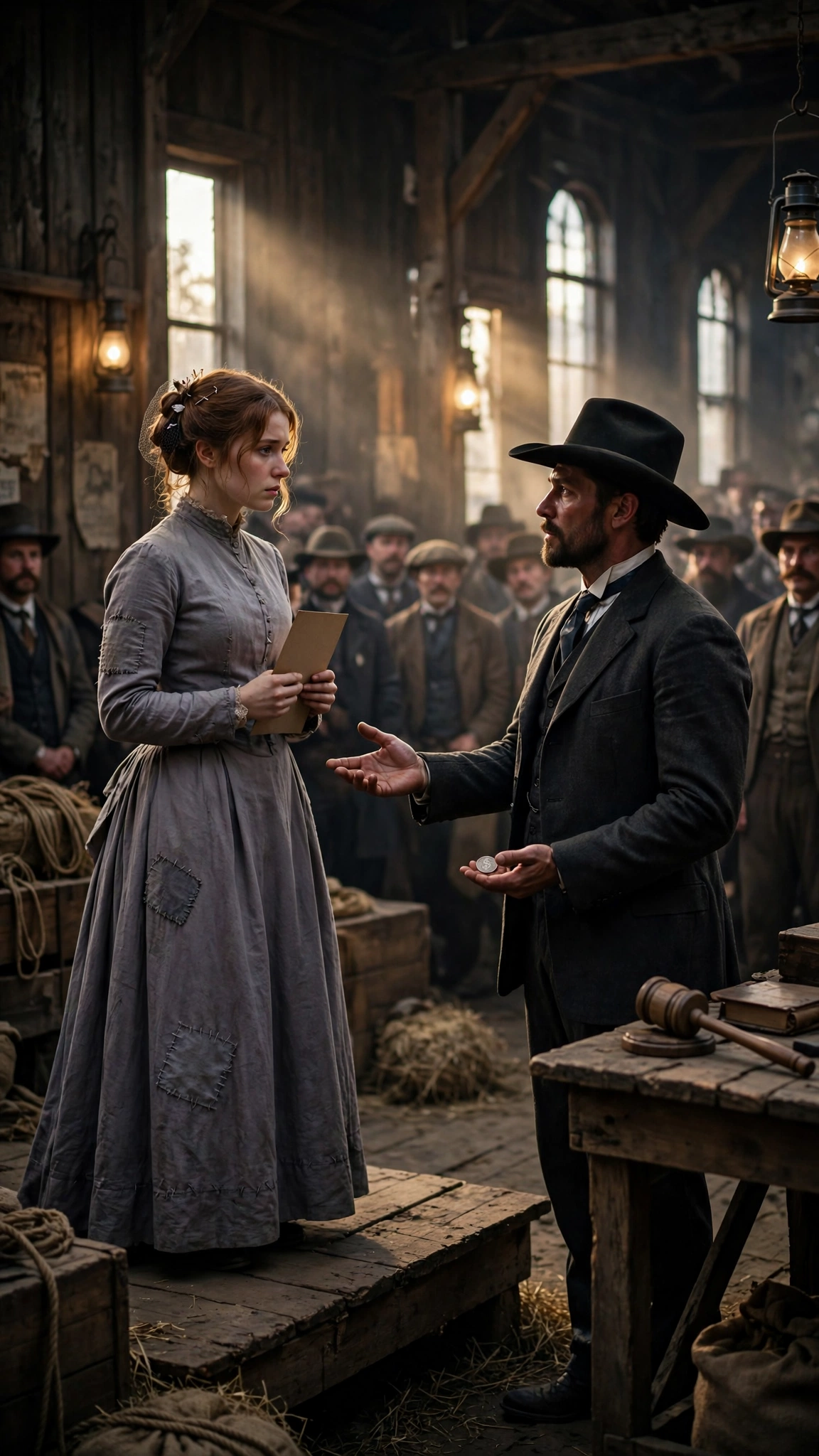
Silas looked at Evelyn, and Evelyn nodded, and Silas leaned back in his chair, and he told it — the way he had told it a dozen times before, and the way the children never tired of hearing it. He told them about the gavel, and the number card, and the man who had shouted in the crowd, and the woman on the stage who had lifted her chin and said, "I cannot promise children." He told them about the silver dollar, and about the words "You're not livestock," and about the hand he had offered, and the question he had asked.
"And what did Mother say?" Grace asked, although she knew the answer, because she always asked, and the answer was always the same.
"She lifted her hand toward mine," Silas said. "And I took it. And I have held it ever since."
"And then you had us," Joseph said, with great satisfaction, as if this were the whole of the story, and in a way, it was.
"And then we had you," Evelyn said. "All seven of you. One at a time, and all at once, and every one of you a gift."
After supper, Evelyn read aloud in the library, the way Thomas had once read to her, with the children on the rug, and Silas in his chair, and the fire burning low. She read from the primer — the spelling primer with the list of names on the back — and Thomas, who was thirteen now and thought himself very grown up, sat beside her and followed along, and when she had finished, he said, in a voice that was trying very hard to sound casual, "Mother. When I grow up, I think I should like to teach school. Like — like the first Thomas did."
Evelyn looked at him — this boy who had arrived on her doorstep in Dutch's coat, thin and frightened, with his sister's hand in his — and she saw, in his face, the man he was becoming: steady, and kind, and brave, and full of books. And she said, "I think that would be a very fine thing, Thomas. The finest thing."
"I'll teach them to read," Thomas said. "And I'll tell them that a child who can't read is a child who can't dream. And I'll tell them about the primer. And about the names."
Ruth, who was twelve and thought herself very wise, said, "And I shall learn to be a nurse. So that when children are sick, someone kind will sit beside them. The way Mother sat beside us."
And Samuel said he would be a rancher, like Father, and Clara said she would keep the garden, and Grace said she would be a teacher too, and Joseph said he would be a cowboy, and Abigail, who was three, said she would be a princess, and everyone laughed, and Evelyn laughed hardest of all, because it was all true, and it was all happening, and it was all hers.
That night, after the neighbours had gone home, and the children had been put to bed, and the house had settled into its evening quiet, Evelyn and Silas sat in the library, with the fire burning low, and the photograph — the first print, still smelling of chemicals — lay on the table between them, beside the number card, the hand-lettered "12," and the silver dollar, which Silas kept in a small wooden box on the mantelpiece, polished bright.
Evelyn looked at the three objects, and she thought about the journey between them: from a number card to a photograph, from a dollar to a dynasty, from a woman no one wanted to a mother of seven. From a warehouse full of men who had laughed at her, to a house full of children who loved her. From a doctor's cold hands to a husband's warm ones.
"Do you remember," she said to Silas, "what you asked me in the warehouse?"
"I do," Silas said.
She looked at him — the black hat hung on its peg by the door, the charcoal suit, the trimmed beard, the pale grey eyes that had not left her face since the day the gavel fell — and she said, in a voice as steady as the day she had stood on the auction stage, "Do you accept?"
And Silas took her hand, and he held it, and he looked at the photograph, and at the children asleep upstairs, and at the woman beside him, and he said, "I accept, Evelyn. Every day. For the rest of my life, I accept."
Outside, the wind moved through the grass, and the cattle lowed in the far pasture, and the stars came out over the eighteen thousand acres, one by one, until the sky was full of them. Inside, the fire burned low, and the house was quiet, and Evelyn Mercer Redmond sat beside her husband, with her hand in his, and with seven children asleep upstairs, and with the future stretching out ahead of her like the grasslands in the morning light — wide, and golden, and hers.