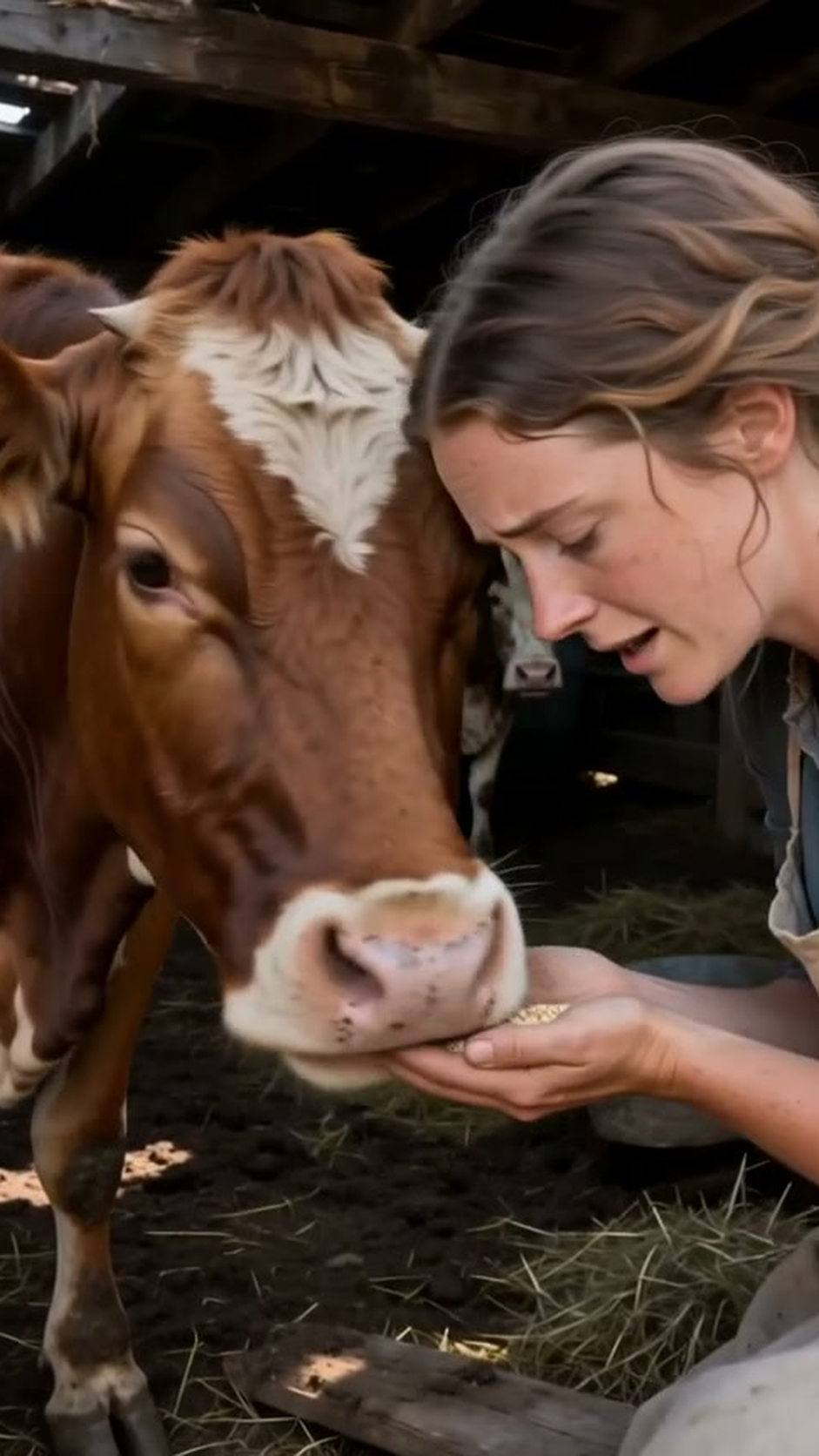
A grass fire in August is a living thing with a mind of its own, and the mind is a bad one.
Lenora was ringing the yard bell before she'd fully decided to — the old iron triangle Amos Hart had hung by the barn — and the sound went out over the darkening hollow like a struck match looking for company. She got the cows first, May first, all six of them bawling and rolling their eyes, down into the creek bottom where the grass grew green and the water ran, and she soaked her blankets and her wagon canvas in the creek and laid them dripping over the barn's leeward wall, and Tom arrived at a dead gallop with Ruth behind him in the wagon with every bucket the Ellery place owned, and behind them — because this was the thing Lenora had built all summer without knowing she was building it, crock by crock and favor by favor — came the county.
Harmon from the mercantile with his clerk and his water barrels in his delivery wagon. The Dawson foreman, of all men, with six Dawson hands — because Mrs. Dawson had eaten Lenora's butter at the hotel and told her husband the Bar-T could go hang. The railroad crew's foreman with a dozen men and shovels straight off the cut. Neighbors she knew by sight and neighbors she knew only as the far smoke of other chimneys, all of them turning out into the dark with axes and wet sacking, because the girl from Brenner Hollow had become a story the county told about itself, and the county had decided how the story was going to end.
They fought the fire the frontier way: a backfire line along the lane, beaten out with wet blankets, plowed where a plow could be rushed in, the creek bottom as the last wall. It took four hours. It took Tom's eyebrows and the hair off Lenora's forearms and half of the north pasture's standing grass before the wind, mercifully, dropped at midnight and the line of fire broke against the green creek bottom and died in the mud like a snake in a doorway.
And it took one more thing, which nobody present ever forgot: at the height of it, with the line buckling at the fence corner, Silas Crowe rode in out of the smoke at the head of nine Bar-T riders with their own barrels and sacking, and without a word of greeting or explanation he put his men into the line at the worst of it and worked a blanket until his hands bled.
Whether the fire had been a Bar-T brand dragged loose, or a campfire of Crowe's own line riders, or nobody's fault at all but a lightning-struck snag and an August wind, was a question the county argued for years. Crowe never answered it. But when the last of the line was out and the hollow stood safe and scorched and steaming under the stars, he came and stood in front of Lenora where she sat on her wagon step with her skirts blackened and Button's head in her lap — Button, who had refused the creek and come back up to stand with her, because that is what Button had decided the two of them did — and he took off his hat.
"I'm not going to insult either of us by saying words about tonight," he said. "I came to make you an offer. An honest one, which I grant you is a change." He looked, for once, exactly his age. "The Bar-T will need water access in dry years, and grazing terms, and they'll pay market rent for both, in writing, with the county recording it. And the company commissary buys butter for four hundred men, Miss Vale, and it's been buying tallow-flavored paste out of Kansas City at a price I am now prepared to describe, having tasted yours, as a criminal waste." The shadow of the old smile. "Name your terms. I expect them to be steep."
"They will be," Lenora said. "And my name goes on every crock, Mr. Crowe. Vale. In ink."
"Miss Vale," he said, "after tonight, I don't believe this county would let me forget it if I tried."
The barn raising was in the last week of September, because a thing half of Cedar Flats had heard about had to be finished properly. Twenty men raised the new barn's frame in a day on the old one's sound foundations — Tom Ellery on the ridgepole, walking the beam like a cat, to general alarm and applause — and twenty women fed them from tables in the yard, and Ruth Ellery directed the entire operation like a small gray general and permitted no argument about anything, including dessert.
The grass came back black-green and sweet on the burned pasture, the way grass does, richer than before. The cows went into the fall fat as butter themselves, which Lenora considered a professional endorsement. And on the first cold morning of October, Button — Button, who had been too weak to lift her head for grain, who had lain down in the straw at midnight to die and been argued out of it — Button lay down in the new barn in the proper way, at the proper time, and produced, with an air of enormous offended surprise, a red heifer calf with a white star on her forehead.
May's granddaughter, by every law of resemblance, and Lenora named her August, because August was the month that had tried to take everything and failed.
It was August the calf, in a way, who settled the last thing. A week later Tom came down the yard at dusk with his hat in his hands — actually in his hands, which in Tom Ellery was the equivalent of a brass band — and found Lenora coming up the springhouse steps with a crock in her arms, and stopped dead at the sight of the open stone door and the cold breathing out of the ground around her like the hollow exhaling.
She had never shown another living soul. She had decided a hundred times she never would.
She stood on the steps with the crock against her apron and looked at the man who had torn a dam out of her creek without being asked, who had carried his grandfather's field book into a courthouse like a shield, who had walked a ridgepole for her barn and singed his eyebrows off in her fire — and Lenora Vale, who had learned at eighteen that everything you love can be taken in a single spring, made the largest decision of her life as simply as she had once held out a palmful of grain in a dark barn.
"Come down," she said. "Mind the steps. Mind the cold."
She showed him the room of fitted stone, the shelves ranked with golden crocks, the water running crystal and eternal through the heart of it. She told him about Johann Brenner, who built for the end of the world, and Amos Hart, who kept the secret for twenty years and sold sweet butter in the hottest summers while the whole county wondered. Tom stood in the lantern light with the cold rising around his boots and he did not say a word until she was done, and then what he said was not about the money, or the water, or the wonder of it.
"He built it to keep things from spoiling," Tom said slowly. "A hundred years of people in this hollow, and that's the whole story of the place, isn't it. Things worth keeping, and somebody stubborn enough to keep them cold and safe until they're wanted." He looked at her, and his ears were red in a way that had nothing to do with the cold. "Lenora. I've been rehearsing a speech since the barn raising and it keeps coming out as a request to be allowed to keep on helping you with this farm, in a — in a permanent capacity — and Ruth says if I say it as a business proposition she'll disown me, so — "
"Tom Ellery," said Lenora, setting the crock down very carefully on a stone shelf, because her hands had begun to shake in a way that had nothing to do with the cold either, "are you asking me to marry you in a hole in the ground?"
"I am asking you to marry me," he said, "in the most valuable room in three counties, which you found with a hoe. I thought it was appropriate. I still do."
They were married in November, in the Cedar Flats church, with Ruth presiding over the arrangements and the whole county eating butter cake. The Bar-T's commissary contract — steep terms, her name on every crock — was signed the same week, and the Dawson hands who'd fought her fire sent, as a wedding present, a painted sign that now stands at the head of the hollow track where the ridge rider once sat watching her:
COLD SPRING DAIRY — L. VALE — BUTTER, CREAM & EGGS — EST. WITH $17 AND SIX COWS
People come up the track sometimes just to read it, and to ask if it's true, and Lenora Vale Ellery — twenty-five years old, broad-shouldered, gray-eyed, rich by every measure that had ever mattered to her — tells them the truth, or most of it.
She tells them about the seventeen dollars. She tells them about May and Button and the dark barn and the palmful of grain. She tells them a farm is not the land, and it is not the buildings, and it is not even the secret under the hill.
A farm, she says, is the things you refuse to let spoil.
The following summer, Cold Spring Dairy did something no one in Cedar Flats had ever heard of a business doing: it got generous in a way that made it stronger. Lenora opened the springhouse — the lower shelves only, and by her leave only — to her neighbors' keeping. Ruth Ellery's seed potatoes wintered in the cold and sprouted like they'd been blessed. The Pruitt family — back on their feet on a rented claim north of town, with a letter of apology and a fair price standing between them and Silas Crowe in the county's memory — stored a side of pork there through the worst of August. When the Kowalski baby burned with fever in July, the doctor from Cedar Flats kept his medicines and cold cloths in Lenora's chamber and said, riding out, that a room like that in a county like this was worth a hospital wing. Word travels. A thing the whole county depends on is a thing the whole county defends, and Lenora — who had learned the arithmetic of being known from behind a butter counter — understood exactly what she was banking, shelf by shelf.
She took a hired girl that spring. Annie Sutter, fifteen, from a dugout family of nine out on the dry flats, who arrived with a carpetbag and her mother's churn-touch and a way of flinching when a door slammed. Lenora paid her real wages, on Saturdays, in coin, and showed her the tin box with the slit in the lid, and set it under Annie's bed with the first nickel already in it.
"Save it before you spend it," she said. "And when a man with a soft voice offers to buy your future from you cheap, you come and tell me, and we'll laugh at him together over coffee. That's the whole method, Annie. That and the butter."
Annie's Button — for the calf August had adopted the girl the way Button adopted anyone with a pocket of bran — grew fat and glossy and entirely too pleased with herself, and was discovered, one June morning, to be giving a trickle of milk of her own, which Lenora carried down the steps in a jar by itself and set on the top shelf, in the coldest dark, like a christening.
And on summer nights, when the heat lies on the plains like a held breath, she goes down the stone steps with a lantern into the cold that Johann Brenner built and Amos Hart kept and she inherited by being the first person in twenty years to go and look — and she sets the day's butter on the stone shelves in golden rows, above the running water, in the dark, in the cold, keeping.
THE END