Grace Redmond was born in the month of January, on the coldest night of the year, while the snow piled against the windows and the wind cried around the eaves.
Evelyn laboured for nine hours, with Mrs. O'Leary holding her hand, and Silas pacing the hallway outside the bedroom door, and Dutch sitting in the kitchen with his hat in his hands, praying in a low voice to a God he had not spoken to in twenty years. And then, just before dawn, the crying stopped being Evelyn's and started being someone else's — small, and furious, and alive — and Mrs. O'Leary opened the bedroom door, and she said, "Mr. Redmond. You have a daughter."
Silas went into the bedroom, and he stood beside the bed, and he looked down at the small red face in the blanket, and at Evelyn, exhausted and radiant, with her auburn hair loose on the pillow, and he took the baby in his arms, with the careful hands of a man who has never held anything so small, and he said, in a voice that shook, "Hello, Grace."
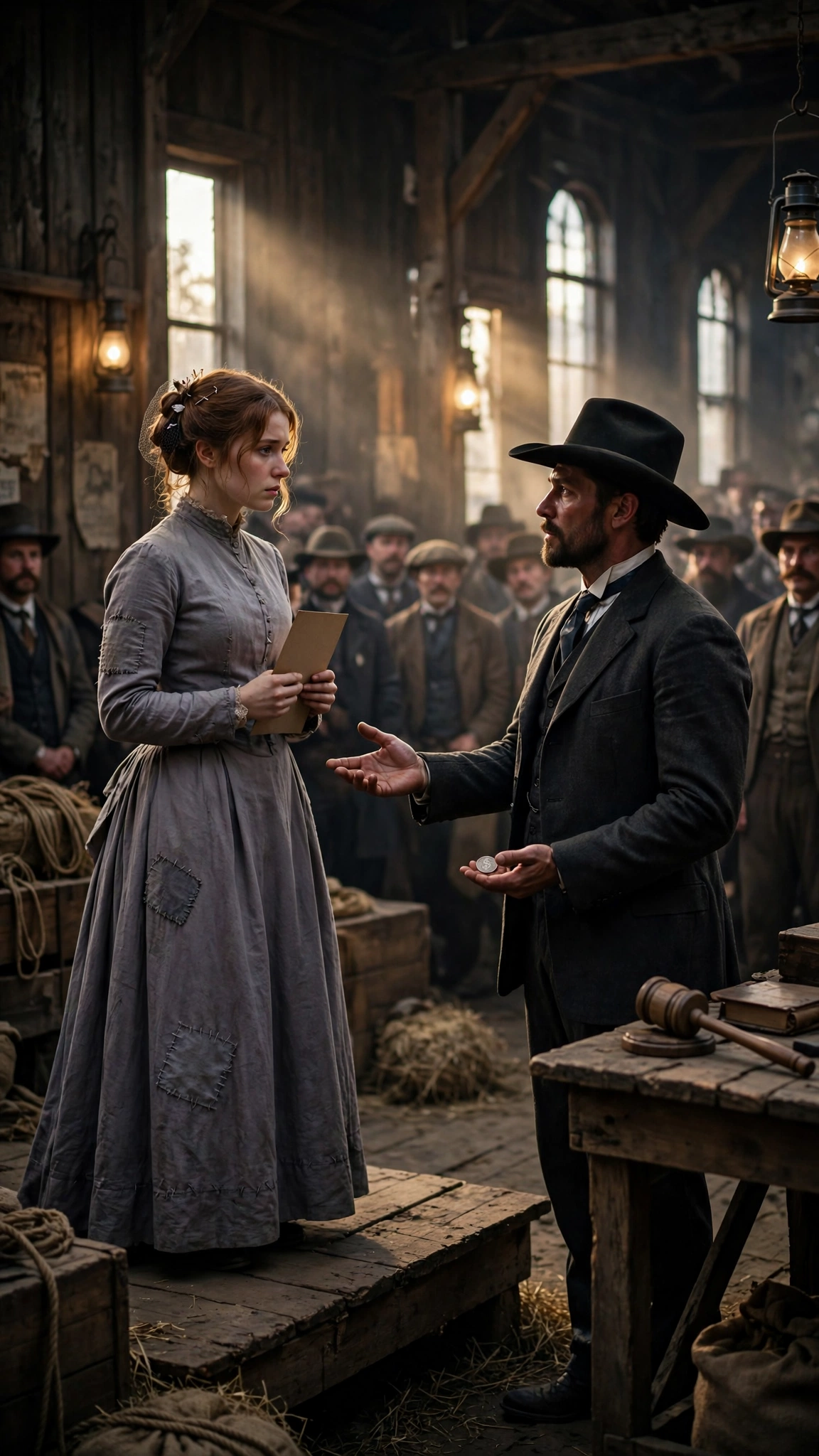
He named her Grace, because that was what she was: grace, after everything. Grace for the doctor's error. Grace for the warehouse. Grace for the one silver dollar that had brought them all together.
Thomas was eleven by then, and Ruth was nine, and they took to the baby the way children take to a new puppy — with awe, and with jealousy, and with a fierce, protective love that surprised everyone, most of all themselves. Thomas appointed himself the baby's guardian, and he sat beside the cradle with a book, reading aloud, the way Silas read aloud in the library. Ruth appointed herself the baby's nurse, and she rocked the cradle, and she sang to it, in a small, tuneless voice, the hymns she had learned at church.
The ranch prospered. The cattle multiplied. The garden grew. The house, which had once echoed with a single man's footsteps, now rang with children's voices from dawn until dark, and Silas, who had once eaten his supper alone at a table built for twelve, now ate it surrounded by his family, with bread being passed, and milk being spilled, and lessons being recited, and laughter filling the rooms like sunlight.
But the county was not finished with them. In the spring of Grace's first year, a train derailed on the line outside Council Bluffs, and two of the dead were a young couple from the east, travelling west to start a new life, leaving behind two small children — a boy of five named Samuel, and a girl of four named Clara — who had been riding in the next carriage, and who had survived without a scratch, and who had no one in the world.
The orphanage in Council Bluffs took them in, and the matron wrote to the county's families, asking if anyone would take them. Most families said no. They were too young. They were too much trouble. They were strangers.
Evelyn read the letter at the breakfast table, and she looked at Silas, and Silas looked at her, and neither of them said anything, because they did not need to. They hitched the wagon, and they drove to Council Bluffs, and they came home that evening with two more children — Samuel, solemn and silent, with his sister's hand clasped tight in his own, and Clara, small and fierce, with her hair in two braids and her chin lifted the way Evelyn had taught Ruth to lift hers.
"Are we staying?" Samuel asked, in the doorway of the kitchen, in a small, careful voice.
"You're staying as long as you want to stay," Silas said, crouching so that his eyes were level with the boy's. "This is your home now, if you want it."
And Clara, who had not spoken since the train, looked up at Evelyn, and said, "Do you have bread?"
"We have bread," Evelyn said. "And milk. And a bed. And a family, if you want one."
Clara nodded, once, the way a woman nods, and she took the bread, and she ate it, and she did not cry, and Evelyn understood, with a sudden clarity, that this child, like Thomas and Ruth before her, had learned too young how to be brave alone.
That was the year the table grew. Silas built three more chairs in the workshop behind the stable — plain, sturdy chairs, made from oak, with the children's names carved into the backs — and he set them around the long kitchen table, and the table, which had been built for twelve, began to look less empty.
Joseph was born two years after Grace, in the summer, on a night so hot that the air did not move, and the cattle stood in the river up to their bellies. He was a big baby, loud from the first moment, with Silas's dark hair and Evelyn's grey-green eyes, and Thomas, who was thirteen by then and thought himself very grown up, held him for the first time and said, with great solemnity, "He's all right. I'll teach him to read."
Abigail was born the following spring, small and fair, with a wisp of auburn hair, and she was quiet where Joseph was loud, and watchful where Grace was bold, and Ruth, who was twelve by then and thought herself very wise, took one look at her and said, "She's going to be the clever one. I can tell."
And so the family grew: Thomas, Ruth, Samuel, Clara, Grace, Joseph, Abigail. Three boys and four girls. Seven children, ages three to twelve, filling the big ranch house with noise and laughter and lessons and bread and spilled milk, and Silas, who had once owned eighteen thousand acres of silence, now owned eighteen thousand acres of something else entirely.
The table was the centre of it all. The long kitchen table, built for twelve, was finally full. At supper, Thomas sat at Silas's right hand, reading the newspaper aloud in his careful, practised voice, while Ruth passed the bread, and Samuel tried to teach Joseph to say his letters, and Clara told Grace a story about a horse she had seen in the corral, and Abigail sat on Evelyn's lap, dropping crusts on the floor for the dog. The noise was tremendous. The milk was spilled at least once a meal. And Silas, who had eaten alone at that table for twelve years, sat at the head of it with his elbows on the wood, and listened to the noise, and thought that it was the finest sound he had ever heard.
In the summer, Silas taught Samuel to ride. He put the boy on a gentle mare named Bess, and he walked beside them around the corral, with one hand on the boy's leg, and he told him the things his father had told him: sit tall, hold the reins easy, look where you want to go, not where you're afraid to go. Samuel learned fast, the way frightened children learn fast when someone is patient with them, and by August he could ride to the gate and back by himself, with Clara watching from the fence, clapping her hands, and Thomas shouting encouragement from the porch.
"You're doing it, Samuel!" Thomas shouted. "You're riding!"
And Samuel, five years old, solemn as a judge, looked down from the saddle at the boy who had once been a stranger in a sod house, and said, "I know. Mr. Redmond taught me."
"Call him Father," Ruth said, from the fence. "He's Father now. To all of us."
Samuel looked at Silas, who was standing by the corral with his arms folded, watching. Silas looked back at him, and he nodded, once, the way a man nods, and Samuel nodded back, and from that day on, he called him Father, and Clara called him Father, and Grace and Joseph and Abigail never knew any other word for him.
Evelyn watched it all from the kitchen window, with her hands in the dishwater, and she thought about the doctor's word, and about the primer with the list of names, and about the warehouse, and about how a family could be built the way a house is built — not all at once, but board by board, and chair by chair, and child by child, until one day you looked up and realised that the house was finished, and it was yours.
Amos Grady tried once more.
He came to the ranch in the autumn, in his buggy, with his son Caleb beside him, and he asked to see Silas, and Silas received him in the parlour, because that was what one did, and Grady laid his offer on the table: he would buy the north range — the nine thousand acres he had wanted for ten years — for twice its value, in cash, on the spot.
"I've come to make peace, Silas," Grady said. "The court settled it. You're married. The children are yours. I'm not here to fight. I'm here to do business."
Silas looked at him for a long moment. He looked at the offer, written out in the lawyer's careful hand. He looked out of the window, at the grasslands, at the cattle, at the children playing in the yard — Thomas teaching Samuel to throw a ball, Ruth and Clara and Grace and Abigail in a circle around the garden, Joseph toddling after them with his arms out.
"No," Silas said.
"No?" Grady said. "Silas, it's twice the value. You'd be a fool to refuse."
"I'd be a fool to sell it," Silas said. "That range is where my children will ride. It's where my grandchildren will ride, God willing. It's not for sale, Amos. Not now. Not ever."
Grady stared at him. Then he laughed, a short, bitter laugh, and he said, "You've gone soft, Silas. A wife and seven children have gone and made you soft."
"Maybe," Silas said. "Or maybe they've made me rich in a way you wouldn't understand. Good day, Amos."
And Grady left, and he never came back, and the north range stayed Redmond land, and the children grew, and the ranch prospered, and the story of the cattle baron who had bought his wife for one dollar became, in time, a different story altogether: the story of the family that had grown out of a single silver dollar, and a warehouse, and a woman who had held her head up.
In the summer of Abigail's third year, a photographer came to the county. He came with a great wooden camera and a black cloth and a wagon full of glass plates, and he set up his camera in the yard outside the ranch house, in the golden hour before sunset, and he arranged the family the way he arranged all families: father standing, mother seated, children gathered around.
"Hold still," he said, ducking under the black cloth. "And smile."
Silas stood beside Evelyn, in his charcoal suit and his black cowboy hat, with his hand resting protectively on her shoulder. Evelyn sat in the chair, in a lavender dress — a new one, this time, made of good cloth, with no mending at the cuffs — with Abigail on her lap and Grace at her knee. Thomas stood tall at Silas's side, thirteen years old and trying very hard not to smile. Ruth stood beside her mother, twelve, with her hair braided and her chin lifted. Samuel and Clara stood together, holding hands. Joseph, four years old, sat on the grass at his father's feet, grinning, with his hair sticking up.
The photographer counted to three. The shutter clicked. The family held still, and the golden light fell over them, and the ranch house stood behind them, and the horses stood in the corral, and the grasslands stretched away to the horizon, and the whole of it — the house, the land, the children, the love — was caught in a single moment, on a single plate of glass, for ever.
That night, Evelyn took the photograph — the first print, still smelling of chemicals — and she laid it on the table beside the number card, the hand-lettered "12," and the silver dollar, which Silas kept in a small wooden box on the mantelpiece, polished bright, and she looked at the three objects, and she thought about the journey between them: from a number card to a photograph, from a dollar to a dynasty, from a woman no one wanted to a mother of seven.
"Do you remember," she said to Silas, "what you asked me in the warehouse?"
"I do," Silas said.
"Do you accept?" she said, echoing his words. "I accepted you. And look what it brought us."
Silas took her hand, and he looked at the photograph, and at the children asleep upstairs, and at the woman beside him, and he said, "I accept, too, Evelyn. Every day. I accept every day."