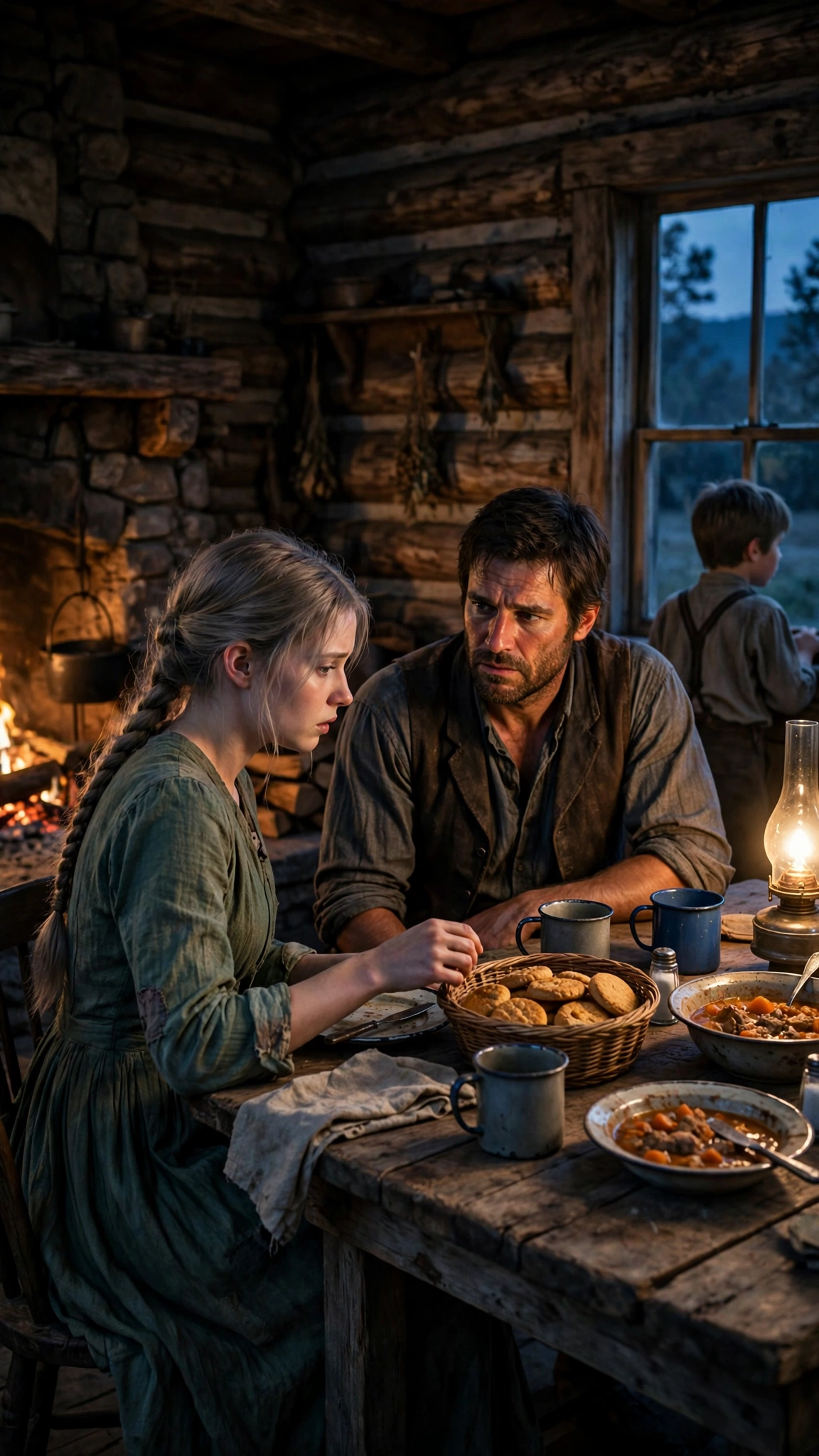
The letter came on Thursday, in the post, in an envelope with no return address, and Cole knew what it was before he opened it, because he had been expecting it since the night Grant Mercer rode out of his yard.
It was from Elias Brooks. It was not written in the clerkly hand of the first letter. This one was written in Elias's own hand, and the handwriting was worse — hurried, and slanting, and pressed so hard into the paper that the pen had torn through in places. It said that Hannah Brooks was a thief and a liar, and that she had stolen four hundred dollars from her own father, and that she had married a rancher under false pretenses, and that Elias Brooks would arrive in Red Creek on Saturday, and that he would bring the law with him, and that Cole Turner would do well to have his wife ready, and the money ready, and to make no trouble, because trouble would go worse for him than for anyone.
Cole read it at the kitchen table, in the morning, before Hannah and Noah were awake. He read it twice. Then he folded it, and put it in his vest pocket beside Grant's copy of the first letter, and he went out to the barn, and he stood there for a long time, looking at nothing, thinking about what a man does when another man writes to him that he is coming to take his wife.
He had been married before. He had loved his first wife, Sarah, and he had buried her, and he had told himself that he would never marry again, because the burying had nearly killed him, and because a man does not dig two graves if he can help it. But the ranch had needed a woman, and Noah had needed a mother, and the advertisement had seemed like a practical thing, a business arrangement, a marriage of convenience. He had written the letter expecting a practical woman. He had gotten Hannah Brooks instead — a girl who flinched when a basket moved, who asked permission to eat, who hid half a biscuit under a cloth — and somewhere between the train platform at Red Creek and the supper table in his kitchen, the practical arrangement had become something else entirely, and he did not have a name for it yet, but he knew that no man was going to ride onto his ranch and take her back to Kansas.
When Hannah came downstairs, he showed her the letter. He did not want to. He had thought about hiding it from her, about carrying it alone, about letting her have a few more days of peace. But Grant had told him something the night he rode out, something Cole had not forgotten: "She has been lied to for fifteen years, Cole. Do not add to it. Tell her the truth, even when the truth is ugly. It is the only thing no one has ever given her."
So he showed her the letter. He laid it on the table between them, and he watched her read it, and he watched her face go white, and he watched her hands begin to shake, and he watched her do the thing she always did when she was afraid: she went very still, and very quiet, and she waited.
"He's coming on Saturday," she said, finally. Her voice was flat. "He always comes when he says he will come. He is a punctual man, my father. He is punctual about everything. He was punctual about the beatings, too. Every Sunday night, after supper, so that I would have the whole week to think about it."
Cole had not known about the beatings. Grant had told him about the lock on the pantry, and the thinness, and the hunger. He had not told him about the beatings, because Grant had not known about them. No one had known about them, except Hannah, and her father, and the walls of the house in Kansas.
"Tell me," Cole said. He said it quietly. He said it the way a man speaks when he is afraid of what he is about to hear, and more afraid of not hearing it.
She told him.
She told him about the pantry first, because the pantry was the easiest thing to tell, and because it was the thing that had shaped her life more than any other. The pantry had a padlock on it, a heavy iron padlock, and her father carried the key on a string around his neck, and he opened it twice a day, morning and evening, and he measured out her food himself, with his own hands, in his own portions. A spoonful of cornmeal. A piece of bread the size of her palm. A cup of milk, when there was milk. And that was all. That was all she was given, because her father had decided that a girl must earn her food, and that a girl who had done nothing to earn it deserved nothing.
"What did you have to do to earn it?" Cole asked.
"Everything," she said. "The washing. The cooking. The cleaning. The mending. The garden. The chickens. I did all of it, from the time I was seven, and it was never enough. There was always something I had done wrong. A shirt not pressed flat enough. A floor not swept clean enough. A meal not cooked fast enough. And when there was something wrong, there was no supper at all. He would lock the pantry, and he would eat his own supper in front of me, and he would tell me that a woman who cannot do her work does not deserve to eat."
She told him about the ledger. Her father kept a book, a small black book, and in it he wrote down everything she ate, and everything it cost, and at the end of every month he added it up, and he showed her the total, and he told her that she owed him, that she was in his debt, that she would be paying him back for the rest of her life. The book was still in Kansas, in the house, in the drawer of his desk. She had seen it a hundred times. She had never been allowed to touch it.
"And the pieces nobody wants," Cole said. "Where did that come from?"
"From the bread," she said. "On Sundays, when there were visitors, my father would bake a loaf — he could bake, when he wanted to — and he would cut it at the table, and he would give the good slices to the visitors, and the ends, the broken pieces, the burnt edges, he would put on my plate. And he would say, in front of everyone, 'Hannah gets the pieces nobody wants. That is what she is good for.' And after a while, I believed him. I believed that was what I was good for. The broken pieces. The burnt edges. The things nobody else wanted."
Cole listened, and he did not interrupt, and he did not touch her, because he did not know if she wanted to be touched, and he was afraid that if he moved, she would stop talking, and he needed her to keep talking, because every word she said was a word she had never said to anyone, and every word was a piece of the lock coming off.
She told him about the beatings. They were not frequent — that was the worst of it, in a way, because she never knew when they were coming. Once a month, perhaps. Sometimes twice. A belt, across the shoulders, for the crime of taking a piece of bread without asking. For the crime of eating too quickly. For the crime of looking hungry. He never hit her face. He was careful about that. He hit her where the bruises would not show, because he was a careful man, and a punctual man, and a man who understood that the world judges a father by what it can see.
"I ran away once," she said. "When I was fifteen. I walked to the next town, and I asked for work at a boarding house, and the woman there took me in, and for three days I ate three meals a day, and I thought I was free. And then my father came, and he told the woman I was a thief, and that I had stolen money from him, and she believed him, because he was a respectable man, and I was a thin girl in a faded dress, and I went back with him. And that night he locked the pantry, and he did not open it for two days. Two days, Cole. I drank water from the pump, and I waited, and I learned that running away was worse than staying. I never ran again."
She stopped. The kitchen was quiet. The fire crackled. Noah was outside, feeding the chickens, and the sound of his voice came faintly through the window, talking to the hens the way he always did, as if they were listening.
"I'm sorry," Hannah said. It was the same thing she had said at the supper table, three nights before, and Cole understood now that it was not an apology. It was a habit. It was the thing she said when she was afraid, because she had learned that apologizing sometimes made the punishment smaller.
"You have nothing to be sorry for," he said.
But she was already standing. She was already moving toward the door, toward the stairs, toward her room, and he could see it in her face — the old instinct, the one she had learned when she was fifteen, the one that said running was worse than staying, but staying was unbearable, and there was nowhere else to go.
"Where are you going?" he asked.
"To pack," she said. "If I go back with him on Saturday, it will be better. If I go willingly, he will not hurt you. He will not hurt Noah. He will only hurt me, and I am used to it, and you are not, and I will not let him hurt you because of me."
Cole stood up. He crossed the kitchen. He put his hand on the door, gently, so that she could not open it, and he looked down at her, and he spoke with a steadiness he did not entirely feel.
"Hannah Brooks," he said. "You are my wife. This is your house. That man is not coming into it. Not on Saturday. Not ever. Do you understand me?"
She looked up at him. Her eyes were blue-gray, and they were full of tears she would not let fall, because she had learned, long ago, that tears made everything worse.
"I don't know how to believe you," she whispered.
"Then don't believe me," he said. "Just stay. Stay, and let me prove it."
She stayed. She went back to the table. She sat down. And for the first time since she had come to Red Creek, she ate a full meal — stew, and potatoes, and a whole biscuit, both halves — without asking anyone's permission, without hiding anything, without apologizing.
But that afternoon, while Cole was out in the north pasture, a second rider came up the road to the ranch. He was not Grant Mercer. He was a lean man with a scarred face and a long coat, and he rode a black horse, and he did not come to the door. He sat on his horse at the edge of the yard, looking at the house, looking at the barn, looking at the corral, the way a man looks at a place he intends to come back to. And when Noah came out of the chicken yard and saw him, the man touched his hat, and smiled a smile that had nothing kind in it, and rode away, slow, down the road toward Red Creek.
Noah ran to the house. He found Hannah in the kitchen, and he told her what he had seen, and the color went out of her face, and she knew the man, even though she had never seen him before in her life, because her father had described him to her once, a long time ago, on a night when he had been drinking, and he had said, "If you ever run, Hannah, I know a man named Silas Creed, and he will find you, and he will bring you back, and you will wish you had never been born."
Silas Creed had found her. And he had smiled. And he had ridden away. And Hannah Brooks understood, with a certainty that went down to her bones, that Saturday was not the day her father was coming.
Saturday was the day he had already arrived.