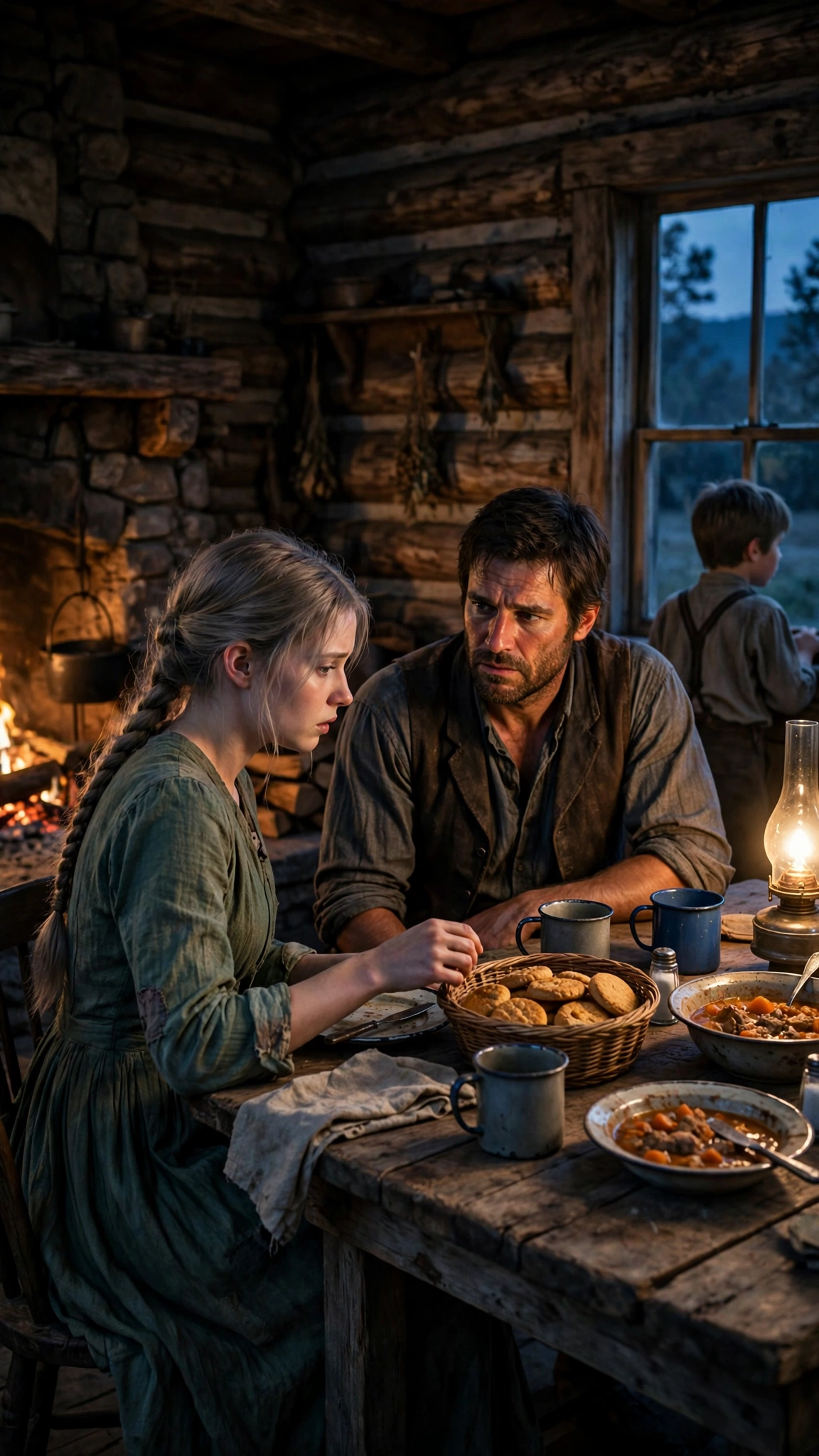
Grant Mercer came back the next morning, before the sun was fully up, and he brought with him a leather satchel, and inside the satchel, wrapped in oilcloth, was the paper he had carried for fifteen years.
They sat at the kitchen table — Cole, and Grant, and Hannah — and Grant unwrapped the oilcloth with the care of a man handling something holy, and he laid the paper on the table, and Hannah looked at it, and she did not touch it, because she had learned that papers belonging to other people were not to be touched.
"It is your mother's will," Grant said. "Willa Brooks wrote it in the winter before she died. I was there. I watched her write it. I signed it as a witness, and so did the Reverend Amos Hale, who is buried now in the churchyard at Red Creek, God rest him. There were two copies. One went to the county clerk in Kansas. Your father burned that one — or so he thought. The clerk kept a record, but your father paid the clerk to lose it. This copy is mine. Your mother gave it to me, and she told me to keep it safe, and to give it to you when the time came."
Hannah looked at the paper. It was old, and yellow at the edges, and the ink had faded, but the handwriting was clear — a woman's handwriting, neat and careful, the handwriting of a woman who had been taught to write properly and had taken pride in it.
"I know that handwriting," Hannah whispered. "She used to write my name in the front of my books. In that handwriting. I had forgotten. I had forgotten what her handwriting looked like."
Grant pushed the paper gently toward her, and she put her hand on it, very lightly, the way a person touches something they are afraid will disappear.
"Read it," Grant said. "It is yours. It has always been yours."
She read it. It was short, as wills are short when there is not much to leave. It said that Willa Brooks, being of sound mind, left to her daughter, Hannah Brooks, all of her property: forty acres of bottom land along the river in Kansas, and the sum of twelve hundred dollars, held in the bank at Topeka, and her mother's wedding ring, and her mother's Bible. It said that the property was to be Hannah's upon her marriage, or upon her twenty-first birthday, whichever came first. It said that her husband, Elias Brooks, was to have no part of it, and no say in it, and that he was to hold it in trust only, and to give it to Hannah when the time came, and that if he failed to do so, the will was to be enforced by the court.
At the bottom, in her mother's hand, there was a line that was not part of the legal language. It said: "For my Hannah, so that she will never have to ask anyone for bread."
Hannah read that line twice. Then she put her hand over her mouth, and she bent forward over the table, and she cried — not loudly, not theatrically, but quietly, the way a person cries when they have held something inside for so long that it finally breaks open, and there is nothing left to do but let it come out.
Cole sat beside her, and he did not touch her, because he still did not know if she wanted to be touched. But Noah, who had been listening from the doorway, came into the kitchen, and climbed onto the bench beside her, and put his small hand on her arm, and said, "Don't cry, Hannah. It's yours now. Nobody can take it."
She looked at the boy. She looked at Cole. She looked at Grant. And she wiped her eyes with the back of her hand, and she nodded, and she folded the will carefully, and she put it back in the oilcloth, and she gave it to Cole to keep, because she did not trust herself to keep anything safe yet.
"We take it to the courthouse," Grant said. "In Red Creek. The judge there is a fair man — Judge Harlan. He knew your mother, Cole. He'll listen. We show him the will, and we show him the bank records, and we tell him what Elias has done. And the law does the rest."
"When?" Cole asked.
"Monday," Grant said. "The court sits on Monday. That gives us two days. And in those two days, we need to be ready, because Elias will not sit still while we do this. He has already sent Silas Creed to look at your ranch, Cole. That means he is planning something. A man like Elias does not hire a man like Creed to deliver a letter."
Cole nodded. He had been thinking the same thing.
That afternoon, he rode into Red Creek, to the bank, and to the sheriff's office, and he did two things. At the bank, he asked the clerk — a thin, careful man named Mr. Abbott — whether a sum of twelve hundred dollars, held in trust for a Hannah Brooks, had ever been recorded in the bank's books, and Mr. Abbott went into the back room, and came out with a ledger, and showed Cole an entry, dated fifteen years before, in a woman's name: Willa Brooks, twelve hundred dollars, to be released to her daughter upon marriage or majority. And beside the entry, in a different hand, a later note: "Withdrawn, in full, by E. Brooks, trustee, 1872."
"Did he have the right?" Cole asked.
"No," Mr. Abbott said. "Not without the girl's signature, or a court order. But he had a paper, a forged paper, saying the girl was dead. I didn't know. I was young then. I took his word for it. I've regretted it for fifteen years."
At the sheriff's office, Cole told Sheriff Daniel Hayes everything — the will, the letter, the rider, Silas Creed — and the sheriff listened, and he nodded, and he said, "I know Silas Creed. He's a hired gun, and a thief, and I've been waiting for a reason to run him out of this county. You tell me when Elias Brooks arrives, Cole, and I'll be there. And you tell your wife she doesn't have to be afraid of the law. The law is on her side, if she'll let it be."
Cole rode home in the late afternoon, and the light was golden on the grass, and he felt, for the first time since the night at the supper table, something like hope. They had the will. They had the bank records. They had the sheriff. They had Grant. They had a judge who was fair. And on Monday, in a courthouse in Red Creek, a girl who had spent her whole life being told she was worth nothing would stand up and be told, by the law itself, that she was worth twelve hundred dollars and forty acres and a mother's love.
But when he rode into the yard, he saw that something was wrong. Noah was standing on the porch, and his face was white, and Hannah was standing in the doorway behind him, and her face was whiter still, and in the yard, sitting on a horse, was a man Cole had never seen before — a tall man, thin, with gray in his hair and a black coat, and a face that Hannah knew, even from a distance, even after fifteen years of trying to forget it.
It was Elias Brooks. He had not waited until Saturday. He had come a day early. And he was smiling the smile of a man who has just found a door he did not know was there.
"Daughter," he said, and his voice carried across the yard, smooth and reasonable, the voice of a respectable man, the voice of a father. "I have come to take you home."
Hannah did not move. She stood in the doorway, and her hands were at her sides, and her face was white, and Cole saw her do the thing she always did when she was afraid: she went very still, and very quiet, and she waited.
Cole stepped between her and the yard. He put his hand on the porch rail. He looked up at the man on the horse, and he spoke, and his voice was steady, and it was cold, the way the creek is cold in winter.
"She's home, Mr. Brooks," he said. "This is her home. You can turn your horse around and ride back to Kansas."
Elias Brooks laughed. It was a short laugh, and it had no humor in it.
"She is my daughter," he said. "She stole my money. She ran away. And I have the law on my side, Mr. Turner. You will find that out on Saturday, when the sheriff comes with me. Or you can give her to me now, and save us all the trouble."
"The sheriff has already been told," Cole said. "He's on our side, Mr. Brooks. Not yours."
For a moment, Elias's smile slipped. Just for a moment. And then it came back, wider than before.
"We'll see," he said. "We'll see on Saturday."
He turned his horse, and he rode away, slow, down the road toward Red Creek, and Hannah stood in the doorway, watching him go, and when he was out of sight, her knees gave way, and she sat down on the porch step, and she put her face in her hands.
"He's here," she whispered. "He's really here."
Cole sat down beside her. He did not touch her. He waited. And after a while, she lifted her face, and she looked at him, and she said, "He will not stop. He never stops. He will come back on Saturday, and he will bring the sheriff, or he will bring Silas Creed, and he will take me, and he will take the will, and he will burn it, the way he burned my mother's papers."
"No," Cole said. "He won't. Because on Monday, we're going to the courthouse, and you're going to stand up in front of a judge, and you're going to tell him everything you told me. And he's going to listen. And Elias Brooks is going to lose."
She looked at him. The evening light was on her face. Her braid was coming loose, and a strand of ash-blonde hair had fallen across her cheek, and she looked, for the first time since Cole had met her, not like a frightened girl, but like a woman who had made a decision.
"All right," she said. "I'll do it. I'll testify."
And in the yard, in the dusk, Noah — who had been listening from the porch, as he always was — came and sat on the step beside her, and put his small hand on her arm, and said, "I'll come too, Hannah. I'll sit right behind you. So you won't be alone."
She looked at the boy. She looked at Cole. And for the first time since she had come to Red Creek, Hannah Brooks smiled — not a big smile, not a brave smile, but a real one, small and tired and true.
That night, after Noah had gone to bed, Hannah sat at the kitchen table with the will in front of her, and she read it again, slowly, word by word, the way a person reads a letter from someone they loved and lost. She read her mother's handwriting — the neat, careful letters, straight up like fence posts — and she traced the words with her finger, and she thought about the woman who had written them, in the winter before she died, in a house in Kansas, with a husband who would burn her papers and a daughter she was trying to protect.
"What was she like?" Cole asked. He was sitting across from her, mending a bridle, and he asked it quietly, the way a man asks a question he has wanted to ask for a long time.
"Kind," Hannah said. "She was kind. She sang while she worked. She used to sing in the kitchen, while she cooked, songs her own mother taught her. And she was clever. She kept the money hidden, in the lining of a coat, in a flour tin, a little at a time, because she knew what my father was. She knew, Cole. She knew before anyone else did. And she tried to protect me. She wrote the will. She gave it to Grant. She did everything she could."
"She would be proud of you," Cole said.
Hannah looked at him. The lamp flame bent. "Would she?" she said. "I ran away, and I came back. I married a stranger. I sat at his table and I was afraid to eat. I hid half a biscuit under a cloth. Is that something to be proud of?"
"You stood on a porch," Cole said, "and you told the truth about a man who spent fifteen years trying to break you. And you didn't break. Your mother would be proud of that. I am proud of that."
She was quiet for a moment. Then she folded the will, carefully, and put it back in the oilcloth, and she stood up, and she went to the window, and she looked out at the dark, and at the stars, and at the road her father would ride down on Saturday.
"I'm not afraid of him anymore," she said. It was not quite true — she was afraid, and she knew it, and Cole knew it too — but it was the first time she had ever said the words, and saying them was the beginning of making them true. "Not the way I was. He can come. Let him come. I'm ready."
Cole stood up. He put the bridle down. He walked to the window, and he stood beside her, and they looked out at the dark together, and he did not touch her, because he still did not know if she wanted him to, but he stood close enough that she could feel him there, and that was enough. For tonight, that was enough.