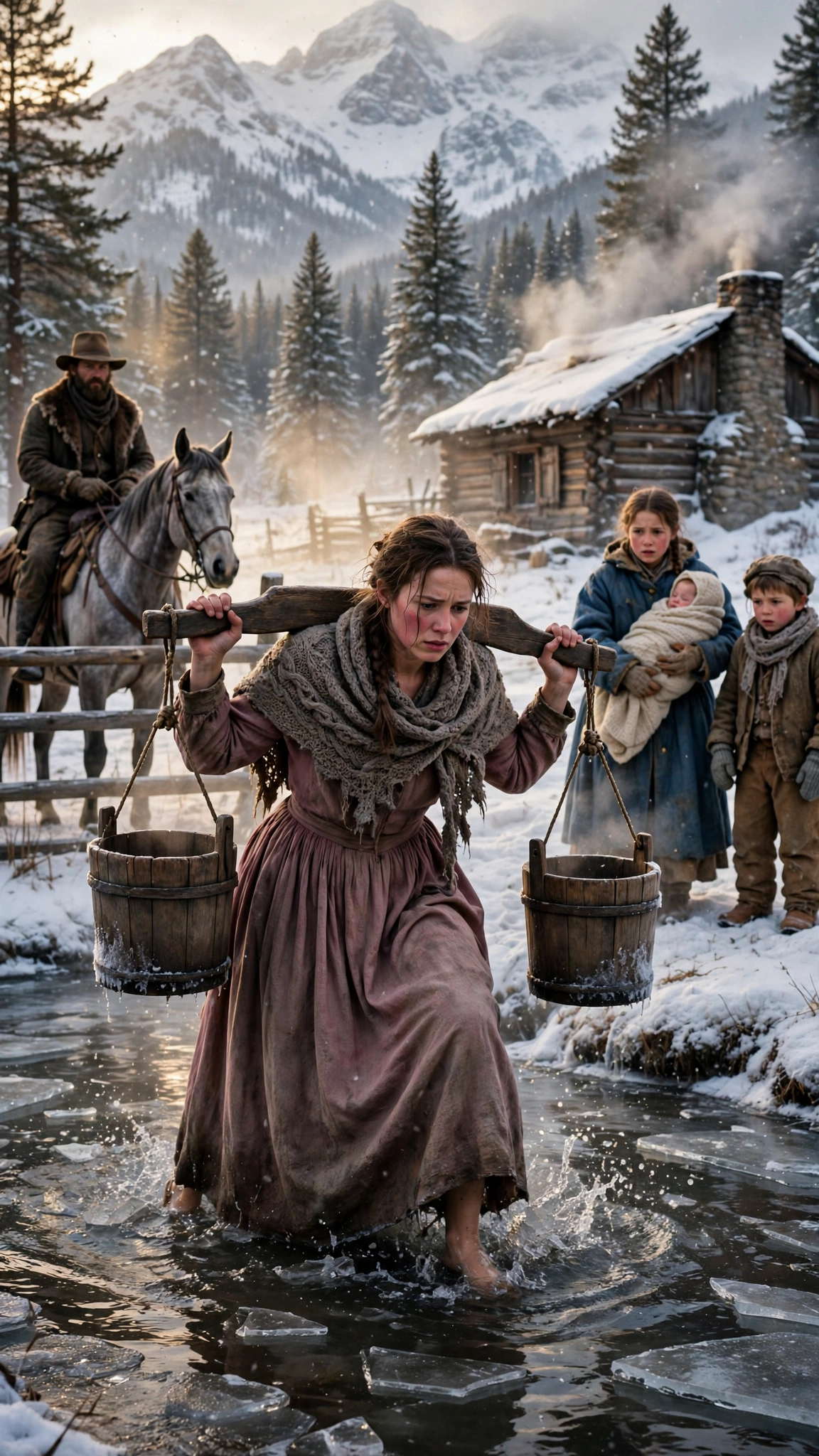
Jonas Reed did not come back the day after tomorrow. He came back the next morning, and he did not come alone.
Addie was at the creek again — not barefoot in the water this time, but kneeling on the bank in Henry's old boots, which were three sizes too big and stuffed with rags at the toes, filling the buckets with a tin dipper because her feet could not stand another morning in the ice — when she heard the horses on the road. Two of them. One she knew: the slow, heavy tread of Smoke, the gray. The other was lighter, quicker, a horse in a hurry.
She stood up, the dipper dripping in her hand, and saw them come around the bend: Jonas on the gray, and beside him a thin man in a black coat on a bay mare, with a face like a hatchet and a rifle in a scabbard at his knee. The thin man was looking at the cabin the way a man looks at a thing he already owns.
"Inside, children," Addie said, quietly, and Clara gathered Peter and the baby and went in without a word, because Clara had learned to obey the tone before the words.
Jonas reined in at the fence. The thin man rode past him, straight into the yard, and dismounted with the easy arrogance of a man who has never been told to stop, and he walked to the cabin door and took a folded paper from inside his coat and a hammer from his saddlebag, and he began to nail the paper to the doorpost beside Bane's notice.
"What is that?" Addie asked.
"A second notice, ma'am," the thin man said, without looking at her. "From Mr. Bane. The first notice gave you until Friday. This one informs you that the livestock is collateral, and will be collected today."
He said it the way a man reads a weather report. He finished nailing the paper and stepped back, and he looked at the barn — a lean-to of rough pine against the cabin wall, where Bess the milk cow stood with her breath making clouds — and he nodded to himself, satisfied.
"You cannot take Bess," Addie said. Her voice was very quiet. "Bess is the children's milk. Anna is sick. The baby needs milk."
"The baby needs a great many things, ma'am," the thin man said, "and none of them are Mr. Bane's concern. The mortgage covers the livestock. Read the paper if you doubt me."
Addie's hands were shaking. She set the dipper down carefully, the way a woman sets down a thing she is afraid she will throw, and she walked toward the thin man, and Clara came to the doorway behind her with Anna in her arms, and Peter stood behind Clara with his fists clenched at his sides.
"My name is Dobbins," the thin man said. "I collect for Mr. Bane. You may call me Mr. Dobbins. Now, if you will open the barn, I will take the cow, and I will be on my way, and no one need make this unpleasant."
"Mr. Dobbins," Jonas said, from the fence.
His voice was low and flat, and it stopped Dobbins in the middle of his next sentence. Jonas had not moved from his horse. He sat in the saddle with his hands resting on the pommel, and his face was calm, and his eyes were fixed on Dobbins, and there was something in his stillness that made the yard go very quiet.
"Mr. Reed," Dobbins said, with a thin smile. "I did not expect to see you here."
"I live twelve miles north," Jonas said. "This valley is my neighborhood, Mr. Dobbins. And in my neighborhood, a man does not take a sick baby's milk cow two days before a debt comes due."
"The debt is Mr. Bane's business," Dobbins said. "The mortgage covers the livestock. It is all in the paper."
"I read the paper," Jonas said. "I read it at the clerk's office in Helena yesterday. The mortgage covers the cabin and the forty acres. It does not cover the livestock. The livestock is not mentioned in the mortgage, Mr. Dobbins. You know that, and Mr. Bane knows that, and the only reason you are nailing papers to this door is that you hoped a widow would not know it."
Dobbins's thin smile did not waver, but his eyes went to the rifle at his knee, and then back to Jonas, and then to the rifle, and Addie saw him doing the arithmetic, and she saw the arithmetic come out badly for him.
"Mr. Bane will hear of this," Dobbins said.
"Mr. Bane will hear of it from me," Jonas said. "I am riding to Helena again tomorrow, and I will tell him myself. Now take your paper down, Mr. Dobbins, and ride out of this yard, and do not come back without a sheriff and a lawful order."
For a moment, Addie thought Dobbins would argue. His hand hovered near the rifle scabbard. His jaw worked. But Jonas did not move, and did not raise his voice, and did not reach for any weapon of his own, and somehow that was more frightening than any threat would have been. A man who does not need to threaten is a man who has already decided what he will do.
Dobbins took the paper down. He folded it, slowly, and put it in his coat, and he mounted his bay mare, and he rode out of the yard without looking back. The sound of his horse faded down the road, and the yard was quiet again, and the wind moved through the pines, and Addie realized she was shaking so hard her teeth were chattering.
Jonas dismounted and walked to her, and he took off his own gloves, and he put them in her hands, because her hands were bare and red with cold.
"Your hands," he said. "You have no gloves either."
"I sold them with the boots," Addie said. "The cobbler gave me an extra fifty cents for the gloves. The medicine cost two dollars. The boots were two dollars. I needed fifty cents more."
Jonas was quiet for a moment. Then he said, "I went to the clerk's office, Mrs. Marsh. I read the mortgage. Your husband borrowed ninety dollars. The note says ninety dollars, at eight percent, due in one year. There is nothing in it about fees, or collections, or a store account. The store account is separate, and the store account is thirty-one dollars and forty cents — flour and salt pork and coffee and the doctor's bill. Ninety and thirty-one forty is a hundred and twenty-one forty. Not a hundred and forty-seven thirty-two."
Addie stared at him. "Then where did the rest come from?"
"From Mr. Bane's imagination," Jonas said. "Twenty-five dollars and ninety-two cents of it, to be exact. He added a collection fee that does not exist, and interest on interest, and he counted the doctor's bill twice — once in the store account, and once on its own. I had the clerk make me a certified copy of the mortgage and the store ledger. It is in my saddlebag."
"But Friday—" Addie began.
"Friday is still Friday," Jonas said. "Bane can still take the cabin if the lawful debt is not paid by Friday. A hundred and twenty-one dollars and forty cents is still more money than you have, and more than I can spare without selling cattle I need for the spring. But it is not a hundred and forty-seven, and Bane knows it, and a man who has been caught adding false figures to a ledger is a man who can be made to listen."
He paused, and looked at the cabin, and at the children in the doorway, and at the pine cross on the rise.
"There is more," he said. "I asked the clerk about the orphanage order. The county board voted on it in December, when you were burying your husband and could not come to town to speak for yourself. Bane sits on the board. He voted for it. Two other men on the board did not know your name and voted with him because he told them you had abandoned the children. That is a lie, and I told the clerk so, and I told him I would bring you to Helena to speak for yourself if it came to that."
Addie felt something loosen in her chest — something that had been tight since November, so tight she had forgotten it could loosen. It was not hope. It was too small and too new to be hope. It was the knowledge that someone else knew the truth, and had written it down, and would say it out loud.
"Why are you doing this?" she asked, and this time the question came out soft, because she was afraid of the answer and needed it anyway.
Jonas looked at the pine cross on the rise, and then at Clara holding Anna in the doorway, and his voice went flat and far away again, the way it had when he spoke of standing where she stood.
"Because in eighteen seventy-six," he said, "my wife died of fever, and my son died two days after her, and I buried them both, and I sat in an empty house for seven years, and no one came to my door. No one knocked. No one asked if I needed help. And I told myself that was the way of the world, and that a man stands on his own feet or not at all." He stopped, and swallowed, and went on. "And then I rode past this cabin, and I saw a woman standing barefoot in a frozen creek, carrying water for her children, and I understood that I had been wrong for seven years. A man does not stand on his own feet. He stands because someone, somewhere, is willing to stand beside him. I am going to stand beside you, Mrs. Marsh. Until Friday, and past it, if you will let me."
Addie did not answer. She could not answer. She stood in her yard in Henry's boots stuffed with rags, holding Jonas Reed's gloves in her bare hands, and she looked at the road where Dobbins had ridden away, and at the cabin where her children waited, and at the man who had come back when he said he would come back, and she thought about the paper nailed to her door, and the wagon that would come on Friday, and the baby in Clara's arms, and the medicine in the leather case, and she thought: three days. Three days until Friday. Three days to find a hundred and twenty-one dollars and forty cents, or lose everything.
She thought of the morning Henry had borrowed the money, a bright morning in April, with the seed sacks piled by the door and the plow share leaning against the barn. He had come home from Helena with the coins in his pocket and a grin on his face, and he had set the money on the kitchen table and said that ninety dollars would buy them a harvest, and a harvest would buy them a future. She had believed him, because he had never lied to her about money, and because his hands had been steady when he counted it. He had signed the note at the mercantile with the pen Bane offered him, and Bane had smiled and wished him a good season, and neither of them had known that a pine tree would fall in November and undo everything. Addie looked at the paper nailed to her door and thought about how small ninety dollars had seemed in April, and how large it had grown by January, and how a man's signature could outlive the man who wrote it.
"We will find it," Jonas said, as if he had heard her thinking. "I have cattle. I have a neighbor who owes me a favor. I have a plan. But first, Mrs. Marsh, I need you to do something for me."
"What?" she asked.
"Put on your husband's boots," he said, "and go inside, and sit by the fire, and let your daughter make you tea. You have been standing in a frozen creek barefoot, and you have been standing in this yard in the cold, and you are no use to your children if you fall ill. Go inside. I will watch the road."
Addie went inside. She sat by the fire. Clara made her tea, with hands that shook only a little, and Peter brought her a blanket, and Anna slept against her shoulder, warm and breathing easy, and Addie drank the tea and looked out the window at Jonas Reed standing in her yard, watching the road, and she thought about how strange it was that a man she had known for two days could make her feel, for the first time since November, as if she were not entirely alone in the world.