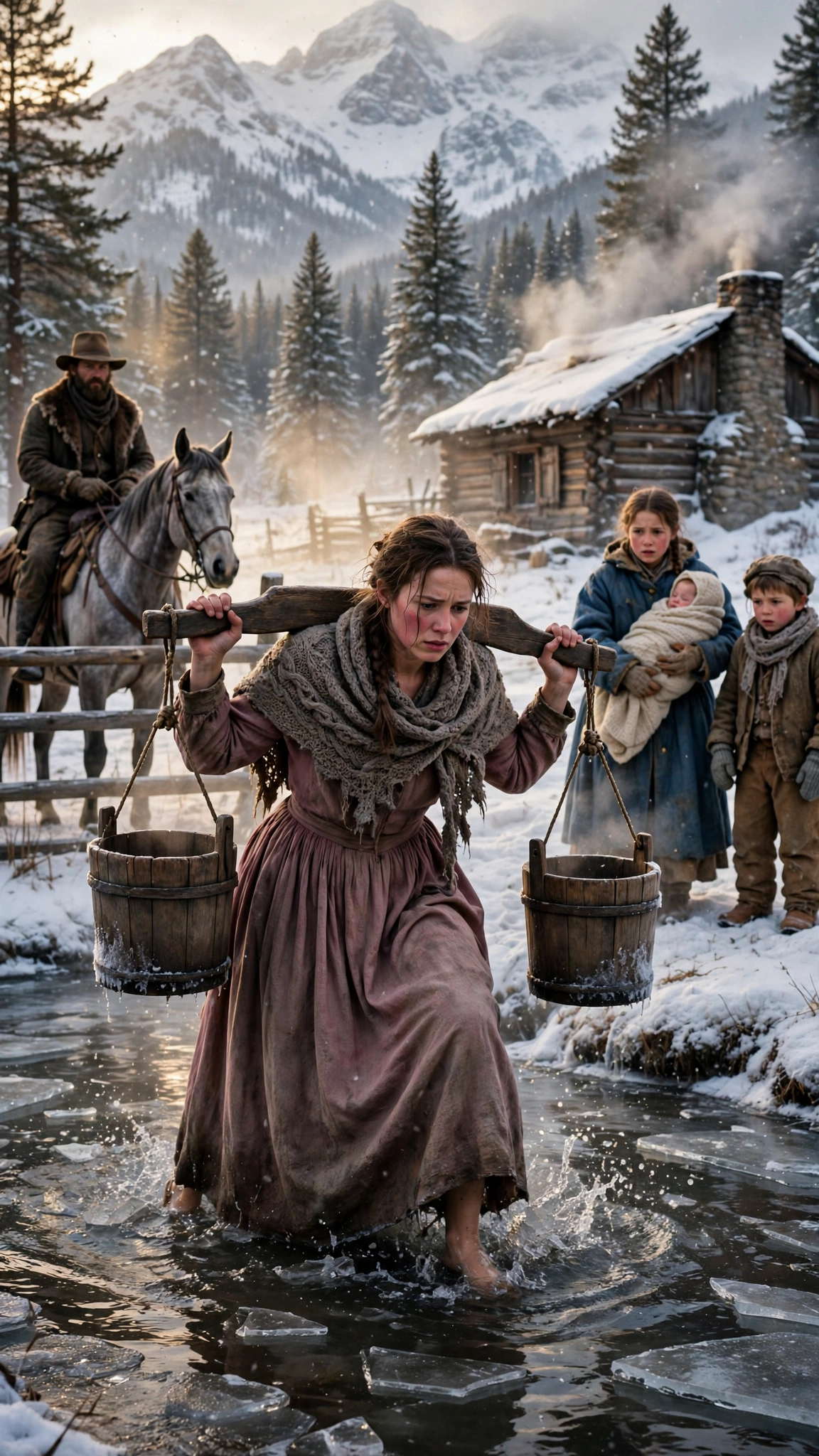
Jonas rode to Helena on Wednesday morning, in weather that was turning ugly — the sky low and yellow-gray over the mountains, the wind rising, the air smelling of snow that had not yet decided to fall. Addie watched him go from the doorway, and then she went about her work, because work was the only thing that kept the fear from settling into her bones.
She mended Peter's coat, and she boiled the laundry, and she ground the last of the cornmeal, and she counted the money in the coffee tin — three dollars and eleven cents, the same as it had been for a month — and she gave Anna her drops every four hours, and she watched the baby's color come back a little more each time, pink replacing the gray-white that had frightened her so much in December.
Clara worked beside her without being asked. That was new. Before Henry died, Clara had been a child — a girl who played with a rag doll and complained about chores and begged for stories at bedtime. Since November, she had become something else: a second pair of hands, a second pair of eyes, a small woman in a blue coat who checked Anna's forehead for fever the way Addie did, and who stood in doorways with the baby in her arms and did not flinch.
"Momma," Clara said, in the middle of the afternoon, while they were shelling the last of the dried beans together, "is Mr. Reed going to marry you?"
Addie nearly dropped the bowl. "Clara Marsh! What a thing to ask!"
"Mrs. O'Rourke said a widow with three children needs a husband," Clara said, with the calm logic of a ten-year-old repeating something she had overheard. "And Mr. Reed has a big house and no wife, and he gave Anna medicine, and he made Mr. Dobbins go away. So I thought maybe he would marry you, and then we would not have to go to the orphanage."
Addie set the bowl down and took her daughter's hands in hers, and she looked into Clara's face — so like Henry's, with his dark eyes and his stubborn chin — and she told her the truth, because lies would have been crueler.
"Mr. Reed is a kind man, and he is helping us because he is kind, and not because he wants anything from us," she said. "A man can be kind without wanting to marry a woman, Clara. And a woman can accept kindness without owing a man her life. Do you understand?"
Clara thought about it. "I think so," she said. "But if he did ask, would you say yes?"
"I would think about it very carefully," Addie said. "And I would ask you, and Peter, and Anna, what you thought. Because we are a family, and a family decides together."
Clara nodded, satisfied, and went back to the beans. And Addie went back to the mending, and thought about what her daughter had asked, and found that she did not know the answer, and that not knowing the answer frightened her almost as much as Friday did.
That night, after the supper dishes were washed and the fire was built up for the night, Peter woke crying from a dream. He did not often cry — he was six, and since November he had taken a fierce pride in not crying, as if tears were a luxury the family could no longer afford — but the dream had frightened him badly, and he came to Addie's bedside with his blanket trailing behind him and his face wet.
"Momma," he whispered, "I dreamed the wagon came, and it took Clara, and I ran after it, but my legs would not move."
Addie lifted him into the bed beside her and held him against her side, and she stroked his hair, which was Henry's hair, thick and dark, and she spoke to him the way her own mother had spoken to her, when she was small and afraid of the dark on the farm in Ohio where she had grown up.
"Dreams are not true things, Peter," she said. "They are only shadows on the wall. The wagon is not coming. Your sister is right here, asleep in the next bed, and Anna is right here, and you are right here, and I am right here, and no wagon is going to change that."
"But Mr. Bane said—" Peter began.
"Mr. Bane says a great many things," Addie said, "and not all of them are true. He said we owed him a hundred and forty-seven dollars, and Mr. Reed says we owe him a hundred and twenty-one, and the clerk's book says Mr. Reed is right. So Mr. Bane is wrong about the money, and he is wrong about Friday, and he is wrong about us. Do you understand? A man can be wrong, Peter, even when he speaks loudly and wears a fine coat."
Peter thought about this, his head against her shoulder, and after a while his breathing slowed, and he said, in a drowsy voice, "When I grow up, I am going to be like Mr. Reed. I am going to have a gray horse, and I am going to make bad men go away."
"You can be like Mr. Reed," Addie said, "and you can be like your father, too. Your father was a good man, Peter. He built this cabin with his own hands. He planted the garden. He taught Clara to read. And he loved you very much."
"I know," Peter said, and he was asleep before she finished speaking, his small hand curled around her thumb, and Addie lay awake in the dark, listening to her children breathe, and thinking about the road to Helena, and the man riding it in the snow, and the papers in his coat, and Friday, which was two days away now, and which would decide everything.
—
In Helena, Jonas Reed walked into the county clerk's office with snow on his shoulders and a certified copy of the mortgage in his coat, and he asked the clerk — a thin, nervous man named Pritchard, who had held the office for twenty years and had never once been shouted at — to show him the original mortgage, and the store ledger, and the minutes of the county board meeting in December.
Pritchard showed him. Pritchard was happy to show him. Pritchard had been unhappy about the December meeting for a month, and unhappy about Bane's ledger for longer, and he was the kind of man who kept careful records precisely so that, when the day came that someone asked to see them, he could show them with a clear conscience.
"The mortgage is ninety dollars," Pritchard said, laying the paper on the desk. "Eight percent, one year, signed by Henry Marsh in April of eighteen eighty-two. The store account is thirty-one dollars and forty cents. I have the ledger here. Flour, salt pork, coffee, and Dr. Hollis — eighteen forty. That is all. There is no collection fee. There is no second interest. Mr. Bane added those himself, in his own book, and then he copied his own book onto the notice he nailed to the widow's door."
"And the orphanage order?" Jonas asked.
Pritchard pulled out the minutes. "December twelfth. Mr. Bane moved that the Marsh children be taken into the care of the Sisters of Charity, on the grounds that the mother had abandoned them and could not provide. Mr. Hale seconded. Mr. Whitfield voted with them. None of them had been to the cabin. None of them had spoken to the mother. Mr. Bane told them she had gone to Helena and left the children alone. That is not true, Mr. Reed. I know it is not true, because Mrs. Marsh came to Helena herself, on foot, carrying her baby, to buy medicine. I saw her at Dr. Hollis's office. She had no boots on her feet. It was snowing."
Jonas stood very still, looking at the papers on the desk, and Pritchard watched him, and waited.
"Mr. Pritchard," Jonas said, finally, "I need you to make me certified copies of all of this. The mortgage, the store ledger, and the minutes. And I need you to write, in your own hand, that the lawful debt is one hundred and twenty-one dollars and forty cents, and that the figures on Mr. Bane's notice are not supported by any record in this office."
Pritchard hesitated. "Mr. Bane is a powerful man, Mr. Reed. He owns half the notes in this county. If I sign such a paper—"
"If you do not sign it," Jonas said, quietly, "then on Friday, three children will be taken from their mother on the strength of a lie, and you will have known it was a lie, and said nothing. That is a heavier thing to carry than Mr. Bane's anger, Mr. Pritchard. I know. I have carried heavier things."
Pritchard looked at him for a long moment, and then he nodded, and he took out his pen, and he wrote, and he signed, and he pressed the county seal into the wax, and he handed Jonas the papers, and Jonas put them in his coat, next to his heart, and walked out into the snow.
It was snowing hard by then — the storm that had been gathering all morning had arrived, and the road back to the valley was disappearing under white. Jonas rode through it with his head down and Smoke picking his way carefully, and he thought about the hundred and twenty-one dollars and forty cents, and where it would come from, and he thought about the cattle he could sell, and the neighbor on Cottonwood Creek who owed him for a winter's worth of hay, and the gold he kept in a coffee tin under his floorboards, saved for a day he had never expected to come.
By the time he reached the valley, the storm had become a blizzard, and the cabin was barely visible through the white, and he rode the last mile by memory, following the fence line with his hand on the top rail.
—
At the cabin, the blizzard had come down like a wall. The wind shook the shutters and drove snow under the door, and the fire burned low because the woodpile was buried, and Peter — six years old, in his brown coat and gray scarf, with his father's determination already hardening in his small face — went out into the storm with Clara to drag in an armload of firewood, and came back with his eyelashes white with snow and his hands so cold he could not feel them, and he did not complain once.
Anna's fever came back that night. It came back hard, the way fevers do when a storm is on the roof and the cold is in the walls, and Addie sat up with her all night, giving her the drops every four hours, and sponging her forehead with water from the kettle, and singing to her the song Henry used to sing — a low, foolish song about a river and a girl and a yellow dress — and Clara sat up with her, because Clara would not go to sleep while Anna was ill, and Peter slept with his head on Clara's lap, and the fire burned, and the wind howled, and the cabin held.
In the morning, the storm broke, and the world was white and still, and Jonas Reed came riding up the road with the sun on his shoulders and a sack tied to his saddle, and Addie opened the door before he had even dismounted, because she had been watching the road since dawn.
"Mr. Pritchard signed the papers," Jonas said, swinging down from Smoke. "The lawful debt is one hundred and twenty-one dollars and forty cents. Bane's figures are false, and the clerk has said so in writing."
"And the money?" Addie asked.
Jonas untied the sack from his saddle and held it out. It clinked, softly.
"Seventy dollars in gold, from my floorboards," he said. "And forty dollars from selling two steers to the O'Rourkes, who owed me for hay. And eleven dollars and forty cents from —" He paused. "From a neighbor who owed me a favor and paid it in coin. That is a hundred and twenty-one forty. To the cent."
Addie stared at the sack. "You sold your cattle. You emptied your floorboards. For us."
"For the truth," Jonas said. "The money is not a gift, Mrs. Marsh. It is a loan, and you will pay it back, a little at a time, by working at my ranch when the spring comes — cooking for my hands, mending, keeping the house. I need the help, and you need the work, and that is an honest arrangement between two honest people. But on Friday, when Bane comes with his wagon, you will pay him in full, in front of the deputy, and he will have nothing left to take from you."
Addie took the sack with both hands, and it was heavier than she expected, and she held it against her chest, and she looked at Jonas Reed, and she thought about the pine cross on the rise, and the boots she had sold, and the baby in Clara's arms, and the paper nailed to her door, and she said the only thing she could think of to say.
"Thank you," she said. "Thank you, Jonas."
It was the first time she had called him by his given name. He heard it, and his face did something complicated again, and he touched his hat, and he went to unsaddle his horse, and Addie stood in the doorway with a sack of gold in her hands and a hundred and twenty-one dollars and forty cents between her family and Friday, and for the first time since November, she believed — really believed — that Friday might not take her children after all.