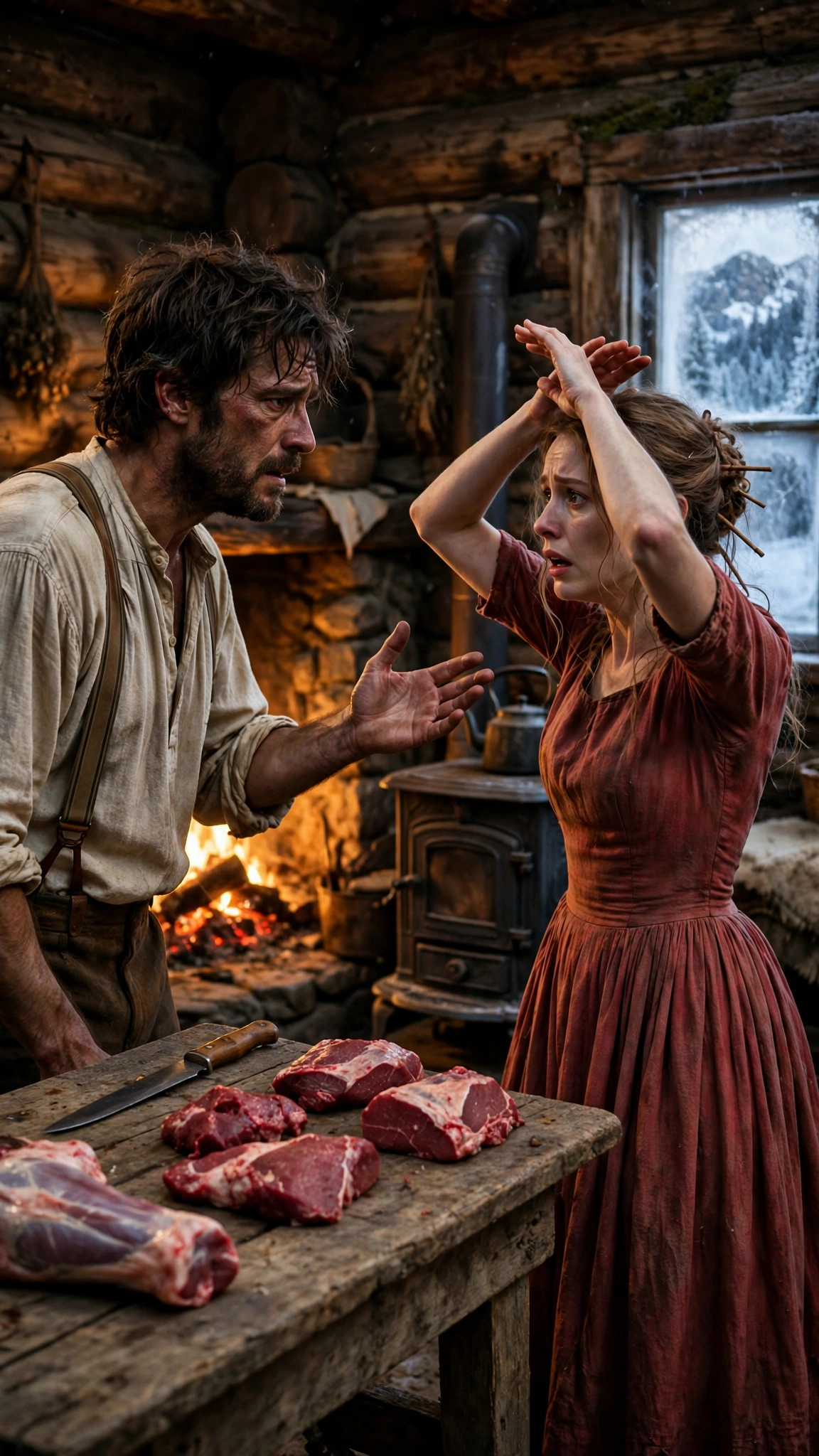
Bitterroot was not much of a town. A dozen log houses strung along a single muddy street, a church with a bell that had cracked in the winter of '71, a smithy, a stable, and, at the far end where the freight road came in from the pass, the trading post of Merritt Voss — the biggest building in the settlement, two stories of squared timber with a false front painted white, and a sign that read VOSS & CO. in letters tall enough to be seen from the road.
Mave had been born in Bitterroot, in the back room of the house her father built with his own hands, and she had never lived anywhere else until the day she climbed the mountain to Gideon Marsh. Her father was a carpenter, a quiet man with sawdust always in his hair, and her mother kept the house and taught Mave to read from the family Bible, the same Bible Mave carried up the mountain in her bundle, its leather cover worn smooth at the corners, its pages soft from a hundred years of hands.
Her father died when she was sixteen, crushed beneath a beam at a barn raising, and her mother followed him three winters later, taken by the lung fever that came down from the north every January and carried off the old and the weak. Mave buried them both in the churchyard under the cottonwoods, and then she was alone in the world at nineteen, with a house she could not keep and no kin closer than a cousin in Missouri she had never met.
That was when Jonah Hale came courting.
Jonah was twenty-four, a freight hauler for Voss & Co., broad and laughing, with a red beard and hands big enough to palm a wagon wheel. He drove a six-mule team up and down the pass, hauling flour and coffee and nails and cloth from the railhead to the mining camps and back again, and he was, everyone said, the best teamster in the valley. He had a good singing voice and a bad habit of spending his wages on drink on Saturday nights, but he was kind, and he made Mave laugh, and when he asked her to marry him on the steps of the church one bright morning in May, she said yes before he had finished the question.
They were married in the church with the cracked bell, and Reverend Bell — younger then, his hair still dark — read the service, and the whole town came to the wedding supper, and for a little while, for two whole years, Mave was happy.
It was not a grand happiness. There was no money to spare and no fine things. Their house was small and cold in winter, and Jonah was gone for weeks at a time on the freight road, and when he came home he smelled of mules and woodsmoke and whiskey. But he never raised his hand to her. He never raised his voice to her, except once, in laughter, when she beat him at checkers on a rainy evening and he accused her of cheating with a grin so wide it split his red beard. He brought her wildflowers in the summer, wrapped in his handkerchief, and he taught her to drive the mule team on the flat stretches of road, and he told her, on the night they were married, that she was the best thing that had ever happened to him, and she believed him, because he said it the way a man says a thing he has thought about for a long time.
Mave learned to keep the house, to bake bread in the iron oven, to mend Jonah's shirts and darn his socks, to put up beans and pickles for the winter. She learned to be alone for weeks without fear, to bank the fire and lock the door and sleep with Jonah's old pistol under the pillow, though she never once had to fire it. She learned the rhythm of a teamster's wife — the waiting, the worrying, the joy when the wagon came rattling down the road at dusk and Jonah jumped down from the box and swept her off her feet in the yard.
And then, in the second winter of their marriage, the river took him.
It was February, the coldest month, and Jonah was hauling a load of flour and bacon to the mining camp at Cutthroat Creek, forty miles up the valley. The freight road crossed the Bitterroot River on a bridge of rough logs, and that winter the river had frozen hard and then, in a sudden thaw, the ice had broken and re-formed in a jam below the bridge, and the water was running black and fast beneath a thin skin of new ice.
No one saw it happen. The other teamsters found the wagon the next morning, half in the water, the mules drowned in their traces, the flour sacks burst and floating downstream like white ghosts. They found Jonah's hat on the bank, and one of his boots, and nothing else. They dragged the river for three days with grappling hooks, and they found nothing, and Reverend Bell held a service with an empty coffin, and Mave stood in the churchyard in the snow and listened to the cracked bell tolling, and she did not cry, because the tears had frozen somewhere deep inside her and would not come out.
She was twenty-five years old, and she was a widow, and she had nothing.
The house was rented, not owned, and the rent came due at the end of the month. Jonah's wages stopped the day he died. The trading post held his account — Jonah had bought his boots and his harness and his winter coat on credit from Voss & Co., as every teamster did — and the debt, when Mave went to settle it, was more than she had feared.
"Ninety-four dollars," Merritt Voss said, and he set the ledger down on the counter between them with a sound like a door closing. "Your husband owed ninety-four dollars at the time of his death, Mrs. Hale. And the law is clear. A widow inherits her husband's debts."
Mave looked at the ledger. The figures swam before her eyes. She could not read numbers well — her mother had taught her letters, not arithmetic — but she could see the columns of figures, and she could see Voss's finger tapping beside the total, and she understood enough.
"I have eleven dollars," she said. "And the house. And my mother's Bible. That's all."
Voss studied her for a long moment. He was a tall man, thin as a fence rail, with a narrow face and eyes the color of river water in winter, and he had a way of looking at a person that made them feel like goods on a shelf, being weighed and priced.
"Eleven dollars," he said at last, and he closed the ledger slowly. "Well. That's a start. We'll work something out, Mrs. Hale. I'm not a hard man. You can work it off here, in the post. Cooking, cleaning, mending. A dollar a week against the debt, and your keep besides. It's a fair offer. Better than fair, considering."
Mave took the offer, because she had no other choice. She gave up the house and moved into the small back room of the trading post, the room where the hired hands slept in summer, cold and damp in winter, with a single narrow bed and a hook on the wall for her dress. She cooked for Voss and his clerks, she scrubbed the floors, she washed the linens, she mended the sacks and the harness leather. She worked from before dawn until after dark, and every week Voss marked a dollar off the debt in his ledger, and every week the debt seemed to grow again, because he charged her for her food and her candles and the soap she used to wash the floors, and the figures in the ledger never quite added up the way she expected.
She did not understand, at first, what was happening. She was a simple woman, honest and trusting, and she believed what she was told. She believed the debt was real. She believed Voss was being kind. She believed, because she had been raised to believe it, that a widow owed obedience to the men who kept a roof over her head.
It was Mrs. Pruitt, the storekeeper's wife, who first tried to warn her.
Mrs. Pruitt was a round, sharp-eyed woman of fifty who had lived in Bitterroot all her life and knew every soul in the valley, and she took Mave aside one afternoon in the churchyard after service and spoke to her in a low, urgent voice.
"Child," she said, "you need to look at that ledger yourself. Or get the reverend to look at it. Jonah was a careful man with money, whatever his faults. He would not have owed ninety-four dollars. Not Jonah."
But Mave shook her head. She was afraid. She was afraid of Voss, and she was afraid of making trouble, and she was afraid, most of all, of being turned out of the trading post with nowhere to go and no money and winter coming on. So she thanked Mrs. Pruitt and said nothing, and she went back to the post and cooked Voss's supper and scrubbed his floors, and she told herself that the debt would be paid someday, and that someday she would be free.
The someday never came. The debt, instead of shrinking, stayed the same, and then it grew, and Voss began to come into the kitchen in the evenings, when the clerks had gone home, and to stand too close to her while she worked, and to lay his hand on her shoulder, and then on her arm, and then lower, and to tell her that a woman in her position ought to be grateful, and that gratitude could take many forms.
The first time he struck her, it was because she had dropped a plate.
She had been carrying a stack of plates from the table to the wash basin, and one slipped from her wet hands and shattered on the floor, and before she could even bend to pick up the pieces, his hand was on her side, his fingers digging into her ribs, seizing her and shaking her and holding her there while he shouted at her about carelessness and waste and ingratitude. The bruises bloomed dark along her side that night, four fingers and a thumb, pressed hard into the flesh, and she lay on her narrow bed in the dark and pressed her hand over them and told herself it was her fault, because she had dropped the plate, because she had made a mistake.
That was the beginning. After that, it was easier for him, and harder for her, and the bruises came more often — for a burned loaf, for a shirt mended crooked, for a floor not scrubbed to his liking, for nothing at all, some days, for the simple fact that she was there and he could. And each time, afterward, he would say the same thing to her, in the same low, reasonable voice, as if he were explaining a business arrangement.
"Your husband sold you to me, Mave. Before he died. He signed the paper himself, down at the post, the night before he left on that last run. Ninety-four dollars, and you were the payment. You're mine now. That's the law, and that's the truth, and if you run, I'll bring the law after you."
She believed him. She believed him because she had no way to prove otherwise, and because he showed her a paper once, a folded sheet with writing on it and a signature at the bottom that might have been Jonah's, or might not have been — she could not read the writing well enough to tell, and she was too afraid to ask the reverend to read it for her, because if the reverend read it and it was true, then there would be no hope left at all.
So she stayed. She stayed for two winters, and she learned to move quietly, and to speak softly, and to apologize before she was accused, and to keep her eyes lowered, and to flinch at sudden sounds, and to be afraid of her own shadow. She learned that a dropped knife, a dropped plate, a burned loaf, could cost her blood. She learned that her body was not her own. She learned to be silent.
And then, in the third winter, the notice went up on the church board, and Reverend Bell read it to her, and for the first time in two years, Mave Calloway — Mave Hale — began to think about a door.