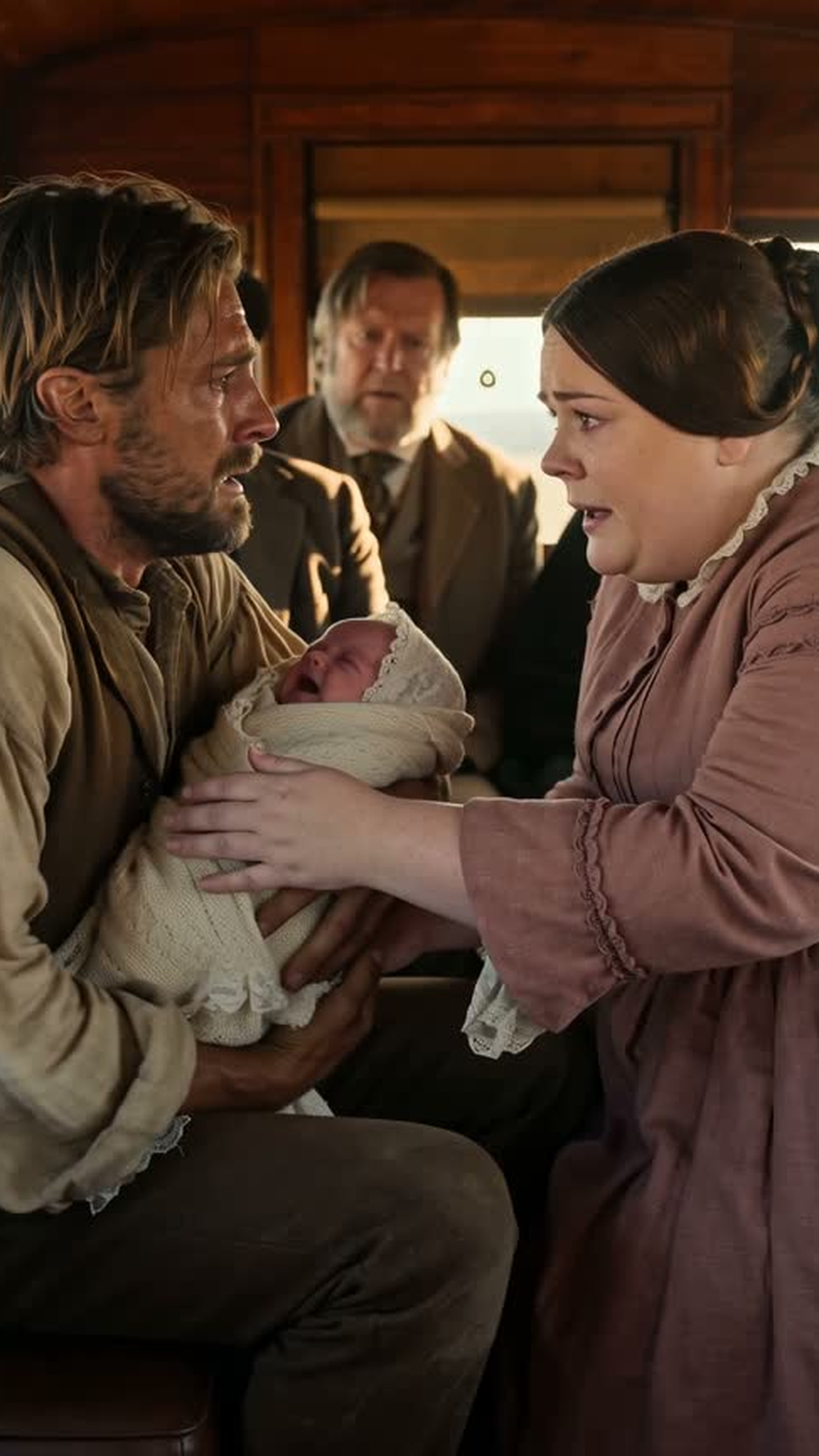
He did follow it. He followed it at a gallop, on a horse half-lathered by the time Fort Collins showed, with the letter folded inside his shirt against his heart like a warrant.
Mrs. Henderson's sister — Mrs. Abigail Pryor, widow, comfortable, with exactly the variety of nonsense Ruth had promised — opened her own door, took one look at the man on her porch, and said, "You're the father. She's in the back parlor. She's been crying since noon and telling me it's the change of altitude, at an altitude no different from your ranch, so you may draw your own conclusions about the quality of the story." She stood aside. "I have also had a report, Mr. Warren, from a Mrs. Henderson who is at this moment taking tea with the minister's wife and dismantling a certain sermon brick by brick. Whatever you came to say — say the true version of it."
Eliza stood when he came in, in the small back parlor, in her traveling dress, with her carpetbag packed by the chair — and the sight of the bag did what the letter had not quite done: it showed him the door of his life closing, quietly, politely, forever, in a back parlor in Fort Collins.
"You told me not to follow," he said.
"I did."
"I know. I'm asking you to forgive me for that part particularly, because it's the last order of yours I ever intend to disobey." He took off his hat, and held it, and the words he had rehearsed all the way down the road at a gallop had all fallen off the horse somewhere around the second creek, and what was left was the plain truth, which turned out to be enough. "Eliza. I am not here to ask you to stop grieving Clara. I am not here to ask you to be Margaret. I'm not a fool, whatever the pulpit says — I know what year this is in our lives. We are two people standing in the wreckage of two families, and between us there's one boy who is alive because you opened your hands in a stagecoach when it would have been easier — kinder to yourself, safer for your name — to keep them folded."
"I left for his sake," she said. "For yours. You read the letter. They'll say it at his school. They'll say—"
"I know what they'll say," Caleb said. "Ruth told me what to say back, the day you signed on in her kitchen. *She saved my life before I was a month old.* Let them say their piece first — that's the answer, and there's nothing after it. Eliza, the boy—" His voice went. He mastered it. "Tomas is riding in behind me. Samuel stopped eating again at noon. Not the goat — he won't look at the goat. He knows the difference now. He knows *you*. Dr. Craig said two months. It's been twelve days. Whatever the minister thinks, the boy thinks you're his—" He stopped short of the word, because it mattered too much to spend carelessly.
Eliza had both hands pressed over her mouth. "Don't," she whispered. "Don't use him to fetch me. It isn't fair. You know it isn't fair."
"It isn't," Caleb agreed. "It's worse than unfair. It's the plain truth of the situation I dragged you into when I asked you in that yard, knowing — *knowing*, you told me to my face — what it would cost you when we reached the end of the road. I asked anyway. Because it was his life. And I am asking again, and it's his life again, and it is also—" He took the breath that men take before stepping into cold water. "It is also mine. Not the boy's part. Mine."
She shook her head, standing very straight, holding her ground the way she had held it in the coach. "Then hear my arithmetic, Caleb Warren, because I will not be fetched like a misplaced parcel, not even by the truth. If I come back for the boy, I am his nurse who couldn't stay away. If I come back for you — if there is an *if* there — then in six months, when he's weaned and thriving and you look across your own table, you'll be looking at a woman you chose out of *gratitude and emergency*, and I have buried one husband who chose me in love, sir, and I will not be any man's *emergency*. I would rather have the scullery closet at Mrs. Vane's and my whole self-respect than a ranch and half a choosing."
The room was very quiet. Somewhere in the front of the house a clock was being extremely audible about the time.
"Good," Caleb said.
Eliza blinked. "*Good?*"
"Good. Because now I've heard the condition, and I can meet it honestly instead of by accident." He put his hat down on Mrs. Pryor's side table like a man settling in for a siege. "I did not come down this road today because Samuel refused a goat, though he did, and Tomas will confirm it and charge it to my account with God. I came because at six o'clock this morning I read your letter in my kitchen, and before I had finished it I knew two separate things, and I have kept them separate all the way here so I could say them to you separately. The first is that my son needs you, and that is an emergency, and I make no apology for riding hard on it. The second — " he looked at her with the whole of his weathered, exhausted, honest face "— is that I need you there even on the days he doesn't. Your voice in that house. Your laugh — I heard it once, in the nursery, the day he smiled, and I stood in the hall like an eavesdropper at my own life. Your judgment. Your — your keeping both. I am thirty-two years old, Eliza, I am not a boy in a fever. I am telling you I choose you in the calm part of the day, not the emergency part. The emergency only told me I couldn't afford to wait until spring to say it."
"Come home, Eliza. Not as his nurse. The nursing will end, we both know it ends. Come home as — as the woman I want sitting across my table when he's ten and telling this story on us both. Court me properly, in the spring, if your mourning allows it. Or don't, and run my house and scowl at me for forty years. But come *home*, where the door—"
"The door," Eliza said faintly, "of the room—"
"Is open," Caleb said. "It stays open. Both rooms. Both names. Margaret's on the hill and Clara's at Julesburg and they're ours — they're part of the family, Eliza, they're not the locked part. Rosa at the way station told you. Keep both."
"Both things are true," Eliza said, and it undid her — Rosa's words in Caleb's mouth, in that parlor, with her bag packed — and she sat down in the parlor chair and cried at last the way she had not cried at the grave, wholly and without managing it, and Caleb Warren, who had argued with his own hands to make them let go of his son, put them now, carefully, on the shoulders of the woman who had saved him, and held on.
* * *
Samuel Warren did not, in fact, wait for the wedding to recover his appetite — he recovered it in the buggy on the ride back to the ranch, in Eliza's arms, somewhere around the first creek crossing, with a ferocity that made Tomas, driving, turn around and say the first unguarded thing of his long employment: "That boy's got opinions."
He grew. That is the plain miracle the rest of the story is built on: he grew. The scrawny edges filled. The war-cry cry became a laugh around Christmas, provoked, history records, by Tomas pulling faces. Dr. Craig, riding out in January to bleed a horse, looked in at the nursery and pronounced the patient disgracefully healthy and the whole case closed, and refused, for the first time in the annals of the county, to bill for the visit.
In March, when the mourning year had done its proper work and the grass was coming green on Margaret's hill, word came that Mrs. Henderson had finished her campaign in Fort Collins: the minister's wife had called at the ranch in February — driven out herself, unannounced, with a cake and a written apology in her reticule — to say that her husband's sermon had been aimed at a family in the next county, that she was sorry to her soul it had flown where it flew, and that the woman who had spoken in the churchyard had been spoken to, in terms, by half the congregation since. The woman herself sent a letter in March, stiff and ashamed and genuine, which Eliza answered in her plain round hand with four lines and an invitation to the wedding breakfast. "Shame does arithmetic badly," Eliza told Caleb, sealing it. "I did it myself, in this kitchen, the night I packed. Hers came out wrong the same way mine did. Let her come and eat cake and see the boy. That's the whole answer there is."
So when Caleb Warren rode with Eliza to Julesburg and stood hat in hand at a small grave next to a big one, and Eliza laid down, not the little white cap — she kept the cap all her life, in a drawer by her bed — but a bunch of the first violets, wrapped in a page of her own writing, in her plain round hand, which told Clara Moore, who would never read it, about the brother she had on earth and the mother who would see her eventually and the man who had stood in the cold wind at the fence saying nothing while she wept, which was the right thing.
They were married in April, on the ranch, by a minister from the next county whose sermons ran to mercy. Ruth stood up with Eliza. Tomas stood up with Caleb, in a coat that predated the war and a state of visible suffering. Mrs. Henderson attended in triumph, with her sister, and informed the congregation at the wedding dinner that she had known how it would end since the second hour of the stagecoach ride, which was not true, and which nobody contradicted. Pritchard sent a silver cup by post, engraved — at ruinous expense, the drummer in him having lost the argument — SAMUEL WARREN, and under it, SMALL PASSENGER, GREAT JOURNEY. And the woman whose sentence in a churchyard had nearly unmade everything came, as invited, in her second-best dress, and stood a long time at the edge of the wedding breakfast holding a plate she did not eat from — until Eliza, in her wedding clothes, crossed the yard with the baby and put him, without a word of preamble, into the woman's arms, and said, "He's heavier than he looks. Mind his head — no, you've got him. There." The woman held Samuel Warren like a sacrament and wept into her plate, and that was the end of the talk in that county, forever, because a story retold at a hundred suppers will always choose its best ending.
And on an evening in May, with Samuel six months old and round as a dumpling and asleep against his father's shoulder on the porch, Eliza came out of the kitchen wiping her hands, and held out her arms in the lamplit doorway, and laughed — standing exactly where the story had begun, between a man and a child, with her whole life on both sides of her.
"Give him to me," she said.
And Caleb Warren, who had once had to argue with his own hands to open, opened them like it was nothing at all — like it was the easiest, most ordinary thing in the world — and gave her his son, and watched her settle the boy against her heart, where he belonged, in the house where all the doors stood open.
Both things were true. They would always both be true. That was not the tragedy of the house.
It was the foundation.
THE END