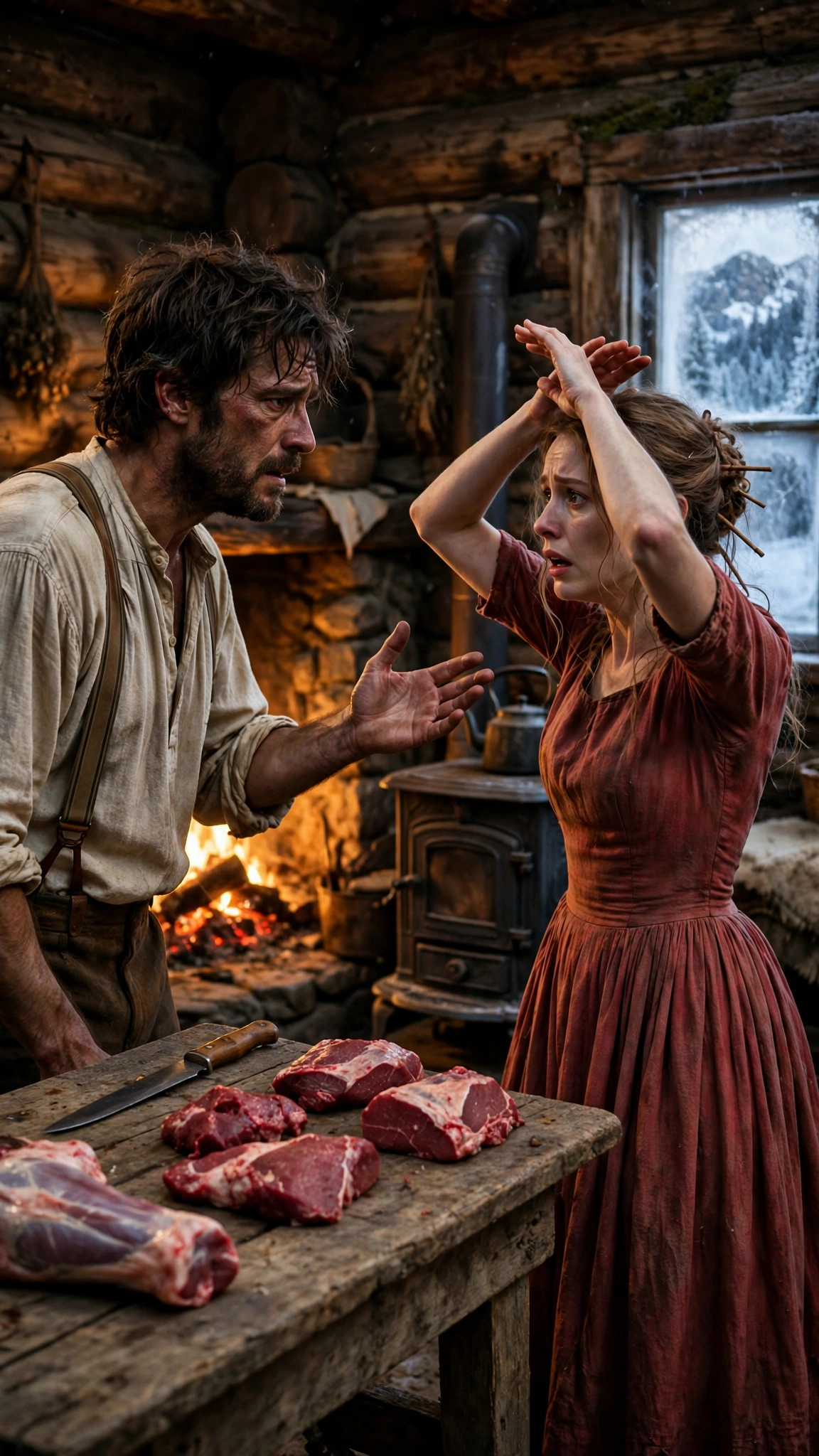
The knife struck the floor with a sound like a bell breaking.
It was a hunting knife, long and heavy, the blade Gideon's father had carried before him, and it hit the rough pine boards point first and rang and then fell flat, skittering a hand's breadth across the floor toward the leg of the table. A thin line of red opened on Mave's thumb where the edge had caught her as it slipped from her grip, no more than a scratch, a bead of blood welling up bright against her pale skin.
She did not look at the cut. She did not look at the knife. She jerked backward so hard the wooden chair went over sideways behind her, its legs scraping loud across the floor, and both her hands flew up over her head, fingers spread, elbows bent, her whole body folding in on itself as if she expected a blow to fall from above.
"I'm sorry! Please!"
The words tore out of her before she could stop them, thin and shaking, and she pressed herself back against the log wall beside the fireplace, her shoulders hunched, her face turned away, waiting.
Gideon stood on the other side of the kitchen table with his hand still extended, the way it had been when he held out the venison to her, palm up, fingers open. He had only meant to give her the meat so she could cut it for the stew. He had only meant to show her where the knife was kept. Now the knife lay on the floor, the chair lay on its side, and his new wife of two days was cowering against his wall with her hands over her head as though he had raised a fist to her.
He stared at her for a long moment, his hand still hanging in the air between them. Then, slowly, carefully, he lowered it.
"Mave… I wasn't going to hurt you."
His voice came out quiet, almost rough, and he kept his hands where she could see them, palms open, fingers spread wide. He did not step closer. He did not move at all.
Mave kept her eyes lowered. Her breathing was shallow and fast, her chest rising and falling beneath the faded red dress, and her hands stayed up, trembling, for a count of three heartbeats before she dared to lower one arm, then the other, moving as cautiously as a deer stepping out of cover.
Her gaze flicked between his hands and the fallen knife on the floor and back to his hands again, as if she were checking, and checking once more, that they were empty.
"I made a mistake."
She said it barely above a whisper, and her voice cracked on the last word. She said it the way a person confesses to a crime, the way a person begs a judge for mercy over a spilled cup or a burned loaf of bread.
Gideon looked at her — really looked at her, perhaps for the first time since she had come up the mountain to him — and something cold and heavy settled in his chest. This was not the fear of a woman who had dropped a knife. This was the fear of a woman who had learned, over years, that a dropped knife could cost her blood. That a mistake, any mistake, even the smallest one, was answered with pain.
He moved then, but slowly, so slowly that every motion was a promise. He bent down and picked up the hunting knife by its handle, and he set it flat on the table, far from her, blade pointing toward the wall. He righted the overturned chair with one hand and pushed it gently back beneath the table. He kept his movements deliberate and unthreatening, the way a man might move around a wounded animal caught in a trap.
"It's only a knife."
He said it gently, the way he might have spoken to his brother's boy, years ago, when the child had broken a plate and stood shaking in the corner. Mave remained motionless beside the fireplace, her back to the stone, the flames flickering against the log walls behind her, her face pale in the firelight.
A heavy silence followed. The fire crackled. The wind pressed against the frost-covered window. Neither of them spoke again that evening, and when Gideon banked the fire for the night and lay down on his side of the narrow bed, he listened to her breathing in the dark for a long time before sleep took him, and he thought about the way her hands had flown up over her head, and the way she had said please as though the word alone might save her.
Six days after the marriage, the storm was over.
The blizzard that had held the mountain in its fist for five days had finally spent itself in the night, and morning came cold and clear, the kind of cold that makes the snow squeak underfoot and the air taste of iron. Pale light came through the frost-covered window and fell in a white square across the floorboards, and the cabin smelled of woodsmoke and cold and the last of the coffee from the pot on the iron stove.
Gideon came in from outside carrying an armload of firewood, snow melting on his boots, his breath clouding in the cold air of the doorway. He stamped the snow from his boots and kicked the door shut behind him with his heel, and that was when he saw her.
Mave stood beside the wooden wash tub in the corner, her back half turned to him, hurriedly adjusting the upper side of her red dress. She had been washing — the tub still steamed faintly, a cloth draped over its rim, her hair loosened from its pins and falling in damp strands down her neck. The dress had slipped at the shoulder where she had loosened it to wash, and as she turned, the fabric fell open for a moment at her side, just for a moment, no more than the time it takes to draw a breath.
And Gideon saw.
Old bruises, yellowed at the edges, and darker purple marks, newer, lay along her side and across her ribs. They were not the shapeless bruises of a fall or a knock against a table. They had a shape. The marks followed the curve of her ribs in a pattern too regular to be an accident, and among them, clear as a brand, was the recognizable outline of a hand — four fingers pressed hard into the flesh, a thumb's dark print below them, as if someone had seized her by the side and held her there, hard, while she struggled.
No nudity. Only that brief glimpse, and then she was pulling the dress closed, her fingers fumbling at the fabric, her face losing all its color. But it was enough. It was more than enough.
Gideon froze in the doorway. The firewood shifted slightly in his arms, a log slipping an inch before he caught it. His expression changed, surprise giving way to something else, something horrified and slow, the way a man's face changes when he finally understands a thing he has been circling for days without naming it.
She saw him looking. She saw where his eyes had gone. Her face went white as the snow outside the window, and she stepped backward, one step, two, her hand going to the back of the wooden chair as if she needed something solid to hold on to.
"I'm sorry…"
She whispered it, and the word was so small, so automatic, that it broke something in him. She was apologizing for her own bruises. She was apologizing for being hurt.
Gideon set the firewood down slowly, log by log, on the floor beside the door. Then he crossed the room and sat at the wooden table, keeping a respectful distance between them, and he placed both his hands flat on the tabletop where she could clearly see them — empty, open, still.
His voice, when he spoke, was low and controlled and compassionate, the voice of a man holding himself very carefully together.
"Who did this to you?"
Mave gripped the back of the wooden chair. Her fingers trembled against the wood. She stared at him, her lips parting, her eyes filling with tears, and she looked toward the cabin door as though she were afraid someone might be listening on the other side of it, as though the walls themselves had ears.
The fire crackled. The room became almost silent. And then, barely whispering, her voice so soft he had to lean forward to hear it, she began.
"He told me…"
She stopped. Her eyes widened with fear. And the sentence hung there in the firelit air between them, unfinished, like a door left open onto a dark room.
Six days earlier, Mave Calloway had come up the mountain to marry a man she had never met.
The notice had been nailed to the board outside the Bitterroot church for three weeks before she worked up the courage to read it properly. She passed it every Sunday on her way in to service, her eyes fixed on the ground, her shawl pulled tight around her shoulders, and she told herself she was not the kind of woman such a notice was meant for. She was thirty-one years old, a widow, worn thin by two hard winters and one harder man, and she had nothing to offer a husband but a pair of willing hands and a silence she had learned to keep.
But on the third Sunday, Reverend Amos Bell caught her at the church door after the service and asked her, gently, if she had seen the paper. And when she shook her head, he read it aloud to her in his slow, patient voice, the way he read the psalms.
A mountain man, the notice said, living alone in a cabin high in the Rockies, sought a wife. He was a trapper and a hunter, honest and God-fearing, and he offered a home, food, and safety to any respectable widow willing to make the climb before winter closed the pass. Inquiries to be made through the Reverend Amos Bell, Bitterroot Church.
"His name is Gideon," the reverend said, folding the paper back up. "Gideon Marsh. I've known his family since before you were born, Mave. His people were good people. He's a rough man, but he's an honest one. And winter is coming, child. The trading post won't keep you through another one, not the way things stand."
Mave understood what he meant. She understood it better than he knew. The trading post was Merritt Voss's place, and Merritt Voss had made it plain, in words and in other ways, that her keep in Bitterroot depended on him. She had been counting the days until the pass closed, and the days until something worse than winter arrived, and the notice on the church board had begun to look less like a stranger's advertisement and more like a door.
"I'll write to him," she said, and her voice shook so badly she had to say it twice.
The reverend wrote the letter for her, because her handwriting was poor and her hands shook when she held a pen, and he sent it up the mountain with a trapper who was heading that way. Gideon's reply came back ten days later, written in a big, slow, careful hand on a torn piece of ledger paper.
He said he was thirty-eight years old and had lived twelve years in the cabin his father built. He said he trapped marten and beaver, hunted deer and elk, and cut his own wood. He said he was not a rich man but he was not a cruel one, and he would not raise his hand to a wife, not ever, and if she came she would have her own room until she chose otherwise, and he would keep her safe through the winter. He asked only that she be willing to work, and to be honest with him, and to give the mountain a chance.
Mave read the letter three times, sitting on the edge of her narrow bed in the back room of the trading post, and then she folded it into her mother's Bible and said yes.
The climb took three days. Elias Crowe, a guide the reverend hired with money from the church poor box, led her up the trail on a mule, with her small bundle tied behind the saddle — two dresses, her mother's Bible, a comb, and a shawl. The snow began on the second day and did not stop, and by the third day the wind was driving it sideways across the trail so hard she could barely see the mule's ears in front of her.
Elias Crowe did not talk much. He was a lean, grey man of sixty with a face like cured leather, and he kept his eyes on the trail and his hand on his rifle. But at night, when they camped in the lee of a rock face and he built a small fire, he told her what he knew of Gideon Marsh.
"He's a good man," Elias said, poking at the fire. "Lost his younger brother to the fever ten winters back, in that same cabin. Buried him under the pine on the ridge. After that he went quiet. Stopped coming down to town except twice a year. But he never cheated a man, and he never raised his hand to a woman. His father was the same. You'll be safe up there, missus. Safer than down here, anyway."
Mave did not ask him what he meant by that last part. She already knew.
On the third day, just as the light was failing, they came around a bend in the trail and there was the cabin — low and solid, built of heavy logs chinked with clay, smoke rising from the stone chimney, a woodpile stacked high against one wall, and beyond it nothing but snow and pine and the white shoulders of the mountains going up and up into the grey sky.
Gideon was waiting in the doorway. He was taller than she had expected, and broader, his dark-brown hair tousled by the wind, his short beard unkempt, his cream linen shirt open at the throat beneath his brown suspenders. He looked at her for a long moment, and she looked at him, and neither of them smiled, because smiling would have been a lie about how frightened they both were.
"You're Mave," he said.
"Yes," she said. "I'm Mave."
"Come in out of the snow," he said. "Supper's on the stove."
Reverend Bell had ridden up two days ahead of them to perform the ceremony, and he was waiting inside by the fire, his coat steaming, his Bible open on the table. The wedding was a short, plain thing. Gideon stood stiff as a fence post in his cleanest shirt, and Mave stood beside him in her faded red dress, the only good dress she owned, and she kept her eyes on the floorboards and said "I will" in a voice so soft the reverend had to ask her to say it again.
Afterward, the reverend ate supper with them, blessed the cabin, and rode back down the mountain before dark, leaving them alone together in the firelight. Gideon showed her the cabin — the bed, the table, the iron stove, the wash tub in the corner, the shelf with his father's books — and he told her, plainly and without embarrassment, that the narrow bed was hers until she chose otherwise, and that he would sleep on the pallet by the fire.
"You don't owe me anything," he said, and he looked at her straight when he said it, his dark eyes steady. "Not tonight. Not ever. We're married before God and the law, and I'll keep you safe and fed. That's the whole of it. The rest is yours to decide."
Mave had not cried when Jonah died. She had not cried when Merritt Voss first put his hand on her. But she cried then, standing in the middle of a stranger's cabin with the snow piling up against the door, because no man had ever said such a thing to her before, and she did not know what to do with kindness except to be afraid of it.
That was six days ago. Six days of quiet mornings and woodsmoke and the iron stove ticking as it cooled. Six days of learning where the cups were kept and how Gideon liked his coffee and how the wind sounded when it came down off the ridge at night. Six days, and then the knife, and then the bruises, and then the question she could not answer.
Now, sitting at the table with his empty hands flat on the wood, Gideon waited. He did not press her. He did not reach for her. He simply waited, the way a man waits for a frightened animal to decide whether to come closer or run, and Mave stood gripping the back of the chair, her breath coming short and fast, the unfinished sentence burning in her throat.
"He told me…" she had said. And she could not say the rest. Not yet.