The hand that had held hers for nineteen years let go.
Claire Bennett Mason stood on the narrow ledge above the ravine, the late-October wind cutting through her dusty-blue dress, and watched her husband's fingers uncurl from around her own. Gravel slid beneath her boots. Below her, the slope fell away in broken rock and pine, down toward a shallow ravine she could not see the bottom of. Above her, the sky was a hard, pale blue, and the San Juan Mountains stood in their cold afternoon light, indifferent and beautiful.
"Daniel?"
Daniel Mason looked down at her without panic. He was forty-nine years old, dark jacket zipped to his throat, his face calm in the way it had always been calm. — the same calm he wore in courtrooms, in board meetings, at dinner parties when someone said something foolish. He did not raise his voice. He did not look away.
"I'm sorry, Claire."
Her footing gave way.
She fell backward down the rocky slope, and the world became noise and impact: loose stones tearing at her dress, a pine branch whipping across her face, her left shoulder striking the ground so hard that the pain came a half-second late, like a letter arriving after the news. She slid, rolled, caught herself against the trunk of a spruce, and lay there gasping, her breath coming in short, shallow pulls, her cheek pressed against cold dirt.
Far above, on the broken ledge, Daniel stood looking down.
"Claire?"
She froze. She did not answer. She did not move. Somewhere in the part of her mind that still worked like a lawyer's mind — the part that noticed things and filed them away — she understood that answering would tell him she was alive, and that being alive was now a problem for him.
A distant female voice drifted down from the ledge beside him, light and almost bored.
"Looks convincing."
Footsteps retreated. Gravel shifted. And then, from far away, muffled by the trees and the wind, Claire heard a car door slam.
She lay against the spruce for a long time. Her left shoulder throbbed with every heartbeat, a deep, grinding ache that told her something in there was torn or broken. Her dress was dusty and scratched, with small tears where the branches had caught it. Her brown leather satchel had somehow stayed on her shoulder, its strap twisted, the leather scuffed. Her phone was gone. She had put it in her jacket pocket that morning, and her jacket was in the car, and the car was gone with Daniel.
There was no safe way back up. The slope above her was steep, loose, and broken, and her left arm would not bear her weight. She pushed herself upright with her right hand, slowly, breathing through the pain, and looked around at the ravine.
"Stay alive."
She said it quietly, to herself, the way she might have said it to a client sitting across her desk in Denver, frightened and out of options. Stay alive. That was the whole plan. Everything else could wait.
Her gaze shifted, and she saw them: two unusual parallel grooves in the damp earth, running downhill between the trees, too narrow for a modern vehicle, too straight to be natural. Old wheel ruts. She had never seen wheel ruts before, not real ones, but she knew what they were the way you know a thing when it does not belong. She crouched beside them, touching the dark soil with her right hand, and saw a rusted horseshoe lying partly buried nearby, its curve eaten by decades of weather.
She looked deeper into the forest. After a moment of hesitation, she followed the tracks downhill, her satchel moving naturally against her hip, her boots finding the uneven ground one careful step at a time. The ruts led her through spruce and pine, past pale boulders and deadfall, until the trees opened and she saw it.
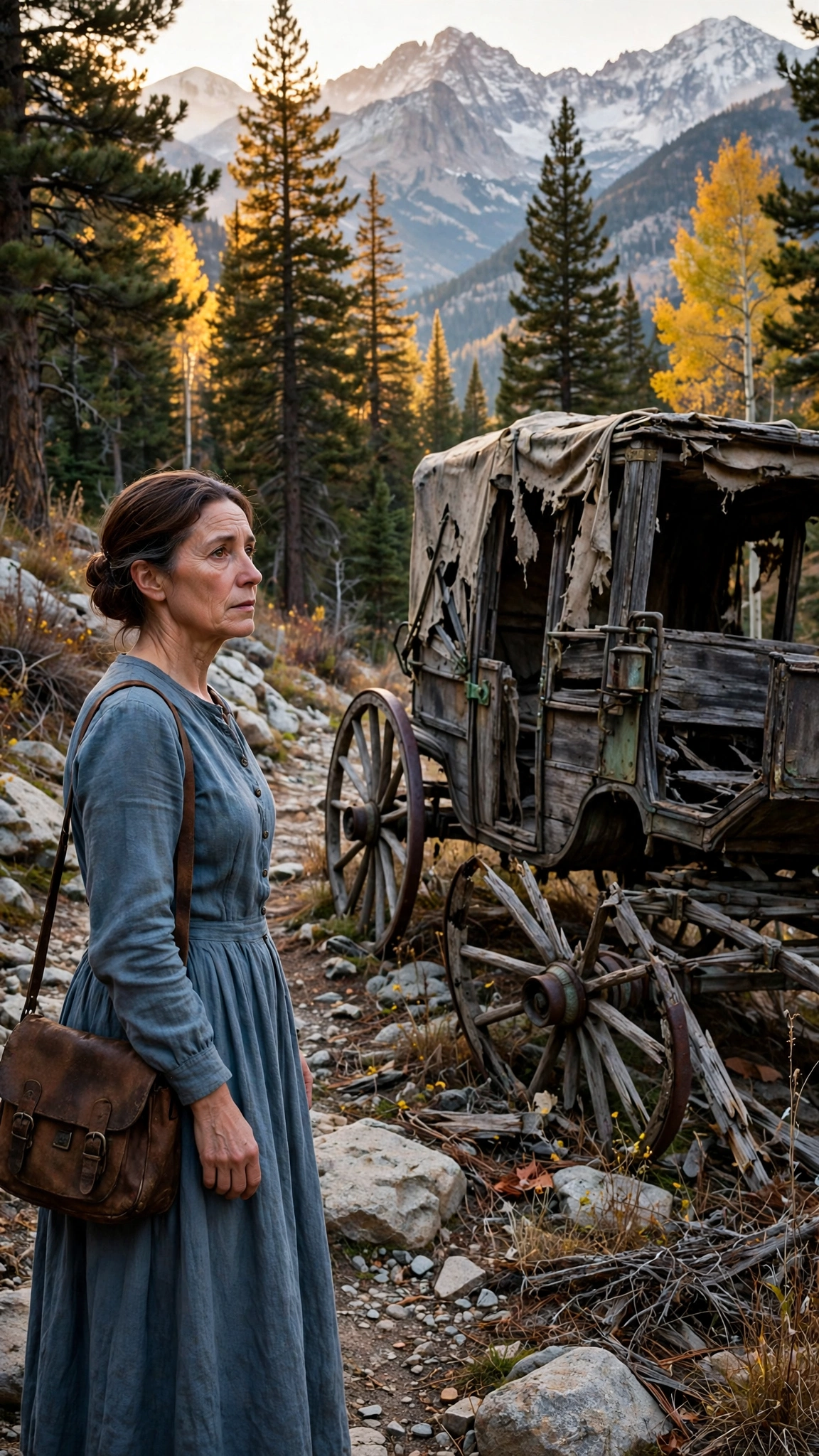
On the right, in a shallow hollow of the ravine, stood an abandoned wooden carriage.
It was old in a way that made her throat tighten — weathered gray-black wood, a canvas covering hanging loosely over a damaged frame, one wheel leaning at an unnatural angle, its brass fittings oxidized green. Stones and weeds pressed close around it, as if the forest had been trying for decades to swallow it and had only half succeeded. Towering pines and distant peaks framed it. Claire stood in the left foreground of that scene, on a rocky mountain path, her dusty-blue dress hanging naturally around her boots, her satchel resting against her side, and she stared at the carriage in disbelief.
"What is this doing here?"
The mountain wind moved loose strands of her hair. She had come down here because a man she had loved for nineteen years had pushed her off a mountain, and now she was standing in front of something that had been waiting in this ravine longer than she had been alive.
She approached the carriage carefully. Old pine branches had been deliberately arranged against one side, as if someone had once tried to hide it, or to keep the weather off it. She pulled at the rear door with her right hand. The door refused to move. She braced her foot against the wooden frame and used a fallen branch for leverage, and the damaged door opened with a long wooden creak.
Inside were decaying leather seats, dust, and a deteriorated blanket. She leaned forward, and something metallic caught the remaining sunlight. A narrow rectangular metal box rested beneath the rear seat.
Claire carefully pulled the metal box from beneath the carriage seat. Its surface was corroded but intact. She placed it on the wooden floor. Using the small folding pocketknife attached to her key ring, she worked the blade beneath the latch. A sharp metallic snap. The lid opened.
Inside was a carefully wrapped oilcloth bundle.
Claire slowly lifted the bundle. Her breathing changed. She looked at it with growing disbelief, and she whispered, so quietly that the wind nearly took the words:
"Twenty-seven years…"
She began to unfold the oilcloth.
—
Three weeks earlier, Claire Bennett Mason had been sitting in her office in Denver, at the Mountain Justice Legal Clinic, reading a file that would end her marriage and nearly end her life. She did not know that yet. That morning she knew only that the coffee was too strong, that the October light coming through the window was thin and gold, and that the woman sitting across from her desk was frightened in the particular way of people who have been frightened by something large and patient for a very long time.
Claire was forty-eight years old, a nonprofit attorney, and she had spent twenty-one years doing work that paid little and mattered a great deal: evictions, wage theft, land disputes, the cases nobody else wanted. She wore her brown hair in a practical low bun because it kept it out of her face when she leaned over files. She wore plain dresses because she liked them, and because a courtroom in rural Colorado respected a woman who did not dress like she was performing. She had a reputation in Denver legal circles as someone who did not bluff and did not quit, and she had earned it the slow way, case by case.
Her marriage to Daniel Mason had lasted nineteen years. He was a commercial real estate attorney, successful, well-groomed, respectable — the kind of man other men described as solid. They had met at a bar association dinner when Claire was twenty-nine and Daniel was thirty, and he had been charming in a quiet, attentive way that she had mistaken, for a long time, for depth. They had no children. That had been a decision at first, and then a fact, and then a subject they no longer discussed. They lived in a comfortable house in the Hilltop neighborhood, and they had the kind of marriage that looked, from the outside, like a photograph of a marriage: two people at a dinner table, a shared calendar, a shared mortgage, a shared silence.
The silence had grown over the years. Daniel worked late. Claire worked later. They spoke about the house, about his mother in Aurora, about the ski trip they kept not taking. He had never raised his voice to her. He had never once been cruel in a way anyone could point to. That was part of what made the ledge so impossible to understand, later, when she tried to explain it to herself: the man who pushed her was not a monster. He was her husband. He was calm. He said he was sorry, and he meant it in the way a man means it when he has already decided that sorry is the price of the thing he wants.
The woman across the desk that October morning was named Ruth Ann Crowe. She was thirty-four, a schoolteacher from Silverton, and she had driven five hours to Denver because the county legal aid office had told her that the clinic was the only place that might take her case. Her family had lived in the San Juans for four generations. A mining company — San Juan Consolidated — was trying to take her family's land, sixty acres above Silverton, on the strength of an old claim. Ruth Ann had the deed, or what she believed was the deed, and a box of her great-grandfather's papers, and a stubbornness that Claire recognized immediately, because it was her own stubbornness wearing a different face.
"I know it's old," Ruth Ann said, pushing a folder across the desk. "I know it's probably nothing. But my great-grandfather kept these papers his whole life, and my grandmother kept them after him, and I just — I need someone to tell me whether they mean something."
Claire opened the folder. Inside were yellowed documents, a survey map, a photograph of a young man standing beside a mule in a mountain pass, and a mining claim certificate dated 1898, made out to a prospector named Elias Crowe.
She did not know then that the certificate would lead her to a carriage in a ravine, or that her husband's family name was written, in faded ink, on the back of it. She knew only that the papers were real, that the case was worth taking, and that Ruth Ann Crowe deserved a lawyer who would read every page.
"Leave it with me," Claire said. "I'll read all of it. I'll call you by Friday."
After Ruth Ann left, Claire sat with the folder for another hour, reading. The claim certificate was genuine — she could tell from the paper, the seal, the handwriting. The survey map showed a parcel in the San Juans that matched the land San Juan Consolidated was claiming. And on the back of the certificate, in a different hand, someone had written a single line: "Transferred to W. Mason, 1899. See file 27."
She copied the line into her notebook, underlined it twice, and went home to a quiet house where her husband was already asleep, or pretending to be.
The next morning, Daniel asked her about the hike. He had been talking about a hike for weeks — a day in the mountains, just the two of them, before the snow came, to clear the air between them. She had put him off, busy with the clinic, busy with Ruth Ann's file. That morning he stood in the kitchen with two cups of coffee and said, "Saturday. The San Juans. Just us. No phones, no files. We need it, Claire."
She said yes. She wanted to believe him. She wanted to believe that the silence between them was something a day in the mountains could fix, and that the man who made coffee for her in the morning was the same man she had married nineteen years ago.
She packed her satchel that Friday night: water, a sandwich, her keys with the little folding pocketknife, a notebook. She left her jacket in the car because the afternoon was warm. She wore the dusty-blue dress because it was comfortable and because Daniel had once told her he liked the color on her. She tied her hair into a low bun, the way she always did.
On Saturday morning, they drove south from Denver toward the San Juans, and Daniel talked about the mountains the way he always talked about them — the trails, the old mining roads, the places his father had taken him when he was a boy. He was relaxed. He was attentive. He held her hand on the trail up to the ledge, his fingers warm and sure around hers.
And then his fingers uncurled, and the gravel slid, and she fell.
Now she sat in the ravine beside an abandoned carriage, with an oilcloth bundle in her lap and her left shoulder burning, and she understood, with the clarity that comes only when there is nothing left to misunderstand, that the hike had never been about clearing the air. It had been about this place. It had been about making sure she never read the rest of Ruth Ann Crowe's file.
She looked down at the bundle in her hands. Twenty-seven years, she had whispered, and she did not yet know why that number had come to her lips — only that it felt true, the way a fact feels true before you can prove it. She drew a slow breath, steadied her right hand, and began to unfold the oilcloth.