The road that no one could see began as no road at all.
They left the cottonwoods before dawn, riding up a dry creek bed between walls of broken rock, the mule's hooves loud on the stones. Twice Dominic dismounted and walked ahead, moving brush, moving fallen branches — and once, Natalie understood with a chill, moving them back behind them, erasing the difference between a trail and a hillside. By mid-morning the creek bed climbed into a country of standing stone where the wind had carved the rocks into shapes like a ruined city, and then, at a place where the canyon appeared to end in a sheer wall, he turned his horse at a crack in the rock that she would have ridden past without a glance.
"Stay close," he said. "Mind her head."
The crack was a defile no wider than a wagon, roofed in shadow, running crooked through the heart of the ridge for perhaps a quarter of a mile. The light went green and cool. Water wept somewhere in the dark of it, drop by patient drop, and their horses' breath smoked. Natalie rode with her heart in her throat and her skirt gathered up and the rock brushing both her stirrups, and thought: no one follows a man into a place like this. No one finds a woman in a place like this, either. She held both thoughts at once, the way her father had taught her to hold a fractious horse — firmly, and without flinching from either.
Then the defile opened.
She had read, in her mother's books, of valleys in Switzerland that travelers wept at the sight of. She had thought it a figure of speech. The valley that spread out below her in the September light was perhaps three miles long and one wide, cupped in peaks like a bowl in two great hands: a meadow going gold at the edges, a creek that ran bright over stones, a stand of pines black against the north wall — and a cabin, a barn, corrals, a garden fenced against deer, smoke rising from a real stone chimney. Everything built stout, and square, and true. Everything built by one pair of hands, over years, alone.
Dominic had reined in beside her. He was watching her face, not the valley, and she realized he was waiting — as he had waited in the square — for her verdict on the thing he was offering.
"It's the most beautiful place I have ever seen," she said honestly, and saw the words land.
"It's yours to live in," he said, "long as you want it." He said it flatly, like a man naming a price he expects to be argued with. "Cabin's got two rooms. I'll take the lean-to off the barn till the preacher comes." And when she turned to stare at him: "I told you. My word in the meantime."
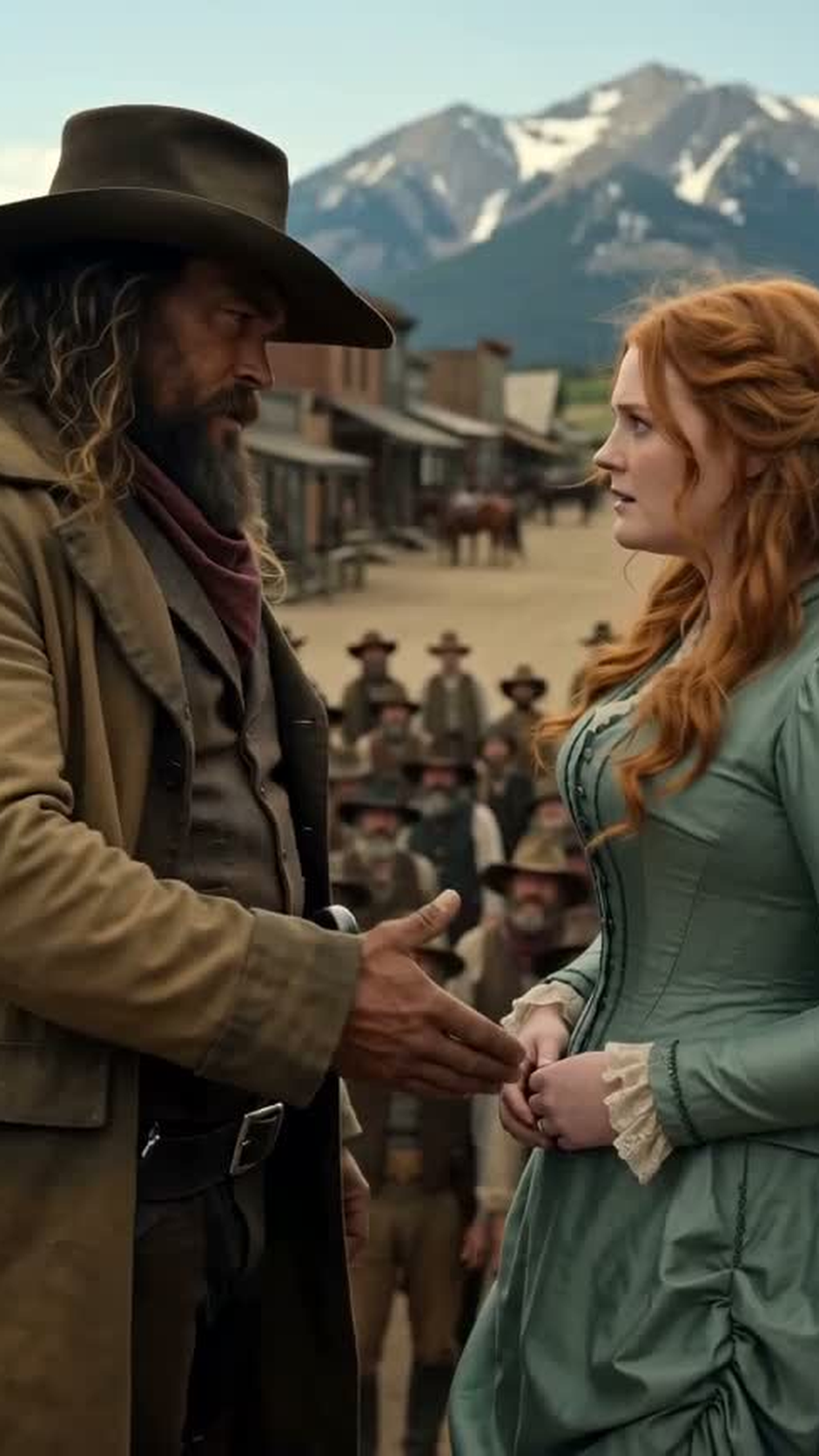
Before she went inside, she unpacked her trunk on the porch with the briskness of a woman claiming territory politely, and it was there, lifting the green dress out of its tissue to hang it from a peg where the air would take the travel out of it, that she saw the thing that told her more about the valley than the graves would. On the porch wall hung a set of measures — notches cut into the doorpost, dated in pencil in a careful hand: M.B. 1868. M.B. 1869. A man's measurement of a woman's height, year by year, the way her father had cut her own growth into the forge door. And beside them, lower, unfinished, a single small notch that had no date at all. Natalie stood with her dress over her arm and looked at that doorpost for a long time, and then she hung the dress on the highest peg, where the afternoon light came through it and made the sage silk glow like water, and went inside.
The cabin, when she ducked — she would always have to duck; the lintel had been set for a shorter world — through its door, stopped her where she stood. It was one man's fortress against loneliness, and it showed her its builder more plainly than his face had. Everything was made and mended to last. There were shelves of provisions laid in like a siege store. There was a table built for four that had plainly only ever seated one. And there were books — a whole shelf of them, thumbed soft: Shakespeare, the Bible, a medical text, Burns, a treatise on mining, two novels of Mr. Dickens with the spines gone white from reading.
"You read," she said, in the tone of a woman discovering the country has a river after all.
"Winter's long," he said. "A man's mind'll eat itself, else."
She also found — doing the thing women do in a new house, which is to say putting her hand on every shelf and latch and surface as if taking the place's pulse — the wedding ring. It lay in a thimble, in a tin box of buttons and needles, in the drawer of the table for four: a plain gold band, worn thin. She closed the drawer as quietly as she had opened it, with the peculiar reverence of a woman who has found the exact place where a stranger keeps his heart, and did not mention it then or ever. Some entries in a man's ledger are not hers to read aloud. She knew that. Her father had kept her mother's hair ribbon in the forge cashbox for seven years, in exactly the same way, for exactly the same reason.
And there was one more thing, which she found that evening, walking the valley while he saw to the stock: at the edge of the pine stand above the creek, in ground that was plainly tended — cleared of brush, ringed with stones — two graves. A tall one. A very small one.
The headboard of the tall grave had been carved by hand, in letters cut deep against the weather, by someone working slowly and meaning it:
MARY BRENNAN. BELOVED WIFE. 1851–1870.
AND HER SON, the small one said. WHO HAD NO TIME FOR A NAME.
Natalie stood in the pines a long time with the wind moving in them like water, and understood several things at once, the way you understand weather coming. Why a man lives alone in a valley no road reaches. Why his table was built for four and seated one. Why a man might speak fifty words in five years — because the fifty-first might have to be about this.
Eight years he had been up here alone with these two graves, since he was thirty years old. She did the arithmetic of his grief the way she'd done Crane's ledger, automatically, in the margin, and then she went back down to the cabin and cooked supper for two on his stove — beans and salt pork and biscuits that rose properly, at altitude, the first time, a thing she permitted herself one small private moment of pride about — and when he came in from the corrals, Dominic Brennan stopped in his own doorway at the smell of it like a man who has walked into a room of his own house he had forgotten existed.
They ate mostly in silence. It was a different silence from the trail's. She was learning it had kinds.
"You found them," he said at last, not asking.
"Yes."
"I should have told it before the signing." He turned his cup in hands that made it look like a thimble. "It ain't a debt you owe, hearing it. But a wife ought to know what house she's come to. She died in childbed, Mary did, eight years gone this winter. Snowed in, same as we'll be, come January. I did everything—" He stopped. The fire settled in the stove with a small collapsing sound. "Everything I knew is not the same as everything there was to know. The boy came wrong. By the time I could have got her down to a doctor, there was no road. There's never a road, up here, when you need one. That is the whole of the sin I committed, Miss Zimmerman. I brought her to a place with no road, and I have been here paying for it since."
Natalie sat very still. She was twenty-three years old and had been raised by a woman who told the truth, and she recognized the shape of what he had just done: he had handed her the heaviest thing he owned, to see if she would set it down gently.
"Why did you come down to Willow Ford at all?" she asked. "You have provisions. You have—" she gestured at the valley beyond the walls, the creek, the gold, "—you have everything, by the look of it. Men don't ride two days to an auction out of curiosity. Not you."
"No," he said. "Not me."
"Then why me, Dominic? I asked you in the square and you gave me a speech. I'd like the truth this time, if it's mine to have."
He was quiet so long she thought the conversation had ended, and she had risen to clear the plates when he spoke — to the table, not to her, which she was learning was how he said the things that cost most.
"I came down for salt and coffee and a new axe helve. I was standing at the back with the horses when they brought the brides out. I watched the first three sold, and I thought what I always think of that platform, that it's a poor way for human beings to start anything. And then you climbed the steps." The cup turned once more, and stopped. "You were scared. Don't argue — I know scared, I've worn it. You were scared and they were laughing, and you stood up there straight as a church door and you looked out over the top of all of them like they were weather you'd decided to walk through. And I thought of this valley. It's a good place, Miss Zimmerman. It's the best place I know. But it is a hard place for anyone who bends. It would eat a bending woman alive in two winters. It needs—" He shook his head once, a man rejecting his own sentence and building a truer one. "I don't hold with buying people. I want you to know that, whatever the paper says. I paid the Society's price to get you off that platform and out of that town's mouth. What happens from here is not a purchase. It's an offer, same as my hand was. You can winter here free, and go down in spring with money in your pocket and no debt to me, and I'll ride you to the stage myself. Or—" For the first time, the deep voice fumbled. "Or you can stay. If staying ever comes to seem like a thing you'd choose."
Outside, the wind came down off the peaks with the first true smell of snow in it, far off and months away. The fire ticked. Natalie looked at this enormous silent man across the table he had built for four, in the cabin he had built for a family, in the valley he had hidden from the world like a wound — and Natalie, who had been priced at thirty dollars that week by men who sounded bored, understood that she had just been offered the only terms she had ever actually wanted, from the one man in Idaho Territory who had thought to ask what she was worth instead of what she cost.
"Dominic," she said, "I would like to see the whole valley tomorrow. All of it. If I'm to decide."
"You shall," he said.
But neither of them had noticed — because the defile hid all sound from below until sound was nearly inside the valley — the two riders who had stopped their horses an hour before dusk at the place where a dry creek bed met a wall of standing stone, and who were even now sitting their saddles in the cold shadow, studying the rock face with the patient eyes of men who are being paid to find a crack in it.
Harlan Pruitt had lost a bride that week for thirty dollars, in front of everyone. And Harlan Pruitt had decided that Dominic Brennan's gold was a story he intended to finish.