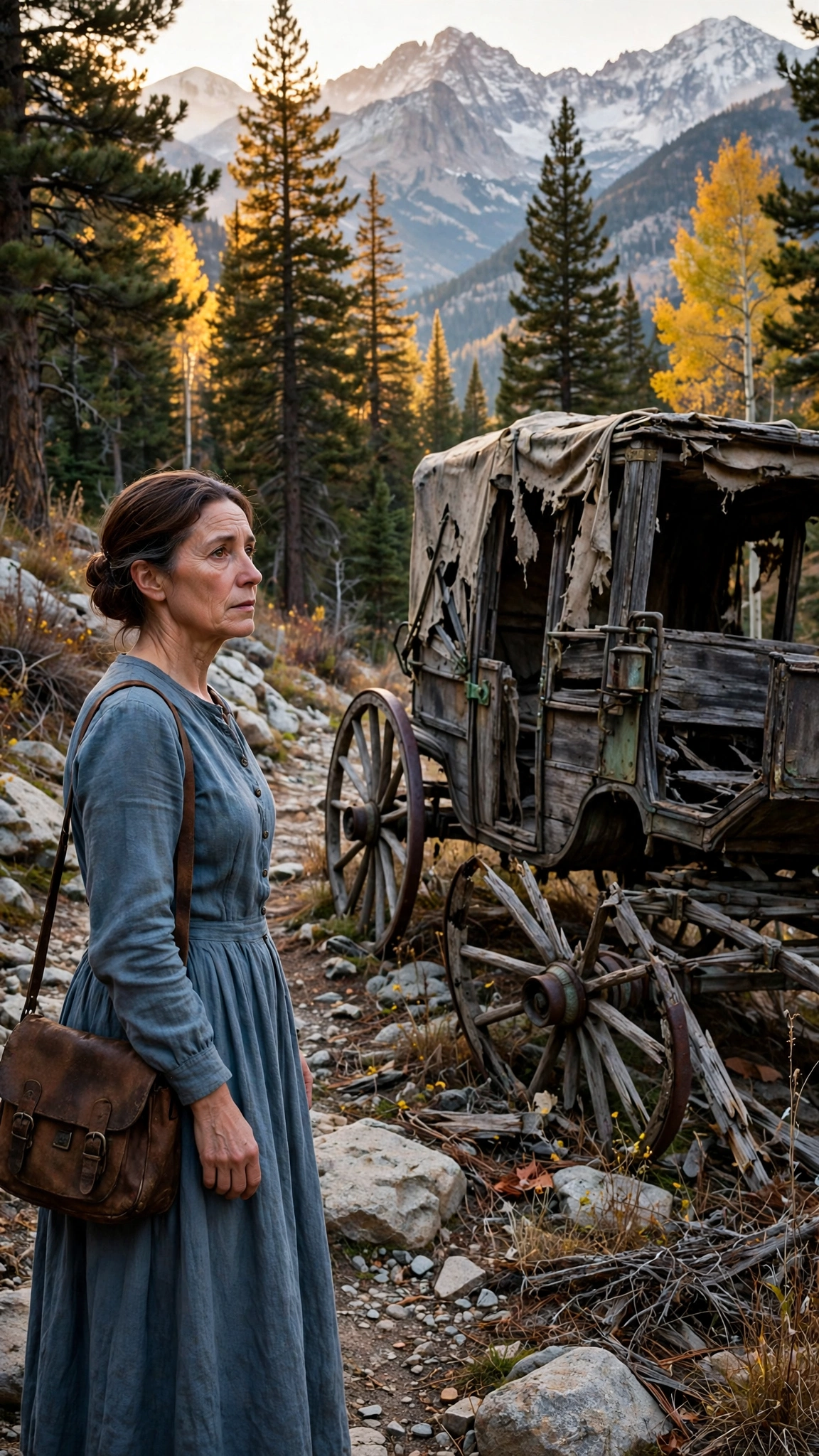
Claire sat in the ravine with the oilcloth bundle in her lap, her left shoulder burning with every breath, and unfolded it one layer at a time.
The oilcloth was old and stiff, but someone had wrapped it with care. Inside the first layer was a second layer, and inside that, three things, each wrapped separately in waxed paper that had yellowed but held.
The first was a mining claim certificate, dated March 1898, made out to Elias Crowe for sixty acres above Silverton, in the San Juan Mountains. It was the original. She had seen a copy of it in Ruth Ann's file, but this was the real thing — heavy paper, an embossed seal, the surveyor's signature in ink that had faded to brown. On the back, in the same hand she had seen on the copy, was the line: "Transferred to W. Mason, 1899. See file 27."
The second was a photograph, taken in black and white, of a young man standing beside a mule in a mountain pass. She knew the photograph — Ruth Ann had the same one in her folder. Elias Crowe, twenty-six years old, in 1898, the year he filed his claim and the year he died.
The third was a letter. It was handwritten, on the letterhead of a Denver law firm, dated October 27, 1999. She read it twice, and then a third time, because the handwriting was her late father-in-law's, and the words in it changed everything she thought she knew about her marriage.
"To whoever finds this," the letter began. "My name is Warren Mason. I am writing this because I am afraid that if I do not write it down, the truth will die with me, and a family will go on being robbed for another hundred years."
Warren wrote that in 1898, a prospector named Elias Crowe had filed a lawful claim on sixty acres above Silverton, where the silver ran close to the surface. In 1899, Warren's own father — Daniel's grandfather — had forged a transfer document, copying Crowe's signature from a supply receipt, and taken the claim. Crowe had protested, and then Crowe had died: his carriage went off the mountain road in a storm, into a ravine, and no one ever recovered the body or the papers he carried. The Masons kept the land, worked the mine, and built their fortune on it. The transfer document the family relied on was a forgery, and Warren Mason had known it since he was a boy, when he found his father's papers in a desk drawer and understood what they meant.
"I have carried this for sixty years," Warren wrote. "I am seventy-one years old, and my heart is failing, and I do not want to die a thief. I have hidden the original certificate and this letter in the carriage where Elias Crowe died, because it is the one place no Mason would ever look. When I am gone, I intend — I have told my son Daniel that I intend — to return the land to the Crowe family, and to make a public record of what was done."
The letter ended there, unfinished, the last line trailing off. Below it, in a different pen, Warren had added a single sentence, dated November 2, 1999: "Daniel knows. He says I am a sentimental old man. He says the money is ours now, whatever paper says. I am going up to the carriage tomorrow to bring the proof down."
Warren Mason had died on November 3, 1999, in a car accident on a mountain road near Silverton. A heart attack at the wheel, Daniel had said. The car going off the road.
Claire sat in the ravine and held the letter in her right hand, and she understood, finally, what the number twenty-seven meant. Twenty-seven years ago, Warren Mason had decided to tell the truth, and twenty-seven years ago, he had died before he could. Twenty-seven years ago, Daniel Mason — twenty-two years old, the heir to a fortune built on a forged signature — had learned that his father's conscience was going to give it all away.
She did not know, and would never know for certain, what had happened on that road on November 3, 1999. But she knew this: Daniel had known where the carriage was. Daniel had known what was in the box. Daniel had brought her here, to this exact ravine, because she had found the Crowe file, and because she was going to read it, and because the last person who had tried to bring the truth down from this mountain had died on the road.
Her hands were shaking. She folded the letter back into its waxed paper, wrapped the bundle again, and put it in her satchel, against her hip, where she could feel its weight with every step. She closed the metal box and left it where it was, under the rear seat of the carriage — it belonged to the story now, and the story would need it.
She looked once more at the photograph before she wrapped it away — the young man beside his mule in the mountain pass, his hat pushed back, his face open to the camera, twenty-six years old and certain of the future. She thought about the wife in Leadville, and the baby daughter who would grow up without a father, and the tin box under a grandmother's bed, and the way a family could hold a truth for four generations without ever being able to prove it. The photograph had waited in that carriage for a hundred and twenty-eight years, through storms and winters and the slow work of the forest, and it had survived because someone — Warren, or Elias himself — had wrapped it with care. She pressed the waxed paper flat with her palm and thought about how fragile a piece of paper was, and how stubborn, and how a hundred years of weather could not destroy what a family had decided to remember.
Then she heard the engine.
It came from above, from the trailhead, faint through the trees: a car, returning. A door opened and closed. Footsteps on gravel. A flashlight beam moved through the pines, high on the slope, sweeping back and forth, looking for something. Looking for her.
Claire pressed herself flat behind the carriage, her heart hammering against her ribs, her injured shoulder screaming as she curled around the satchel. The flashlight came closer. She could hear Daniel's voice, low, talking to someone — the woman, the one who had said "Looks convincing." from the ledge. They were searching the slope below the ledge, methodically, the way you search for a body.
"He can't have gone far," the woman said. She was close now, close enough that Claire could hear the impatience in her voice. "She," Daniel corrected, quietly. "She can't have gone far."
Claire held her breath. The flashlight swept over the carriage, over the pines, over the pale boulders. It passed within a foot of where she lay, and then it moved on, down the slope, away from her, toward the place where a body would have come to rest if it had simply fallen and died.
She waited until the light was gone and the voices had faded and the engine had started again and died away down the mountain road. Then she stood up, slowly, her left arm hanging useless at her side, and she began to climb.
Before she climbed, she checked the satchel. The strap had cut into her shoulder during the fall, but the bag itself was intact, and inside it, wrapped in her spare scarf, the oilcloth bundle was dry and whole. She touched it once, through the waxed paper, the way you touch something to make sure it is real, and then she closed the satchel, and she started up the slope.
She thought, as she climbed, about Monday. Mrs. Alvarez's eviction hearing was on Monday, and the response had to be filed by noon, and Maggie would file it if Claire did not come in, but Claire wanted to file it herself, because Mrs. Alvarez had trusted her, and because the work was the one thing in her life that had never lied to her. It was a strange thing to think about while climbing out of a ravine with a torn shoulder, but it steadied her: the ordinary world was still there, waiting, with its hearings and its deadlines, and all she had to do was get back to it.
It was the hardest thing she had ever done. The slope was steep and loose, and every time she reached with her left hand, pain shot through her shoulder like a wire pulled tight. She climbed with her right hand and her boots, one careful hold at a time, stopping to breathe, stopping to listen, following the old wagon road where it was visible and the line of the ravine where it was not. The light was going. The pines threw long shadows across the rocks. Twice she slipped and caught herself on her right arm, and twice she thought about lying down and waiting for morning, and twice she kept going, because the bundle in her satchel was the only thing standing between the Crowe family and another hundred years of being robbed, and because Daniel would come back in the morning, and in the morning he would bring tools.
She reached the Forest Service road after dark. It was gravel, rutted, empty. She followed it downhill, toward the lights she could see far below in the valley — Silverton, small and bright and impossibly far away. Her boots were full of grit. Her dress was torn at the hem. Her left shoulder had gone from burning to a dull, sick throb that told her the joint was badly damaged. As she walked, she went over the letter again in her mind, sentence by sentence.
Warren had written about finding his father's papers when he was twelve years old, in a desk drawer in the Aurora house, and understanding, even then, that the transfer document was wrong — that the signature was too careful, too slow, the work of a man copying a name he could not write fluently. He had written about the mine, and how the silver had paid for the house in Aurora, and for Daniel's education, and for the comfortable life the Masons had lived for a century, and how every dollar of it had come from sixty acres that belonged to a man who died in a ravine with his papers in his carriage.
"I have tried to make my peace with this in every way a man can," Warren wrote. "I have told myself that Elias Crowe is dead and his family is gone, and that returning the land would only punish the living for the sins of the dead. I have told myself that the money has done good — that it built a business, that it employed men, that it sent my son to law school. None of it is true enough. The truth is that I was afraid. I was afraid of what my father would have thought of me, and I was afraid of what my son would think of me, and I was afraid of being poor. I am seventy-one years old, and I am done being afraid."
She thought about the certificate, too — the thick paper, the seal still sharp after a hundred and twenty-eight years, the surveyor's name, J. Whitfield, and the description of the parcel: sixty acres, bounded by the creek on the east and the old wagon road on the west, in the San Juan Mountains above Silverton. It was the same land Ruth Ann Crowe had shown her on a county map, in her office in Denver, three weeks ago. It was the same land San Juan Consolidated was trying to take.
She thought about Daniel, twenty-two years old, following his father's car up this same road in 1999, watching it go off the edge, and driving away.
She did not know whether he had caused the accident or merely failed to prevent it. She knew that it did not matter, not anymore. What mattered was that he had spent twenty-seven years protecting a fortune that was built on a forged signature, and that he had brought his wife to this mountain to keep her from finishing what his father had started.
The stars came out above the peaks, cold and sharp, and her boots were full of grit, and her dress was torn at the hem, and her left shoulder had gone from burning to a dull, sick throb that told her the joint was badly damaged. She walked, and she walked, and the lights came closer, one step at a time, and she did not stop, because stopping was how you died on a mountain, and she had already decided, back in the ravine with her cheek pressed against the cold dirt, that she was going to stay alive.