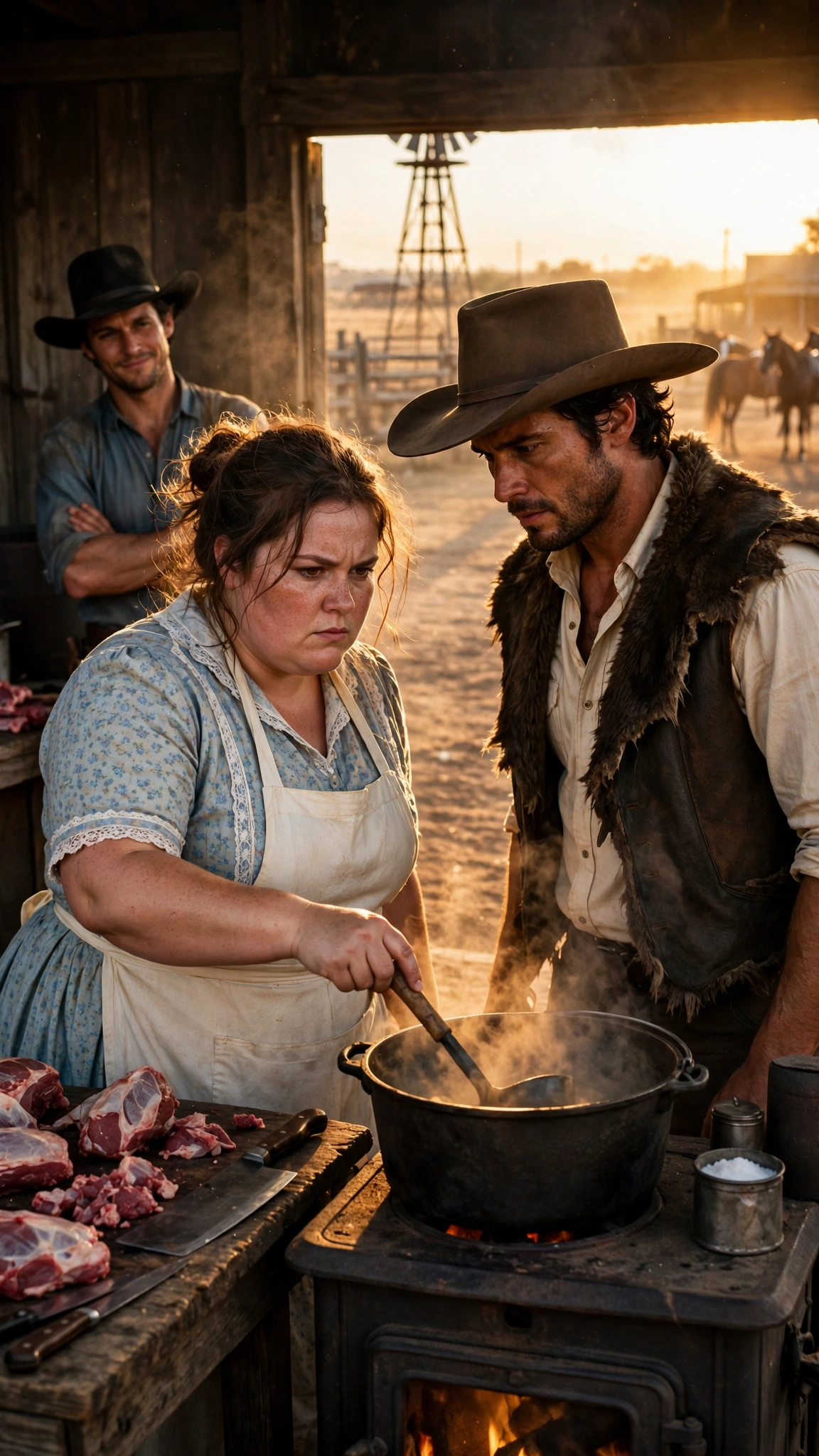
The goats were gone by morning.
Abigail discovered it the way she discovered everything in the cookhouse — by counting. She went to the far pen at first light with the feed bucket in her hand, and the gate stood open, and the pen stood empty, and the ground was churned with small sharp hoofprints going off toward the creek in a ragged line. She stood there for a long moment with the bucket in her hand, and she did not move, and she did not speak, and the cold of the morning settled into her bones.
Thirty men. Breakfast in two hours. And no meat.
She set the bucket down. She walked the fence line, slow, looking at the ground the way Thomas had taught her to look at the ground — not at the fence, but at the earth beneath it, where the truth was written. The gate had not blown open. The latch was undone, and the latch was the kind that takes a hand to undo, a hand that knows the trick of it, and the hoofprints went out in a rush, all at once, the way animals go when something has frightened them. And there, in the dust beside the gatepost, was a boot print. A man's boot, long and narrow, with a heel worn down on the outside edge. She knew that boot. She had seen it in the yard a hundred times. Wyatt Granger wore his boots down on the outside edge because he walked like a man who was always leaning into something.
She did not run to Caleb. She did not scream. She stood in the cold morning and she thought, the way her mother had taught her to think: what is true, what can be done, and what comes first. What was true was that the goats were gone. What could be done was that they could be found — goats do not run far, not at night, not in country they know, and they would have gone toward the creek for water. What came first was the men. Thirty men would come to the cookhouse at seven o'clock expecting breakfast, and if there was no breakfast, there would be trouble, and trouble was exactly what Wyatt wanted.
So she did the first thing first. She went back to the cookhouse, and she lit the stove, and she put the coffee on, and she made the cornbread — a double batch, because cornbread was cheap and filling and the men would eat it — and she fried the last of the salt pork she had been saving, and she set out the beans from the night before, and she made a breakfast that was not what she had planned but was enough, and when the men came in at seven o'clock, there was food on the table, and there was coffee in the pot, and nobody went hungry.
And then she went after the goats.
She told no one where she was going. She took the old mule from the stable — the one Silas had ridden to Waco, patient and slow — and she rode out toward the creek with a rope coiled over her shoulder and her father's old walking stick in her hand, and the morning sun came up behind her, and the prairie stretched out empty and gold in every direction. The hoofprints were easy to follow in the soft ground near the creek. The goats had gone down to the water and then scattered along the bank, the way goats do, nibbling at the brush, and she found the first three within an hour, caught up in a thicket of mesquite, and she tied them to the mule's saddle and went on.
She found the rest of the herd by mid-morning, gathered in a hollow near the creek where the grass was thick, and she was tying the last rope when she heard the horse.
Wyatt Granger rode down into the hollow slow, the way a man rides when he wants you to know he is not in a hurry, and he stopped his horse ten feet from her, and he looked down at her with the same smug smile he had worn in the yard, and he said, "Well. The widow rides out alone now."
Abigail did not look up. She finished the knot. She stood up, and she wiped her hands on her apron, and she looked at him, and her face was calm, and her voice, when she spoke, was calm too, because she had decided, standing in the empty pen that morning, that she was not going to be afraid of this man.
"The gate was open, Mr. Granger," she said. "The latch was undone. The goats went out in the night, and I have brought them back."
"Have you now," Wyatt said. "That is a shame. I was hoping they had run off for good. A cook with no meat to cook is not much of a cook, is she?"
"They did not run off," Abigail said. "Somebody opened the gate."
Wyatt smiled. He shifted in his saddle. He looked at the goats, and he looked at the mule, and he looked at her, and the smile never left his face, and that was the thing about Wyatt Granger that frightened people more than shouting ever could — he did it all with a smile, and then he denied it with the same smile.
"You are a suspicious woman, Mrs. Thornton," he said. "A man might think you were accusing somebody."
"I am not accusing anybody," Abigail said. "I am telling you what I found. The gate was open. The latch was undone by a hand. And there was a boot print beside the gatepost, long and narrow, with the heel worn down on the outside."
The smile flickered. Just for a second. Just enough for her to see it.
"You should be careful, Mrs. Thornton," Wyatt said, and his voice was soft now, and that was worse than the smile. "A woman alone on this ranch, with no husband, and a cabin at the edge of the land — a woman like that should be careful about the things she says, and the things she notices. Accidents happen out here. Gates open. Horses shy. People get hurt."
Abigail looked at him for a long moment. She thought about Martha's words — "He will do something quiet, when nobody is looking, and he will deny it with that same smile." She thought about the empty pen, and the breakfast she had made out of cornbread and salt pork, and the thirty men who would have gone hungry if she had panicked. She thought about Thomas, and the grave on the hill, and the promise she had made to herself.
Then she picked up the rope, and she turned toward the mule, and she said, over her shoulder, in the calmest voice she owned, "Thank you for your concern, Mr. Granger. But I am not alone. I have thirty men who eat at my table, and I have a roof over my head, and I have a debt that is being paid, one meal at a time. And if you want me gone, you are going to have to do better than an open gate."
She walked the mule out of the hollow with the goats trailing behind her, and she did not look back, and she did not hurry, and her heart was beating so hard she thought it might break her ribs, but she did not hurry. Behind her, Wyatt sat on his horse in the hollow for a long time, watching her go, and the smile was gone from his face, and in its place was something colder and harder, something that had not been there before.
By the time she reached the ranch, the sun was high, and the yard was full of men, and Caleb was standing by the cookhouse door with his arms crossed, and his face was dark. She brought the goats into the pen, and she latched the gate herself, and she tested it twice, and then she turned to him.
"The gate was open," she said. "Somebody opened it in the night. I found the herd by the creek and brought them back."
Caleb looked at her. He looked at the goats. He looked at the gate. He looked at the dust on her dress and the rope in her hand and the mule standing patient behind her, and something moved in his face — something she could not name, something that was not suspicion and not mockery, something closer to respect, or the beginning of it.
"Did you see who did it?" he asked.
"No," Abigail said. And then, because she had decided that morning that she was not going to be afraid, and because a cook does not lie about what is in the pot, she added, "But I know who did it. And so do you."
Caleb was quiet for a long moment. The yard went quiet around them. The men stopped what they were doing. Eli put down the harness he was mending. Sam stopped halfway to the well. And Caleb Reynolds looked at his cousin's boot print in the dust beside the gatepost — long and narrow, heel worn down on the outside — and he looked at Abigail Thornton, standing there in her flour-dusted apron with a rope in her hand and the morning sun on her face, and he said, very quietly, "Fix the latch. Double it. And from now on, the pen gets checked at dark and at dawn."
He turned and walked away. He did not say anything more. But that night, when Abigail went to close up the cookhouse, she found that someone had left a new padlock on the gate of the goat pen, heavy and iron, with a key tied to it with a piece of twine — and the twine was the kind Caleb used to tie his own tack, and she knew, without being told, who had put it there.
She put the key in her apron pocket. She locked the gate. And she slept that night with her mother's recipe book under her pillow, and the key in her pocket, and the knowledge that the man who had mocked her in the yard was now, quietly, on her side — or at least, that he was beginning to be.
The next morning, the men noticed the padlock before she did — or rather, they noticed that she carried the key on a piece of twine around her neck, tucked beneath her apron, and that she checked the gate twice, once at dawn and once at dark, the way Caleb had ordered. Eli watched her do it from the corral fence and said nothing, but the following morning he walked over and checked the latch himself before she arrived, and when she thanked him, he only shrugged and said, "A gate that stays shut is everybody's business, Mrs. Thornton." It was the first time any of them had treated the cookhouse as something they all had a part in guarding, and she carried that with her through the day like a small warm stone in her pocket.
The next morning, she told Martha about the hollow.
She told her at the cabin table, over coffee, while the sun was still low, and Martha listened without interrupting, which was unusual for Martha, and when Abigail was done, Martha set her cup down and said, "He threatened you."
"He did not threaten me outright," Abigail said. "He warned me. There is a difference, and he knows it, and that is what makes him dangerous. A man who threatens you outright can be answered. A man who warns you can always say he was only being kind."
Martha snorted. "Kind. That man would not know kind if it bit him on the leg. Listen to me, girl. He will try something else. Men like that always do. They try the gate, and when the gate does not work, they try the lock, and when the lock does not work, they try something worse. You have won twice now, and that is two times more than he expected, and he will not forgive you for it."
"What should I do?" Abigail asked.
"The same thing you have been doing," Martha said. "You count. You watch. You write it down. And you do not go anywhere alone if you can help it — not to the creek, not to the far pen, not anywhere a man can find you with no one watching. You are not afraid of him, and that is good, but being brave and being foolish are two different things, and I did not raise a foolish girl."
Abigail nodded. She finished her coffee. She went to the cookhouse, and she checked the pen at dawn, the way Caleb had ordered, and she checked it again at dark, and she did it every day after that, and the padlock held, and the goats stayed where they belonged, and the men ate, and the days passed, and the ranch went on — but she kept the key in her pocket, and she kept her mother's recipe book under her pillow, and she kept her eyes open, because Martha was right, and she knew it.
Wyatt Granger had not finished. He had only begun.