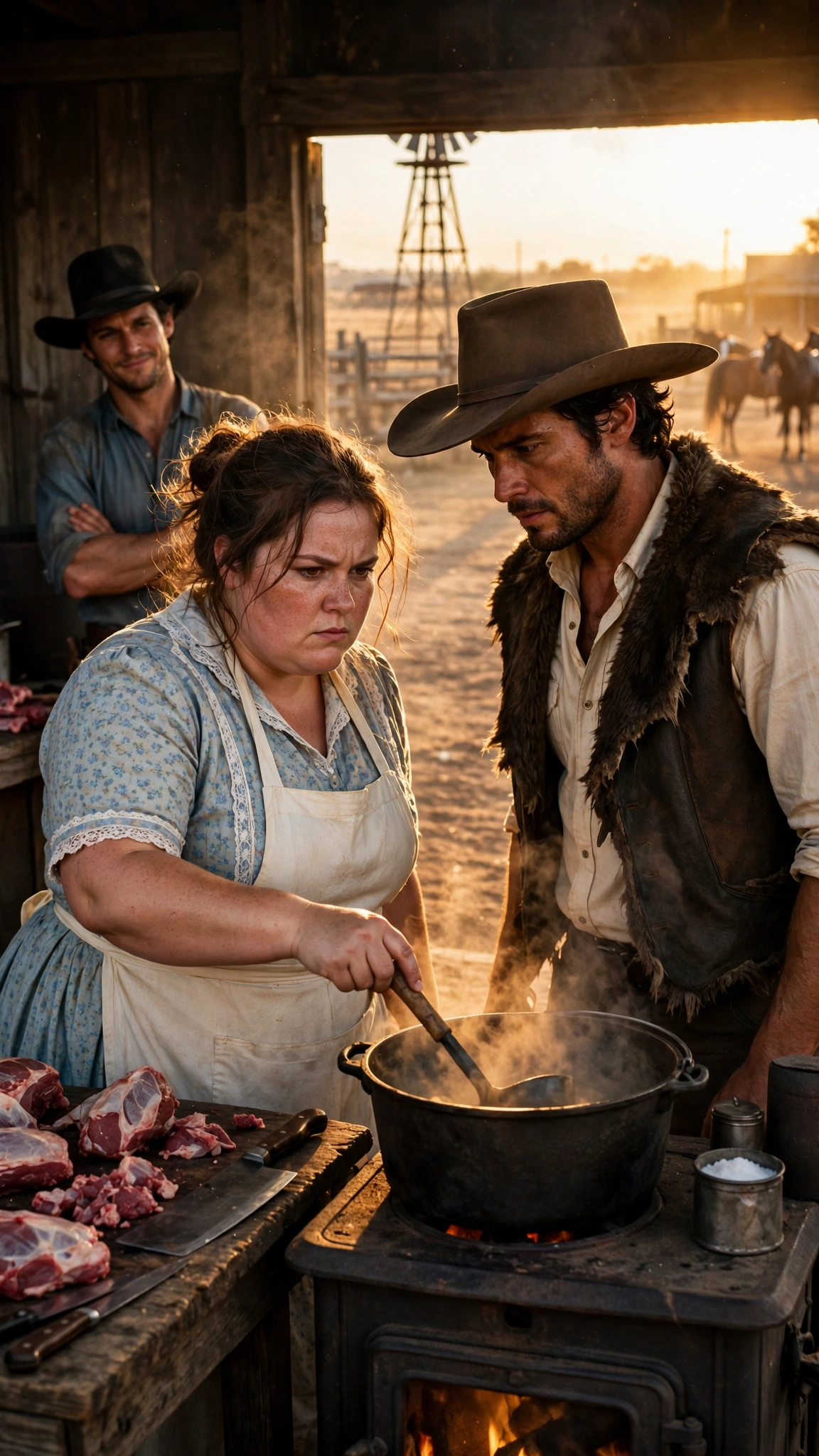
Abigail Thornton had never kept a ledger in her life, and she began to keep one on a Thursday, because her mother had taught her that a cook who does not count her stores is a cook who will be blamed for what goes missing.
It started with the coffee. She went to the store bin on Thursday morning to make the coffee, and the bin was lighter than it should have been. She knew how much coffee thirty men drank in a week — she had been making it for three weeks now, and she knew the weight of the scoop in her hand, and the bin felt wrong. She lifted the lid and looked inside, and she frowned, and she put the lid back on, and she said nothing.
Then it was the flour. On Friday, she went to measure the flour for the bread, and the sack was lighter than it had been on Monday, and she had not baked that much bread. She stood in the store with her hands on her hips and she counted in her head — Monday's bread, Tuesday's bread, Wednesday's bread — and the numbers did not add up. A sack of flour does not lose five pounds by itself.
Then it was the salt. On Saturday, she reached for the salt container — the small metal one that stood beside the pot, the same one Wyatt had reached for on the day of the goat meat — and it was nearly empty. She had filled it herself on Monday. Salt does not vanish. Somebody had taken it.
She did not tell Caleb. Not yet. She had learned, in the year since Thomas died, that an accusation without proof is worse than no accusation at all, because the man you accuse will smile and deny it, and the people listening will remember the smile and forget the accusation. So she did what her mother would have done. She got a pencil and a scrap of paper, and she sat down at the cookhouse table after supper, and she began to write it all down.
Monday: flour, full sack. Coffee, full bin. Salt, full container. Sugar, half a sack.
Tuesday: bread, two loaves. Coffee, three pots. Salt, one pinch.
Wednesday: bread, two loaves. Coffee, three pots. Salt, one pinch.
Thursday: coffee bin lighter than it should be.
Friday: flour sack lighter than it should be.
Saturday: salt container nearly empty.
She wrote it all down in her neat, careful hand, and she put the paper in her apron pocket, and she went to bed, and she lay awake for a long time thinking about it. Somebody was taking food from the cookhouse. Somebody was taking it quietly, in small amounts, the way a man takes things when he does not want to be noticed — a scoop of coffee here, a handful of flour there, a pinch of salt. It was the kind of stealing that adds up slowly, and the kind of stealing that a cook who does not count would never notice.
And then she thought about Wyatt Granger, and about the way he had smiled in the yard, and about the way he had stood in the hollow by the creek, and about the boot print beside the gatepost, and she thought about Martha's words — "I know who steals the sugar and who steals the salt" — and she understood, all at once, what Wyatt was doing.
He was not just trying to drive her off. He was stealing from the ranch, and he had been stealing for a long time, and the cookhouse was where the stealing happened, because the cookhouse was where the stores were kept. The old cook, Silas, had been too old and too tired to count. And a new cook — a widow, a woman, somebody who was supposed to be grateful just to have the job — a new cook was supposed to be too frightened to count, too.
But Abigail Thornton counted.
On Sunday morning, she went to the store before dawn, and she counted everything. She weighed the flour sack on the kitchen scale. She measured the coffee in the tin cup. She counted the sugar, and the salt, and the beans, and the dried chiles, and she wrote it all down, and she put the paper in her pocket, and she went about her day as if nothing had happened.
Wyatt came to the cookhouse that afternoon. He came when the men were out in the fields and the yard was empty, and he leaned in the doorway the way he always did, with his arms folded and his black hat pulled low, and he said, "Mrs. Thornton. How is the cooking?"
"Very well, Mr. Granger," Abigail said. She did not look up from the dough she was kneading.
"And the stores?" Wyatt asked. "Are the stores holding up?"
"The stores are fine," Abigail said.
"I am glad to hear it," Wyatt said. And then he walked across the cookhouse, slow, the way a man walks when he wants you to know he is not in a hurry, and he stopped beside the table, and he reached out, and his hand brushed against her apron — just for a second, just the lightest touch, the way a man might brush past a woman in a crowded room — and then he was gone, out the door and into the yard, and Abigail stood there with the dough under her hands and a cold feeling in the pit of her stomach, because she knew, without knowing how she knew, that something had just happened.
She put her hand in her apron pocket. Her fingers closed around something cold and round and hard.
A silver dollar.
She pulled it out and stared at it. It was bright and new, and it did not belong to her, and it had not been in her pocket that morning, because she had put her hand in that pocket a dozen times that day and there had been nothing in it but the scrap of paper with her numbers on it. Somebody had put it there. Wyatt had put it there. And she understood, in a single sickening moment, what he had done: he had planted a stolen coin on her, so that when it was found — and it would be found, because Wyatt would make sure it was found — she would look like a thief.
She stood in the cookhouse with the silver dollar in her hand, and her heart beat hard, and her first thought was to throw it away, to drop it in the stove, to pretend it had never been there. But her second thought was her mother's voice, clear as if her mother were standing beside her: "A cook does not lie about what is in the pot." And her third thought was that a woman who throws away the evidence is a woman who looks guilty.
So she did the bravest thing she had done since the day she buried her husband. She put the silver dollar back in her pocket, and she wiped her hands on her apron, and she walked out of the cookhouse and across the yard to where Caleb Reynolds stood by the corral, and she said, "Mr. Reynolds. I need to speak to you."
Caleb turned. He looked at her face, and his own face changed, because he could read her the way he could read a horse — he could see when something was wrong, and something was very wrong now.
"What is it?" he asked.
She took the silver dollar out of her pocket and held it up, and she told him everything. She told him about the coffee, and the flour, and the salt. She told him about the paper in her pocket with the numbers on it. She told him about Wyatt brushing past her in the cookhouse, and about the coin that had not been there that morning. She told him straight, and she told him true, and she did not cry, and she did not beg, and when she was done, she stood there in the yard with the silver dollar in her hand and she waited.
Caleb took the coin from her. He turned it over in his fingers. He looked at it for a long time. And then he looked at her, and his eyes were not cold, and they were not mocking, and they were not suspicious. They were the eyes of a man who had just been given a piece of a puzzle he had been trying to solve for a long time.
"Three weeks ago," he said, very quietly, "Hargrove at the store told me that the ranch account was short. Flour, coffee, salt — small amounts, every week, for months. I thought it was Silas. I thought the old man was taking a little extra for his daughter in Waco, and I let it go, because Silas had given me eleven years. But Silas has been gone for a month now, and the account is still short."
He held up the silver dollar. "And this," he said, "is from the store's cash box. Hargrove marks his coins. He cuts a small notch in the edge, so he knows which ones are his. See?" He turned the coin, and there it was — a tiny notch, cut into the rim, no bigger than a grain of sand.
Abigail stared at it. "Then Wyatt —"
"Wyatt has been stealing from the store for months," Caleb said. "And when you started counting, he knew you would find him. So he planted this on you, so that when the stealing came out, it would look like you did it."
He was quiet for a moment. The yard was quiet. The windmill turned. And then Caleb Reynolds did something Abigail had never seen him do. He reached out, and he took her hand — her flour-dusted, work-worn hand — and he held it for a moment, and he said, "Thank you for counting, Mrs. Thornton. And thank you for bringing this to me instead of throwing it away. That took more courage than most men on this ranch have got."
He let go of her hand. He put the silver dollar in his own pocket. He said, "Do not tell anyone about this. Not yet. I am going to Hargrove's tonight, and I am going to look at his books, and when I have the whole of it, I will deal with Wyatt Granger myself."
Abigail nodded. She went back to the cookhouse. She finished the bread. She made the supper. And that night, when she went to bed, she took the scrap of paper with her numbers on it out of her apron pocket, and she put it under her pillow beside her mother's recipe book, and she slept — not well, but better than she had slept in weeks — because for the first time since she had come to the Bar R, she knew that she was not alone in the fight.
Caleb Reynolds believed her. And a man like Caleb Reynolds, once he believes you, does not stop believing you.
The next morning, the cookhouse felt different. Abigail noticed it the moment she walked in at dawn — the way the room felt when something has changed and nobody has said what it is yet. Wyatt did not come to the doorway. He did not lean against the frame with his arms folded. He did not say a word to her all day. He took his breakfast at the far end of the table, and he ate it fast, and he left before the coffee was gone, and Jed went with him, and Jed would not meet her eyes.
The other men noticed. Men always notice when something changes in a room, even if they cannot say what it is. Eli watched Wyatt leave, and then he watched Abigail, and then he went back to his breakfast without a word, but he ate slower than usual, and he looked thoughtful, the way Eli looked when he was turning something over in his head.
That evening, after supper, Abigail sat at the cookhouse table with her pencil and her scrap of paper, and she turned to a fresh page, and she wrote at the top, in her neat, careful hand: "Wyatt Granger — what I know." And underneath it, she wrote three lines.
One: He opened the gate and drove off the goats.
Two: He planted a silver dollar in my pocket.
Three: He has been stealing flour, coffee, and salt from the store for months.
She read the three lines over twice. Then she folded the paper, and she put it in her apron pocket with the other one, and she went to the door of the cookhouse, and she looked out at the yard, where the sun was going down and the windmill was turning slow against a sky the color of cold ash, and she thought about the man who had gripped Wyatt's wrist over the pot and said, "Don't," and about the man who had put a padlock on the goat pen, and about the man who had held her hand in the yard and said, "Thank you for counting."
She was not alone in this fight. She had not been alone since the day she had walked into the cookhouse at dawn with her mother's recipe book under her arm. She simply had not known it yet.