Veronica had come into Alexander Carter's life on a Tuesday in April, in a flower shop on Peachtree Street, and Alexander had been there because his first wife had died three months earlier and someone had told him that lilies were appropriate for a grave, and he had not known anything about flowers. He had known about shipping routes and warehouse leases and the price of diesel, but he had not known anything about flowers, and Veronica had been standing at the counter, buying white roses for a dinner party, and she had turned and looked at him, and she had smiled, and she had said, "Lilies are for funerals. Roses are for the living. Which one do you need?"
He had married her eleven months later.
That was the story Alexander told people, when people asked. It was a good story. It was a romantic story. It was the kind of story that made people nod and smile and say that life goes on. What Alexander did not tell people — what he did not tell anyone, not even his closest friends — was that by the second year of the marriage, he had begun to understand what he had married.
It was not one thing. It was a hundred small things, each one too small to matter on its own, and all of them together adding up to something he could not ignore. The way Veronica looked at Matthew — not with dislike, exactly, but with a kind of blankness, as if the boy were a piece of furniture that had come with the house. The way she never asked about his school, or his friends, or the books he was reading. The way she talked about money — always about money, about the house, about the cars, about what they would have when Alexander's business grew, about the life they would live when they were rich enough to stop pretending. The way she went through his desk when she thought he was asleep. The way she asked, casually, about his will, and his life insurance, and who would get what if something happened to him.
Alexander was not a stupid man. He had built a logistics company out of a single truck and a secondhand warehouse, and he had done it by paying attention to small things — to the way a driver held his steering wheel, to the way a client paused before signing, to the way a number on a ledger did not quite add up. He paid attention to Veronica the same way, and what he saw frightened him. Not because she was cruel in any obvious way. She never raised her voice. She never struck the boy. She never did anything that a person could point to and call abuse. She was simply, quietly, completely indifferent to Matthew, and she was waiting. Alexander could feel her waiting, the way you can feel a storm coming when the air goes still.
And then, three years into the marriage, Alexander got sick.
It started small — a cough that would not go away, a tiredness that sleep did not fix, a pain in his side that he told himself was nothing. He went to the doctor because Matthew begged him to, because Matthew had already lost his mother and was terrified of losing his father too, and the doctor ran tests, and the tests came back, and the news was bad. The kind of bad that does not get better. The kind of bad that comes with a number of months, not years.
Alexander did not tell Veronica the full truth. He told her he was sick. He told her the doctors were working on it. He did not tell her how sick he was, or how little time he had, because by then he understood something about his wife that he had not understood when he married her: that if she knew he was dying, she would begin preparing for his death, and her preparations would not include Matthew.
So he prepared instead. Quietly. Carefully. The way he had built his company — one small, deliberate step at a time.
He went to a lawyer in Savannah, a man named Douglas Pryce, a man he had known for twenty years, a man who had never met Veronica and never would. He sat in Pryce's office, with the blinds drawn and the door closed, and he told him everything. He told him about Veronica. He told him about Matthew. He told him about the house and the money and the business, and he told him what he wanted, and Pryce wrote it all down, and together they made a new will — a revised will, executed six months before Alexander's death, with a different executor and different terms.
The house, and the money, and the business, would go into a trust for Matthew, to be held until he was twenty-one. Gabriel Carter — Alexander's older brother — would be the trustee and the guardian. Veronica would receive nothing beyond what the law required, which was very little, because Alexander had been careful, and because the house had been his before the marriage, and because the business had been his before the marriage, and because he had kept the accounts separate, the way Pryce had advised him to do years ago, when he was young and the business was small and nobody had thought it would ever be worth anything.
And then Alexander did the hardest thing he had ever done in his life. He wrote a letter to his brother.
Gabriel Carter was twelve years older than Alexander, and they had not spoken in twelve years. The quarrel had been over the family business — their father's trucking company, which Gabriel had wanted to sell and Alexander had wanted to keep — and it had been bitter, and stupid, and the kind of quarrel that only brothers can have, the kind that starts about money and ends up being about everything else. They had said things to each other that could not be unsaid. Gabriel had gone to Atlanta and become a lawyer, and Alexander had stayed in Georgia and built his own company, and they had not called, and they had not written, and their father's funeral, five years earlier, had been the last time they had been in the same room, and they had stood on opposite sides of the grave and not spoken a word.
But Alexander knew something about his brother that he had never forgotten, even after twelve years of silence: that Gabriel was an honest man. That Gabriel had a sense of right and wrong that was like a spine — it held him up, even when it was inconvenient, even when it cost him. That if Gabriel knew a child was in danger, Gabriel would come. That was the kind of man his brother was, and it was the only kind of man Alexander could trust with his son.
So he wrote the letter. He wrote it by hand, late at night, when Veronica was asleep, sitting at the kitchen table with the lamp on low, his hand shaking a little from the medicine, and he told Gabriel everything. He told him he was dying. He told him about Matthew. He told him about Veronica. He told him about the new will, and the trust, and the papers that Pryce was holding in Savannah. And he asked him — not as a brother, but as a father — to be the guardian of his son, and to come when the time came, and to bring the folder, and to do what was right.
He did not know if Gabriel would answer. He did not know if Gabriel would even open the letter. He put it in the mail anyway, and he waited, and a week later a letter came back — short, plain, in Gabriel's handwriting, the handwriting Alexander remembered from when they were boys — and it said only this: "I will come. I will bring everything. Your son will be safe. — G."
Alexander kept that letter in his desk drawer, under a stack of old invoices, where Veronica would never look. And he kept the most important thing of all in his head: the telephone number. Gabriel's number. Written on a folded piece of paper, in his own handwriting, big and careful, because his hands were shaking and he wanted his son to be able to read it.
He gave the paper to Matthew in the hospital, on the last day, when the machines were quiet and the nurses had stepped out and it was just the two of them, father and son, in a room with the blinds half drawn.
"Matthew," he had said, and his voice was weak, and he had to stop and breathe between the words. "I need you to listen to me. I need you to keep this safe. Do not show it to Veronica. Do not tell anyone about it. Keep it in your pocket, and use it only if you have no one else. Do you understand?"
Matthew had nodded, his eyes wide, his hand closed tight around the paper.
"He'll help you, son," Alexander had said. "He's my brother. He's a good man. He'll help you."
And then he had closed his eyes, and he had smiled, a small, tired smile, and he had said, "You are the best thing I ever did, Matthew. Don't you ever forget that."
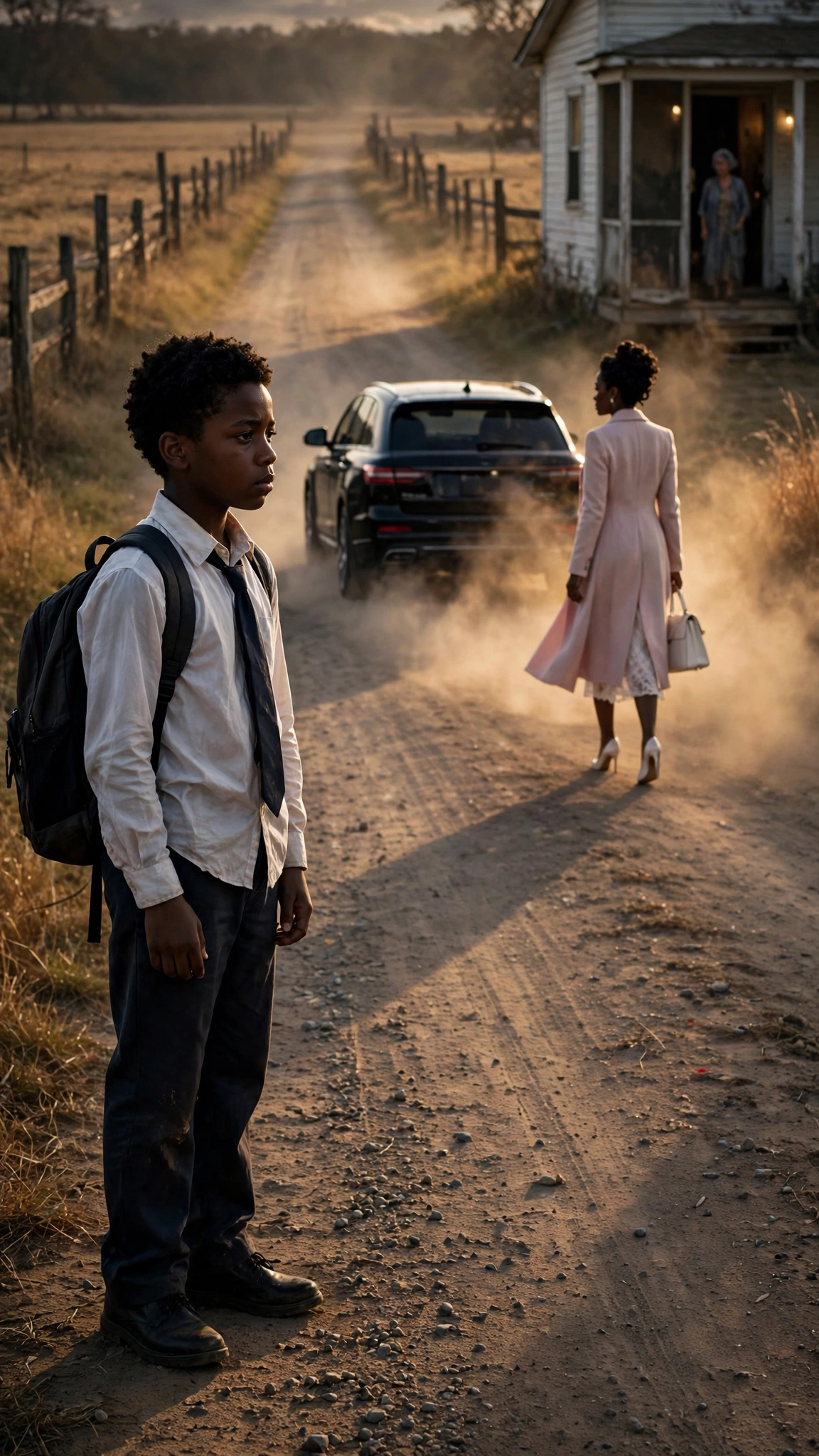
Those were the last words he ever said to his son. Matthew had held his hand until it went cold, and then the nurses had come, and then Veronica had come, dry-eyed and straight-backed, and then the long morning at the church, and the burial, and the drive, and the gravel road, and the words — "You're not coming home" — and the door slam, and the dust.
But Alexander had known. He had known all along. And he had prepared. And now, two days after his death, in a small house in Georgia, a telephone was ringing in Atlanta, and a man named Gabriel Carter was packing a folder full of papers, and getting into his car, and driving toward the boy his brother had trusted him with.
Gabriel had received Alexander's letter on a Thursday, in his office on the twelfth floor of a building in downtown Atlanta, and he had read it twice, standing by the window, before he had sat down. He had not cried. He had not cried in years — not when his wife died, five years earlier, not when his father died, not when his own son, the boy he had lost before the boy was even born, had been taken from him before he had a chance to be a father. Gabriel Carter did not cry. He did what he had always done when the world broke open: he made a list, and he started working through it, one item at a time.
First, he had called Douglas Pryce in Savannah, and he had listened while Pryce explained the will, and the trust, and the folder, and the papers, and Gabriel had said only, "I will come. I will bring everything." Then he had gone home to his empty apartment — an apartment that had been too quiet for five years, an apartment with a kitchen he never cooked in and a second bedroom he never opened — and he had packed a bag, and he had taken the folder from his desk drawer, where Pryce had sent it by courier that morning, and he had put it in his car, and he had driven south.
The drive took hours, and Gabriel did not stop, and he did not turn on the radio, and he thought, the whole way, about his brother. He thought about the two of them as boys, in their father's yard, throwing a baseball until the light failed, and he thought about the quarrel — the stupid, pointless quarrel about the trucking company, about money, about who their father had loved more — and he thought about how small it seemed now, how small it had always been, and how he had let twelve years go by without picking up the telephone, and how his brother had died, and how his brother's son had been left on the side of a road, and how none of it could be undone, but some of it could still be made right.
He stopped once, at a gas station outside Macon, and he bought coffee, and he stood beside his car for a moment, looking at the fields, and he thought about Alexander's letter — the last line of it, the line that had stayed with him more than any other. "I know we have not spoken, brother. I know I have no right to ask. But he is my son, and he is ten years old, and he is alone, and you are the only person I trust. Please. Come for him."
Gabriel had read that line a dozen times. He had folded the letter and put it in his jacket pocket, next to his heart, and he had kept it there ever since, and he would keep it there until the day he died, because it was the last thing his brother had ever asked of him, and because it was the first thing his brother had asked of him in twelve years, and because a man who has lost his wife, and his father, and his unborn child, does not walk away from the one thing he can still do right.
He got back in the car, and he drove on, toward Georgia, toward the small house, toward the boy, and the folder sat on the passenger seat beside him, heavy with papers, heavy with the truth, and Gabriel drove with one hand on the wheel and the other hand resting on the folder, the way a man rests his hand on something precious, and he did not stop again until he saw the house, and the porch, and the boy standing on it, frozen, one hand on the railing, looking at him with his father's eyes.