The night Dominic Castellano threw his wife out of his house, it was raining.
Evelyn remembered the rain more clearly than she remembered his words. It drummed on the roof of the Hudson Valley house and ran down the tall windows in silver streams, and the four babies — two years old then, small and warm and bewildered — cried in their cribs because the shouting had woken them.
Dominic had come home from his office with Gabriel's envelope in his hand and his face like stone. He had laid the papers on the dining table — a DNA report, stamped and signed, with numbers and charts that Evelyn did not understand — and he had said, very quietly, "Tell me these children are mine."
She had looked at the papers. She had looked at him. And for one terrible moment, she had thought about telling him everything: about the rooftop, about the last night with Lucas, about the month she had waited too long to speak. But the report said more than that the children were not his blood. It said the children had been conceived during their marriage. It said she had betrayed him in his own house, in his own bed, while he was building a life for her. And she knew, with a certainty that turned her stomach to ice, that if she said the dates were wrong, he would not believe her. The paper looked so official. The numbers looked so certain.
"I was pregnant when we married," she whispered. "I didn't know until after. I was afraid to tell you."
Dominic stared at her. His gray eyes, which had once looked at her with such tenderness, went flat and cold. "You lied to me," he said. "For two years, you lied to me. You let me love children who were never mine. You let me hold them and read to them and call myself their father, and all the time you knew."
"I never cheated on you," she said. "I swear on the lives of my children, Dominic, I never cheated on you. The dates in that report are wrong."
"Then whose are they?" he asked.
And she could not answer. Because the answer was Lucas, and Lucas was gone, and saying his name would only make it worse. It would sound like a confession. It would sound like she had loved another man all along — and in a way, she had. Not the way Dominic meant. But the truth was tangled, and she was tired, and the babies were crying, and Gabriel was standing in the doorway watching it all with his cold, satisfied eyes.
"Pack your things," Dominic said. "You and the children will leave tonight."
She left with four small suitcases, four babies, and the clothes on her back. The prenuptial agreement she had signed without reading — Gabriel had drawn it up — gave her almost nothing. Dominic's lawyers were efficient. Within a week, the divorce was filed. Within a month, it was final. Evelyn Hart was a single mother of quadruplets with no job, no home, and no family, living in a two-room apartment in Queens above a bakery that smelled of bread at five in the morning.
She survived the way mothers survive: by not stopping. She worked nights cleaning offices while the babies slept in a row on a mattress on the floor. She worked days at the gallery that had once fired her — the owner, an old woman with a soft heart, took her back out of pity and then out of respect, because Evelyn worked harder than anyone. She learned to cook for five on almost nothing. She learned to cut four small heads of hair with kitchen scissors. She learned to read four children to sleep with four different voices, because each of them wanted their own story.
Layla was the leader, even at two. She had her father's large fawn eyes and her mother's stubborn chin, and she organized her siblings the way a small general organizes an army. Noah was watchful and quiet, always the first to notice when his mother was tired. Mia clung to Layla's hand and to her mother's skirts, and cried when anyone raised their voice. Leo was the smallest and the bravest, the one who climbed everything and fell off everything and got up laughing.
They were poor. But they were together. And Evelyn told herself, every night, that together was enough.
Lucas came back to New York a year after the divorce, and he came back by accident. His firm had won a project in Manhattan — a library, a small beautiful building on the Upper West Side — and he walked into a coffee shop on a Tuesday morning and saw a woman with long auburn wavy hair and four small children, and his heart stopped.
He followed them. He was not proud of it, but he followed them, all the way to the gallery, and he stood across the street for an hour, watching her through the window, until she looked up and saw him. She came outside. They stood on the sidewalk with the traffic rushing past, and neither of them knew what to say.
"You have four children," he said at last.
"Yes," she said.
"Are they—" He stopped. He could not finish the question.
"They're mine," she said. And then, because she was tired of lying, because she had lied to one man and lost everything and she would not lie to another, she added, "They're yours, Lucas. They were always yours. I'm sorry."
He did not speak for a long time. He looked at the four small faces pressed against the gallery window, watching him with enormous eyes, and he thought about the letters he had written — a hundred letters, every day for six months — and the silence that had answered him. He thought about the night he had held two of them in a hospital room, and the woman he loved telling him to go away.
"I wrote to you," he said. "Every day. Did you get my letters?"
"I never got a single one," she said.
And that was the moment the story began to change. Because Lucas was an architect, and architects notice structures, and the structure of what had happened to them did not make sense. A man writes a hundred letters and none arrive. A woman marries a billionaire three months after her lover leaves. A DNA report appears, perfectly timed, in the hands of a cousin who has always wanted the family fortune. Lucas did not know who had done it. But he knew that someone had.
He did not ask Evelyn to take him back. He asked her to let him help. He fixed the leaking tap in her apartment. He brought groceries. He sat on the floor and built towers out of wooden blocks with four small children who climbed all over him and called him "Mr. Lucas" and fell asleep on his chest. He was gentle and patient and kind, and slowly, very slowly, Evelyn began to trust him again. Not with her heart — not yet — but with her children. And for a mother, that is the same thing.
While Evelyn was learning to survive, Dominic Castellano was learning to be empty.
The house in the Hudson Valley was too big without the sound of small feet on the stairs. He came home from the office to silence. He ate dinner alone. He slept alone. He told himself he had done the right thing — that a man who had been betrayed had no choice — but at night, when the house was dark, he remembered Layla's small hand in his, and the way Noah had looked up at him when he came home, and the sound of four small voices shouting "Daddy!" from the top of the stairs. And he drank, and he worked, and he pretended that the ache in his chest was only anger.
Gabriel was always there. Gabriel, with his smooth voice and his silver hair and his cold eyes, telling Dominic that he had done the right thing, that Evelyn had used him, that a man like Dominic deserved a wife who would not lie to him. Gabriel, who arranged the dinners and the introductions and the slow, careful campaign to marry Dominic to Vanessa Laurent, the daughter of a shipping magnate whose fortune, joined to the Castellano empire, would make the family untouchable. Gabriel, who would manage the merger. Gabriel, who would control the money. Gabriel, who smiled and said, "Trust me, cousin. I only want what's best for you."
Ambrose watched all of it from his house on the hill, and he said nothing. He was an old man, and he was tired, and he had kept one secret too many. His heart was failing — the doctors had told him so, quietly, in the way doctors tell old men things they already know — and he thought about the photograph in his desk drawer every day. He thought about the night the babies were born, and the young man holding two of them, and the watch in his pocket that had stopped at three-fourteen in the morning and never ticked again.
He had kept the secret to protect Evelyn. Now he understood that his silence had protected only Gabriel.
One afternoon, in the second year after the divorce, Ambrose drove himself to Queens. He found the gallery. He stood outside for a long time, watching his grandchildren through the window — four small children, drawing pictures at a table in the back — and then he went inside and asked for Evelyn.
She came out of the back room with paint on her hands, and when she saw him, she went very still.
"Mr. Castellano," she said.
"Evelyn," he said. "I owe you an apology. And I owe you something else." He took an envelope from his coat and held it out to her. "I had the dates checked. Quietly. By a doctor I trust. Your children were conceived before your wedding, Evelyn. I knew it the night they were born. I did the math then, and I said nothing, because I was a coward. I'm sorry."
She took the envelope with shaking hands. Inside was a letter from a doctor, and a copy of a hospital record, and a photograph — the photograph he had taken that night, of her in the hospital bed, holding two of the babies, with Lucas standing beside her holding the other two.
"I kept this," Ambrose said, "because I thought it would protect you. I was wrong. It protected the man who lied about you. If you ever decide to fight back, Evelyn — if you ever decide to walk into a room and tell the truth — I will be standing behind you. And so will this."
She looked at the photograph for a long time. Then she looked at the old man, at his white hair and his deep wrinkles and his piercing dark eyes, and she saw that he was crying.
"Thank you," she whispered.
She did not fight back — not then. She was not ready. The children were three years old. She had a job and a home and a man who was slowly, carefully earning her trust again. She put the envelope in a drawer and went back to her life. But she kept it. She kept it the way a woman keeps a weapon she hopes never to use.
It took one more year — and one more piece of news — to make her use it.
The news came in the form of a wedding invitation, printed on thick cream paper with gold lettering, delivered to the gallery by a courier who did not know what he was carrying. Dominic Castellano and Vanessa Laurent requested the honour of your presence at their marriage. Evelyn read it twice, and then she sat down very slowly, because her legs had stopped working.
He was getting married. The man who had thrown her out was marrying a girl young enough to be his daughter, in a grand hall full of flowers, while her children ate bread and jam in a two-room apartment above a bakery. And Gabriel — Gabriel would be there, smiling, managing everything, one step closer to the fortune he had always wanted.
That night, Evelyn opened the drawer. She took out Ambrose's envelope. She took out the photograph. And she called Lucas, and she called a lawyer, and she called a laboratory, and she began to plan.
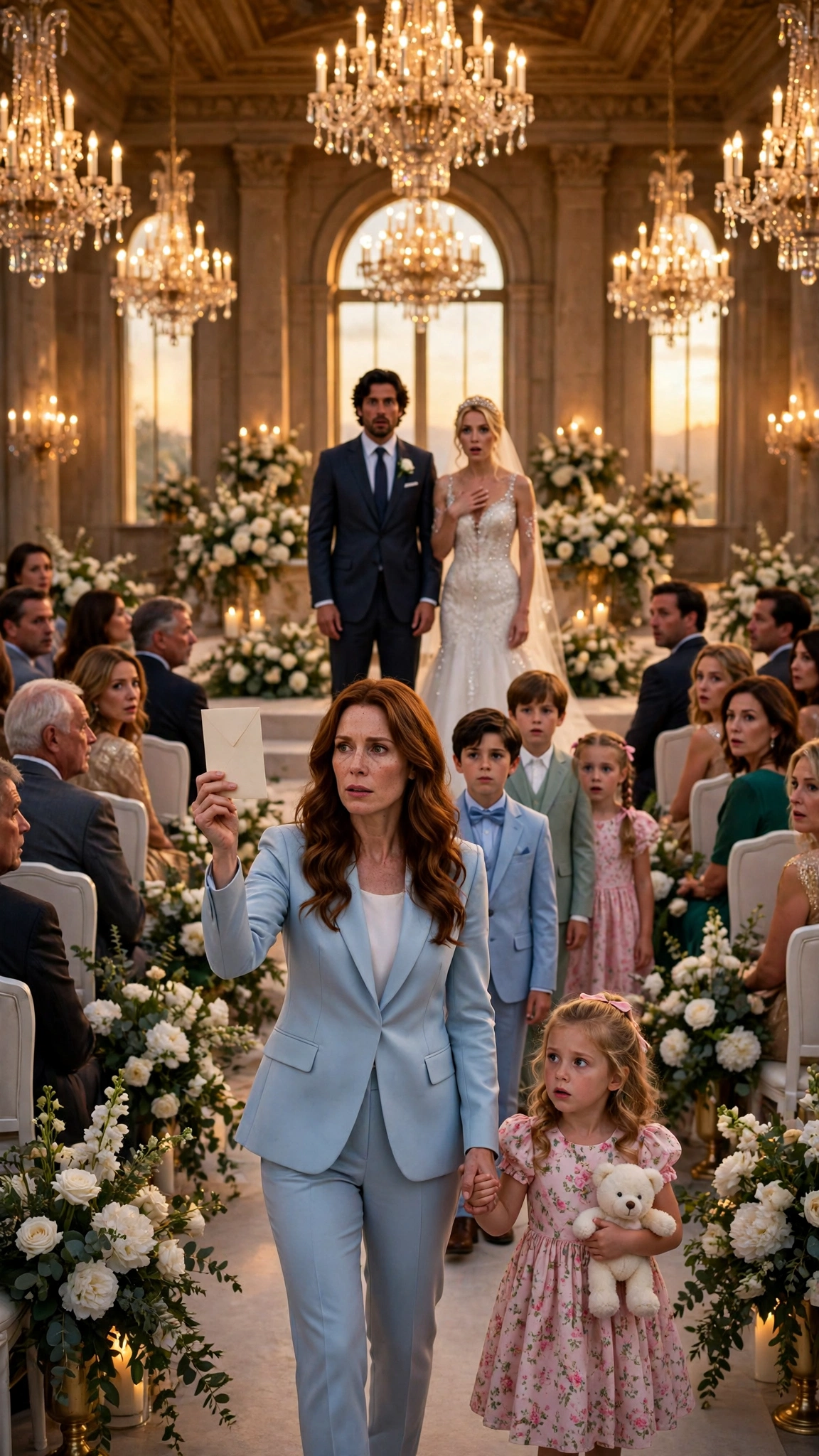
She would need a real DNA test — one that no one could forge, one done in the open, with witnesses. She would need the hospital records. She would need Ambrose. And she would need the courage to walk into a wedding hall full of two hundred people who believed she was a liar, and stand in the center aisle with her four children, and speak the truth.
It took her six months to get everything she needed. Six months of quiet phone calls and careful paperwork and long nights sitting at her kitchen table, while the children slept in a row on the mattress and Lucas sat across from her, holding her hand.
And when it was ready — when the envelope was sealed and the photograph was in her bag and the children were dressed and Layla had her teddy bear — she looked at herself in the mirror, put on her light blue suit, and said to the woman in the glass, "It's time."