The organ stopped.
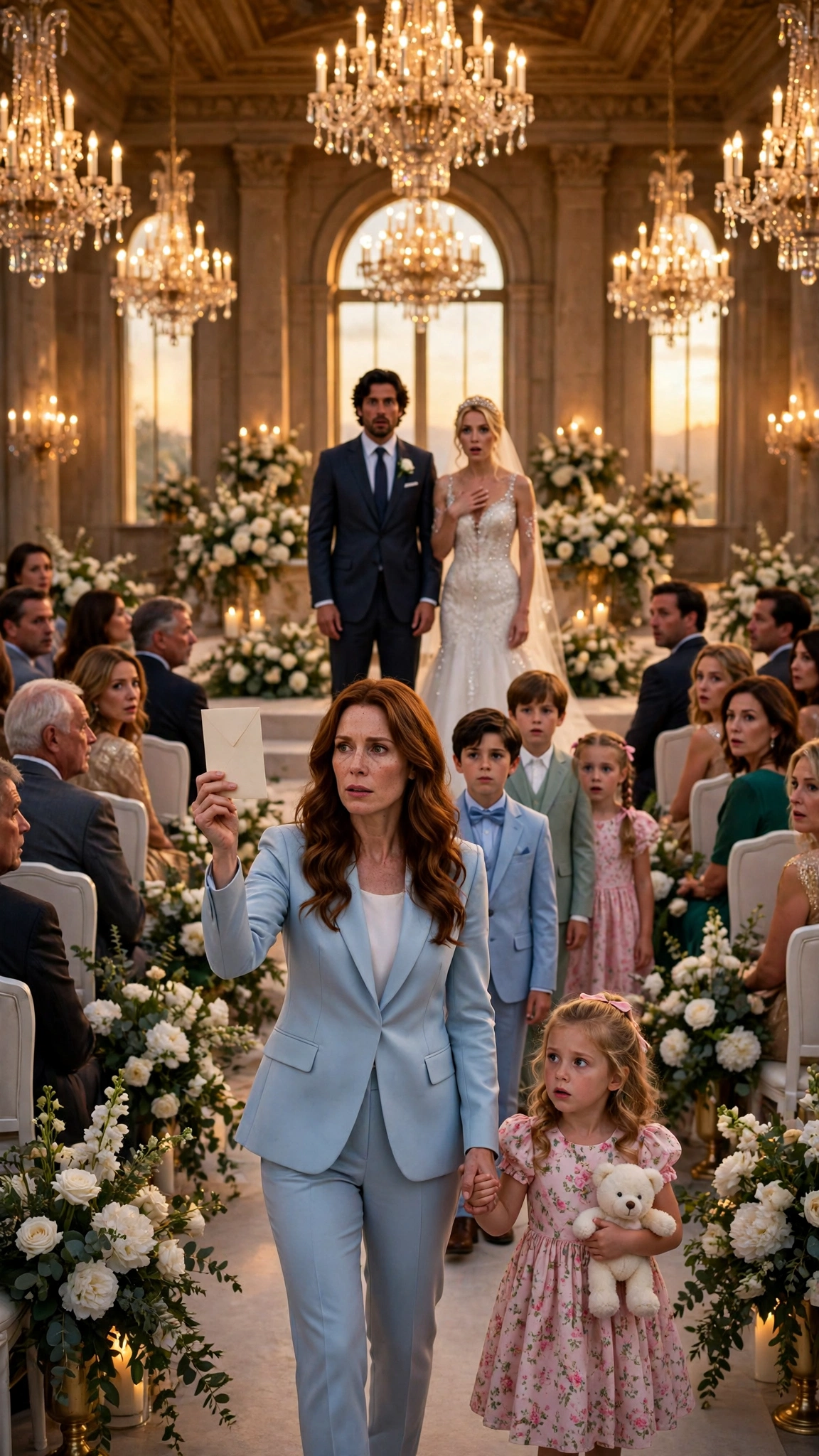
Evelyn had expected the music to stop. She had not expected the silence that followed — a silence so complete that she could hear her own breathing, and the small white sandals of her daughter on the marble, and the rustle of two hundred guests turning in their seats to stare at her. The hall was vast, with high ceilings and crystal chandeliers that threw prisms of light across the white chairs, and the warm golden light from the tall windows fell on the red rose petals scattered down the aisle, and for a moment, Evelyn could not move. She stood in the center of the hall with her hand wrapped around Layla's fingers, and she felt the weight of every eye in the room, and she thought: this is the hardest thing I will ever do.
Dominic stood at the altar with the envelope in his hand, the DNA report open, his face white. He looked at the children. He looked at Evelyn. And then, slowly, he turned to the bride.
"Vanessa," he said. "Vanessa, why are you afraid? What haven't you told me?"
Vanessa Laurent looked at him, and her blue eyes were wide with something that was not surprise. It was fear — the fear of a woman who has been found out. Her bouquet shook in her hands. Another white rose fell to the marble.
"Dominic," she whispered. "Please. Not here. Not like this."
"What haven't you told me?" Dominic said. He took a step toward the altar, the envelope still in his hand. "Vanessa. Look at me. What haven't you told me?"
She looked at him. And then she looked at Evelyn, standing in the aisle with her four children, and something in her face broke — not into tears, but into a terrible, exhausted honesty.
"I knew," she said. Her voice was so quiet that the guests in the front row leaned forward to hear it. "I knew the report was forged. Gabriel told me — the week before the wedding, he told me, because he needed my father's signature on the merger papers, and he thought that if I knew what was at stake, I would keep quiet. He said you had been pregnant before the wedding, Evelyn. He said the dates were real and the report was a lie, and that if anyone found out, the merger would fall apart and my father's company would be ruined. And I said nothing. I stood here, in this dress, and I said nothing, because I was afraid of my father, and I was afraid of Gabriel, and I was afraid of losing everything. I'm sorry, Dominic. I'm sorry, Evelyn. I was a coward."
The silence that followed was worse than shouting. Two hundred guests sat frozen, and the only sound in the hall was the soft tick of the great clock above the doors.
Gabriel stepped forward. He had been standing near the altar, watching, his face a mask of charm — but now the mask was cracking. His eyes showed panic. He moved toward Dominic, his hand outstretched, as if to take the papers away.
"Dominic," he said urgently, "don't listen to her. She's lying to save herself. She's trying to humiliate you, in front of everyone, on your wedding day. Those results are fake. She paid for them. She—"
"Stop." Dominic's voice was quiet, but it cut through the hall like a knife. He looked at his cousin, and for the first time in his life, he saw the panic in Gabriel's eyes, and he understood what it meant. A man who has nothing to hide does not panic. "Gabriel," he said slowly, "you told her. You told her the report was forged. You knew the dates were real, and you told her to keep quiet. Was that true?"
Gabriel's mouth opened. He looked at the guests. He looked at Vanessa. He looked at Evelyn, standing in the center aisle with her four children, holding his future in her small black handbag. "Dominic," he said, his voice sharp and desperate, "no more secrets. Not today. Please. We can talk about this in private—"
"No," Dominic said. "No more secrets. Not today. Not ever again." He turned to the room. "My cousin gave me a report five years ago that destroyed my marriage. This woman" — he looked at Evelyn — "says the report was a lie. And now my bride tells me my cousin knew it was a lie. I want to know the truth. Right now. In front of everyone."
And then, from the front row, a chair scraped back, and an old man stood up.
Ambrose Castellano rose slowly, with the careful dignity of a man whose heart was failing and who had decided that he would not die a coward. He was sixty-five years old, white-haired, with deep wrinkles and piercing dark eyes, and he wore an elegant black suit with a subtle navy tie. In one hand he held his silver pocket watch. In the other, he held an old photograph.
The hall went silent. Even the chandeliers seemed to hold their light.
"Dominic," Ambrose said, and his voice carried to the back of the hall, "sit down. I have something to show you."
Dominic sat. He did not know why. He only knew that his father had never spoken to him in that voice before.
Ambrose walked to the center of the aisle, slowly, his shoes loud on the marble. He stopped beside Evelyn. He looked at her, and his eyes were full of sorrow and love. "Forgive me," he said softly. "I should have done this four years ago."
Then he turned to the room, and he held up the photograph.
It showed a young Evelyn in a hospital bed, pale and exhausted and radiant, holding two newborn babies wrapped in white blankets. Beside her stood a young man with short black hair and warm brown eyes — Lucas Papadopoulos — holding the other two babies in his arms, looking down at them with wonder. On the back of the photograph, in Ambrose's careful handwriting, was a date. The date the quadruplets were born. And the date, Ambrose explained, that proved everything.
"This photograph was taken the night the children were born," Ambrose said. "I was there. I took it myself. This young man is Lucas Papadopoulos. He is the children's father. He flew home that night from Milan to see his children, and Evelyn sent him away because she was afraid. She was afraid of losing her marriage, and she was afraid of losing her children, and she was right to be afraid — because the man who should have protected her chose to believe a lie instead."
He turned to Gabriel. "And the lie came from you, nephew. You forged the report. You paid the laboratory. I have the bank record. I have kept it for a year, waiting for the day I would have the courage to use it. That day is today."
Gabriel's face went white. He took a step backward. His mouth moved, but no words came out. Around him, two hundred guests stared, and the silence was so deep that Evelyn could hear her own heartbeat.
Dominic looked at the photograph. He looked at the young man in it — the man with the warm brown eyes, holding two babies — and then he looked at Layla, standing beside her mother in her pink floral dress, with her large fawn eyes and her dimples and her long light-brown wavy hair. He had always thought she looked like Evelyn. Now he saw it. She looked like Lucas. She had always looked like Lucas. He had simply never allowed himself to see it.
His eyes filled with tears. His hands, still holding the DNA report, began to shake. And the devastating truth settled over him like a weight he would carry for the rest of his life: he had thrown away the woman he loved, and four children he had loved as his own, because he had believed a liar. The children were never his by blood. But they had been his in every way that mattered — and he had given them up for a piece of paper.
He looked at Evelyn. "I'm sorry," he whispered. "God forgive me, Evelyn. I'm sorry."
Evelyn looked back at him, and her face was calm, and her eyes were dry, because she had cried all her tears years ago, in a room above a bakery, and there were none left. "I know," she said. "I know you are."
Behind them, Vanessa Laurent set down her bouquet, very gently, on the altar. She looked at Dominic, and at Evelyn, and at the four small children, and she did the bravest thing she had ever done in her life.
She walked out of the hall — not in anger, not in tears, but with her head held high, because she had just watched a family break apart and come back together in front of her, and she understood that her place was not in it.
The wedding was over. It had never really begun.
Before Vanessa left, Dominic stopped her at the doors. The hall was nearly empty by then, the florist already gathering the white roses, the waiters folding the chairs. She stood with her bouquet forgotten on the altar behind her, her veil pushed back, her face pale but composed.
"Vanessa," Dominic said, and his voice was gentle now — the gentleness of a man who has just learned how much damage silence can do. "Thank you. For telling the truth, even when it cost you everything. I know what it took."
She looked at him, and for a moment her composure slipped, and she was simply a young woman of twenty-eight who had almost married a stranger for her father's sake. "I should have told you the day Gabriel told me," she said. "I will carry that for a long time."
"Then carry it forward, not backward," Dominic said. "Go to Florence. Study art. Live the life you wanted before your father decided it for you. And if you ever need anything — a reference, a friend, a door opened — you have it. From me. From all of us."
Vanessa's eyes filled. She nodded, and she turned to Evelyn. "You were the bravest woman I have ever seen," she said quietly. "I hope your children grow up knowing that."
Evelyn took her hand and squeezed it once. "They will," she said. "And I hope you grow up knowing it too."
Vanessa walked out into the golden evening light, and for the first time that day, she was smiling.
Evelyn watched her go, and she thought about how easily it could have been her — how easily a frightened young woman could become a silent one, and how the silence could rot a whole family from the inside. She squeezed Layla's hand a little tighter, and she was glad — fiercely, suddenly glad — that she had chosen, at last, to speak.
But the story — the real story — was only just starting.
Outside, on the steps of the hall, the guests lingered in the golden evening light, and the talk was of nothing else. A woman from the fifth row told her husband that she had always known there was something wrong about Gabriel, that she had seen the way he watched Dominic, the way he smiled when other people were unhappy. A man who had done business with the Castellanos for twenty years shook his head and said that he had never trusted a forged paper in his life, and that Dominic should have known better. And an old friend of Ambrose's, a judge retired now, said quietly that he had seen many families break apart in his courtroom, and very few put themselves back together — but that the woman in the light blue suit had the look of someone who would.
Evelyn gathered her children on the steps, counting them the way she always did — one, two, three, four — and she straightened Layla's dress, and wiped a smudge of dust from Leo's cheek, and she did not cry. She had cried enough. She took their small hands in hers, and she looked back at the hall one last time, at the tall windows and the white chairs and the arch of flowers that had been built for a wedding that would never happen, and she thought: I came here to tell the truth. I told it. Whatever happens next, I told it.
Behind her, in the doorway, Dominic stood watching her go, and Ambrose laid a hand on his son's shoulder, and neither of them spoke. There was nothing left to say that evening. The truth had been spoken. Now it had to be lived.