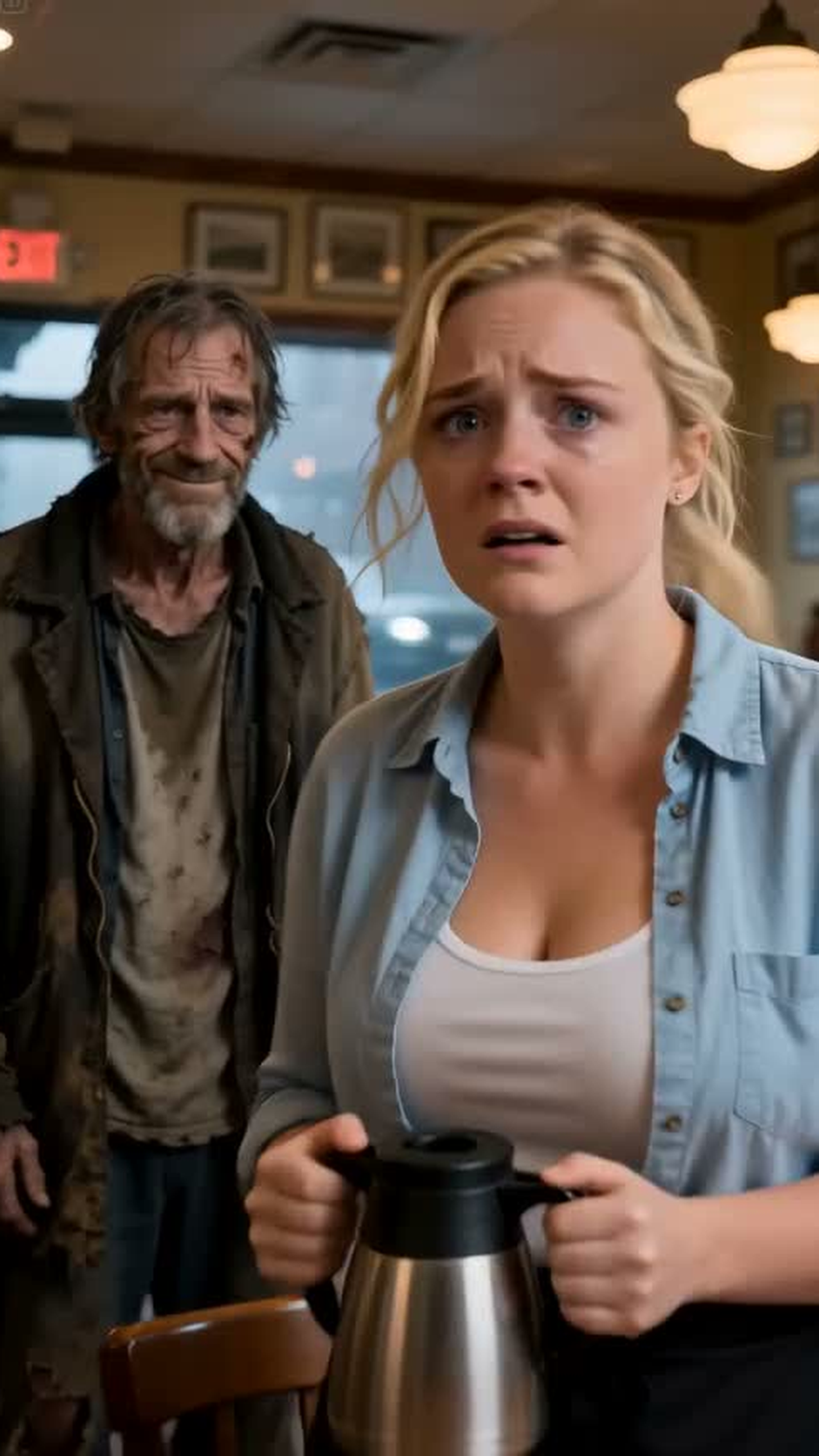
The photograph was in the hands of Adrian Moretti's people by eight the next morning, because Emma — after a night spent listening to her building breathe — had done the thing that surprised her most in a week of surprises: she had asked for help, out loud, like a grown woman, and meant it.
"The text was sent from a burner," said the quiet man Adrian had posted at the Kettle's door, an ex-something named Ilya whose politeness had a military finish. "The photo is from Tuesday. Before the video. Before anybody knew your name, Miss Lawson." He looked at her with professional sympathy. "Which means it isn't about fame. Somebody was already watching the diner. Watching him. And now they've seen what he thinks of you — and what he thinks of you, they're afraid of."
"Why would anybody be afraid of me?" Emma said. "I'm a waitress. I have a bus pass and opinions about pie."
"You also," Ilya said, "have something no one in that family has managed to buy in forty years of trying, which is why the gentleman will be at the noon service in person and why I will be at this door until he is. Your mother has a man on her building now, around the clock. He is dull, reliable, and extremely fond of her cooking shows through the wall. She has already fed him twice. I have reported this as a security concern." The corner of his mouth moved perhaps a millimeter. "She told him he looked peaked."
"Because my father," Adrian said, arriving with the rain still on his shoulders and two coffees he had apparently bought elsewhere out of some obscure point of honor, "has spent forty years teaching this city that his favor is a fortune and his attention is a weapon. And on Thursday, in front of four million people, he looked at you and said: she is the one." He set a coffee in front of her. It was, she noted despite everything, exactly how she took it. "Every enemy he has — and he has been collecting them since before you were born — now believes you are the key to something. The tragedy, Miss Lawson, is that so does he."
"Emma," she said. "If people are photographing me through windows, we've outgrown Miss Lawson."
"Emma." He said it like a man accepting a treaty term. "Then I'll tell you what he won't. Come and hear it from him. He'll be here at noon. He refuses bodyguards, he refuses the car, he says a man should be able to walk three miles in his own city. My men are behind him at six hundred yards having a collective heart attack." He rose, and paused. "Whatever he asks you today — and he will ask you something; the examination is never finished with my father — you may refuse. It will not change what you did. I want that understood between us before he starts being charming. He's very good at it. It's how he built everything."
He came at noon in a gray suit that fit him like a birthplace, clean-shaven, shod, upright — and the Kettle's lunch crowd performed the rare and beautiful maneuver of pretending, in unison, not to notice a famous man, which meant noticing him at maximum intensity with their peripheral vision. He took the third stool. He ordered the chicken.
"Your grandmother," Salvatore Moretti said, when Emma set the plate down, "used to stand exactly where you're standing, with exactly that expression, when she thought I was lying about having eaten."
Emma's hand stopped halfway back to the pass.
"Spring of eighty-six. I was twenty-six years old and rich in everything except money, food, prospects, and sense. Your grandfather had just refused her — did you know that? No. Family edits. She was working double shifts here because this place—" his palm rested flat on the counter, gently, the way you touch a sleeping animal "—was new then and drowning, and her young man wanted her to quit and be sensible. She fed me nine mornings out of her own staff meal. Stood right there. Told me I had a face like a famine painting and it was bad advertising for the street."
"She never told me she knew you," Emma said. "She told everybody she knew you. Movie stars. The Pope, once, during a documentary. Grandma said she'd fed half of history."
"She fed one broke boy who became me." He turned his coffee cup a half-turn on its saucer, precise as the fork beside the plate in the rain. "I made her a promise when I left this street with a job and a loan she co-signed with a character reference that would have indicted her in any court — pay it forward when you're rich, handsome, she said. So I built the Foundation in my wife's name. Eleven thousand meals a month, Emma. Kitchens in nine neighborhoods. Trucks. A gala." His voice went dry as paper. "And somewhere between the brass plate and the annual report, it stopped being a promise and became a machine. Meals counted. People processed. My director speaks of hunger as 'food insecurity metrics.' Three audits postponed. Two million dollars unaccounted for in eighteen months, and my own consigliere pouring warm oil on my hands — patience, Sal, you're retired, let the machine run."
The diner hummed around them — silverware, steam, the low music of other people's lunches — and at the third stool, in a low voice, a king described the rot in his kingdom to a waitress.
"Someone inside is stealing food from the hungry and selling my name back to me as the receipt," he said. "I cannot trust my own house to find it. Every person I'd send is a person Carlo has poured oil on for thirty years — or a person Adrian has frightened, which amounts to the same silence. I sat out in the rain for nineteen days in the city I built, Emma, asking one question: is there anybody left who feeds a man because he is hungry?" He looked up at her, and the spring-water eyes were not cold at all. "Nineteen days. Churches. Cafés. My own foundation's flagship kitchen turned me away from its door, because I had no referral. And then there was this street. And the Lawson girl with the water, and the real mug, and half her sandwich. You are the only creature in my city who passed."
"I'm not a detective," Emma said. "I can barely do my own taxes. My mother does my taxes. My mother has a heart condition and does my taxes, that's the level of detective you've recruited."
"I'm not asking you to be a detective. I'm asking you to be my eyes where my eyes are no longer believed. Visit my kitchens. Eat there. Talk to people — people talk to you; it's your genius, don't argue — and tell me what's true. A waitress is invisible in rooms where my name makes everyone lie." He folded his napkin — the diner's paper napkin — once, precisely, in half. "One visit. Then refuse me, if you like, with my blessing and Adrian's car to drive you home forever. But come and see what your grandmother's nine mornings built, before the men who are stealing it finish the job."
Emma thought of the envelope in the drawer. She thought of the photograph through her kitchen window, and the nine mornings in 1986, and the man in the doorway of the diner in the rain saying she has Rose's eyes.
"One visit," she said. "Saturday. And you eat the chicken before it gets cold, and somebody is driving you home. Kings don't walk three miles in the rain on my shift, I don't care what the examination says."
"She negotiates," Salvatore Moretti said to the ceiling, with the satisfaction of a man whose examination has just produced its answer. "Rose negotiated. The Pope story — she told me that one too. I believed her for a year."
He had been gone perhaps twenty minutes when the counter produced its own, smaller weather. The man took the end stool, ordered coffee and the meatloaf, paid in advance with a bill too large and told Emma to keep the change, and asked his questions the way weather asks them — gradually, from several directions. Had the old fellow really been sleeping rough, did she think. Was it true what the news said about the napkin. Which door did the family use when they came, the front or the back. Nice people, the Morettis, whatever the papers said — a person in her position, a friend in that family, that was worth something. That could be worth a great deal, to the right person, if the right person knew things early.
He was good. He was so good that it took Emma until the second question to hear the first one properly, and until the third to understand that she was being read the way she read a room — professionally, for leverage.
"We don't know anything early here," she said, and set his change down in front of him in a neat stack, coin by coin, because some messages are best delivered in arithmetic. "We serve lunch. The meatloaf's better than the questions, mister. It's not close."
Ilya, at the door, had not moved, but the room had changed temperature around him the way it does around a stove being lit. The man ate half his meatloaf with every appearance of enjoyment, left the change anyway — out of respect, she chose to believe — and went out into the wet afternoon unhurried, and Ilya followed him with his eyes all the way to the corner and then made a phone call in a language Emma didn't speak, in a tone she didn't need translated.
"Rivals?" she asked, when the rush thinned.
"Rivals, press, police, or family," Ilya said. "In my experience, Miss Lawson, the questions are always the same. Only the funerals differ." He considered her. "You did well. You gave him the meatloaf. Mr. Moretti the elder would approve of the method — feed people first."
"And ask later," Emma said.
"Later," Ilya agreed, "is taking care of itself."
She almost laughed. It sat strangely in the day — almost laughing, beside a mafia king at the counter, with a burner-phone threat in her apron pocket like a second heartbeat.
The laugh lasted until closing, until the bus, until the second-floor walk-up on Candler Street, where her mother's television voice came through the door before her key did, and then stopped — cut off mid-syllable in a way June Lawson's television never stopped — as Emma turned the key in a lock that turned too easily. That turned, in fact, without resistance at all, because it had already been turned by somebody else.
The apartment was not destroyed. That was the worst of it, somehow — how tidy the violation was. Drawers opened and closed again in the wrong order. Her mother's chair moved two feet left. The RENT envelope, in the kitchen drawer, unopened, untouched, fat with money, passed over like an insult. Whoever had come had not come for money.
June stood in her bedroom doorway with the phone in her hand and her face the color of the walls. "I was at Mrs. Abernathy's," she kept saying. "I was only at Mrs. Abernathy's. Emma — Emma, they were in my room."
What they had taken, in the end, amounted to a single object, and it took Emma an hour to be sure of it, because it had no value anyone could pawn: her grandmother's recipe tin — green metal, dented, smelling faintly of cinnamon and other people's centuries — gone from the shelf above the stove where it had sat since Rose Lawson died.
And what they had left, they had left on Emma's pillow, folded once, precisely, in half.
A white paper napkin.
There was nothing written on it. That was the message — the whole city knew a napkin was where Salvatore Moretti wrote his verdicts now — and as Emma stood holding it in the doorway of her own ransacked room, she understood that the examination was no longer his.
It was theirs. And she was failing it simply by being the answer.