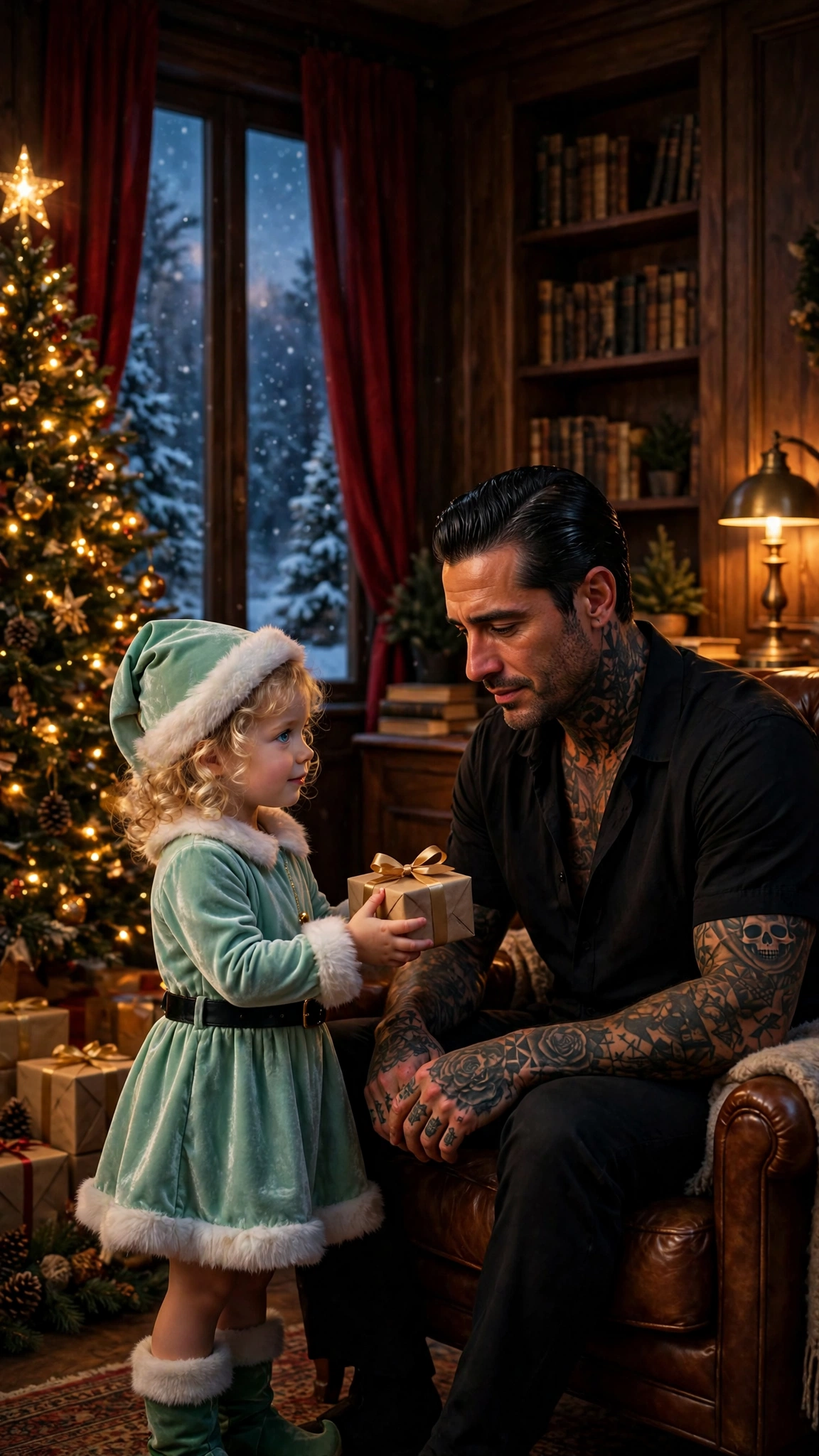
Sophia waited until the afternoon, when the house was at its quietest, to begin.
The afternoons in the Moretti mansion belonged to Rosa, who did the mending in the sitting room by the kitchen, and to John, who worked in the garden even in the snow, and to Lorenzo, who shut himself in his study with his telephone and his papers and did not come out until supper. The afternoons were the safest time to do a secret thing, because nobody was watching, and nobody was asking questions, and a small girl could slip through the house like a mouse through a wall.
Sophia went to her room and closed the door, and she took the sheet music from the music box, and she laid it flat on her bed, and she looked at it for a long time.
It was a single page, old and soft at the edges, and across the top, in her mother's looping handwriting, were the words "Silent Night." The notes marched across the page in neat black rows, and in the margins were her mother's pencil marks — a circle here, a star there, the marks of a woman who had played this song a hundred times and loved it more every time. Sophia could not read music. Rosa had been teaching her to read words all autumn, but music was a different language, and the notes on the page looked to her like small black birds sitting on wires, waiting to fly away.
She did not want to cut it. She knew, in the way that children know things without being told, that the page was precious, and that cutting it would be a little bit like breaking something that could never be put back together. She sat on the bed for a long time with the scissors in her hand, and she looked at the page, and she looked at the little gold star her mother had made, which lay beside it on the blanket, old and creased, with one point bent a little where it had been pressed flat for years.
"Mummy," she whispered, to the empty room, to the photograph on the table, to the music box that still smelled faintly of her mother's perfume. "Mummy, I need to borrow your song. Just one page. Just the top part. I promise I will make something beautiful out of it. I promise Daddy will smile."
The room did not answer. But the snow kept falling past the window, soft and steady, and the little gold star lay on the blanket catching the pale afternoon light, and Sophia, who had made up her mind three days ago and had not changed it since, picked up the scissors and began to cut.
She cut slowly, because she wanted it to be perfect, and because her hands were small and the scissors were big and the paper was old and soft and wanted to tear. She cut a star with five points, the way her mother had cut hers, and when she was finished she held it up to the light, and it was not perfect — one point was a little shorter than the others, and one edge was a little crooked — but it was hers, and it was made from her mother's song, and that made it the most beautiful thing she had ever made in her life.
Then she painted it.
The paint came from Rosa's craft box, a little pot of gold paint that Rosa used for mending the Christmas decorations, and Sophia painted the star on both sides with her smallest brush, carefully, patiently, until every bit of the black notes was covered in gold, and the star shone in her hands like a small piece of the sun. She set it on the windowsill to dry, and she sat beside it and watched it, and she thought about what to write on the back.
She could write only a few words. Rosa had been teaching her all autumn, and she knew her letters, and she knew how to spell the words that mattered most. She took her green crayon, the one she used for drawing trees, and on the back of the gold star, in big, careful, wobbly letters, she wrote:
FOR DADDY
She stared at the words for a long time, and then she smiled, because they were the truest words she had ever written, and because she knew, with the absolute certainty that only a five-year-old can feel, that when her father saw them, he would understand everything.
But a star is not a present, not by itself. A present needs a box, and a box needs a ribbon, and Sophia had neither, and she had no money to buy them with, and no way to get to a shop even if she had. So that evening, when the house was busy with supper and nobody was watching the kitchen, she went downstairs to find Macy.
Macy was in the kitchen, washing dishes, her sleeves rolled up to her elbows, her dark hair coming loose from its braid, and when she saw Sophia standing in the doorway with her hands behind her back, she dried her hands on her apron and knelt down so that she was at the little girl's height.
"What is it, sweetheart?" she asked. "Are you hungry? I can get you a biscuit, but don't tell Rosa."
Sophia shook her head. She looked around the kitchen to make sure nobody was listening, and then she leaned close to Macy and whispered, in the way a child whispers when she is sharing the most important secret in the world, "I need a box. A small box. And a gold ribbon. And you mustn't tell anyone. Not Rosa. Not Daddy. Not anyone."
Macy looked at her for a moment, and then she smiled, because Macy was nineteen years old and she remembered, very clearly, what it was like to be five years old and to have a secret that felt as big as the whole world.
"A box and a gold ribbon," she said. "For a present?"
Sophia nodded, and her blue eyes were wide and serious. "For Daddy. For Christmas. It has to be a surprise."
Macy thought for a moment. Then she went to the pantry, and she came back with a small box — the kind the kitchen used for storing tea, plain brown cardboard, just the right size — and from the drawer where the Christmas wrapping was kept, she took a length of gold ribbon, the last of it, saved for the staff's own presents.
"Will this do?" she asked.
Sophia took the box in both hands, and she looked at it the way a jeweler looks at a diamond, and she nodded, slowly, solemnly, as if she were accepting a great responsibility.
"It will do," she said. "Thank you, Macy."
Macy smiled, and she ruffled Sophia's blonde curls, and she said, "Your father is a lucky man, little one. I hope he knows it."
Sophia did not answer. She tucked the box under her arm, and she took the ribbon, and she ran back upstairs to her room, and she wrapped the gold star in a piece of white tissue paper, and she put it in the box, and she tied the gold ribbon around the box in a bow that leaned to one side, because she had tied it three times and it still leaned, and she decided that a leaning bow was better than no bow at all.
She hid the box at the back of her wardrobe, behind her winter coats, where nobody would ever think to look, and she went to bed that night with a smile on her face, and she dreamed of Christmas, and of her father's face, and of the moment when he would open the box and see the star and smile the way he used to smile in the photograph.
She did not know that the next day would be the worst day of the whole month, or that the worst day would be the reason everything else happened the way it did.
The next day began with a telephone call.
Sophia did not hear the telephone call itself. She was in the kitchen with Macy, learning how to roll out the pastry for the Christmas pies, with flour on her nose and flour on her dress and flour in her hair, and she was laughing, because Macy had flour on her nose too, and they looked like a pair of snowmen. But she heard her father's voice, from the hallway, and it was not the voice he used when he spoke to her. It was the voice he used when he spoke to his men, the cold, controlled voice that made the whole house go quiet, and then she heard the study door slam, and then she heard his footsteps coming down the hallway toward the kitchen, fast and heavy, the footsteps of a man who owned every floorboard he walked on and was angry at all of them.
Macy heard the footsteps too, and her hands went still on the pastry, and her face went white, and she whispered, "Oh no. Oh no, oh no."
Lorenzo Moretti came into the kitchen like a storm coming into a room. His black shirt was open at the collar, and his tattoos showed dark against his skin, and his gray-brown eyes were hard, and his jaw was set, and he looked at the flour on the counter and the pastry on the board and the two of them standing there with flour on their noses, and he did not smile.
"Macy," he said, and his voice was very quiet, which was worse than if he had shouted. "I told you. I told everyone in this house. I am not to be disturbed today. I have business that cannot wait, and I will not have noise in my house while I am conducting it. Is that understood?"
Macy nodded, and her hands were shaking so hard that she hid them behind her back, and she said, in a voice so small it was barely a voice at all, "Yes, sir. I'm sorry, sir. It won't happen again, sir."
Lorenzo looked at her for a long moment, and then he said, in the same quiet, terrible voice, "Anyone who disturbs me tonight will be dismissed on the spot. I do not care who it is. I do not care what the reason is. Tonight, I am not to be disturbed."
And then he turned, and he walked out of the kitchen, and his footsteps went back down the hallway, and the study door slammed again, and the whole house seemed to hold its breath.
Macy stood very still for a long time. Then she sat down on the kitchen stool, all at once, as if her legs had given way beneath her, and she put her face in her hands, and Sophia, who had never seen a grown-up cry before, stood beside her with flour on her nose and did not know what to do.
"He doesn't mean it," Sophia said, at last, in a small, brave voice. "He's just sad. He's sad about Mummy. He doesn't really want to fire anyone."
Macy looked up at her, and her eyes were wet, and she tried to smile, and the smile did not quite work.
"I hope you're right, little one," she said. "Because if I lose this job, my mother and my brothers and my sisters will have nothing for Christmas. Nothing at all."
Sophia looked at her for a long moment. Then she patted Macy's hand, the way Rosa patted her hand when she was sad, and she said, with the absolute certainty that only a five-year-old can feel, "Don't worry, Macy. I have a plan. And my plan is going to fix everything."
Macy did not ask what the plan was. She was too frightened to ask, and too tired, and too grateful for the small warm hand on hers. But that night, when she went to bed in the little room at the top of the house, she lay awake for a long time, listening to the wind in the chimney, and thinking about the wages she sent home every week, and the rent, and the food, and the shoes her little brother needed, and the words her employer had said in the kitchen that afternoon.
Anyone who disturbs me tonight will be dismissed on the spot.
And in her room, in the dark, Sophia Moretti lay awake too, with the gold star hidden in the back of her wardrobe and the plan bright in her head, and she thought about her father's sad face, and Macy's frightened face, and the tree in the study that nobody was allowed to celebrate, and she made up her mind about something else, something even more certain than before.
Tomorrow was Christmas Eve. And tomorrow, no matter what her father had said, no matter what anyone had said, she was going to give him his present. She was going to walk into his study, all by herself, and she was going to make him smile. And nothing — not his orders, not his anger, not the whole big silent house — was going to stop her.