"Well," said Preston Caldwell, turning the key in the corridor door with the deliberation of a man locking his own office. "Isn't this convenient."
The east service corridor was the artery nobody used — a narrow, windowless throat between the laundry and the linen stores, lit by two bare bulbs and floored in concrete that had been poured before Kate was born. The linens were heavy in her arms. Her right side faced the wall of folded shelves. Her left, the door he had just locked.
"Mr. Caldwell." Her agency training stood up in her throat like a soldier. "This corridor is staff only, sir. If you're looking for Mr. Blackwell's study, I can—"
"You can stop pretending, for a start." He came toward her unhurriedly, the way he did everything, with a glass of the boss's whisky in his hand though it was barely three in the afternoon. "Eleven weeks I've been coming to this house, Kate. Did you really think I hadn't noticed you noticing me?"
"I don't know what you mean, sir."
"I mean the little performance at dinner. The trembling hands. The eyes." He set the whisky down on her stack of linens, balanced it there, amused at his own daring. "Girls from agencies always have a price, even the ones who play at being frightened. Especially those. So — what's yours? Name it. I like buying things that pretend they aren't for sale."
The corridor seemed to shrink to the width of his smile. Kate held the linens like a shield and understood, with the clean cold clarity that terror sometimes gives, that this was not a misunderstanding. This was a man who had chosen the locked corridor, the hour, and the girl — chosen all of it the way he chose investments: after study, with confidence, expecting return.
"There isn't one," she said. "Please unlock the door, Mr. Caldwell."
She made the mistake then — the only one. She turned sideways to set the linens down, because her arms were aching and she needed her hands free, and some deep, decent, catastrophically stupid part of her still believed that a clear no, politely given, was a language rich men spoke.
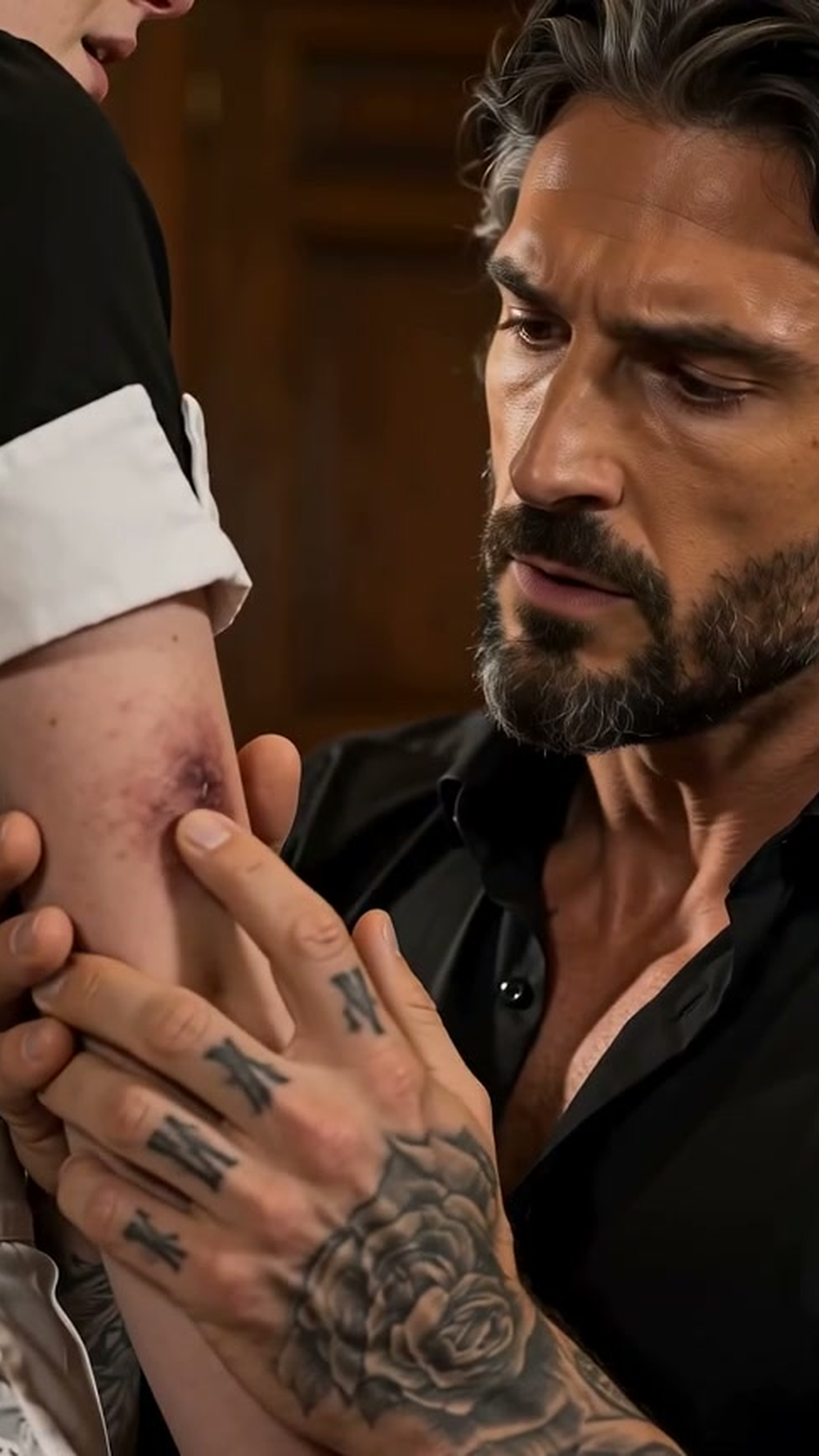
His hand shot out and caught her right upper arm — four fingers and a thumb, a grip like a machine closing — and swung her around to face him, and her shoulder slammed the shelf edge and the whisky glass fell and broke somewhere below them like a small, bright warning nobody heard.
"Careful," he said pleasantly, as she cried out. "You'll ruin the linen."
"Let go of my arm—"
"I don't think you understand your situation." His voice stayed at the temperature of a business lunch. "Damon Blackwell is my partner. My ships move half of what his organization earns. You are a maid he could replace before your bed cooled. So when I tell you that on gala night you will be assigned to the east wing, and that after the fireworks you will come to the garden folly and be kind to me — you will not look at me like that. You will say: yes, Mr. Caldwell. Thank you, Mr. Caldwell."
"No," Kate said, and pulled.
It was not a dramatic thing, what happened next. There was no blow, no fall, no cinematic crash. He simply kept hold of her arm, all his considerable strength in that one grip, and turned her — wrenched her — toward the door she had begged him to unlock, the way a man turns a stuck key, and something deep in her forearm gave way with a sound she felt rather than heard, a green-stick crack that ran up into her elbow and detonated white light behind her eyes.
She did not scream. Even then. Even as the pain dropped her to her knees on the concrete with her ruined arm cradled against her stomach and her teeth locked on the knuckle of her good hand — she did not scream, because somewhere beneath the pain the arithmetic was still running: noise means staff, staff means questions, questions mean the hospital deposit, the specialist, her mother's heart beating in a bed at St. Aurelia's on a timer Kate was paying to extend.
Preston Caldwell looked down at her for a moment, and straightened his cuff, and sighed like a man whose afternoon had been mildly inconvenienced.
"You see?" he said. "That didn't need to happen."
He was not even breathing hard. That was the detail she would return to, in the nights that followed, the way a tongue returns to a broken tooth: the ordinariness of him. No rage, no lust cracking his voice, no madness to explain it by — a man mildly annoyed that a door had stuck and needed forcing. She understood, flat on the concrete with her arm singing its new broken song, that she had never been a person to him at any point in the transaction. She had been an amenity of the house, like the cellar or the view, and the house's amenities did not get to choose their hours. He stepped over the broken glass. "Get that seen to quietly, if you're seeing to it at all. Girls who make scenes about accidents don't keep jobs in houses like this one. And Kate—" The key turned. The door opened on a flood of ordinary daylight and ordinary house sounds, a vacuum cleaner somewhere, a radio, the world — "gala night. The garden folly. After the fireworks. Wear the arm in a sling if you like. I think I might prefer it."
The door closed. The lock did not turn this time. He did not need it to. He had locked something else.
She stayed on the concrete for as long as she dared, breathing through her nose in short, careful sips, and then she did the things she had always done when the world broke her: she got up, she gathered the scattered linens with one hand and her teeth, she swept the broken glass into a dustpan balanced on her knee, and she went to find Rosa.
Rosa Delgado had worked at Blackwell for nine years, which in that house was a geological age. She found Kate in the laundry at dusk, feeding sheets into the press one-handed with her right arm held against her body like a dead thing, and she took one look and shut the laundry door and said, "Show me."
"It was an accident. The linen shelf—"
"Katherine Bennett, I have watched you carry a full silver tray up two flights of stairs without a sound. Show me."
So Kate showed her. In the steam and bleach-smell of the laundry, with the presses hissing like tired dragons, she unbuttoned her cuff and rolled the sleeve up past bruises already blooming the color of plums, past a forearm swelling tight and glossy as fruit skin, and Rosa — who had served breakfast to men the police had files on, who had once, famously, ironed a shirt while a federal agent waited in the hall — crossed herself and went the color of the sheets.
"That's a hand," she said. "Hermana, that's a whole hand on your arm. And that's broken. I can see it's broken, the shape is wrong. Who—"
"You can't tell anyone."
"Kate—"
"You can't." The tears came then, finally, in the one place she allowed them, standing between the steam presses with her uniform half open. "Rosa, listen to me. My mother's surgery deposit is due in eleven days. Eleven. If there's a scandal, if I accuse a guest — his partner, Rosa, his business partner — do you think they keep me? Do you think any agency in this city ever places me again? I'll be the girl who cried about Preston Caldwell. He told me that. Word for word. He has it all planned, including what I am after."
Rosa held her — carefully, around the shoulders, the way you hold a bird with a broken wing — and said nothing for a long time, and the presses hissed, and somewhere upstairs a door closed like a full stop.
"We'll bind it," she said at last, with the grim practicality of a woman who has buried three brothers and out-stubborned every man who caused it. "Properly. My cousin is a nurse; she'll tell me how by phone and ask nothing. You'll wear the long cuffs. You'll take the light duties; I'll swap the heavy ones to me and Marta and say your wrist is sprained from the shelf. It happens. Shelves are dangerous." Her mouth twisted. "And God will keep the account, Kate. God always keeps the account."
For three days, the account stayed open.
On the second night, the pain woke her at three with its hand around her throat, and she lay in the dark doing the breathing Rosa's cousin had prescribed — in for four, hold for four, out for six, as if agony were a waltz that could be counted — and thought, with a clarity that felt like falling: I cannot call anyone. There was no one to call. That was the whole architecture of the trap, and Preston Caldwell had not built it; he had merely read it, the way a surveyor reads land. A girl with a dying mother, a contract, a reference, and no savings is a girl who can be broken in a corridor at three in the afternoon and will sweep up the glass herself, and every man like Preston in every great house in the world knows the floor plan by heart.
On Sunday morning — the last ordinary morning — she called her mother from the service stairs with the phone pressed to her ear and her voice arranged into its Sunday shape. "The deposit, Mama. Don't argue with the nurses about the deposit. It's nearly there. It's nearly all there." And her mother said, "You sound tired, Katherine," and Kate, holding a broken arm against her stomach in a stairwell that smelled of bleach, said, "I'm never tired, Mama. I'm twenty-six. Tired is for other people," and made her laugh, and got off the phone, and stood with her forehead against the cool concrete wall for one whole minute, spending the only weeping she allowed herself that day, silently, standing up, like a professional.
Kate worked those three days the way a soldier holds a trench. She learned to polish silver left-handed, to fold sheets with her forearm pinned useless at her side and her good hand doing the work of two, to smile at Mrs. Whitmore's inspection with sweat standing on her lip from the simple labor of lifting a teapot. The makeshift binding Rosa's cousin prescribed by phone — a splint made from a cut-down kitchen board, wrapped tight, hidden under the long formal cuff — turned her right arm into a stranger that lived at the end of her sleeve and throbbed in time with her heart.
At night she lay in her narrow room in the staff wing and did mathematics in the dark. Eleven days to the deposit. Four hours of sleep against sixteen of pain. The garden folly. The fireworks. Preston Caldwell's smile, straightening his cuff.
She thought about running. She thought about it the way you think about the window in a burning building — constantly, and as a last resort, because everything she was jumped with her: the deposit, the weekly cash that was keeping the hospital patient, the reference no agency would write for a girl who fled a house like Blackwell mid-contract. Running saved Kate Bennett and killed her mother by installments. She stayed.
And on the second day, the house began, quietly, to notice things — because Kate had forgotten the first law of the Blackwell estate, which was that it had eyes, and most of them belonged to one man.
She noticed him noticing at Friday lunch service. She was setting down a water glass — left hand, careful, slow — when she felt the peculiar pressure of a gaze the way you feel weather change, and looked up to find Damon Blackwell watching her across a table of eight oblivious guests. Not at her face. At her hands. At the way she favored the right. At the small, aborted flinch when a guest's chair scraped and she stepped back too fast.
His eyes narrowed a fraction. Kate set the glass down without a tremor — it cost her something she would feel all afternoon — and removed herself from the room with perfect, invisible grace.
She did not sleep that night either. Not from pain. From the sudden, certain knowledge that the most dangerous man in the city had begun, however faintly, to look in her direction — and that in three days' time, at his own gala, with his partner's champagne in three hundred glasses, the two most terrifying men in her life would be in the same ballroom.
On the third morning, Mrs. Whitmore pinned the gala staffing sheet to the kitchen board, and the girls crowded around it, and Kate read down the columns with her heart hammering in her injured arm, and found her own name, in the housekeeper's neat hand, beside two words that turned the floor to water.
East wing. Garden service. Fireworks rotation.
Just as he had promised her. Arranged — through whom, she never learned — with the calm administrative confidence of a man who had never once been refused anything that mattered.
Kate stood in the bright kitchen with the roster in her good hand, and understood that by tomorrow night, one way or another, the hiding was going to end.