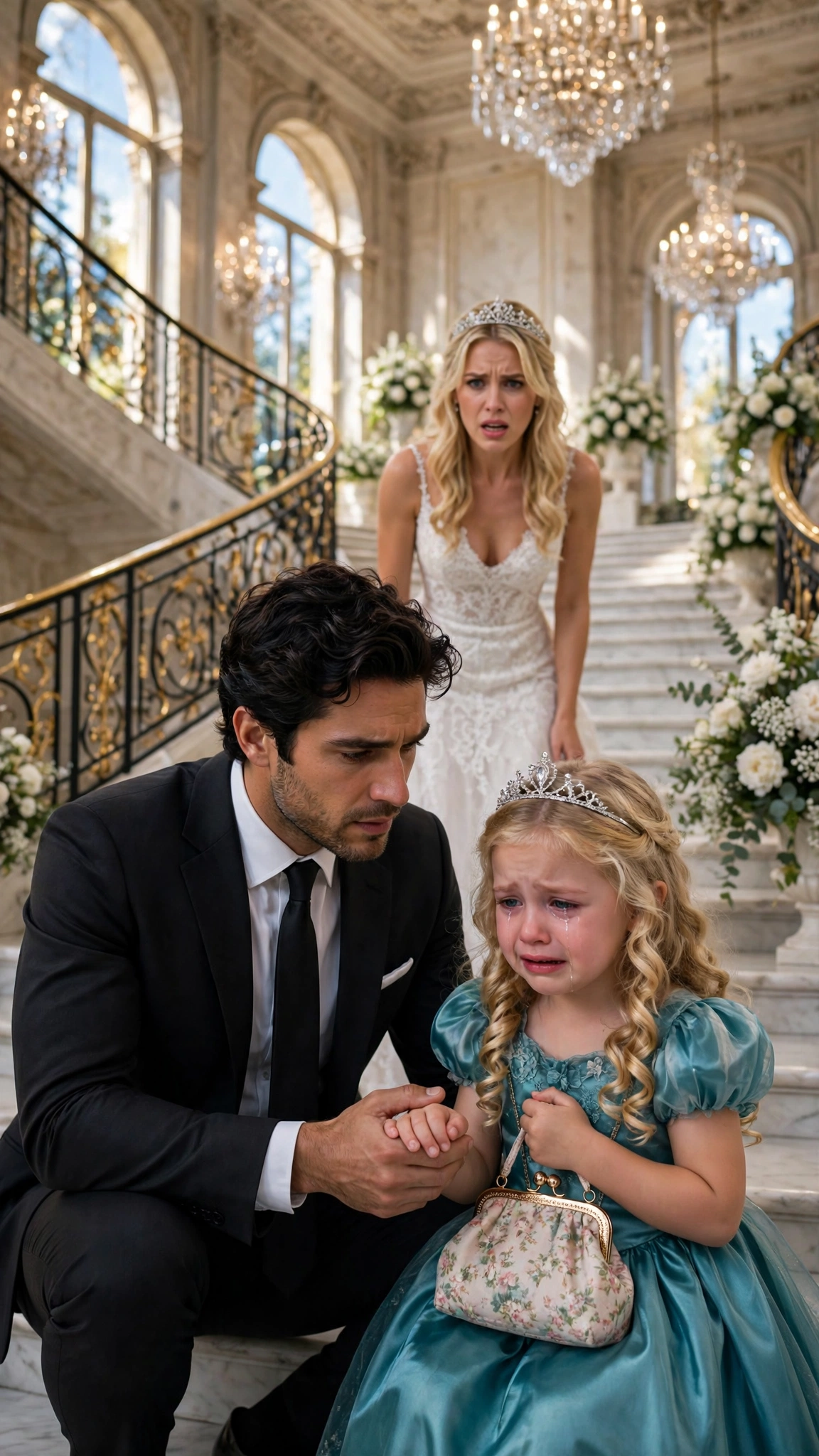
Victoria moved into Daniel Moretti's life the way a tide moves into a harbor — slowly, gracefully, and with a force you do not notice until the water is already at your door.
In the beginning, she was everything Daniel had forgotten a woman could be. She laughed at his jokes. She asked about his work, and listened, and did not flinch when he told her things other people flinched at. She brought white roses for the hall table, and she knew the names of the wines in his cellar, and she played the piano in the evenings, her fingers moving over the keys with a confidence that filled the cold rooms with something almost like music.
And she was good with Lily. Or she seemed good with Lily. That was the terrible part — the seeming.
When Daniel was watching, Victoria was patient and warm. She knelt to Lily's height. She complimented the teal dress. She asked about the music box, and the stuffed rabbit, and the drawings taped to the nursery wall. She brushed Lily's blonde curls once, her fingers gentle, and Lily sat very still and let her, because her father was standing in the doorway smiling, and she wanted him to keep smiling.
But when Daniel left the room, something in Victoria changed. It was never dramatic. Victoria was far too clever for drama. It was small things. A hand on Lily's shoulder that gripped a little too hard. A voice that went flat and cold, like a door closing.
"Don't follow me around, Lily. Little girls should be seen and not heard."
"Your father doesn't have time for your drawings. Stop leaving them everywhere."
"That dress is too bright. A Moretti daughter should dress with dignity, not like a child at a birthday party."
Lily was five. She did not have the words for what was happening. She only knew that her stomach hurt when Victoria was in the house, and that she felt safer in the nursery with her rabbit than anywhere else, and that she had started hiding her drawings in the back of the nursery closet, where Victoria would not find them and frown.
She did not tell her father. She had made a decision, in the wordless way children make decisions, that telling would make him sad, and that her father's sadness was the worst thing in the world. So she was quiet. She was very good at being quiet. She had been practicing for two years.
Carlo saw it, of course. Carlo Benedetti had known Daniel since they were boys, and he had been Daniel's lawyer and his oldest friend for twenty years, and he could read a room the way other people read a newspaper. He saw the way Lily flinched when Victoria's hand came near her shoulder. He saw the drawings disappearing from the nursery wall. He saw the music box — the one Victoria had given Lily, the one Lily had carried everywhere for a week — sitting untouched on the shelf, gathering dust.
One afternoon, Carlo found Lily in the garden, sitting under the old oak tree, her teal dress spread around her, her mother's floral handbag in her lap, her small fingers tracing the pink roses printed on it.
"Hello, princess," Carlo said, sitting down beside her on the grass. He was a big man, broad and graying, with kind eyes and a voice like gravel. "What are you doing out here?"
"Hiding," Lily said.
"From what?"
Lily looked at her small cream shoes. "From Miss Victoria. She said my dress is too bright."
Carlo was quiet for a moment. He reached out and touched the silver tiara in her hair — not the one she wore to the rehearsal, but a small silver hair clip, shaped like a star, that she wore every day.
"Your dress is beautiful," Carlo said. "Your mother would have loved it."
"Is Miss Victoria going to be my new mommy?" Lily asked.
Carlo's heart twisted. "She is going to marry your daddy. That is different from being a mommy."
"Will she throw me out?" Lily asked, and her voice was very small. "A girl at school said when a daddy gets a new wife, the old children have to go away."
"That girl is wrong," Carlo said firmly. "No one is going to throw you out of your own home. Not while I am here. Not while your daddy loves you."
"Does Daddy love me?" Lily asked. "He is always busy."
"Oh, princess," Carlo said, and he pulled the little girl into his arms, grass stains and all. "Your daddy loves you more than anything in this world. He is just… he is a man who does not know how to say it. But he loves you. I promise you."
Lily believed him, because Carlo had never lied to her. But that night, she lay awake in her bed, staring at the ceiling, listening to the piano downstairs — Victoria playing, her father laughing — and she felt the cold of the house creep in through the walls, and she pulled her blanket up to her chin, and she thought about her mother, and she wondered if her mother could see her, and if she was proud, and if she was sorry.
The courtship, as the newspapers would later call it, lasted a year. Victoria was patient. She never pushed. She let Daniel come to her, let him believe that every step was his own idea. She hosted dinners. She attended charity events on his arm. She charmed his associates, who had never seen their boss look at a woman the way he looked at her. She sent Lily gifts on her birthday — a doll with real hair, a set of paints — and she was gracious and smiling when she gave them, and Lily smiled back, and said thank you, and put the gifts on her shelf, and never played with them when Victoria was not looking.
Daniel was happy. That was the thing nobody could deny. After two years of grief, of silence, of coming home to a cold house and a quiet daughter, Daniel Moretti was happy. He laughed. He played the piano with Victoria. He took Lily to the park on Sundays, Victoria walking beside him, and for the first time since Isabella died, the Moretti family looked, from the outside, like a family.
His men noticed. His lawyer noticed. Carlo took him aside one evening at the club and said, "She's good for you. But watch her with the girl."
"What do you mean?" Daniel asked.
"I mean," Carlo said, choosing his words carefully, "that she is very warm when you are looking, and I have never once seen her look at Lily when you are not looking."
Daniel frowned. "You're imagining things."
"Maybe," Carlo said. "But a man who imagines things lives longer than a man who ignores them."
Daniel did not forget the conversation. But he did not act on it, either. He told himself Carlo was being overprotective. He told himself Victoria was simply a woman who had never raised a child, who needed time. He told himself Lily was shy, and that shy children took time to warm to new people. He told himself all the things a man tells himself when he is happy and does not want to look too closely at the thing making him happy.
Victoria, meanwhile, was making plans.
She had a mother, a woman named Rosa, who lived in a small apartment in Queens and who had raised Victoria to believe that beauty was a currency and that a woman's job was to spend it wisely. Rosa called every Sunday, and Victoria told her everything — the mansion, the cars, the accounts, the little girl who was always underfoot.
"When you are married," Rosa said, "the girl goes to school. A good school. Far away. Switzerland, perhaps. That is what is done in families like this. A child needs structure."
"She is only five," Victoria said.
"Five is old enough," Rosa said. "Five is when they start to remember. You do not want her remembering that you were not always there. Send her away before she is old enough to fight you."
Victoria did not argue. She had already written to the school — a strict, expensive boarding school in the Swiss Alps, the kind of place where little girls wore uniforms and spoke French and did not come home for Christmas. She had the brochure in her desk drawer, hidden under a stack of wedding magazines. She had already told the headmistress, in a letter written in her most elegant hand, that her stepdaughter would need "firm guidance" and "distance from certain influences."
She had not told Daniel. She would tell him after the wedding, when it was too late to object, when the ring was on her finger and the papers were signed and the house was hers. She would tell him gently, as a mother concerned for her child's education, and he would agree, because he trusted her, because he was happy, because he did not know how to say no to a woman who smiled at him the way she smiled.
That was the plan. It was a good plan. It was a careful plan. It would have worked, too, if Victoria had understood one thing about Daniel Moretti: that he was a man who had lost one woman he loved, and that he would burn the world down before he lost another person he loved — especially his daughter.
But Victoria did not understand that. She understood money, and status, and the way a diamond caught the light. She did not understand that the quiet little girl in the teal dress, with the silver tiara in her hair and her mother's floral handbag on her arm, was the only thing in Daniel Moretti's life that he would kill for — and the only thing he would die for, too.
She was about to learn. But not yet. First, there were small cruelties to commit, and small cruelties have a way of adding up, until one day a five-year-old girl stands at the foot of a marble staircase and says the words she has been practicing in her bedroom mirror, and the whole house stops, and the whole world changes.
The first of the small cruelties happened on a Tuesday, three weeks before the wedding.
Lily had drawn a picture. It was a good picture, for a five-year-old — her family, standing in front of the mansion, the tall man, the small girl, and a woman with wings, drawn in yellow crayon. She had drawn a new figure beside them, a woman in a white dress, and she had shown it to Victoria, shyly, hopefully, because she was trying, in the only way she knew how, to make room for the new woman in her family.
Victoria looked at the drawing. She looked at it for a long moment. Then she smiled — the smile that did not reach her eyes — and she said, "That's very nice, Lily. But you spelled 'family' wrong. And your mother doesn't have wings. Your mother is dead. You should draw things that are real."
Lily's face went white. Her small hand, holding the drawing, began to shake.
Victoria took the drawing from her, folded it in half, and dropped it into the wastebasket.
"There," she said. "Now you can draw something better."
Lily stood there, staring at the wastebasket, and she did not cry. She had learned not to cry in front of Victoria. She waited until Victoria had left the room, and then she reached into the wastebasket, and she took the drawing out, and she smoothed it flat against her chest, and she carried it to her room, and she taped it to the nursery wall, right where her mother could see it.
That night, Carlo found her sitting on the nursery floor, staring at the drawing.
"Princess," Carlo said. "What happened?"
Lily looked up at him, and her eyes were dry, and her voice was very steady, and she said, "Miss Victoria says Mommy doesn't have wings. But I think she does. I think Mommy is watching me from heaven, and she has the biggest wings of all."
Carlo sat down beside her. He put his arm around the little girl. He did not say anything for a long time, because there was nothing to say that would make it better. Finally, he said, "Your mommy has the biggest wings of all. And she is very proud of you."
Lily leaned against him. "Carlo," she said. "When Daddy marries Miss Victoria, will I still be his little girl?"
Carlo looked at the drawing on the wall — the tall man, the small girl, the woman with yellow wings — and he said, very quietly, "You will always be his little girl. No one can change that. Not ever."
But Carlo was not sure. And that night, after Lily was asleep, Carlo sat in his car outside the mansion for a long time, looking up at the lighted windows, thinking about the woman his oldest friend was about to marry, and about the little girl with the floral handbag, and about what he would do if the worst thing he feared turned out to be true.