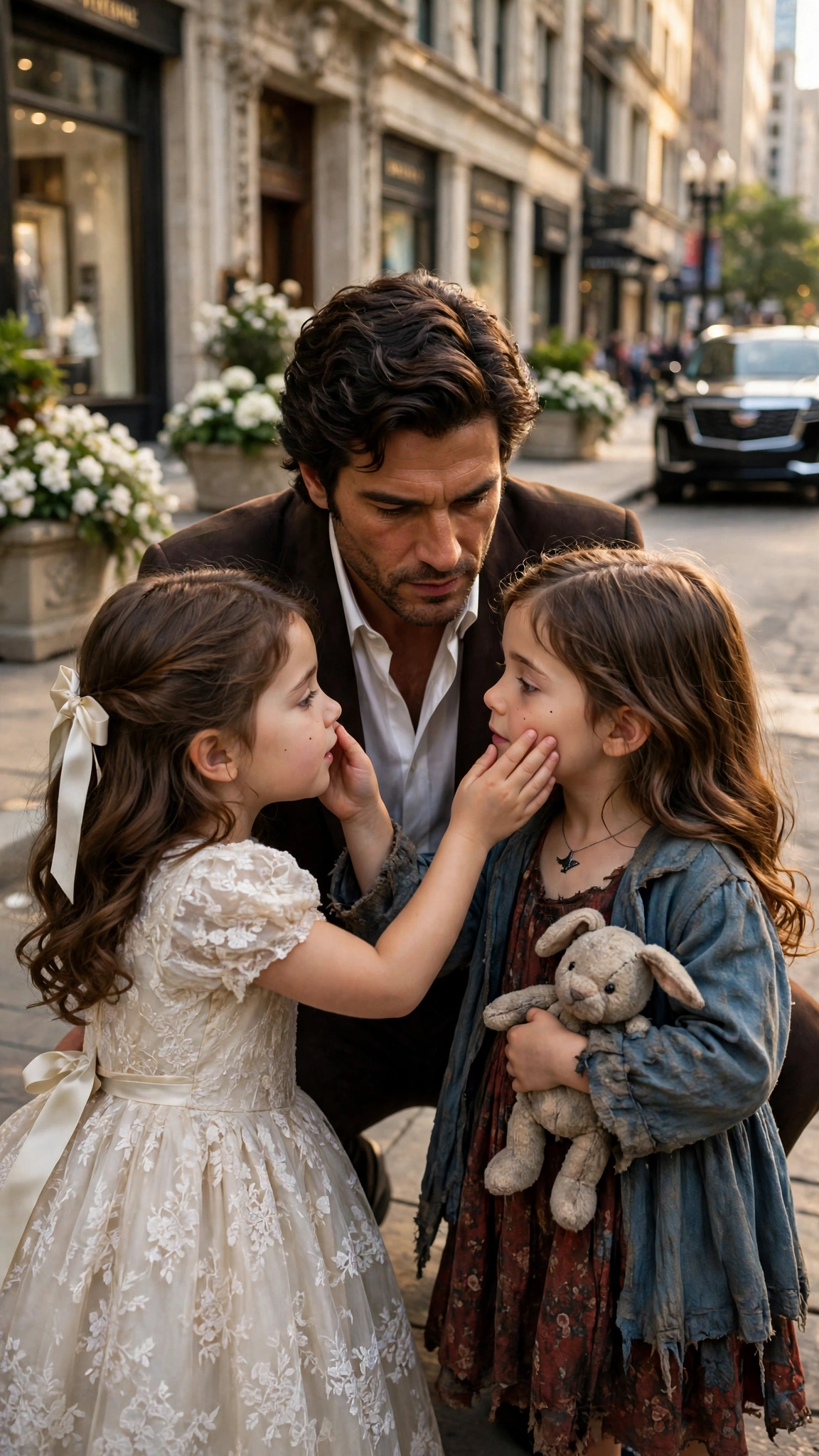
Sophie was waiting on the front steps when we drove up the long driveway to the house in Lake Forest, and the moment she saw the car she came running down the steps in her bare feet, her ivory dress flying, her ribbon coming loose, shouting, "Daddy! Daddy, you're back!"
And then she stopped. Because the car door opened, and a woman in a gray dress got out, and a little girl in a shabby blue coat got out behind her, holding a dirty rabbit, and Sophie stood on the gravel with her mouth open, staring at a girl with her own face, and the girl stared back, and for a moment nobody in the world moved at all.
"Sophie," I said, kneeling down in the gravel in my suit, "I need you to listen to me, baby. Do you remember how you always ask me to tell you about Mama?"
She nodded, her eyes wide.
"This is Mama," I said. "She is alive. She has been alive all this time. And this—" I put my hand gently on Ruby's shoulder. "This is Ruby. She is your sister. Your twin sister."
Sophie looked at Elena. She looked at Ruby. She looked at me. And then she did the bravest, most Sophie thing I have ever seen: she walked straight up to Ruby, took the dirty rabbit out of her arms, hugged it to her own chest, and said, "You can have my bear. He is brown and his name is Biscuit and he is not afraid of the dark. You need him more than I do."
Ruby stared at her. Then her face crumpled, and she started to cry — not the loud, dramatic crying of a child who wants attention, but the quiet, shaking crying of a child who has been holding everything in for a very long time and has finally been given permission to let it out. Sophie put her arms around her, right there on the gravel, and Elena sank to her knees and gathered both girls into her arms, and I stood there in the driveway in my suit with tears running down my face, and I did not care who saw, because there was no one left in the world whose opinion mattered more than the three people in front of me.
We went inside, and the house — which had been quiet and careful and cold for five years — filled up with noise. The girls ran from room to room, comparing everything: their hands, their feet, their hair, their freckles. They stood in front of the big mirror in the hallway and pressed their faces together and laughed at their own reflections. Elena walked through the rooms slowly, touching the furniture, opening the kitchen cupboards, standing in the doorway of the bedroom that had been ours, and I followed her, not saying anything, because there was nothing to say that would not sound too small.
In the kitchen, she stopped in front of the window where she used to sing in the mornings. "I used to stand here," she said softly, "and the sun would come through that window, and I would sing, and you would come in and tell me I was off-key."
"You were off-key," I said. "Terribly off-key. It was my favorite sound in the world."
She laughed, and then she cried, and then she laughed again, and I held her, and for the first time in five years, the house felt like a home.
That evening, after the girls were asleep — in the same bed, holding hands, Ruby's rabbit and Sophie's bear tucked in on either side — Elena and I sat in the study, and I told her everything Dominic had told me, and she told me everything the man in the van had told her, and we laid the two stories side by side, and they fit together like the two halves of a torn photograph.
"He told me you were dead," she said. "He told me the fire killed you and that if I came back, they would kill Ruby. I believed him because he cried when he said it. He cried, Adrian. He held my hand and cried."
"He cried with me too," I said. "He sat beside my hospital bed and held my hand and cried. He buried two coffins. He showed me photographs."
"Why?" Elena asked. "Why would he do this to us?"
I had been asking myself the same question since Michigan Avenue, and I thought I knew the answer. "Your father's shipping company," I said. "Carter Shipping. When your father died, you inherited it. And when you 'died,' it came to me, as your husband — and Dominic managed it for me, because I was grieving and I trusted him. He has been running Carter Shipping for five years, Elena. He has been taking the money, the contracts, the routes. And if you were alive, and if Ruby were alive, then the company was never his to run. And if I ever found out the truth, I would take it back and I would destroy him."
"So the fire—"
"The fire was his," I said. "The men in the van were his. He wanted you dead and the girls gone, and when the plan went wrong — when you escaped with Ruby and I survived with Sophie — he built a wall of lies between us so we would never find each other and put it together."
Elena was quiet for a long moment. Then she said, "He will know we are back together. He will know the moment he sees us. What will he do?"
I looked at her, and I felt something I had not felt in five years: not grief, not fear, but cold, clear purpose. "He will try to finish what he started," I said. "And we will be ready for him."
I was right. He came the next morning.
Dominic arrived at ten o'clock, in his perfect gray suit, with a bottle of wine and a smile, the way he had arrived a hundred times before. Marco let him in — I had told Marco to let him in, and to say nothing — and Dominic walked into the living room, and he saw Elena sitting on the sofa with a cup of tea, and he stopped dead in the doorway, and the bottle of wine slipped from his hand and shattered on the marble floor.
"Elena," he said, and his voice was a whisper. "My God. Elena."
"Hello, Dom," she said, very calmly, setting down her cup. "It's been a long time."
He looked at me. He looked at the hallway, where the girls' laughter was drifting down the stairs. His face went through three expressions in as many seconds — shock, calculation, and then something colder and harder, the face of a man who has just realized the game is over and is deciding whether to flip the table.
"Adrian," he said, "I can explain."
"Can you?" I said. "Can you explain the fire? Can you explain the van? Can you explain five years, Dominic? Because I have been waiting five years to hear it."
He took a step toward the door. Marco was already standing in it, very large and very quiet, with his arms folded. Dominic looked at Marco, and then at me, and then he laughed — a short, ugly laugh that I had never heard from him before.
"You were always too soft, Adrian," he said. "Your father was soft too. The business needed a hard man. I was the hard man. Carter Shipping was dying under her father's hands, and I saved it. I built it. And you — you were too busy playing house with your little flower girl to see it."
"I saw enough," I said. "I saw the men you hired. I saw the money you moved. Marco found them last night, Dominic. The man with the tattoo on his neck. He remembers you. He remembers the van. He remembers everything."
That was a lie — Marco had found nothing yet. But Dominic did not know that, and his face told me everything I needed to know. The guilt was written across it in letters a child could read. He had done it. He had burned my house. He had stolen my wife and my daughter. He had stood beside my hospital bed and held my hand and wept like a father, and all the while he had been counting the money.
"Get out of my house," I said, very quietly. "And do not come back. If I ever see you again, Dominic, I will not be as merciful as I am being right now."
He went. But as he reached the door, he turned back, and his eyes were full of hate, and he said, "This isn't over, Adrian. You don't know what you've started."
I watched him drive away down the long driveway, and I knew he was right about one thing: it was not over. Men like Dominic Rizzo do not lose gracefully. They lose loudly, and they take as much with them as they can carry. I called Marco into the study, and I told him to put men on the house, on the girls, on Elena, day and night, and I told him to find the man with the tattoo, and the money, and the records, and everything Dominic had touched in five years. Because the next move was his, and I intended to be ready for it.
That night, after the girls were asleep, Elena came and stood in the doorway of the study, hugging herself, and I knew she was afraid — not of Dominic, not exactly, but of something bigger and harder to name. The fear of a woman who has spent five years believing the world is a dangerous place and has just been told that it is safe, and who does not know how to believe it yet.
"What if he comes in the night?" she asked quietly. "What if he takes Ruby again?"
"He won't," I said. "Marco is outside. There are men on every door. This house is a fortress tonight, Elena. I promise you."
She came and sat beside me on the sofa, and for a while we did not say anything at all. Then she said, "I used to dream about this. About coming home. About you. And in the dream, it was always too late. I would get here and the house would be empty, or you would look at me and not know me. I stopped dreaming about it after a while, because it hurt too much to wake up."
"I dreamed about you too," I said. "Every night for the first year. You would be standing in the kitchen, singing, and I would come in, and you would turn around, and then I would wake up. And the house would be quiet. And Sophie would be crying in the next room. And I would get up and hold her, and I would think: at least I still have her. At least I still have one of them."
Elena took my hand. Her hand was thin and work-worn, the nails short, the skin rough from five years of cleaning other people's floors, and it was the most beautiful hand I had ever held. "We have them both now," she said. "Both of them. And we are never letting go again."
Upstairs, in the room where the girls slept in the same bed, holding hands, I heard a small sound — not crying, not a nightmare, but a soft, sleepy humming. Ruby, humming in her sleep, the way Sophie hums when she is happy. And Elena heard it too, and she smiled through her tears, and she whispered, "She hums. She has always hummed in her sleep. I used to think it was the only music we could afford."
Outside, in the dark at the end of the driveway, a car sat with its lights off. Marco saw it before I did — Marco sees everything — and he walked down to the gate with two of his men, and the car pulled away into the night, and Marco came back inside and said, "It was one of Dominic's. He is watching. He knows."
"Good," I said. "Let him watch. Let him see what he tried to destroy, standing in the light, unafraid. Tomorrow, we end this."