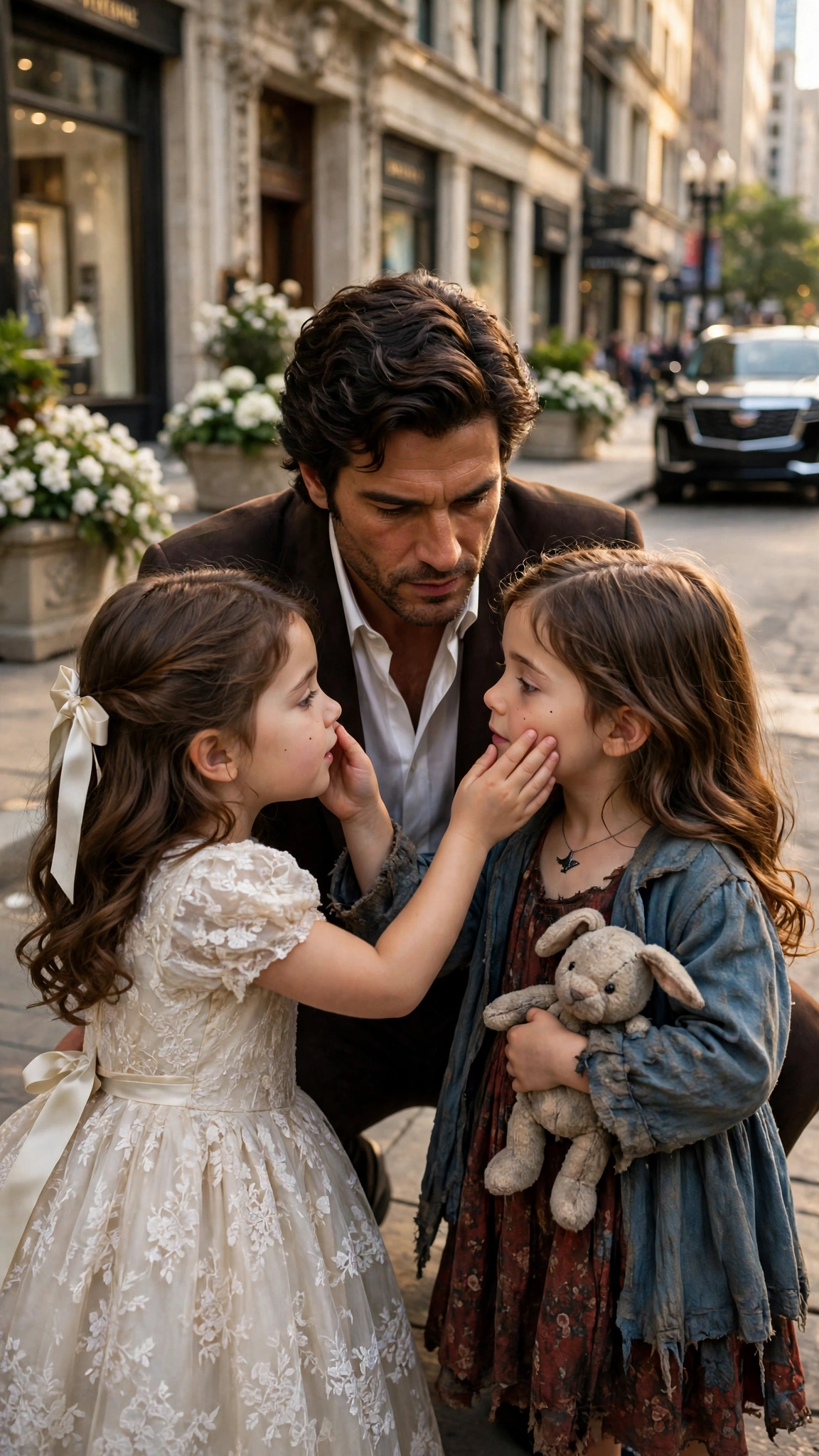
Marco found the man with the tattoo on his neck in a bar in Gary, Indiana, drinking away the money Dominic had paid him five years ago and telling anyone who would listen that he had once worked for the Moretti family. His name was Tommy Kessler, and he was not a brave man, and when Marco sat down across from him and put a photograph of Ruby on the table, Tommy Kessler started talking, and he did not stop for a very long time.
He told us about the van. He told us about the money — fifty thousand dollars, cash, in a bag on the seat. He told us about the phone call, the voice that gave him the rules: new name, no contact, no police, no going back. He told us that Dominic had called him personally, twice, over the years, to make sure Elena was still hidden and still afraid. He told us that Dominic had paid for the apartment above the bakery — paid the landlord in cash, every month, for five years — because a woman who is afraid and poor is a woman who stays quiet.
He told us something else, too. He told us that the fire had not been meant to kill Elena. It had been meant to kill all of us — me, Elena, both babies. Dominic had wanted the whole family gone, so that the Moretti business and the Carter business would fall to him as the last man standing. But the fire had gone wrong. I had gotten Sophie out. Elena had gotten Ruby out. And Dominic, standing in the ashes the next morning, had done the only thing he could do: he had built a lie big enough to hold the pieces apart.
"He said it was business," Tommy said, staring at his hands. "He said the Morettis were weak. He said the old man would have wanted it this way. I didn't believe him, but the money was real, and I had a baby of my own coming, and I — I'm sorry. I'm sorry."
I looked at this man — this small, frightened man who had held a gun on my wife and my baby daughter in the back of a van — and I felt nothing. Not anger. Not pity. Nothing at all. Because he was not the man who had done this to us. He was a tool. The man who had done this to us was sitting in an office downtown, in a perfect gray suit, counting money that belonged to my wife.
"Thank you for telling the truth," I said. "It won't save you. But it will help my family. And that is worth something."
Marco took him to the FBI field office in Chicago, where Agent Laura Simmons had been building a case against Dominic Rizzo for three years — wire fraud, embezzlement, arson, conspiracy — and had been waiting for one person brave enough to talk. Tommy Kessler talked for six hours. He gave them names, dates, account numbers, the van, the money, the phone calls. He gave them everything.
The next morning, the FBI walked into the Carter Shipping offices and arrested Dominic Rizzo at his desk, in front of his whole staff. They found the records in his safe: five years of stolen contracts, forged signatures, money moved through shell companies, all of it in his own handwriting, because Dominic had always believed he was too clever to be caught, and clever men always keep records.
He did not go quietly. He shouted. He threatened. He told the agents that Adrian Moretti would kill them all, that the family would come for them, that they did not understand who they were dealing with. And Agent Simmons looked at him and said, "Mr. Rizzo, the man who brought us this evidence is Adrian Moretti. He came to us. He asked us to help his family. You might want to think about that."
While the law did its work, we did ours. Elena and I sat with the girls and told them the truth — not all of it, not the fire and the gun and the van, because five years old is too young for all of that — but the important part: that they were sisters, that they had been separated when they were babies by a bad man who was now going to jail, and that they would never be separated again.
Sophie took it the way Sophie takes everything: with enormous seriousness and then immediate practical action. "We need a plan," she announced. "Ruby needs a room. Ruby needs a bed. Ruby needs a toothbrush. Ruby needs a bear, but she already has Biscuit, so that is done. Mama, does Ruby like pink?"
Ruby, who had been quiet through the whole conversation, said, "I like red. Red is my favorite."
"Then your room will be red," Sophie said, with the authority of a queen. "And mine is pink. And we will share the bathroom, and we will take turns, and you can have the first turn because you are new."
Elena and I looked at each other over the girls' heads, and I saw my own amazement reflected in her face: that two five-year-old girls could take the strangest, saddest story in the world and turn it into a plan for bedrooms and toothbrushes, and that this — this ordinary, practical love — was what healing actually looked like.
The DNA test came back on a Thursday. The doctor called me himself, and his voice was careful and kind, the way doctors are when they are delivering news that will change a family's life.
"Mr. Moretti," he said, "the results are conclusive. Sophie and Ruby are identical twins. There is no doubt whatsoever."
I thanked him and hung up the phone and sat in my study for a long time, looking out at the lake, thinking about how strange it was that a piece of paper could confirm what my heart had already known since the moment I saw that little girl on Michigan Avenue with my daughter's face. Science had caught up with love. It had only taken five years.
That night, I went to the cemetery for the last time. I stood in front of the two stones — ELENA MORETTI and RUBY MORETTI — and I told them that they could rest now, that the names on the stones belonged to people who were alive and well and sleeping in warm beds ten miles away, and that I would have the stones removed, because no one should have to walk past a lie carved in granite. I laid two white lilies on the grass, the way Elena used to lay them in her shop window, and I walked away without looking back.
On the drive home, my phone rang. It was Agent Simmons.
"Mr. Moretti," she said, "Dominic Rizzo has agreed to plead guilty. He'll spend the rest of his life in prison. I thought you'd want to know."
"Thank you, Agent Simmons," I said. "Thank you for helping my family."
"Mr. Moretti," she said, "in my experience, most men in your position would have handled this themselves. You did it the right way. Your daughters are lucky."
I thought about that for the rest of the drive. She was right, and she was wrong. I had wanted to handle it myself. There had been a moment, standing in my living room with Dominic Rizzo, when I had wanted to do the things I know how to do, the things my father taught me, the things that would have made the problem go away forever. But Elena had been standing beside me, and the girls had been laughing upstairs, and I had looked at Dominic and understood something I had never understood before: that the strongest thing a man can do is not destroy his enemy. The strongest thing a man can do is build something his enemy cannot destroy. A family. A home. A life that is bigger than revenge.
I drove home to my wife and my daughters. And I never looked back.
There were still things to finish. The law had Dominic, but the family had wounds that the law could not close, and Elena and I knew we would have to close them ourselves, one day at a time, the way you close any wound: carefully, and with clean hands.
The first thing we did was go back to the cemetery, together this time, Elena and I and the two girls, holding hands in the gray morning light. The workmen had already removed the two stones, and the grass was bare where they had been, and Elena knelt down and put her palm flat against the earth, and she said, very quietly, "I'm sorry. I'm sorry I let him put your names here. I'm sorry I let him make the world believe you were gone."
Ruby, who had been very quiet, said, "Mama, were we dead?"
"No, baby," Elena said, pulling her close. "We were never dead. We were just… lost. And now we are found."
Sophie, practical as always, said, "We should plant flowers here. White ones. So it is pretty, even though nobody is here."
So we planted white lilies in the bare earth, the two girls digging with their hands, and Elena laughed through her tears and said it was the best funeral anyone had ever had for people who were not dead.
The second thing we did was send the girls to school together. On the first morning, they stood at the end of the driveway in their matching dresses — pink and red — holding hands, with their backpacks that were too big for them, and the whole neighborhood seemed to stop and stare, because identical twins are a rare thing, and identical twins holding hands on the first day of school are rarer still. The teacher, a kind woman named Mrs. Alvarez, took one look at them and said, "Well. This is going to be an interesting year."
Ruby was afraid that first day. She clutched her rabbit until her knuckles were white, and she whispered to Sophie, "What if they don't like me?"
"They will like you," Sophie said, with total confidence. "Because you are me, and everybody likes me."
It was not quite true, and it was not quite false, and it was exactly the kind of logic that gets two five-year-old girls through a hard day. By the afternoon, Ruby had made three friends, and one of them had asked if she could touch the blackbird necklace, and Ruby had said yes, very solemnly, and explained that blackbirds were brave, and brave was the most important thing a person could be.
The third thing we did was the hardest: we waited for the sentencing. Dominic pleaded guilty, and the judge gave him life without parole — for the arson, for the fraud, for the conspiracy, for the five years he had stolen from four people. Elena and I went to the hearing, and we sat in the back, holding hands, and when the judge asked if we wanted to speak, I stood up, and I said the only thing I had come to say.
"You took my wife," I said. "You took my daughter. You took five years. And you did it for money. I want you to know that the money is gone, and the family is not. My wife is alive. My daughters are alive. They are at home right now, doing their homework. And you will spend the rest of your life in a cell, thinking about that. That is all I have to say."
Dominic did not look at me. He stared at the floor, and his hands were shaking, and for the first time in my life, I felt sorry for him — not because he deserved it, but because I finally understood what he had never understood: that the things he had stolen were the only things that mattered, and that no amount of money could ever buy them back.
That night, Ruby fell asleep without clutching her rabbit. She put it on the pillow beside her, neatly, the way Sophie puts her bear, and she held Sophie's hand instead, and Elena and I stood in the doorway and watched them, and Elena whispered, "She feels safe now."
"She is safe now," I said. "They both are. We all are."