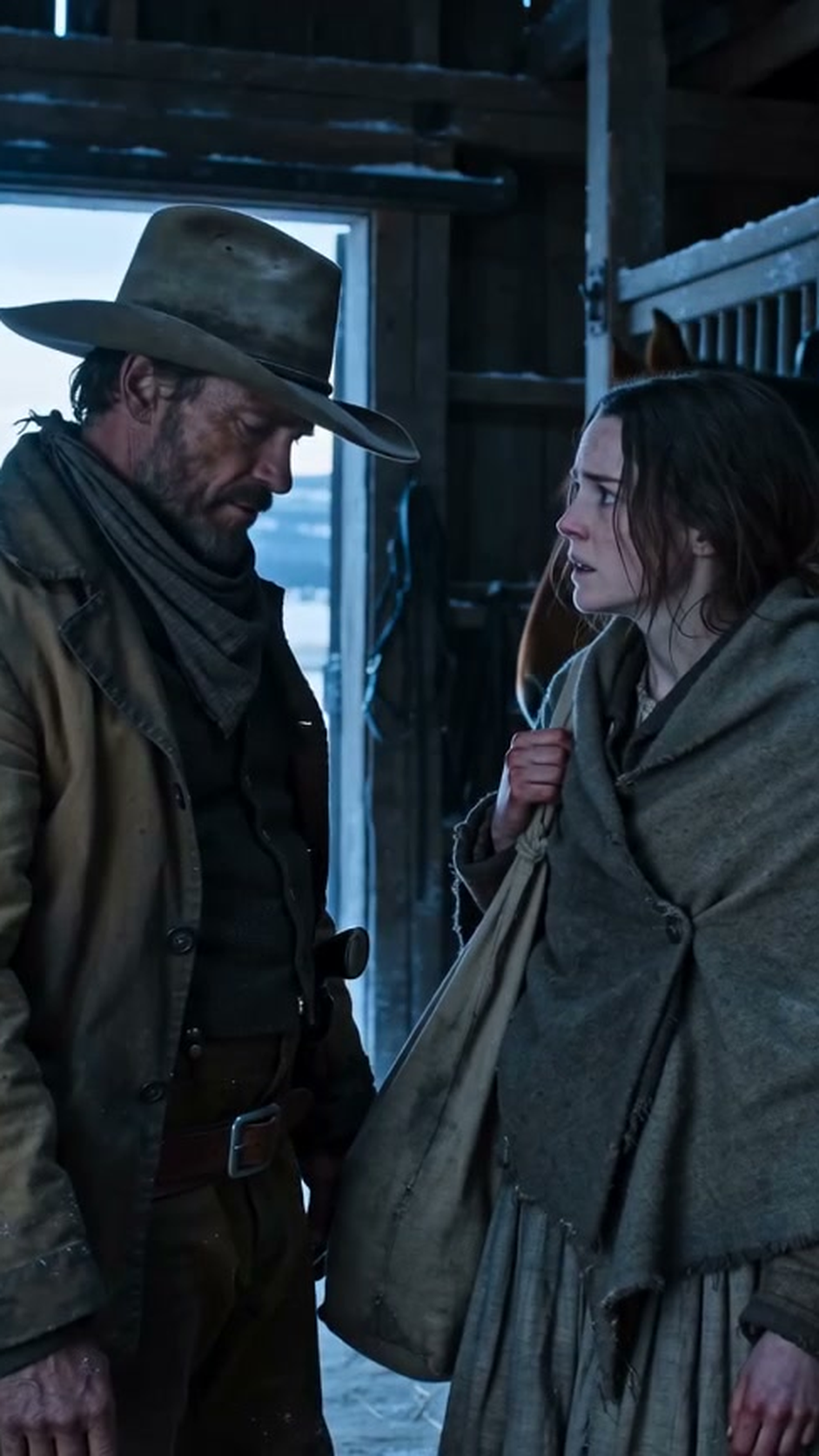
The storm came down out of the northwest an hour before midnight like something with a grudge, and by two in the morning the world outside the Silver Crown ranch house had been reduced to a single fact: white, moving sideways, at fifty miles an hour.
They had been out since the first gust. Two hundred head of cattle and forty yearlings were drifting before the wind on the north coulee — cattle will walk with a storm wind at their backs until they walk into a coulee wall or a river cut or simply walk until they drop, and a herd that drifts in a blizzard dies in a pile against whatever stops it. Ransom had the whole crew out: Gus, Will, and Tomas the young hand, riding a line in the dark with lanterns hooded against the wind, trying to get ahead of the leaders and turn them into the sheltered draw below the cottonwoods, where the wind would pass over their heads and a cow could survive standing.
Tessa went out over Gus's protest, Ransom's order, and the evidence of her own senses, and she went for the simplest reason in the world: she knew that coulee the way she knew her own hands.
Her father's claim had bordered the north pasture. She had ridden that broken country from the time her legs were long enough to straddle a pony — every cutbank, every crossing, every place where the ground fell away without warning. In a white dark where a man could not see his own horse's ears, the man who knows the land by memory is worth ten who know it by sight, and Tessa Ren knew it in her bones.
"You're a fool, girl," Gus shouted at her over the wind at the corral gate, and then, because he was Gus, he handed her his own spare pair of mittens and his second-best scarf. "Coulee mouth," he said. "If the leaders get past the cottonwood draw, they're into the deep cut an' we're diggin' out carcasses come spring. You an' me take the east side. Boss an' the boys'll swing the west."
She would remember that ride all her life, and not with horror, which surprised her afterward. With a fierce, stripped-clean clarity. The cold was a hand pressed flat against her whole body. The snow came not down but across, needling through every seam. Her horse — Gus's steady bay mare, who had more sense than most people — picked her way by memory and instinct, and Tessa let her, and thought about nothing but the next hundred yards, and the count, and the dark.
They found the leaders at the coulee mouth, exactly where Gus had feared: sixty head bunched and bawling, milling at the lip of the deep cut, the wind worrying them forward a step at a time.
What happened next was not heroic, because cattle work in a storm is never heroic; it is slow, and loud, and stupid with cold, and it is done a yard at a time. Tessa got the mare across the leaders' front and turned the lead cow — an old red matriarch with frost on her lashes who looked at Tessa out of the white dark with the eyes of a creature that has also had enough — and once the red cow turned, grumbling, toward the draw, the herd's mind turned with her, the way a river turns, all at once and by inches. Gus came in on the east side whooping through frozen lips. From the west, faint through the wind, came Ransom's voice and the swing of a lantern, and the whole mass of the herd began to pour, slow as tar, into the shelter of the cottonwoods.
A gust took her lantern a minute later — not out of her hand, but out of existence, the wind finding the seam of it and snuffing it like a thumb and finger, and the dark that followed was total, a dark with weight. She worked by ear after that: by the bawling, by the shift and creak of two hundred bodies, by the mare under her who knew the ground better than any map. Once, at the very lip of the deep cut, a yearling slipped past her in the white dark and went sliding toward the drop, scrabbling, and Tessa went after it without thought — rope in her teeth, one hand in the mare's mane, hauling with the horse's strength added to her own until the yearling's hooves found purchase and it lunged back onto level ground and stood shaking against her mare's shoulder. She leaned her forehead for one second against the mare's wet neck and laughed out loud into the storm, from pure fury and joy mixed, and the wind tore the sound away and gave nothing back.
That was when they heard the scream — a horse's scream, and a man's shout cut off short, from the coulee rim behind them.
Gus's gelding had gone down on an ice-slicked crossing, gone down hard and rolled, and Gus Pruitt, nineteen years a foreman and sixty-one years a man, was pinned in the snow with his leg bent under the horse in a way legs do not bend, white to the lips, trying with one free hand to keep the gelding's head up so the animal wouldn't drown them both in a drift.
The horse freed itself in a thrashing scramble before Tessa got there — she got there. She got her arms around Gus under the shoulders and hauled him, a dead dragging weight with a broken leg, up onto the bank hand over hand in the snow, and she did not remember deciding to do it or finding the strength, because there was no decision in it anywhere. There was only Gus, and the snow, and the thing that had to be done.
"Leg's gone, girl," Gus said through his teeth, while she bound it straight against a cottonwood branch with her own second scarf and strips torn from her petticoat hem, her hands working by touch in the dark. "You leave me an' finish the herd. That's an order, if I got any authority left in this outfit."
"You don't," Tessa said. "You're a cook's assistant now, same as me, and the cook says hold still."
He laughed — actually laughed, a cracked, furious sound — and then swore at the pain, and she got him up onto the bay mare with the help of the gelding's saddle and her own shoulder under him like a post, and sent mare and foreman crawling back toward the ranch lights with the mare's reins tied to Gus's wrist so that if he fainted the horse would drag the knowledge of the way home with her.
Then she turned back into the storm to finish the herd, because the herd was not finished, and neither was she.
Ransom found her an hour later at the draw, on foot, leading her borrowed horse, turning the last stragglers in out of the wind with her father's clasp knife in her teeth at some point she couldn't afterward account for, and her left boot — the split boot, cord-tied, her old shame — torn clean through at the toe and packed with snow, and her foot inside it gone the gray-white color that men who winter in that country learn to fear more than any gun.
He did not waste words. He got her up in front of his saddle and her horse tied on behind, and he held her against the storm with one arm the whole ride back, and she was aware — through the cold, through the exhaustion that was pulling her down like deep water — of two things only: that he was shaking, and that it was not from the cold.
They got the herd in. Every head but three, and the three were old cows who'd gone down before the crew ever reached the coulee, and Gus, delivered home by his mare like a parcel, was installed by the kitchen fire roaring orders with a splinted leg. Two hundred and thirty-seven cattle stood in the cottonwood draw with the wind screaming harmlessly over their heads, alive, because a girl who knew the ground had refused to be left in the kitchen.
In the kitchen, with the door barred against the storm, Ransom Calder knelt on the floorboards in front of Tessa's chair and took her frozen foot into a basin of cool water — cool, never hot, her father had taught her that too, and Ransom knew it without being told — and worked over it with a care that undid her completely. His hands, those big scarred rancher's hands, were gentler than any woman's she could remember. Her foot came back to life in a blaze of pins and needles that made her bite her lip through, and he saw her do it, and his jaw worked.
"You could have lost the foot," he said. "You could have lost more than the foot, out there. Do you understand that?"
"I understand it better than you do," Tessa said, and the words came out ragged, because she was so tired, and because his hands were still around her ankle like she was something made of glass, and no one had touched her like she was worth care in longer than she could tally. "It's my country, Ransom. That coulee took my father's claim and my father's life, in the end, between the fees and the winters — I'm not giving it one more thing of mine. Not the herd. Not Gus. Not—" Her voice broke, traitorously, at last. "I am so tired of running from Silas Brandt. I ran out of Elkhorn. I hid in your hay like a — like a raccoon, Gus said. I won't do it anymore. Whatever happens next, I face it standing up, in daylight, with my name on. That's all I know how to do anymore."
"Tessa." It was the first time he had used her Christian name, and they both heard it. "Then we face it standing up. Both of us. That's the end of the discussion."
Outside, the storm hit the house like a sea. And it was then — with the lamps lit and Gus asleep at last under quinine and two blankets — that Will came in through the lean-to door half carrying a man, and the man was Doyle.
He had been found by the ranch gate where his horse had thrown him — he'd been out in the storm since dusk, it emerged later, posted on the road by Brandt to watch whether the marshal's party would find a welcome at Silver Crown. The cold had done to him what it does: he was past shivering, which is the worst sign of all, and his eyes were open and seeing things that were not in the room.
They got him by the fire. They got warm broth into him a spoonful at a time. And in the fever that came up as the warmth came back into him, Doyle began to talk — to the ceiling, to his dead mother, to persons invisible — and the kitchen went very quiet, and Gus, who was not as asleep as they'd thought, opened his eyes.
"Never stole nothin'," Doyle mumbled, clear as a bell in the warm room, turning his head from side to side. "Tell him — tell Brandt — I done what he said. Brooch was in his coat. His own coat. I put it there like he told me, night before. Girl never stole nothin'. He just needed her gone 'cause of what she seen in that book. Tell him I want my ten dollars. He never paid me my ten dollars."
The fire settled. Nobody moved.
"He's raving," Will whispered.
"He's confessing," Gus said from his blankets, with enormous satisfaction. "There's a difference, boy. Raving don't usually come with figures."
But Doyle's eyes were glassy and wandering, and by the time the storm blew itself out toward dawn he had sunk into a deep, cold sleep that no one could say he would wake from — and Tessa stood by the window watching the sky clear to a hard, brilliant, merciless blue over a world remade in white, and she understood the shape of the trap exactly:
A dying man's fever words were wind. If Doyle woke himself again, loyal to Brandt and afraid, he would call it all a dream — and the word of Silas Brandt, banker and hotelier, would stand against the word of a runaway cook and a rancher the whole valley already whispered had gone soft in the head over a girl.