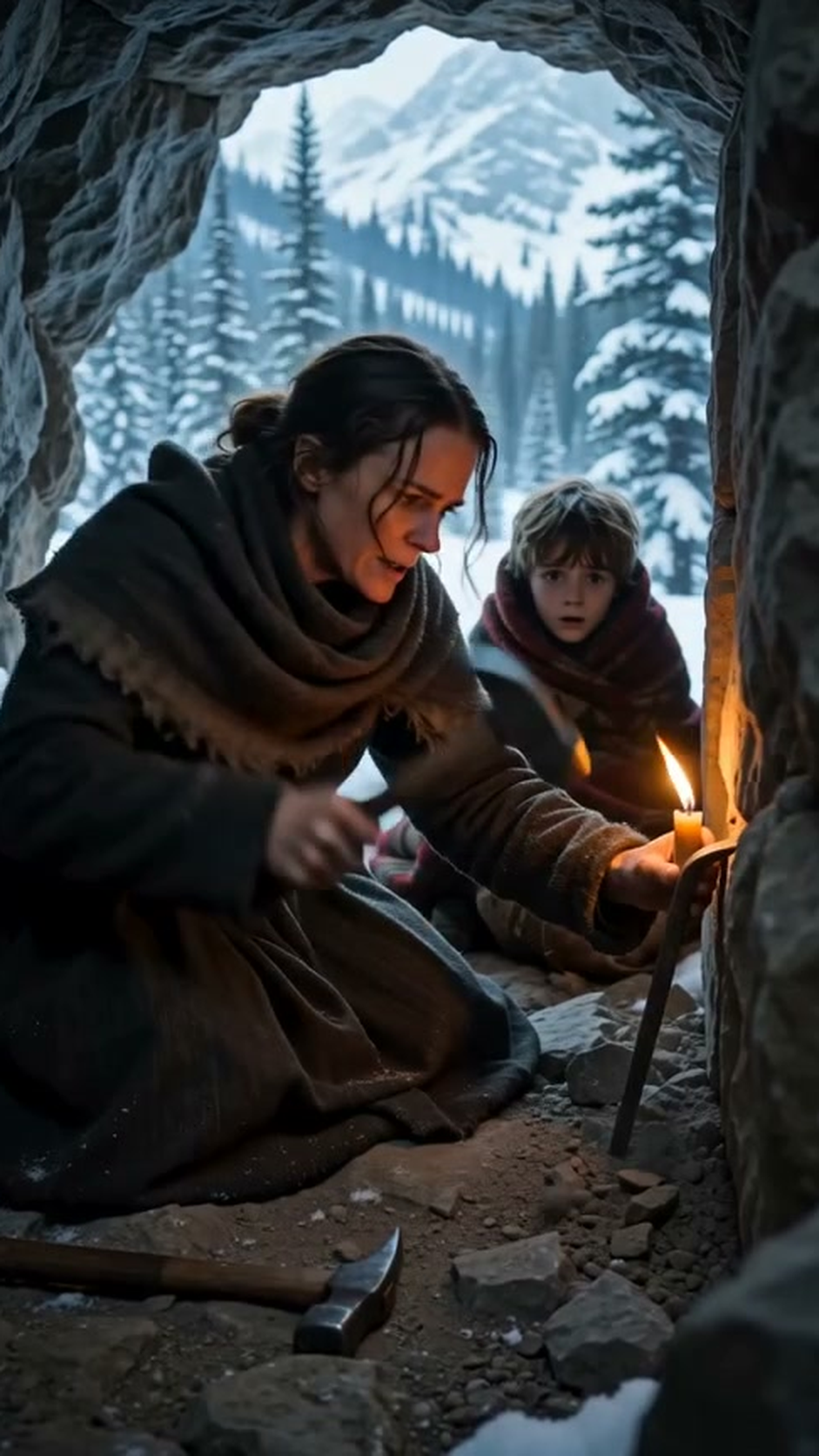
Harlan Pike ducked under the cave mouth with snow on his shoulders and a lantern in his hand, and the first thing he did — Martha would remember it later, and use it — was look not at her, and not at the sick boy, but at the wall.
At the opened wall. At the black doorway where nine courses of stone had stood whole for thirty years.
His face did something then that no amount of money could have bought back: it changed. The courteous coffin-lid mask went off it entirely, and underneath was a man watching thirty years of profit swing open in the dark. He recovered in a breath — he was Harlan Pike; recovery was his trade — but Martha had seen it, and Samuel, from his bed of pine boughs with the grant against his heart, had seen it too.
Witnesses, she thought. We're collecting them like firewood.
But first — because he was Harlan Pike, and Pike never opened with the club when the glove was still on his hand — he turned to the boy. He crouched, lantern and all, at a father's distance from the pine-bough bed, and his voice went down into the register of uncles and grandfathers, and out of his coat he brought a twist of paper with peppermint drops in it, the kind Hendricks kept in a jar by the scales for good boys.
"Samuel," he said. "You're looking peaked, son. Your mama's done wonders up here, but this is no place for a chest like yours. There's a doctor in Pinewood warming a room for you this very night, and a sled with blankets, and your mama can ride right behind you the whole way. Wouldn't you like to be warm, son? Wouldn't you like to stop coughing?"
It was beautifully done. It was the best and worst of the man in a single gesture: he was offering the one true thing in the cave — the boy did need warmth, and a doctor, and an end to coughing — and he was offering it in such a way that refusing it would make Martha the villain of every story told about this night in Pinewood for the rest of her life. She could feel the trap's jaws standing open, oiled and reasonable. Take the boy down. For the boy's sake. And a boy carried down a mountain in Pike's blankets, with Pike's men, past Pike's office, might arrive at that warm room. Or he might arrive at a signature extracted from a mother who had been shown, very gently, exactly how long a boy's journey could be made to take.
Samuel looked at the peppermint drops. Eight years old, a week out of a fever, hungry as a wolf cub, and he looked at them the way his father had looked at a false survey line — carefully, and from the side.
"Mama," he said, "is this the man?"
"This is the man, Samuel."
"Then I don't want his candy." The boy's voice shook once, and steadied, and found something in it that had been put there by two surveyors and a schoolteacher and thirty years of mountain. "I'm the witness, Mr. Pike. Witnesses don't take presents from the — from the — " He searched for the word his father's book would have used, and found an honest one. "— from the other side."
Pike stood up slowly, and the peppermint drops went back into his coat, and something went out of the cave with them — the last of the performance, the last of the gloves. What was left looked at the opened wall the way a man looks at a fire in his own warehouse.
"Mrs. Sullivan," Pike said. "You've been busy."
"Keeping house," Martha said, and set the pry bar down within reach and did not pick up the rifle, because the rifle would only give them a story to tell afterward. "You climb a long way in a storm to watch a widow sweep her floor, Mr. Pike."
Behind him, two of his men crowded into the lamplight — a barrel-chested fellow she didn't know, and Doyle Rusk, who would not look at her, and would not look at Samuel, and stood studying his own hands like a man reading bad news in them. Three men and a lantern. And Pike, who came forward another two steps and spoke as if they were alone, in the warm, reasonable voice he'd used through her kitchen door.
"Let me save us all some weather, Martha. There's an occupancy matter come January—"
"It's December," she said.
"—and a debt matter, and a boy with a bad chest, and whatever you think you've found in that hole, it won't feed him." He held out one gloved hand, palm up, reasonable as a priest. "Give me what's in the box. I'll burn it in your own fire, we'll all watch it burn, and I'll carry a paper down this mountain that says the Sullivan note is paid in full, the claim released friendly, and the boy and his mother kept on in the cabin as my tenants, rent-free, for as long as she lives. That's not an offer a drowning woman refuses, Martha. That's a rope."
"It isn't a rope," Martha said. "It's the same water, with better manners."
"You'd rather the law?" He let the hand fall. "The law is a six-day ride in this snow, and the law keeps what it can hold, and it cannot hold that mountain any more than you can. Your husband tried the law, in his way, with his little books and his little figures. You see where his figures got him."
There it was at last — said aloud, in her hearing, in her son's hearing. Martha felt the whole cave go very still, the way the world does in the second before a roof beam gives. Rusk, at the edge of the light, had gone the color of old snow.
"Say it plainer," Martha said quietly. "My boy is his father's witness. He should hear it in words."
But Pike was too old a hand to be drawn twice in one minute. He smiled, and nodded at the chamber. "Search it," he told the barrel-chested man. "Box, shelves, all of it. Bring me paper."
The man went in with the lantern, and they heard the crates shift and the strongbox lid sing against the stone, and he came out with his hands empty and his face careful. "Box is empty, boss. Tripod, chain, old stores. No paper."
"No paper." Pike turned back to her slowly, and the reasonableness was gone now, and what stood in its place was thirty years of the other thing. "Mrs. Sullivan. A widow does not open Caleb Foss's cache and find nothing. Widows find things. Where is it?"
"Gone the way of your deed, Mr. Pike," Martha said. "On paper, and worth about as much."
"You're bluffing with an empty box, Martha."
"Am I?" She let her voice stay level, almost gentle, the voice she had used for difficult sums in the schoolroom. "October the ninth, 1859. A man came up this mountain in a good coat, with two men behind him who did not offer their names. He made an offer, and then a price, and then — smiling the whole while, a reasonable man — he named what surveyors cost in this territory when they will not be reasonable, and what widows cost, and orphans." She watched his face the way Isaac had taught her to watch a compass needle. "Your father wrote none of it down, Mr. Pike. He was too careful. But Caleb Foss wrote everything down. Surveyors do. It's the whole of the trade: we write it down, and we sign it, and the mountain keeps it. Would you like to hear what else he wrote? My boy can read it to you. He's a fine reader. His father taught him — the father your forty dollars killed on a schedule, on a face that had never been crossed in a day, with a guide who knew it."
"That is a story," Pike said, very quietly, "that a woman tells a cave."
"It isn't a cave I'm telling it to," Martha said. "It's the three men standing in it. Count your witnesses, Mr. Pike. You're a man who keeps books. Count."
And when he took one step toward her — only one, and not even a fast one — it was not Martha who moved.
It was Rusk.
He moved the way a man moves in his sleep, without deciding to: two steps, into the space between Pike and the woman, and he was looking at last not at his hands but at the pry bar against the wall, and at the thing lying beside it in the firelight. Caleb Foss's hammer. The carved handle. He made a sound that was not a word.
"Doyle?" Pike said, with genuine, mild surprise. "What ails you, son?"
"My father held the lantern," Rusk said. His voice came up out of him like something dredged. "In '59. For your father. He told it to me on his deathbed with the priest in the room, and the priest pretended not to hear, and I've carried it nine years like a stone in my gut. They went up to Foss's camp to move a survey line, and Foss wouldn't be moved, and my father held the lantern while—" He stopped. He looked at Samuel, eight years old, sitting up in his blanket with his father's grant against his heart, and something in Doyle Rusk's face finished breaking. "And in October I did the same work for you, Mr. Pike. I held the lantern. I told Isaac Sullivan the north traverse could be done in a day. I KNEW it couldn't. You paid me forty dollars and I knew—"
"Doyle," Pike said, with terrible gentleness, "you are unwell from the climb. Sit down before you say things in front of strangers that cannot be unsaid."
"Isaac asked me at the cairn if the face was sound," Rusk said, to Martha now, to the only court left in the world. "And I said it was sound. I watched him go out onto it. I heard it go.
"It wasn't a big sound, ma'am. That's the thing I cannot get shed of. Two hundred feet, you'd think it would be a big sound. It was a stone sound. A clatter, like somebody emptying a bucket of rocks, and then the wind took it, and then there was just the wind, going on and on like nothing in the world had changed. I stood there at that cairn a long while doing the arithmetic Mr. Pike taught me — forty dollars, and a man I'd eaten with, and a widow, and a boy — and I walked down the mountain whistling, Mrs. Sullivan. I want that in it too. I walked down whistling, so if anybody saw me they'd think the day had gone ordinary. My father taught me that part without ever saying it. He whistled, coming home from the ravine in '59. I was six years old. I remember the tune.
"Forty dollars. I have spent eleven of them and I cannot spend the rest, I have tried, it turns to dirt in my hand—"
The barrel-chested man had his hand on his pistol, looking to Pike for the word, and Pike was looking at the chamber, at the woman, at the boy, doing the arithmetic of three witnesses and one winter cave, and Martha saw the exact moment the arithmetic came out in favor of a second accident — a cave-in, a fire, a widow and a boy overcome by smoke in the night, why, it happened every winter, the whole valley would be so sorry, kindly, with pies—
A lantern swung into the cave mouth behind them all, and a voice Martha had last heard reading the Christmas lessons in the Pinewood church said, in the unhurried tones of a man who has never once in his life needed to raise it:
"Harlan Pike. In the name of the Territory, you will step away from that woman, and your man will take his hand off his pistol, and everybody in this cave will keep their hands where God's light can see them."
Marshal Elias Cole stood in the entrance with the storm at his back, six feet of soaked wool and quiet certainty, and behind him — soaked to the skin, snow in his hair, grinning the grin of a boy who has outrun four horsemen on a borrowed mule — was young Tom Abernathy, sixteen years old, whose grandmother had watched Harlan Pike ride north past her window at dusk, and had done her own arithmetic, and sent for the law.