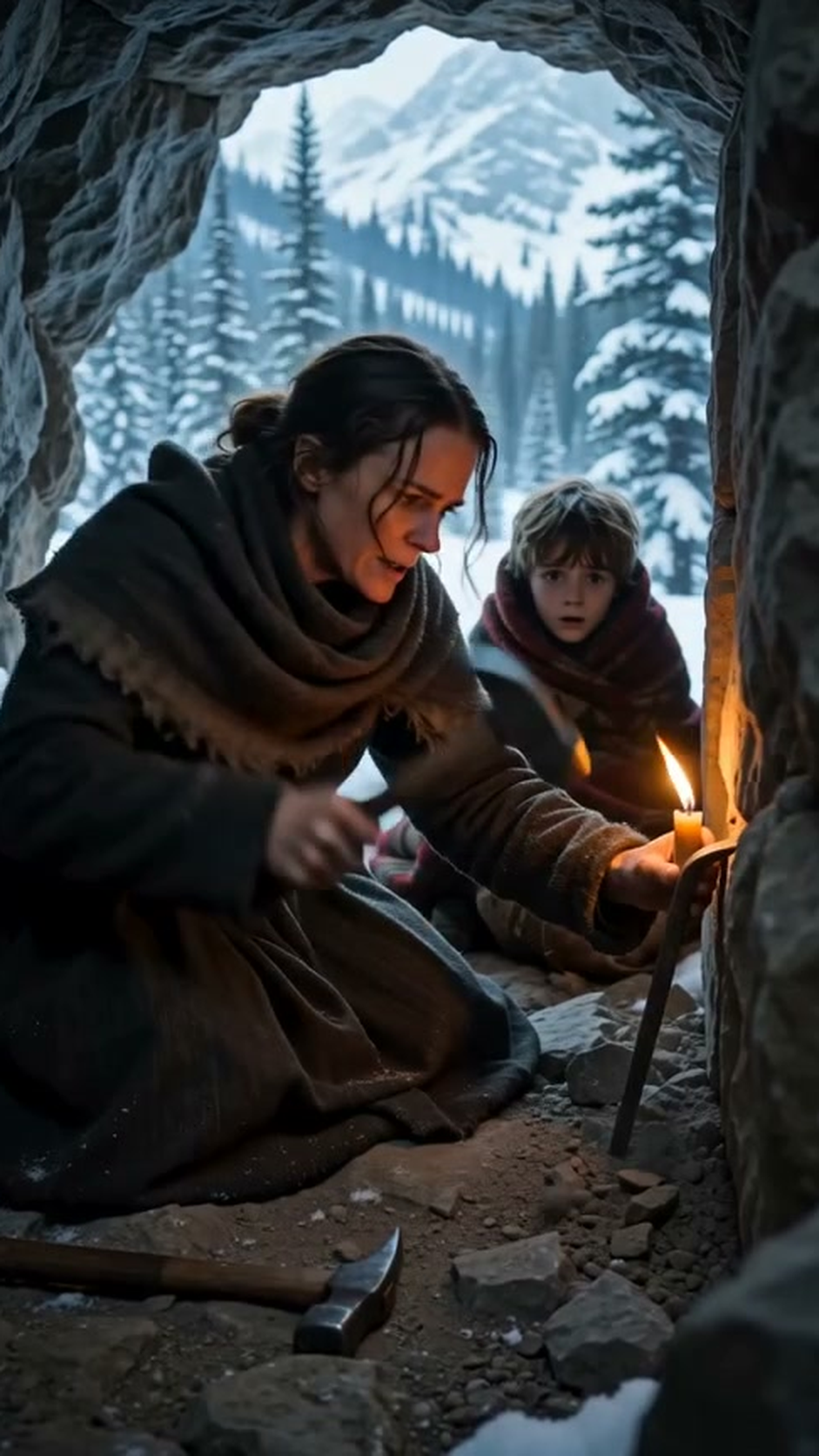
The ride down took a full day, and Martha remembered it afterward the way you remember weather: in pieces, all of them cold. The marshal rode point with Pike's hands bound to his saddle horn — unnecessarily, everyone understood, and correctly, everyone also understood. Rusk rode free, by his own request, in the middle of the column, where any man could watch him, and sang nothing, and whistled not at all. And Samuel rode in front of Martha on the mule, bundled to the eyes, carrying the mountain's truth against his heart the whole way down, and at the tree line he twisted around and looked back up at the black shoulder of Blackstone Mountain standing over the valley and said, with the satisfaction of a professional closing a job: "The wall kept its counsel, Mama. We kept ours."
"That we did, witness," she said. "That we did."
They held the hearing in the Pinewood land office on the fourth day of the new year, because the office had the only stove in town that could heat a room that size, and because half the county intended to be inside it.
They came on sleds and snowshoes, in church coats and Sunday hats: Hendricks from the general store, the minister, the doctor who had taken Martha's last silver dollar, and Mrs. Abernathy in the front bench with her grandson, straight-backed and burning-eyed, in the seat of honor she had not asked for and entirely earned. Pike sat at the long table with a lawyer brought up from the capital on a special sleigh, a young man with clean cuffs who kept touching the forged deed in front of him as if it were a Bible that might still save him. Harlan Pike himself sat very still, in a black coat, with his hands folded, a man who had decided that dignity was the last property he owned outright.
He was wrong about that, too. But it took all day to prove it.
The territorial judge — a cadaverous Kansan named Whitlock, snowed in at Pinewood on circuit and visibly pleased to have something worth his robes — began with the paper, because paper is where thieves feel safest. But first Pike's lawyer made his stand, and it was a good stand, and Judge Whitlock let him make all of it, standing, before the whole room: the so-called journal of Caleb Foss was the unsworn scribbling of a man thirty years dead, who could not be cross-examined; the grant had surfaced from a hole in a mountain by way of an interested party; the chain of custody — the lawyer had clearly been practicing the phrase on the sleigh ride up, and he used it nine times in four minutes — the chain of custody was a widow and an eight-year-old boy.
Judge Whitlock heard him out with his long fingers steepled and his eyes half closed, in an attitude the room at first took for sleep and later understood to have been appetite.
"Counselor," he said at last, "I have hung two men on the word of the dead in my time on this circuit, and in both cases the dead were righter than the living. A corpse cannot be bribed, threatened, promoted, or made sorry with pies. It is the only incorruptible witness this territory affords, and I will thank you not to keep objecting to its testimony on the ground of its convenience." He opened the field book that lay before him like a man opening a service. "We will hear the paper. All of it. In order. And I would advise everyone in this room to get comfortable, because I have nowhere to be until spring, and I read slowly when it matters."
Martha laid it out the way Isaac had taught her, in the order Caleb Foss had commanded: the figures first.
The original territorial grant of 1859, with its seal unbroken these thirty years in the mountain's keeping: Blackstone Mountain, six hundred forty acres and the mineral rights entire, to the Sullivan family, in perpetuity. The territorial survey plat in Caleb Foss's hand, the lines clean and hard. And against them, the Pike filing of 1859, and the judge laid the two plats one over the other on the window glass against the winter light, and the whole room watched the bow in the Pike line swell across the true one like a snake across a road, swallowing six hundred acres of timber, water, and silver showing into the Pike claim.
A sound went through the room that was not quite a word.
Then the journal. Judge Whitlock read Caleb Foss's last entries aloud himself, in his dry courtroom voice, and a dead man testified for the better part of an hour — the offer, the threat, the cache behind nine courses of stone, the walk out by the south ravine at first light to draw them off. Then Isaac's field book, and the entries of the final week, and Martha, from the witness chair, explained about schedules, and hurried men, and a north traverse that had never once been done in a day.
Pike's lawyer rose then, in his clean cuffs, and was very gentle with her, which she had been warned about by everyone she knew and had prepared for the way you prepare for weather. Was it not true, he asked, that she had never seen these famous documents before December? That she had produced them from a cave no living soul could search but her? That grief — he was so sorry — that grief and debt and a sick child might press a clever woman's memory into shapes that served her? That the boy, her only corroborating witness, was eight years old and fevered and her son?
"It is true that I am his mother," Martha said. "It is true that I am a widow, and that I was pressed. Mr. Pike's company pressed me every week since October, and I have the rider's deed at home that I burned — no." She stopped herself, and smiled, just slightly, into the record. "I burned it, so I haven't. What I have is the figures, sir. My husband's book and Mr. Foss's book agree with each other across thirty years, and neither man knew the other would ever read him, and a lie has to be arranged, and the dead cannot arrange. You may call my memory anything you like. Call the survey wrong. I have waited all winter to hear a Pike surveyor stand up in a room with a flag on it and call the survey wrong."
The lawyer sat down. No Pike surveyor stood up. There wasn't one in the room; there had never, in thirty years, been one anywhere near a room with a flag on it, and the room understood that all at once, like a temperature changing.
Hendricks testified about the note — how the company's agent had bought up the valley's paper, name by name, Sullivan, Alvarado, Whitt, always the claims that touched the mountain, always below value, always from men who had been asked to be sorry about it first. Mrs. Abernathy testified about riders at dusk, and a boy sent for the marshal, and things the valley had known and not known for thirty years, and when Pike's lawyer suggested, delicately, that an old woman's memory was a garden where anything might grow, she looked at him the way she had looked at death and childbirth and the measles year, and said, "Son, I have buried four husbands' worth of better liars than you. Sit down before you tire me." Judge Whitlock did not strike it from the record. Witnesses would swear afterward that he had written it down.
Then the judge called Doyle Rusk.
Rusk had asked to be kept in irons until he had spoken, which the marshal had refused, and which told the room everything before he opened his mouth. He told it all. He told about his father, and a lantern held in the snow in 1859 while Amos Pike's men did their work in the south ravine, and a body the early storm had taken and kept. He told about October, and forty dollars, and a cairn above the tree line, and a surveyor asking him, man to man, if the face was sound. "Isaac Sullivan was my friend," Rusk said, standing very straight, looking at no one. "I want that in whatever record there is. He was my friend, and I held the lantern anyway, same as my father before me, and there is no bottom to that, Judge. There is no bottom to that at all."
Pike's lawyer was on his feet by then about hearsay and deathbeds and the unreliability of guilt, and he was good, and it did not matter, because Marshal Cole had spent three days in the Pike land company's own office with a court order, and now he laid the company's payment ledger on the judge's table, open at October, and read out in his Christmas-lesson voice a single line of bookkeeping, entered in a clerk's fair hand and initialed by Harlan Pike himself:
October 27th — D. Rusk, services re: Sullivan traverse — $40.00.
"I keep books for a mining concern, myself, in a manner of speaking," Judge Whitlock remarked, into the silence. "I find I am unfamiliar with the custom of paying forty dollars for an accident."
The ruling, when it came, took eleven minutes. The Pike deed of 1859 was declared void from its making, a forgery upon the territorial record. The grant of Blackstone Mountain was confirmed in the heirs of Isaac Sullivan — in Martha, and in Samuel, eight years old, who was at that moment asleep against his mother's shoulder with his boots still on, having held out like a little soldier until the figures were finished and the shouting started. Harlan Pike was bound over for trial in the capital on charges of fraud, forgery, and conspiracy in the deaths of Caleb Foss and Isaac Sullivan, and Doyle Rusk was bound over with him as accomplice and state's witness, which was the thing Rusk had asked for, standing in the snow outside the cave, in almost those words. Let it be a court, he'd said. Let it not be a lantern this time.
Pike said nothing at all through any of it, until they were leading him past Martha's bench, and then he stopped — the deputies let him stop; the whole room let him stop — and looked down at her with something on his face she had never seen there in all the months of his siege: not rage, not contempt. Recognition, almost. As if he were seeing her for the first time.
"Your husband," Harlan Pike said, "was a difficult man to buy. I want you to know I remarked on it at the time."
"He wasn't for sale at any price, Mr. Pike," Martha said. "It runs in the family."
They took him out into the snow, and the room stood up around her like a field standing up after wind, and Mrs. Abernathy took her face in both hands and kissed her forehead hard, like a blessing with knuckles in it, and said, "There now. There now. The mountain remembers, doesn't it, girl."
"The mountain remembers," Martha said.
That night, in the inn room the town had insisted on paying for, she counted what the winter had left them and what it had given back, and the two lists were longer than she expected. The mountain was theirs — by law, by blood, and at last by record. Isaac's name stood clear. Samuel slept in a real bed, breathing easy, dreaming whatever boys dream when the fever and the fear are both behind them.
But one name on her list had no ending yet. One witness had testified from a journal and a grave no one had ever found, out of a ravine the snow had kept for thirty years.
"Caleb," Martha said to the dark room, and the candle, and the boy asleep. "We found your wall. We found your figures. This spring, when the snow lets go of that ravine — we're coming to find you, too. A Sullivan pays a debt. All of it."