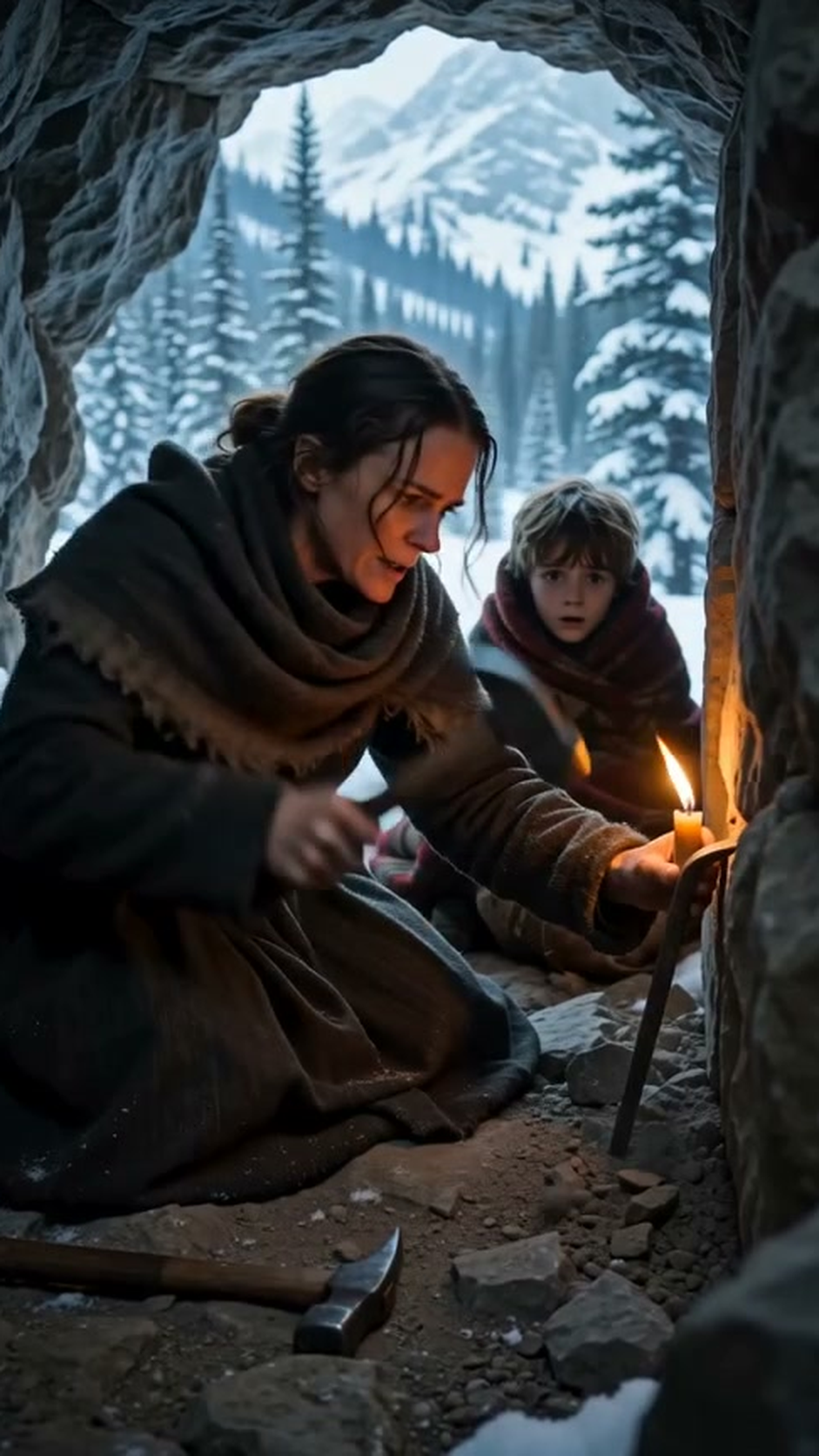
The snow let go of the south ravine in the second week of April, reluctantly, the way it lets go of everything on Blackstone Mountain, and on the first Saturday after the melt Martha rode up with Marshal Cole, the doctor, young Tom Abernathy, and Samuel — Samuel on the mule's packsaddle, straight-backed and eight years old and entirely well, with the color back in his face and an appetite that had become a standing joke in the Pinewood inn kitchen.
They found Caleb Foss where his journal had said he would be: at the head of the ravine, where the draw narrows between two shoulders of black stone, in a place that had been a snowdrift for thirty winters running.
They worked the head of the ravine the way a survey crew works a line — in a rank, on their knees, an arm's length apart, moving downslope at the pace of prayer. It was Martha who set the method, out of Isaac's field book, out of the habits of men who search ground for a living and know that ground gives up its dead grudgingly and only to the systematic. Samuel walked the rank with the others, between the doctor and Tom Abernathy, carrying the canvas sack, and it was Samuel — because he was lowest to the ground, and because a boy looks at the world from a height where small true things live — who stopped, an hour into the searching, beside a scatter of storm-washed stone at the ravine's narrowest pinch, and said, in the voice of a boy who has been taught that witnesses speak up promptly and plainly:
"Mama. There's a boot."
There was not much. Thirty years of mountain weather is thorough. But a surveyor is not hard to know, even then. The brass compass had kept its polish in the dark of his coat. The chain lay coiled as he had carried it, link on link, patient as ever. And the ravine, which Amos Pike's men had chosen for its silence, had kept its own counsel exactly as the cave had — it had simply been keeping the man himself, until someone who owed him came to ask.
They carried him down on a litter of pine poles, all four of them taking a corner in turn, Samuel walking ahead with the compass in both hands like a chalice, and they buried Caleb Foss in the Sullivan plot on the hill above the cabin, beside the ground where Isaac lay, with the whole of Pinewood turned out on a weekday to watch it done. The minister had prepared remarks suitable for a stranger thirty years dead, and they were fine remarks, but afterward it was Martha who stepped forward, because the debt was hers.
"He surveyed this mountain with my husband's father," she said, "and when he was offered money to move a line, he moved himself instead — into a cave wall, and then into this ravine, so that a family he would never meet could stand on its own ground. He had no children. He has us. The mountain was his witness for thirty years. Now it has a stone, and his name spelled right, and people to say it."
Then Samuel stepped forward, unasked, with his father's field book open at a page he had marked with a strip of red blanket wool, and read aloud — in a clear, carrying voice that did not shake once — Caleb Foss's final entry, the whole of it, the walk out by the south ravine and the wall keeping its own counsel, while the whole town stood in the spring mud with its hats in its hands and listened to a dead man finish his sentence at last. When the boy closed the book, there was a silence of the particular kind that only occurs in graveyards and courtrooms, the two places where the territory told the truth, and old Mrs. Abernathy was heard to say, not quietly, that she had waited thirty years to hear that read out by a Sullivan in the daylight, and it had been worth every winter of the wait.
The stone had been cut in Pinewood by a mason who refused payment, and it said:
CALEB FOSS
SURVEYOR
HE KEPT THE LINE
Word came up from the capital in June, in a letter with the territorial seal, which Samuel read aloud at the supper table twice through, standing on a chair for the importance of it: Harlan Pike, convicted on all counts, twenty years. And Doyle Rusk — state's witness, four years, with the judge's own handwriting in the margin of the record, a thing the clerk had copied out for her because he thought she should see it: This court notes the defendant's testimony was given freely, fully, and at cost to himself, and recommends it be remembered. Rusk had sent a letter of his own, three lines, in a hand that wandered: Mrs. Sullivan, I am learning to sleep. What I owed your husband I will pay to the boy's mountain if I am ever let. D.R.
Martha kept that letter in Isaac's field book, in the blank pages at the back, where it belonged.
In May she rode down to Pinewood on a spring morning so fine it felt invented, and stood in the land office — the same room, the same stove, cold now — and watched the clerk enter the confirmation of the Sullivan grant into the territorial record in a fair round hand, and blot it, and sand it, and close the great book on thirty years of theft with a sound like a chapter ending. Then she did a thing no Pike had ever managed to do in all the years of the company's dominion: she negotiated. A timber contract on the south face, on Sullivan terms, at Sullivan prices, with Sullivan men hired at Sullivan wages, and the first payment of it — real money, honest money, her mountain paying her instead of burying her — went into the Pinewood bank in an account with two names on it, hers, and beneath it in a child's careful printing, practiced all the way down the trail on a slate: SAMUEL SULLIVAN.
She also paid her debts. Every one. Hendricks got his stove-pipe money with interest he tried twice to refuse and was not permitted to. The doctor got his dollar and the most of another, and a ham, and a standing invitation he used twice a month all summer. The Alvarados and the Whitts, whose paper Pike had bought for pennies, got something better than money, though it began with money: they got Martha Sullivan at the land office with her confirmed grant and her husband's field book, helping them file their own claims figure by figure, line by line, because a bow in a survey is a bow in a survey, and it had never only been her six hundred acres the snake had swallowed. By August there were three more Sullivan-style filings working their way through the territorial office, and the valley had begun, kindly, with pies, to remember that it had a spine.
She took to walking the near boundary at first light, the way Isaac had, with the field book under her arm and a biscuit in her pocket for whichever of them got hungry first — which was always Samuel, who ate like a boy making up arrears. The mountain gave back its small change that summer: strawberries in the ravine shade, a lost tally pin found in the rocks, the surveyor's ditty coming out of her mouth unbidden while she worked.
By summer the cabin had a new roof — raised in two days by men who had been sorry all winter and seemed determined to make up the arrears in shingles — and the south meadow was fenced, and there was a garden where the beans came up strong, and the doctor, riding past on his rounds in July, stopped his horse at the gate and looked a long time at Samuel, who was splitting kindling with more enthusiasm than technique, and said, "That boy's chest is as clear as a bell, Martha. Whatever you did up that mountain, it cured more than the fever."
She knew what they had done up the mountain. They had been witnessed, and they had witnessed. It amounted, she sometimes thought, to the whole of the law and most of the gospel.
In August, the timber crew came up the mountain — Sullivan's crew, hired at Sullivan wages, under a crew boss named Hartley who had worked for Pike for six years and walked off the company's payroll the week the verdict came down from the capital, along with half the men in the valley who could swing an axe and read a boundary blaze. On the first morning, Martha walked the south-face line with Hartley herself, Samuel trailing them with the tally pins in a leather pouch at his belt, solemn as a deacon, while she showed the crew boss where the true line ran and where it did not, blaze by blaze, stone by stone.
"Company used to run this cut a hundred yards wider, ma'am," Hartley said at last, standing on a ridge of old slash that had no business existing on Sullivan ground. "I cut some of that myself. I won't pretend I didn't."
"You cut where you were told the line was," Martha said. "Men mostly do. The sin was never in the axes, Mr. Hartley. It was in the paper." She looked out over the south face, green and gold and loud with birdsong, all of it hers, all of it Samuel's, all of it bought back at a price she did not let herself count before breakfast. "You'll cut to the true line now. Both ways. If my own men go one foot over onto a neighbor's claim, I'll know it before the stump cools, and I'll be the one who reports it. That's the house rule on this mountain. It's the only rule. It comes down from the management."
Hartley touched his hat. "Yes, ma'am. I expect it does at that."
On the last evening of August, in the long gold light, Martha took Samuel up the trail to the cairn above the cave — not the cave mouth; she had left the chamber open to the weather and the swallows, swept clean, the strongbox sitting empty on its stone shelf with the tin cup beneath the drip, counting the years in the dark, TAP… TAP…, for whoever might need to know that a mountain keeps what it is given. They stood at the cairn and looked down at everything that was theirs: the cabin with its lamp lit, the meadow, the river bend, the whole bowl of the valley going purple in the dusk, and the north face above them, black and enormous and permanent.
"Mama," Samuel said. "Am I old enough to learn the chain?"
She had been waiting, she realized, all summer for the question. She took Isaac's survey chain from her shoulder — she had carried it up without deciding to, the way you carry a hand to a rail — and she put the first links into her son's hands, and showed him how the tally pins were kept, and how a line is walked true: not by staring at your feet, but by fixing your eye on the far mark and trusting the count.
"Sixty-six feet to a chain," she said. "Four chains to a furlong. And the surveyor's rule, that your papa taught me, that his papa taught him, that Caleb Foss died keeping—" She looked out over the valley, at the lights coming on one by one in Pinewood, at their own lamp below, at the whole of the mountain standing over it all like a held breath finally let go. "—is that the line is the line, Samuel. It doesn't move for money, and it doesn't move for fear, and it doesn't move for winter. You just keep it. Whatever comes. You keep it true."
Samuel Sullivan, eight years old, heir to Blackstone Mountain by law and by blood and at last by record, wrapped his small hands around the bright links of his great-grandfather's friend's chain and nodded with the gravity of a judge.
"I can keep it, Mama," he said.
And together, in the last of the light, they began to walk the line home.
THE END