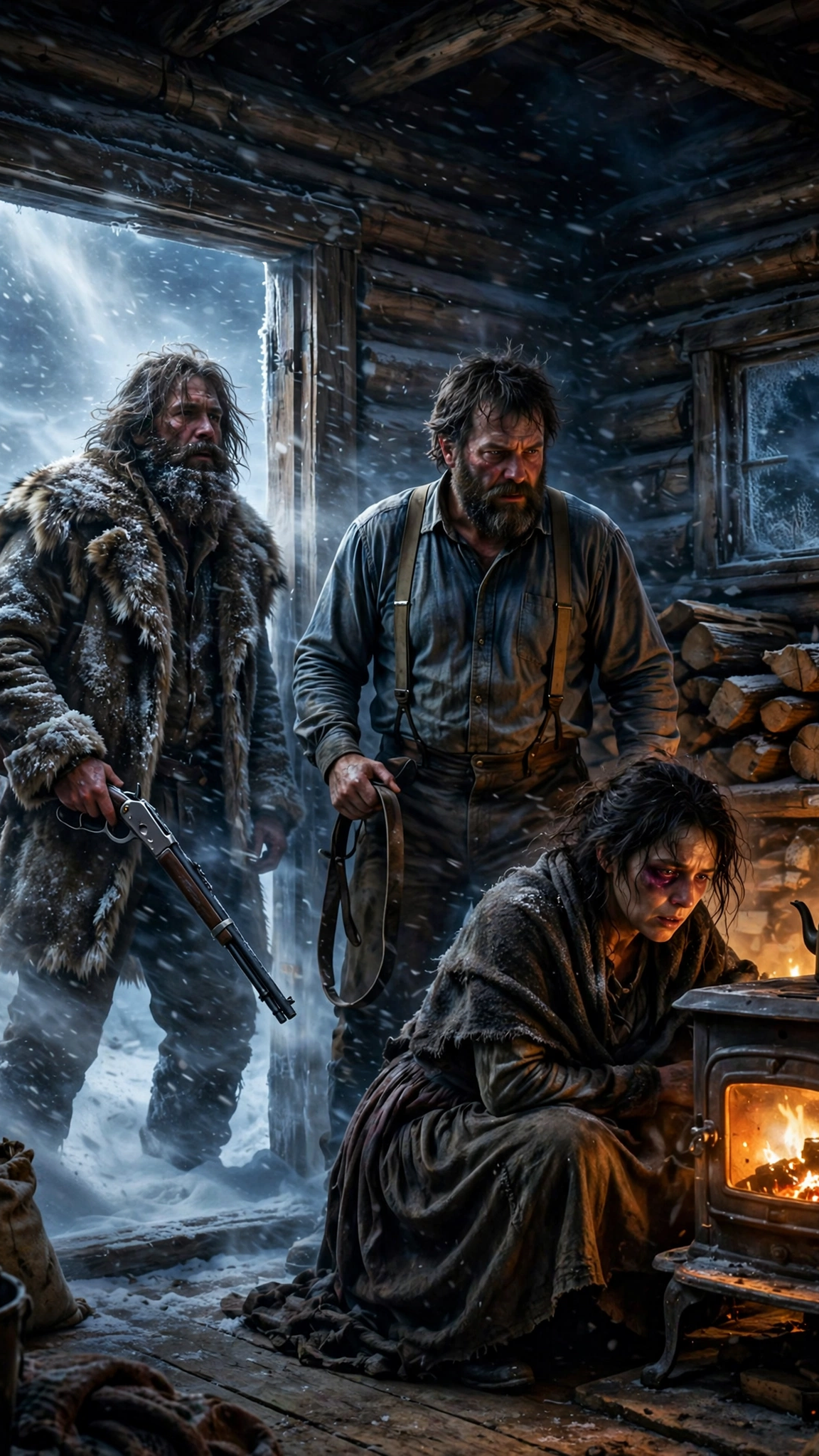
The belt lay on the wet floor between them, and nobody moved.
Hazel stayed crouched beside the chair. Her hands were still over her head. She did not trust the quiet. Quiet in this cabin had always been the space between one blow and the next, and she had learned not to trust it, the way a person who has been bitten by a dog does not trust a dog that has only stopped barking.
Baron stood with his arm still half raised, staring at the stranger, and his face was doing something she had never seen it do before. It was afraid. Not angry — afraid. The humiliation was there, yes, and the hatred was there, gathering behind his eyes like a storm behind a ridge, but underneath it, plain as day, was fear. A man with a rifle aimed at his chest is afraid, no matter how big he is, and Baron was afraid, and Hazel felt something she had not felt in three years.
She felt safe. Not safe the way a locked door makes you safe. Safe the way a wall makes you safe when the wind is on the other side of it.
The stranger — Harlon, she would learn his name later, though not tonight — did not lower the Winchester. He did not speak again. He stood with the rifle against his shoulder, his breathing calm, and he waited, and the cabin waited with him, and the blizzard screamed in the walls, and the stove crackled, and the water from the percolator spread slowly across the plank floor.
Finally Baron moved. He lowered his arm the rest of the way. He stepped back from Hazel, one step, then another, and he sank down onto the bench by the table, and he put his hands on his knees, and he stared at the floor.
"Pick it up," Harlon said. It was not a command. It was not a question. It was a statement of fact, the way a man states the weather.
Baron looked at the belt on the floor. He looked at Harlon. He looked at Hazel. Then he bent down, slowly, and picked up the belt, and he coiled it, and he hung it on the nail by the door where it belonged, and his hands shook the whole time.
Harlon lowered the Winchester. He did not put it down. He held it in one hand, the barrel pointed at the floor, and he went back to the stool by the stove, and he sat down, and he held his hands out to the fire again, as if nothing had happened at all.
Hazel did not move. She stayed crouched beside the chair, and her heart was beating so hard she could feel it in her throat, and she did not know what to do with her hands. She let them fall to her lap. She looked at Harlon. She looked at Baron. She looked at the belt on its nail. And then, very slowly, she got to her feet.
Her legs shook. She steadied herself on the chair. She went to the stove, and she took down a clean cup, and she poured coffee — the coffee she had made before the percolator fell, the pot still warm on the back of the stove — and she carried it to Harlon, and she set it down on the stool beside him, and she said, in a voice she barely recognized as her own, "Thank you."
Harlon looked up at her. His eyes were gray, she saw now, the color of river stone, and they were not unkind. He nodded once, a small movement, and he picked up the cup, and he drank.
Baron watched them from the bench. His hands were still on his knees. His face was red, and his jaw was tight, and Hazel could see the drink and the rage fighting in him, and she could see something else too — a calculation. The stranger had a rifle. The stranger had silver coins. The stranger was bigger than Baron, and calmer than Baron, and Baron was a man who understood size and calm the way a dog understands a bigger dog. He would not fight tonight. But he would remember tonight. She could see that in his face as clearly as if he had said it out loud.
Hazel made supper. She did it the way she had done it a thousand times — beans and salt pork and the last of the bread, served on tin plates, eaten in silence — except that tonight there were three plates instead of two, and the silence was different. It was not the silence of fear. It was the silence of three people listening to a storm and waiting to see what the morning would bring.
Harlon ate slowly. He thanked her for the food, quietly, and he asked if the roof leaked, and she said yes, in the corner, and he nodded, and he asked if the woodpile would last the winter, and she said she did not know, and he nodded again, and he did not ask about the bruises. He did not ask about the swollen eye. He did not ask about the belt. He ate his beans, and he drank his coffee, and he watched the fire, and Hazel understood that he was the kind of man who waited for people to tell him things in their own time.
Baron ate nothing. He sat on the bench with his hands on his knees, and he drank from the bottle, and he watched Harlon, and he watched Hazel, and the bottle went down, and the evening went on, and the storm went on, and at some point Baron stood up and went to the bed in the corner, and he lay down without taking off his boots, and he was asleep within minutes, snoring, the bottle still in his hand.
Hazel stayed by the stove. She did not know what to do. In three years, she had never stayed up after Baron slept. She had always gone to bed when he did, because the bed was where she was supposed to be, and because staying up meant being awake in a dark cabin with a sleeping violent man, which was worse than sleeping beside him.
But tonight was different. Tonight there was a stranger by the stove with a Winchester, and the stranger was awake, and the stranger was watching the fire, and Hazel felt, for the first time in three years, that she could stay up if she wanted to.
She stayed up. She mended the shirt — the shirt she had been mending when the light went, the shirt that had started the whole evening. She mended it by the firelight, her needle moving in and out, and Harlon watched the fire, and the storm screamed, and the cabin was warm, and for a little while, it was almost peaceful.
Then Baron woke.
She heard the bed creak. She heard his boots hit the floor. She heard him mutter something, and she looked up, and he was standing in the dark at the end of the room, and his eyes were on the shotgun leaning by the woodbox, and his hand was reaching for it.
Hazel's breath caught. Her needle stopped. She looked at Harlon, but Harlon was already moving.
He did not hurry. He did not shout. He rose from his stool, and he crossed the cabin in three long strides, and he was between Baron and the shotgun before Baron's fingers had closed around the barrel, and he took the shotgun out of Baron's hand as easily as a man takes a toy from a child.
Baron lunged. He was drunk, and he was clumsy, and he was furious, and he swung at Harlon with his fist, and Harlon caught the fist in one big hand and held it, and he looked at Baron, and he said, very quietly, "No."
It was one word. It was enough.
Baron's arm went slack. Harlon let go of his fist. Harlon broke open the shotgun, and he took out the shells, one by one, and he put them in his own coat pocket, and he set the empty shotgun down on the table, and he looked at Baron, and he said, "You'll get these back when the storm breaks. Not before."
Baron stared at him. His face was white now, and his hands were shaking, and the rage was gone, and what was left was something small and frightened and old, and Hazel saw it, and she felt no pity for it at all.
"Go back to bed, Baron," Harlon said.
Baron went back to bed. He lay down. He pulled the blanket over himself. He did not snore this time. He lay there in the dark, awake and silent, and Hazel knew he was listening, the way she had listened for three years, and she knew he was afraid, the way she had been afraid for three years, and she felt something else she had not felt in a long time.
She felt sorry for no one. And that, too, was a kind of freedom.
She went back to her mending. Harlon went back to the stove. The storm screamed. The fire burned. The rifle leaned against the stool within reach of Harlon's hand, and the shells were in his pocket, and the belt was on its nail, and the shotgun was empty on the table, and Hazel sat by the fire in a cabin that was, for the first time in three years, quiet in the way a house is quiet when the people inside it are safe.
She did not sleep that night. She did not want to sleep. She wanted to stay awake and listen to the storm and watch the fire and know that the man by the stove was there, and that the rifle was there, and that the morning would come, and that whatever the morning brought, it would not be the same as all the mornings before it.
Outside, the blizzard raged on, white and blind and merciless. Inside, the iron stove glowed orange, and the coffee pot steamed, and Hazel mended her husband's shirt by the firelight, and the mountain man watched the fire, and the night passed, hour by hour, and the rifle never moved.
—
Somewhere past midnight, when the storm was at its worst and the wind was screaming through the gaps in the walls like a living thing, Harlon spoke.
It was the first time he had spoken since the supper, and his voice was so low and calm that Hazel almost thought she had imagined it.
"You don't have to stay awake on my account," he said. He did not look at her. He looked at the fire. "I'll keep watch. That's what I'm here for."
Hazel's needle stopped. She looked at him — really looked at him, the way she had not dared to look at him all evening. In the firelight his face was all weather and shadow: the thick beard iced at the edges, the deep lines around his eyes, the gray in his hair that the snow had turned white. He looked like a man who had spent his life alone in hard country, and who had learned to be still, and who had learned that stillness was a kind of strength.
"I'm not tired," she said. It was a lie, and they both knew it was a lie, and neither of them said so.
He nodded. He poked the fire with a stick, and the coals shifted, and the flames rose, and the cabin grew a little warmer.
"Your eye," he said, after a while. "How long?"
Hazel touched her swollen eye without thinking, and then she pulled her hand away, embarrassed, as if she had been caught at something shameful.
"This morning," she said.
He nodded again. He did not say he was sorry. He did not say it was a shame. He did not say any of the things people said when they saw a bruise and wanted to feel better about seeing it. He just nodded, and he looked at the fire, and he said, "My wife had a temper. Not like that. She threw a plate at me once. Missed. Broke the window instead." A pause. "She died of the fever, ten years ago. I couldn't save her. I tried. There wasn't anything to try against."
Hazel did not know what to say. She had never heard a man talk about his wife that way — as if the wife had been a person, with a temper and a plate and a window, and not a piece of property to be kept in line. She wanted to ask him more. She wanted to ask him where he lived, and where he was going, and whether the fever had taken anyone else. But she had forgotten how to ask questions, and the words stuck in her throat, and so she said nothing, and Harlon did not seem to mind.
"Sleep," he said. "I'll wake you if the fire goes low."
Hazel looked at the bed in the corner, where Baron lay awake and silent in the dark. She looked at the floor by the stove, where the blanket was folded. She thought about the knife in her mother's trunk, and the salve under the floorboard, and the six miles to the Odegards, and all the things she had hidden and hoarded and hoped for, and she thought about the man by the stove with the gray eyes and the Winchester, and she made a decision.
She took the blanket from the floor. She wrapped it around her shoulders. She lay down on the floorboards beside the stove, where the fire could reach her, and she closed her eyes, and for the first time in three years, she slept without listening for footsteps.
The storm screamed. The fire burned. The rifle leaned against the stool within reach of Harlon's hand, and the shells were in his pocket, and the belt was on its nail, and the shotgun was empty on the table, and Hazel slept, and the mountain man kept watch, and the night passed, hour by hour, and the rifle never moved.