The county recorder's office in Alder Creek smelled of dust and other people's ink, and the clerk — a man named Whitlock with the complexion of a file — turned the great deed book with the tenderness of a father turning a child in bed.
"Grady," he said. "Alder Creek water. Here we are." The page was foxed and brown as a leaf. "Priority filing, 1851, Thomas Grady. Senior right, whole creek flow to the section line. Recorded proper, sealed proper." He looked up at Coulter over his glasses. "Your daddy did that right, son. Whatever else." Then his mouth did something complicated. "You ought to know there's been a petition filed against it. Quiet title. Beck's attorneys out of Lincoln. Claims the right's been abandoned by non-use — which is foolishness, you've run cattle on that water thirty years — and claims no original instrument can be produced."
"We're producing it," Coulter said. "You're looking at the record."
"I'm looking at the record," Whitlock agreed, "and I know what I know. But a record can be disputed, son, and a dispute takes a hearing, and the hearing—" he checked a paper, and his face changed — "the hearing's been set for the second Thursday in June. After your note comes due. Somebody arranged that calendar very careful."
Riding home, neither of them said much. The math was plain enough to do silently. If the note came due June 1 with the water right under legal cloud, the bank would not renew — Beck's friends sat on the bank's board — and Beck, who had been buying up paper all spring, would buy the ranch at the courthouse steps for the price of the debt, water and all, and the senior right with it. The petition didn't have to win. It only had to hang in the air for six weeks, like smoke, like—
Edith stopped the thought there, because she had had enough of smoke in her life, and there were four days left in May, and she intended to spend them cooking, copying the deed book entry in her clean hand, and helping Amos write to the territorial water commissioner, whose office, Whitlock said, kept its own duplicate filings from the fifties.
She did not know that the war had already moved out of the courthouse.
The last evening of May, the lamps burned late in the study. Edith copied the deed-book entry onto good paper in her cleanest hand, and then copied it again, because paper burns and paper walks and she intended the truth about Alder Creek to exist in more places than one man's safe. Coulter drafted his statement for the commissioner in his fence-post hand, swearing at the pen and then apologizing to it. Amos addressed envelopes like a man loading a rifle. It was, though none of them said so, the first time the three of them had worked at that table as a unit — the boss, the foreman, and the cook who kept the books — and the house felt it the way a house feels weather changing: the shut door at the end of the hall stayed shut, but the rest of the rooms, one by one, had come back into use.
A letter had come for Edith on the Tuesday stage, nine days from Missouri, mostly about a girl named Pearl and a mule. But the last paragraph was in Sam's serious hand, the one he used for church and accounts. Ruth had married the widower herself in April — married Mr. Hartwell of the two graves, in what Edith read as a fair exchange of viewpoints — and the house in Herron's Ferry was to be sold at summer's end, and Sam, being sixteen and suddenly surplus, wondered whether Nebraska had work for a boy who could shoe a horse and read a whole book in a week. Edith had written back that same night, sitting up in the cook's room: Come. There's a man here who reads hands, Sam. You'd do.
She sealed that letter an hour before the fire, and set it on the mantel to go out with the morning stage, and went to bed in a house that smelled of ink and coffee and lamp oil, and slept the way people sleep on the last night of the world they know.
* * *
It woke her the way it always woke her, in the dreams and out of them: not the light, not the sound. The smell.
Edith sat up in the cook's room in the dark with her heart slamming and ten years fell off the world. Smoke. Wood smoke, and under it the sweet chemical tang of coal oil, and under that the smell that lived in the back of her throat since she was fourteen: burning horsehair, burning hay.
The barn.
She was out of the bed and into her dress without deciding anything, bare feet on the cold floor, and the yard when she burst from the kitchen door was the color of the inside of a stove. The barn's east end was alight — not a corner, not a lamp accident, a long roaring seam of fire along the wall where the oil had been poured — and inside it, horses were screaming in the particular way horses scream, which no one who has heard it ever agrees to hear again, and through it, thin and terrified, a boy's voice:
"Miss Edith! Miss Edith, I can't — the door's — "
Ben. Ben, who had been sleeping in the loft three nights running because the sorrel mare was near foaling and he had appointed himself her midwife. Ben, sixteen, who wrote the bunkhouse bets in a round school hand.
Afterward, Amos would say that she did not hesitate, and Coulter would say she did, and both of them would be right. She stood one second — one — in the yard with her whole body remembering a painted-shut window and a wall of fire with her mother on the other side of it, and the smoke got into her eyes, and her eyes filled, and her feet were already moving.
She went in low, the way the doctor in Herron's Ferry had taught her, all those years ago, for going back after Sam: wet cloth over the mouth, stay under the smoke, count the stalls by touch. She had soaked a flour sack at the pump as she passed — she did not remember doing it — and she counted: four stalls, five, the sorrel mare mad-eyed and plunging at her tie, and she cut the rope with the knife she kept in her apron for string and got the mare moving toward the light with a slap that started them both running. The loft ladder. Ben came down it half-climbing, half-falling, coughing, his shirt over his face, and she got her arms around him and understood, with the clarity fire gives a person, that the burning beam across the rear door — placed, dropped, arranged — was not an accident of the fire but the design of it: the rear door was the loft's way down and out, and somebody had wanted it shut.
"Front," she said into his ear, through the cloth. "Low. Under. Go — I'm behind you, Ben, I'm right behind you—"
The roof over the hay mow went with a sound like the world clearing its throat. The air filled with a snow of sparks. Something in the left side of her — the old side, the mapped side — registered heat the way a bell registers a hammer, and Edith Mayburn, who had run out of a burning house at fourteen carrying her whole future on her back, put her shoulder under a sixteen-year-old boy and ran at the light, and did not stop.
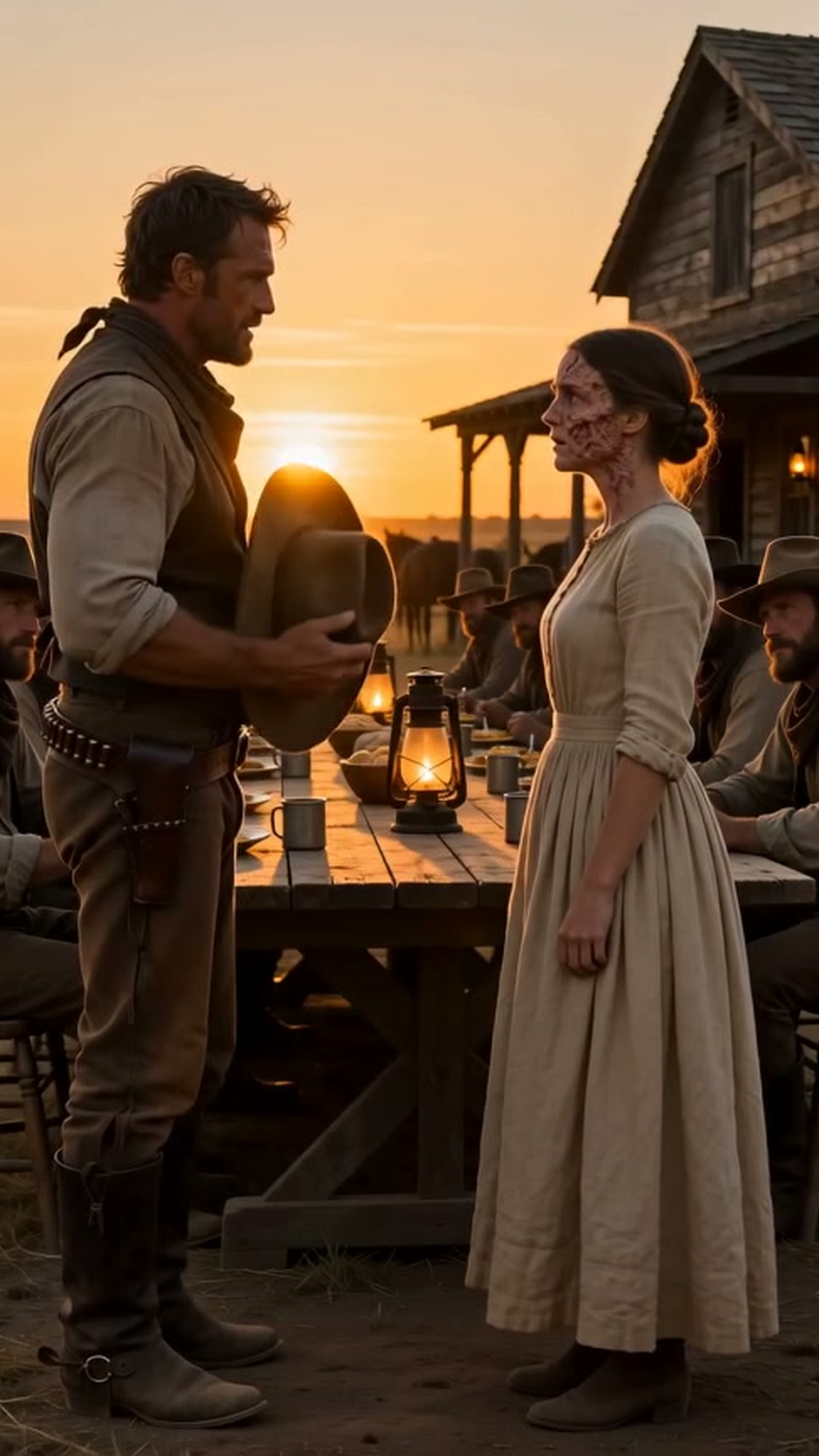
Coulter caught them both at the door. He had come out of the house with the rifle still in his hand from the porch — he had heard the horses — and he took Ben's weight off her without breaking stride and half-carried, half-dragged them clear as the mow collapsed inward in a fountain of fire that lit the yard like noon. Men were pouring out of the bunkhouse. Amos was already working the pump with the bucket line forming like it had been drilled — it had been drilled, by Gus, years ago, and the ranch remembered — and Coulter, with Ben coughing into the dirt and Edith on her knees beside him with the wet sack fallen and her hair coming down and the left side of her face shining in the firelight, scar tissue catching the glow the way it always had, looked at her and said, hoarsely, "Edith. Edith. Look at me. Are you burned?"
"No," she said, and coughed, and laughed once, horribly, with relief. "No. It had its chance at me once. It doesn't get two."
They saved the barn's frame and the house and the herd. They lost the hay, the east stalls, the winter tack, and Pierce.
Pierce was found by Judd — Judd, who had run the bucket line until his hands blistered and then, looking for the hands who weren't there, counted heads the way Ben counted bets. Judd found him at the corral gate with a saddle already on a Bar B horse that wasn't his and his good boots reeking of coal oil, and Judd, who had laughed at a scarred woman the day she arrived and mended her bench within the fortnight, hit him once, scientifically, and sat on him until Amos arrived with a rope.
By the time the eastern sky went the color of a pearl button, Ben was asleep on a bunk with his head in Edith's lap and his breathing gone rough but even, and the yard was full of men standing in the ash-fall with buckets in their hands, looking at the two of them. Nobody said anything foolish. Rafe took off his hat. One by one, the way men do when a thing has been settled past language, the others did too — thirteen hats, in the gray light, for the cook. Edith looked up into their faces with the soot on her like war paint and her mother's quilt-pattern of a life in ashes behind her a second time, and she thought: so this is the other side of the fire. This is what was on the other side of it, all these years, waiting.
In the bunkhouse, with the fire dying behind the windows and his jaw swelling, Pierce talked the way bought men talk when the buying is finished: Beck had paid him since January — for the habits of the house, for the deed box, for the paper in the folder with the string tied around nothing. Beck had the copy of the 1851 filing in his office safe in town. Beck had bought the Grady note off the bank four days ago, quiet, so the debt and the water would fall into the same hands on the same morning. And the fire — the fire was to be the persuader, to hurry Coulter into selling before June.
"Only it wasn't supposed to be the barn with the boy in it," Pierce said, and could not look at the door, where Edith stood with Ben's head in her lap, stroking the boy's hair down with hands that shook. "That part wasn't — I set the east wall. The loft—" He stopped.
"The loft had my midwife in it," Coulter said, in a voice like a gate closing. He turned to Amos. "Wire the sheriff in the morning. Then wire Lincoln." His eyes went to Edith over the boy's head, and something in his face had finished changing — the last of the restraint burned off it, like paint off a wall.
"Beck bought my note," he said. "He means to take the water Thursday week at a hearing he's already salted, with my own paper locked in his safe. He's made one mistake, though." Coulter crossed the bunkhouse in two strides and went down on one knee in the dirt and ash beside her, careless of his trousers, and took her blackened hands in both of his, in front of Amos, in front of Pierce, in front of God and the bucket line. ""He thinks I'm still a man with nothing in the house worth fighting in a new way for."
Outside, in the corral, in the middle of the worst night the ranch had known in thirty years, the sorrel mare — smoked, singed, and entirely unimpressed — lay down in the trampled dirt and delivered, without assistance or apology, a leggy black foal, who stood up inside of twenty minutes on legs like stilts and looked around at the burning world as if he owned it.
"He'll need a name," Ben croaked from the bunk, surfacing out of sleep at the news, because some things pull a boy back from anywhere.
"He'll get one when I've thought," Edith said. Her hands were still shaking. They would shake, off and on, for days. "Everything on this place gets named careful, Ben. That's house law too.""