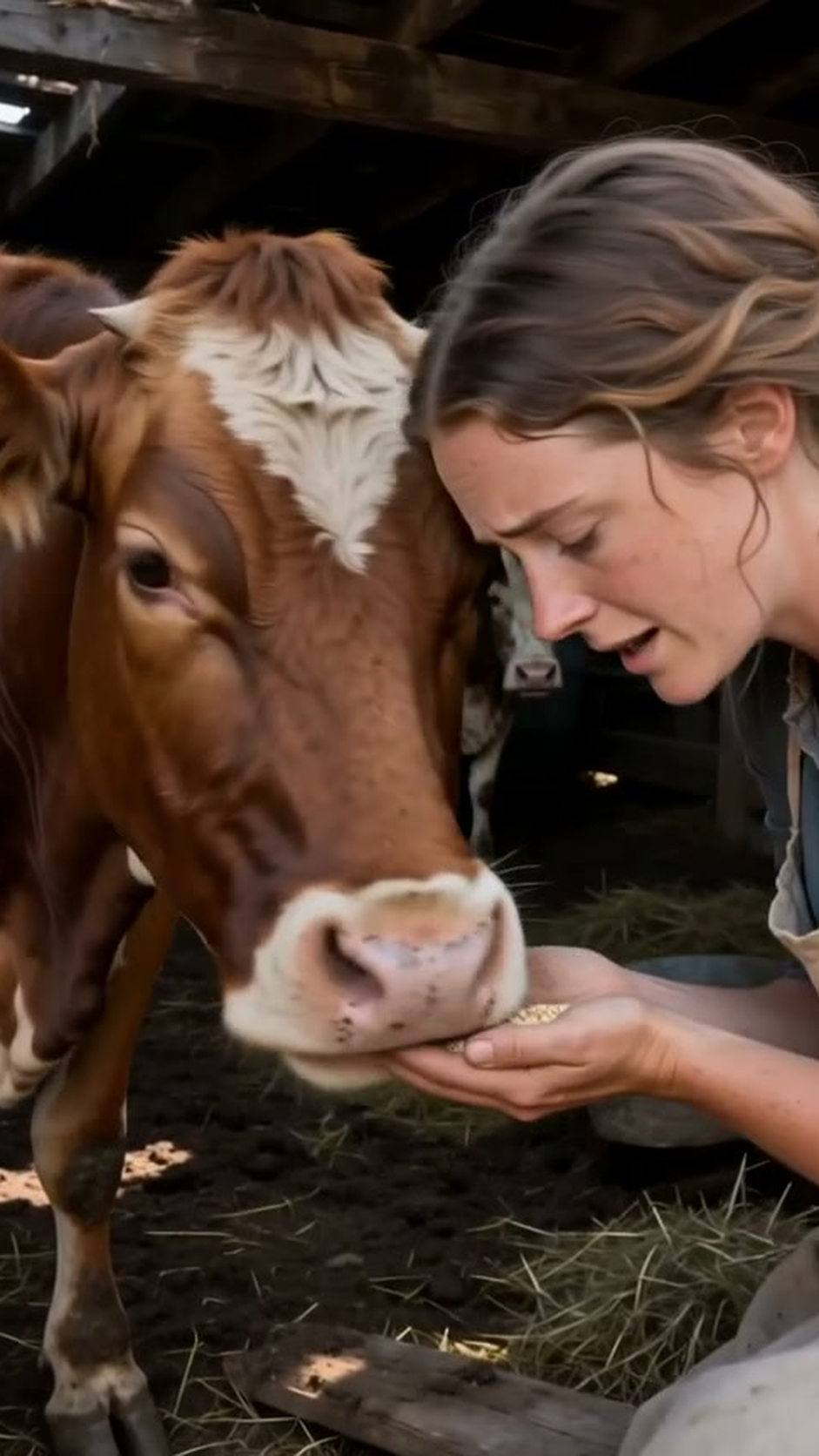
Lenora did three things that night, by lantern light, after Crowe's dust had settled on the track.
First, she finished disguising the springhouse door. She laid the turf back over the stone in its original pieces, tamped the edges, scattered loose dirt and dragged a bundle of cut weeds across the whole patch until the ground behind the cabin looked like nothing in the world but a place where a woman had half-heartedly started a garden and thought better of it.
Second, she went down the steps and stood a long time in the cold with the lantern, thinking.
Third, she moved everything that mattered down into the dark — every crock, every jar, every pound of butter she owned — and she made a decision that she would keep for the rest of her life: she would never, ever explain it. Let them guess. Let them think what Amos Hart's neighbors had thought about Amos Hart for twenty years — that she had a gift, a knack, cold well-water and patience and her mother's secrets. The springhouse was not a story to be told. It was a lock to be kept.
What the cold could do announced itself on Friday.
She carried her butter into Harmon's in crocks that were cold to the touch in a July noon — cold, the way butter comes out of an ice-house in a rich man's town. Harmon cut his thumbnail corner, tasted, and then did something he had not done in twenty years of keeping that store: he closed his eyes.
"Miss Vale," he said, "I have eaten butter in St. Louis. I have eaten butter that came off the cars packed in ice, at prices that would make a preacher swear. And I am telling you that this—" he held up the corner on his thumbnail like evidence at a trial "—is a better article than any of it. How many pounds can you make?"
"All I can churn," Lenora said. "The herd's coming back strong. Say a number and I'll fill it."
"The hotel wants twenty pounds a week. The railroad contractor's man was in yesterday begging. And I'll take all the rest for the store." He named a price a full cent a pound above Amos Hart's old price, and Lenora kept her face as still as May deciding whether to trust a stranger, and accepted it like a woman who hadn't been mentally dancing on his counter.
By August she was hiring Ruth Ellery's youngest daughter twice a week to help churn. By August the account book in Harmon's hand — she saw it when he opened it to her page — had more figures on her line than any other supplier in Cedar Flats. The cows stood fattening in the creek pasture with their ribs disappearing like a bad memory being forgotten; Button, the cow who had tried to die out of habit, was giving two gallons a day and bossing Pearl away from the best grass with the confidence of a queen restored. Lenora ordered a proper new churn from the catalog, and seed for a real garden, and — in a transaction that made her hands shake worse than the auction had — she paid off the last of the county's fees on the deed, every cent, and got the clerk's receipt folded into the family Bible next to the Brenner names.
In the first week of August, the hollow received a visitor of a new kind: a Mr. Pell, of Kansas City, who arrived in a hired buggy wearing a linen suit and a smile like a price tag, describing himself as a buyer for a chain of hotels and a student, in his spare hours, of "modern dairy methods."
He had heard of her butter. All Kansas City, it seemed, had heard of her butter. He wished to see her operation, with a view to a contract of truly gratifying size — and, in the meantime, as one enthusiast to another, he was simply fascinated by her keeping method. Ice, surely? No ice. A spring house? She had smiled and shown him the well. A remarkably deep cellar, then? She had shown him the root cellar, rubble and all, and the wet burlap, and set the cream crocks in the creek in full view like a woman dealing cards face-up. Mr. Pell walked her whole farm with his hat in his hand and his eyes everywhere, and grew more courteous and less satisfied with every step, and Lenora — who had been fished for compliments and recipes by experts in the Dawson kitchen for six years — watched him do it with the tranquil pleasure of a cat watching a dog try to climb a tree.
He stayed to supper, since she offered and his curiosity was stronger than his manners. He ate three helpings of everything. He asked about her churn (her mother's), her cream (rested overnight), her water (the well, cold as charity), her salt (a measure her mother taught her, which she described accurately and completely, because it didn't matter), and at each answer he nodded like a man checking items off a list in his head and finding the sum wouldn't come right.
"Astonishing," he said at last, over coffee, with the air of a duelist conceding a touch. "Because between ourselves, Miss Vale — the heat in this hollow last week would have ruined cream in any cellar in the territory. And yet your butter arrives in Cedar Flats cold. Actually cold. My principals would pay handsomely to understand the method. Handsomely." He named a figure that represented more money than Lenora had ever heard spoken aloud in her own kitchen. "For the method alone. No land. No cattle. Just — the understanding."
"The understanding," Lenora said, "is that butter kept cold stays sweet, Mr. Pell, and butter kept warm doesn't. My mother held that view, and her mother before her, and I'll sell you the whole of it for the price of the coffee you're drinking, which is nothing." She rose and began clearing the plates with the finality of a closing door. "What I sell is butter. By the pound, on Fridays, through Mr. Harmon. If your principals want some, they can do what everyone else does — stand in line."
Mr. Pell drove out of the hollow in the dusk with a pound of butter on the seat beside him and nothing else at all, and Lenora watched his buggy lights go over the ridge and thought about how many men, in how many kinds of suits, the same question could wear. A method with a price on it was a secret already half-sold. Hers wasn't for sale at any figure — because the day she named it, priced it, pointed at it, it stopped being hers and became a thing men could file papers about.
Three nights later she found the dead branch she'd laid across the patch moved six inches, and knew that somebody else had come to look at her farm in the dark — somebody who hadn't stayed to supper.
And in the second week of August, Silas Crowe rode into Cedar Flats and walked into Harmon's Mercantile and tasted the butter himself.
Tom brought her the account of it that evening, and Tom — who had heard it from Harmon's clerk, who had heard the whole room go quiet — told it the way a man tells weather coming.
"He asked where it came from. Harmon says, 'Brenner Hollow,' and Crowe just stands there. He asks how you're keeping it sweet in this heat — everybody's asked you that, half the county's asked — and Harmon says what you told him: cold well, deep shade, your mother's method. And Crowe smiles that smile of his and buys a pound, and stands in the door eating a shaving of it off his knife like a man reading a letter he doesn't like." Tom turned his hat in his hands. "He's not a fool, Lenora. He's doing sums. Your butter is worth more than your land was. He's going to figure out that the value isn't on top of this farm. It's under it."
"He can figure all he likes," Lenora said. "Figuring isn't having."
But she doubled her watches. She walked the ground behind the cabin every dawn and every dusk, and twice she found the grass at the patch's edge pressed in ways that might have been deer and might not. She began varying the times she went down the steps. She took to carrying the lantern shuttered, and once she lay a dead branch across the patch at an angle she memorized.
The branch had moved on the morning the hearing notice's second letter came.
This one was not a notice of examination. This one set a date. The boundary question would be heard before Judge Alcott in the county court on the last Monday of August, and witnesses were summoned, and the letter informed her, in language as cold as her spring, that if the 1861 survey was found in error, the tax sale itself could be voided as to the disputed land — the creek, the pasture, the water. Everything but the cabin patch. Everything that fed the cows. Everything that fed the spring.
She read it three times at her table. Then she got up and walked the place: the barn, sound now, full of hay she'd cut by hand; the pasture, green along the creek; six fat cows and one small dun queen. Eleven dollars and six years of nickels had built this, and one man's signature in a courthouse could unbuild it in an afternoon — and she understood, finally and completely, what the whole fight had always been about. It had never been forty dollars. It had never even been the grass. Crowe had sat in her yard and priced her farm like a slaughter buyer because he suspected, the way dogs suspect things — by smell, by instinct — what Amos Hart's butter had been telling the county for twenty years. There was cold under Brenner Hollow. There was wealth under it. And the hearing was not about a line on a map.
The hearing was about who got to own the cold.
That night Tom found her at the pasture fence in the dark, and she told him the whole of it — not the springhouse, not yet, but the rest: the summons, the date, what it meant to lose the creek. He listened the way he did everything, with his whole attention, and then he said the words that rearranged the furniture of her heart:
"Then we'd best know exactly where the old line runs. My grandfather helped survey this township in 'sixty-nine, and his field book's in my mother's cedar chest, because Ellerys don't throw away paper. And there's the county records besides, and Amos's ledger you've got, and whatever else this hollow's been keeping." He turned and looked at her across the fence rail in the dark. "He's had the county fooled for a decade because nobody ever went and looked, Lenora. It's the same as the cows. We go and look."
She was still holding onto the sound of that we when he stiffened beside her, staring past her shoulder toward the cabin.
"Tom?"
"Your light," he said quietly. "Up at the house. It moved."
They crossed the yard without a sound, Tom with his hand on the knife at his belt, Lenora with her blood going cold in a way that had nothing to do with springs. The cabin was dark. The door was shut. But the little window at the back — the window of the room where Amos's things were kept, the window she had left unshuttered that morning and no other morning — stood open two inches wider than she had left it. And on the sill, in the dust she had swept that week and no one had disturbed since, lay the clear, fresh print of a man's hand.
Someone had been inside her house while she stood in her own yard. Someone had climbed in at the back, careful as a cat — and, the deepest cold of all, someone had been looking for something. Not stealing. The Bible was there. The ledger was there. Her money tin was untouched in its place.
Looking. For papers. For a survey. Or for a door.