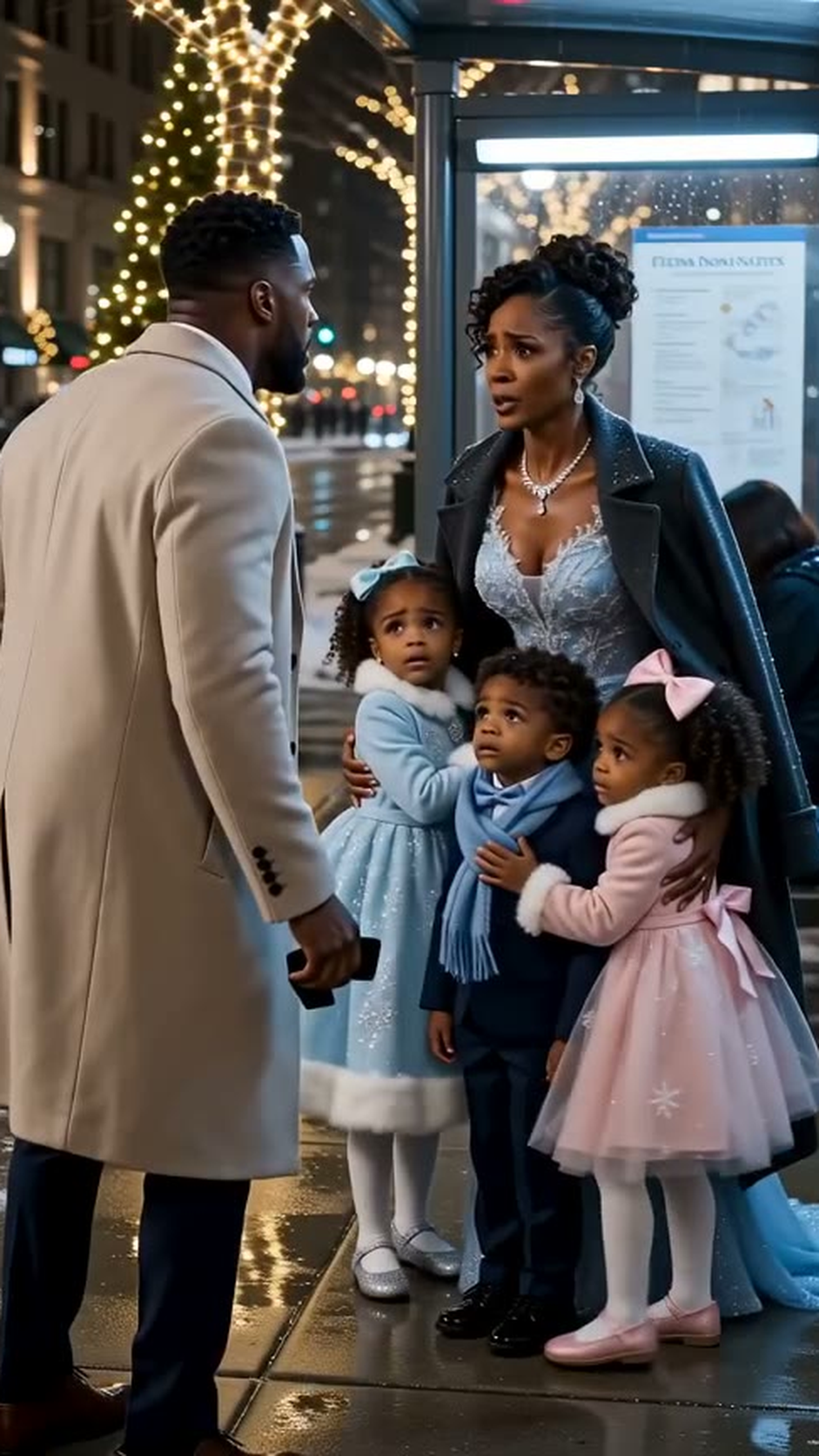
The door had closed, but Grace was still looking at him through the glass.
Ryan watched her make the decision — watched it cross her face the way weather crosses a lake — and then she spoke to the nurse, briefly, and the nurse nodded and took the girls' hands and led them, gently, no farther than the family alcove by the elevators, where they could be seen and could see. And Grace came back through the doors alone, into the cold vestibule where Ryan stood dripping on the mat with his coat ruined and his heart slamming, and the doors sighed shut behind her, and it was just the two of them, three years later, in a box of glass and rainlight.
"Ryan… there's something you don't know," she said. "There's something you don't—" Her voice broke on it cleanly, like a stick. She pressed her fingers hard against her mouth. When she took them away, she had rebuilt herself, the way he had seen her do at charity podiums and once, memorably, at his father's funeral. "Nick is sick."
"Nick." The name landed softly and rearranged everything. "The boy."
"The boy." Her eyes went to the alcove, where the boy — Nick — was watching them through the glass with Ryan's own gray-blue stare, one small hand flat against the window. "He has aplastic anemia. His bone marrow doesn't make enough blood. He's had transfusions for almost two years, and this year they stopped being a plan and started being a countdown." The words came out practiced; she had clearly said them to social workers and insurance boards until they could be carried without spilling. "He needs a stem cell transplant. There's no match in the registry — we've searched for eleven months, all over the world. His sisters aren't matches. I'm only half. The team here does parent transplants. Haploidentical. It's his best chance, and this hospital is the best place in the country for it, and that is why—" She stopped. Swallowed. "That is why I came back to a city I swore I'd never set foot in again. Not for you. Never for you. For him."
Ryan stood very still. Rainwater ran off his coat onto the mat in a darkening pool.
"The girls," he said. "Tell me the girls are—"
"The girls are healthy." Grace said it quickly, the mercy first, the way she'd clearly learned to deliver all news. "Noelle and Holly are healthy. Bruises that come from furniture, like other children. It's only Nick. It's only ever been Nick." A ghost of something that was not quite a smile moved across her face. "Noelle is the oldest by two minutes and has never once let the other two forget it. Holly is the youngest and runs the entire family from behind my skirt. Nick is the middle and the first — he came out first of the boys of himself, he says. He says it constantly. He's had to be — he's had to be brave in ways that have made him—" She stopped, because her voice had gone somewhere she could not follow it.
"Tell me," Ryan said. "Anything. Their favorite— I don't know their favorite anything, Grace. I know their ages because a three-year-old girl's shoe slipped on my street. Tell me one true thing that isn't medical."
Grace looked at him, and for a moment the fury in her face softened into something more desolate than fury: pity, and the memory of love, which is pity's most painful form. "Nick keeps a notebook of grievances against the hospital food and reads them to the nurses. Noelle interviews people; she has a crayon notebook and she will ask you questions and write down answers you didn't give, she writes the answers she expected. Holly is afraid of the word goodbye said after dark, so in our house we say see you at breakfast. Even to the goldfish we had. Especially to the goldfish."
Ryan made a sound that he would have been ashamed of in a boardroom.
"He has your eyes," Grace said, almost gently. "Did you think I wouldn't notice you noticing? He has your eyes and your hands — watch him with a puzzle. And your grandmother's temper, according to—" She stopped herself, hard, the way you stop a car at a line you have drawn for exactly this. "According to no one. I don't know your grandmother. Forget I said that."
"You knew her for three years," Ryan said. "You sat with her every Sunday of the last year of her life. You held the book when her eyes went. Forgetting is my family's disease, Grace. It isn't yours."
"I learned it," she said, "from the best."
She turned then, a quarter-turn, toward the alcove where the children sat in their row behind the glass, three small faces turned toward their mother the way flowers track a lamp, and Ryan saw her do the thing he would see her do a hundred times in the weeks to come: count them. One, two, three. A hand at her own heart, light as a moth. One, two, three. The whole of her religion, in arithmetic.
"This way, Mr. Mercer," said a voice — a nurse had come through the doors with a clipboard, brisk, kind, oblivious — "the family room on three is empty, you can both—" She stopped, looking between them, reading the weather. "I'll give you a moment."
"How long have you known?" Ryan said when they were alone again. "That he was sick. How long have you carried this by yourself?"
"Since he was eighteen months old." Grace's chin lifted, and for the first time that night he saw not fear but the thing underneath it, the thing that had always been underneath everything with Grace: a ferocious, exhausted dignity. "Don't look at me like that. Don't stand in a hospital you could buy and look at me like I'm the one who kept secrets. I came to you, Ryan. When I found out I was pregnant, I came to Mercer Tower and I sat in your lobby for two hours, and Amelia Brooks came down in your private elevator and told me you didn't want to know. Whatever it was, she said. You'd moved on."
The vestibule was very quiet. Somewhere beyond the doors a child laughed, once, in a corridor painted with stars.
"She said that." Ryan heard his own voice from a distance. "Amelia said that to you."
"Word for word. I've had three years to memorize it." Grace wrapped her arms around herself — the fur stole, the diamonds at her throat, and the posture of a woman holding herself together with both hands. "And your mother had my name on a list at security. There's a list, Ryan. At the desk. For people who are not to come up. My name was on it before the ink was dry on the divorce."
"Grace." He reached for her — slowly, the way he had on the street — and this time she did not draw back, but she did something worse: she stood perfectly still and let his hand stop in the air an inch from her sleeve, and looked at it, and said, with great courtesy, "Don't."
His hand fell.
"They're mine," he said. It was not a question and it was entirely a question.
Grace looked through the glass at three children in their Christmas clothes, sitting in a row in the alcove now, the girls leaning together like tired birds, the boy upright between them with his palm still on the window.
"Look at them," she said.
He looked. He had been looking all night; it was taking the skin off him, looking. Noelle's calm judicial stare. Holly's curls, his mother's curls, on a three-year-old in a pink dress. Nick's face — Nick's face was a photograph Ryan's grandmother kept in a silver frame of Ryan at four, down to the cleft of concentration between the eyebrows.
"I don't need a test," Ryan said hoarsely. "I don't — I believe you. I've believed you since the bus shelter. I just need—" His voice failed. "I need you to say what you need. Money, doctors, lawyers, the whole hospital — say it, and it's done. Say it, Grace."
"What I need," she said, "is a donor for my son. What I need is for you to be very careful about wanting to be a hero in this story, because heroes leave. They leave through lawyers. They leave through their mothers. They leave through penthouse elevators with other women's hands on the desk." Her eyes were dry and burning. "Finish your evening, Ryan. Amelia is waiting. Everyone is waiting — she texted you eleven times in the car; I saw your phone. Go and propose to the woman you chose, and let me take my children upstairs, and we will all pretend this rain never happened."
She turned toward the doors.
"Grace."
She stopped. She did not turn around.
"There isn't going to be a proposal," Ryan said.
He took out his phone, there in the vestibule, with the rain drumming the glass and his whole former life standing three feet away with her back to him, and he typed with his thumbs: Amelia. I'm sorry. There will be no proposal tonight. Something has happened that changes everything. Do not wait for me. He watched the message deliver. Then he opened a second thread — Daniel, his best man, his COO, the only person in that dining room who had ever told him the truth straight — and typed: Kill the dinner. Send everyone home. Tell my mother I'll call her. It's Grace. It's always been Grace. I need you here instead: Children's Medical Center, family room, third floor. Bring nothing but your discretion.
"Ryan, what are you doing—" Grace had turned. She was staring at the phone in his hand, at his face, with the first unguarded expression he had seen on her all night: not fear. Alarm. "You can't just— your mother will— Eleanor will—"
"My mother," Ryan said, "is about to have the worst phone call of her life, and for once it isn't going to be delivered by her lawyers." He dialed. The phone rang twice against his ear, over the sound of the rain, and Eleanor Mercer answered in the voice she used for boardrooms and bishops.
"Ryan. The Brooks family is seated. The quartet is— where are you?"
"Mother." Ryan looked at Grace, and Grace looked back at him, and the three children looked at both of them through the glass with their hands pressed white against the window. "I need you to answer one question, and I need you to hear how carefully I'm asking it. Three years ago, after the divorce — did Grace ever try to reach me?"
The silence that came down the line was not empty. It was furnished. It had weight and texture and a full upholstered history, and it lasted four seconds, and five, and in those five seconds Ryan Mercer, thirty-eight years old, CEO of the Mercer Group, heir to nine hotels, felt the floor of his life tilt on an axis he had not known was there.
"Mother," he said, very quietly. "Answer me."
And upstairs at the Mercer Grand, in a dining room full of flowers, Amelia Brooks set down her champagne glass with a hand that had begun, slightly, to shake — because Eleanor Mercer had gone the color of candle wax, and the string quartet had stopped, and somewhere out in the rain her future was coming apart at the seams.
Amelia had planned this evening for the better part of a decade. She had planned it the way she had planned everything since she was seventeen years old and had watched, from a summer-house window, a scholarship girl in a borrowed dress make Ryan Mercer laugh so hard he had to sit down on the grass — had watched him look at Grace Ellis the way he had never once, before or since, looked at anything in the world Amelia could offer. She had spent ten years and one ruined marriage arranging to be the woman in the white dress in that dining room. And now the groom was at a children's hospital, and Eleanor was staring at her phone as if it had personally betrayed her, and Daniel — Daniel, who had left an hour ago with two coffees and an overcoat — was not answering his messages.
"Amelia, darling," her mother said brightly, into the widening silence, "shall we have them serve the first course while we wait?"
Amelia smiled the smile that had served her so well in marble lobbies. "Of course," she said. "I'm sure it's nothing. Ryan would never—"
She did not finish the sentence. She was remembering, with perfect clarity, a sentence of her own, delivered three years earlier in a private elevator's glow: Whatever it is, he doesn't want to know. She had wondered, on exactly four nights in three years, whether Grace Ellis had been carrying something in that lobby besides a suitcase face and a ruined name. Four nights. She had done the arithmetic on none of them.
"Serve the first course," Amelia said. "He'll be here."