She asked him the next morning. That, Ryan would tell Daniel years later, was how he knew the war was really over: Grace Ellis, who had once walked out of a penthouse and a marriage rather than ask a question whose answer could wound her, stood in the family room with two paper cups of coffee and asked him straight.
"Why are you still carrying the ring?"
He looked up from the whiteboard photograph he'd been studying — Nick's counts, day +12, the first number with an upward arrow drawn by Noelle in green crayon — and he understood instantly, because he had been carrying the answer for weeks, waiting for exactly this much courage from both of them.
"Come with me," he said.
He took her down in the elevator, out of the unit, to the hospital's winter garden — the glass atrium where the great Snowflake tree stood waiting for the gala that had already happened in another timeline, its lights dimmed for the morning. His coat was over his arm. He took the velvet box out of the pocket himself, and held it out to her on his open palm, and said: "Open it."
Grace opened it.
The box was empty. The little cushion where three carats of committee-approved future had sat was bare, with the faint square ghost of the ring pressed into the velvet.
"I returned it," Ryan said. "The morning after the bus shelter. Daniel drove me to the jeweler at nine o'clock, before the typing results, before I knew if you'd ever speak to me again, before any of it. It was never Amelia's, in the end — I never gave it to her. It was just the most expensive apology I ever owed myself for trying to live a life with the volume turned off." He looked at the empty box, and his mouth did something complicated. "I kept the box. I don't fully know why. I think because you saw it. It's the last thing from the old life that was present at the beginning of the new one. I carried it the way you carry a photograph of a house that burned down — not because you want the house. Because you want to remember you got out."
Grace closed the box gently. She held it a moment, this small black square that had cut her in a dark room at 4 a.m., and felt it turn, in her hand, into something else: not a threat. A relic. A thing from before, with the power gone out of it.
"You are," she said, "the most exhausting man I have ever—" and then she laughed, really laughed, standing in the winter garden in yesterday's clothes, and Ryan laughed too, and a nurse pushing a cart past the glass smiled without knowing why.
"There's more," Ryan said. "Wait here. One minute. Don't — Grace. Stay with the tree. Please."
He came back in four, slightly out of breath, with three children.
Nick traveled in his wheelchair like a small admiral, masked, blanketed, with the line's pole dressed in tinsel by persons anonymous. Noelle walked on one side with her notebook, in her capacity as press. Holly walked on the other side holding absolutely tightly to a fistful of Ryan's coat, in her capacity as Holly. A nurse brought up the rear, grinning, in her capacity as an accomplice of long standing.
"What's happening?" Grace said, very quietly, because her heart had started doing something ungovernable. "Ryan, what— Nick, sweetheart, you should be—"
"Counts are up for the third day," the nurse said, with enormous satisfaction. "Doctor Patel signed off on twenty minutes. She said to tell you: the new marrow is his father's, and it is moving in like it owns the place. Her words."
Ryan went down on one knee, there in the winter garden, in front of the great unlit tree, with a wheelchair, two daughters, a nurse, and the whole miraculous unlikelihood of his life arranged around him — and from his pocket he took not the black velvet box but a small worn leather case, older than both of them, soft as a glove.
"This was my grandmother's," he said. "She wore it for sixty-one years, through everything the century had. My grandfather put it in a drawer when she died and told me, when I was fourteen, that it was for the woman I'd choose with my whole heart and not a committee in sight." He opened the case. The ring inside was simple and warm and bright, a single stone in old gold, nothing like the cold comet in the velvet box. "I chose her once already, Grace, and I failed the choosing when it got expensive. I have now been tested — literally, they typed me for it — and I am a match. Let me spend the rest of my life proving the typing right."
He looked up at her with his gray-blue eyes, in which she could see, as clearly as she'd seen it in the rain, every year they'd lost and every year they hadn't.
"Grace Ellis. Will you marry me — again — for the first time, properly?"
"Mommy," said Nick, with the air of a chairman calling a vote, "that's the rain man asking."
"I know, baby," Grace said, through tears and laughter both, "I can see him," and she held out her hand — the hand she had drawn back from him at the bus shelter, the hand that had signed the papers alone, the hand that had held three children against her body in the rain — and she let him slide his grandmother's ring onto it, and it fit the way the last three years had never once let anything fit, and she said yes into his hair as he rose and gathered all of them — her, and the wheelchair admiral, and the press, and the girl holding his coat — into one unbroken, tinselled, medically improbable embrace.
– – –
They walked out of the Children's Medical Center on the twenty-third of December, into air so cold and bright it rang.
Discharge had taken all morning — papers, instructions, a pharmacy bag the size of a carry-on, Dr. Patel's final examination delivered with her hands folded and her eyes suspiciously bright, and a send-off the nurses had clearly been planning for days: a corridor lined with staff, the painted stars under a fresh fall of paper snow, and Nick, in his navy suit with the blue scarf, processing down the middle of it in his wheelchair like visiting royalty while Noelle read out the discharge summary as a press release and Holly distributed star cookies with the gravity of communion.
At the entrance, the automatic doors sighed open — the same doors, the same glass — and Nick said, "Stop."
Ryan stopped pushing. "Buddy?"
"I want to walk out," Nick said. "On my feets. Like a person."
Grace looked at Ryan. Ryan looked at Grace. It was four steps to the doors, and then the world. She nodded once — the count done, one two three, all present, all hers — and Ryan lifted his son down and set him on his feet, and took one hand, and Grace took the other, and the girls took the hems, and Nicholas Mercer, aged three, with his father's blood newly at work in his bones and his father's eyes lifted to the December light, walked out of the hospital under his own power, slowly, in his Christmas suit, while behind the glass the whole transplant unit stood up at their stations like a congregation.
"It isn't far," Grace said, in the car, with Nick asleep between his sisters before they reached the avenue, his head on Ryan's coat folded as a pillow. "The family housing. We can stay there until—"
"No," Ryan said. "There's a house. It's been empty three years and it has a kitchen with terrible light and a fruit bowl that needs supervision. It's yours. It was always yours. The paperwork is in the glove box, next to about forty of your daughter's interview transcripts." He kept his eyes on the road, because some things could only be said at thirty miles an hour. "Come home, Grace. Not as a guest. Not as a patient family's mother. I had the ceramic frog brought over from the penthouse this morning. It is, at this moment, wearing a paper crown in the fruit bowl, where it has apparently been waiting for orders."
Grace looked out the window at the city going gold in the early dark, and she laughed, and then she cried, and then she did the thing she had not done since she was twenty-nine years old and the world was new: she reached across the console, in full daylight, unhurried, unafraid, and took her husband's hand, and held it the rest of the way home.
They were married again in April, in the hospital chapel with the wooden boat, because Nick demanded the boat be invited. He carried the rings down the aisle in a black velvet box, at a pace so slow and ceremonial that the small congregation aged noticeably, and delivered them to his father with the words, "No dropping this time. That's the report."
One year later, the Mercer Grand put its lights up in the second week of December, and the bus shelter across Michigan Avenue wore its garland, and the rain — remembering itself — came down silver over the wet gold pavement.
The triplets were four, and Nicholas Mercer had a head of curls like a storm cloud, a scar he showed to other children with the pride of a pirate, and blood in his veins that a team of doctors described, in their reports, as fully engrafted, fully his father's, fully his own. He had been back to the Children's Medical Center eleven times in the year, and every time as a visitor grows less afraid, and the last time he had brought the ward a drawing of a bus, labeled in crayon, with every passenger smiling.
Noelle's investigations had expanded into print. Holly had read the bear book to an entire kindergarten.
Eleanor Mercer came to dinner on Sundays. She came slowly, and on their terms, exactly as agreed — and it is a matter of family record that the first time Nick, at full health and full volume, raced down the hallway of the penthouse and launched himself at her with the words "Grandma, you're here for the weather!" she caught him, and held him, and over his head her eyes met Grace's, and neither of them looked away.
On the twenty-first of December, the anniversary no one called an anniversary, Ryan took his family out under the awning of the Mercer Grand while the snow rehearsed and the rain performed, and he opened his hand. In it was a small black velvet box, which he had had remade — same box, new heart — and inside it, on the little cushion, sat nothing but a folded slip of paper, in a three-year-old's favorite green crayon, that he had commissioned through proper channels.
"Daddy," Nick read, importantly, because reading was new and therefore ceremonial, "who's that man?"
"That's me, buddy," Ryan said, lifting his son up against the cold, where the boy's arms went around his neck with three years of practice compressed into one. "That's the man who almost missed everything."
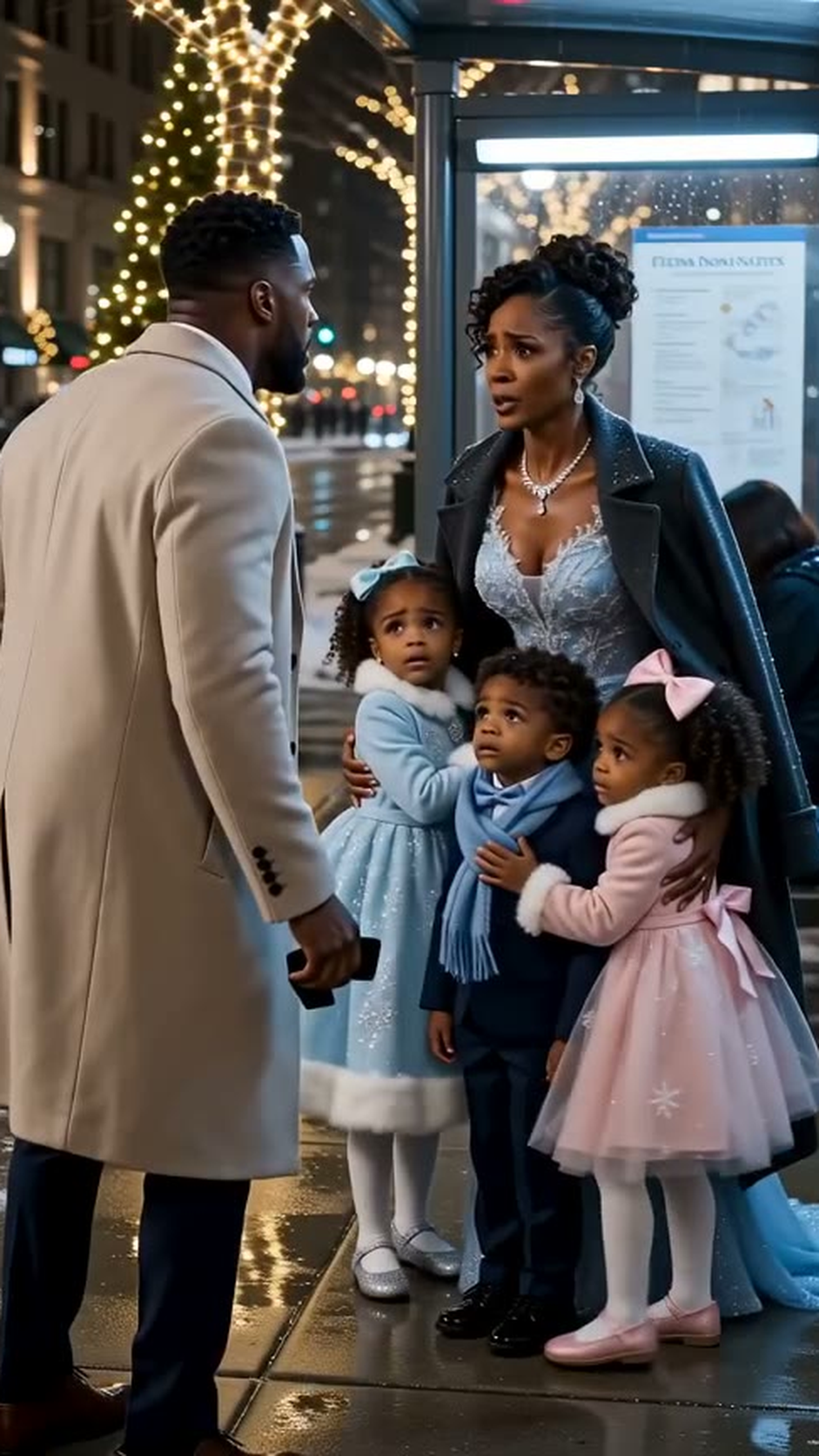
Grace leaned her head against his shoulder, in the icy blue she had once worn like armor and now wore like a celebration, and the girls pressed in on either side like bookends, and the five of them stood a while in the golden light, watching the buses come and go across the avenue — carrying other people's urgencies, other people's almosts, away into the rain — while theirs, at last, stood still, and stayed.
On the mantle, in the house with the terrible kitchen light, there stood a framed set of four photographs — not four anymore. In the year since the discharge, the wall beside it had filled the way walls fill when a family stops rationing its own record: Nick on a bicycle, scar and all, mid-shout. Noelle interviewing the mailman, notebook raised. Holly asleep in a laundry hamper, as was apparently hereditary. Grace and Ryan in a hospital chapel, laughing, with a wooden boat sailing forever overhead. And at the end of the row, newest and smallest, a drawing in green crayon of five stick figures holding hands in the rain, every one of them smiling, labeled underneath in the careful capitals of a boy who had been given, at last, all the time in the world to learn his letters:
MY FAMILY. NO DROPPING.
THE END