It was a reaction to the infusion — a known one, a feared one, a survivable one, the team said later, in the careful language of people who have ridden out the same storm in other children's rooms. A fever that spiked like a struck match. Blood pressure wandering where it shouldn't. Forty minutes in which Grace stood at the foot of the bed with her hands folded so tightly her knuckles shone, reciting — under her breath, in the rhythm of a rosary — Nick's full name, his sisters' names, his blood type, his weight in kilograms, as if the facts were a rope and she could hold him in the world by listing them.
Ryan stood at the head of the bed and did the only job he had been assigned and the only one that mattered. He held the bucket. He held it through the worst of it, and he talked, steadily, in the flattest calm he had ever manufactured, about buckets and bears and beet-red Jell-O and the report from the cafeteria, until, at 9:26, the fever broke like a wave going back out, and Nick's numbers remembered themselves, one by one, and the room exhaled in a single shared breath that Dr. Patel permitted herself to make audible.
"That," she said, "was the storm we watch for. He came through it beautifully. He's a fighter."
"He gets that," Ryan said, "from his mother."
Grace's legs gave out then — quietly, tidily, an hour after they were needed — and Ryan caught her the way he should have been catching her for three years, and sat her in his chair, and put the blanket from her cot around her shoulders, and she let him. She let him. She sat there shaking with her face in her hands, and when he crouched beside the chair she looked at him with eyes like the end of a long war and said, "He called you Daddy's blood. Noelle said it and he didn't correct her. He never lets things pass that aren't true."
"I know."
"He knows, Ryan. He's known since the bus. Children know the shape of things before they know the words." Her hand found his — unerringly, in the dark of the ward at night, the way it had ten thousand times in another life — and stayed there. "I'm so tired of being afraid of you. It's the heaviest thing I carry, and I carry some heavy things."
"Put it down, then," he said. "Grace. Put it down here. I'll watch it for a while."
– – –
Eleanor Mercer came back to the hospital on the ninth day, alone, without counsel, without the folder, in a gray suit Ryan did not recognize, and asked the nurse at the desk — asked, not instructed — whether Mrs. Ellis might have a moment when the children were resting.
They sat in the hospital chapel, where the light came through amber glass and a wooden boat hung from the ceiling for reasons no one could fully explain. Grace sat with her hands folded and her spine straight, a woman attending her own trial. Eleanor looked at the boat for a long time.
"I saw the letter," Eleanor said at last. "Daniel showed me a copy. I did not write the instruction, Grace. I want you to know that, though I doubt it acquits me." Her voice did something Ryan had never heard it do in a boardroom. It slowed, and roughened. "My assistant routed it to the family office under a standing instruction of mine — that you were not to trouble Ryan during the settlement. Amelia encouraged that instruction. I signed the routing without reading the letter itself. When I initialled the slip, I believed I was sparing my son a scene." She turned her head, and her eyes were wet, and Eleanor Mercer did not weep in public, so she did it in a chapel instead. "I was sparing myself the risk of being wrong about you. And I have been wrong about you — the photographs, the café, all of it. Victor Pye confessed it to Daniel's investigator for considerably less money than Amelia paid him. The man in the photographs is your brother. I have known for four days. I have been deciding what kind of woman is going to say this to you, and the honest answer is: a worse one than you deserved to meet, and a better one than I was."
Grace was silent a long time. The chapel light moved an inch across the floor.
"Nick asked if you were here for the weather," she said finally. "Children forgive on credit, Eleanor. They lend you the person they hope you'll be. I am not going to spend his credit for him — that's his to give. But I won't poison the well, either. When he's well. When he's well, if you want to know your grandchildren, you may come and be known. Slowly. On their terms and mine."
"On your terms," Eleanor said, "and theirs." She rose, and stopped, and spoke to the wooden boat as much as to Grace. "I have already told the board that the Brooks merger is dead — and that if they wish to remove my son, they may begin by removing me. It appears I am capable of learning. It appears it only cost everything." She walked out into the corridor where the floor was painted for toy cars, and was seen, by one nurse who told no one, to touch each painted star on the wall as she passed, like a woman counting her way out of a dark house.
Amelia Brooks left Chicago in the second week of January. There was no scene. There never is, with the Amelias of this world; there is only a calendar quietly emptied, a family's events budget audited by its own board with an enthusiasm that bordered on the personal, and a woman at a window seat watching the lake go dark, discovering that a future assembled out of other people's erasures has a way of erasing its architect first. The Mercer Group's stock, which had dipped four points on the scandal of a CEO with secret triplets, recovered six on the news that he had told his board to take the company and leave his family alone — the market, like Noelle, approving of a clear report.
Eleanor came a second time on the twelfth day — announced, permitted, and at the children's hour, bearing nothing but a paper bag of star-shaped cookies she had, it emerged under Noelle's cross-examination, baked herself for the first time since 1987. She was not admitted to Nick's room; isolation was isolation, and Eleanor Mercer, to her visible astonishment, accepted a nurse's refusal with the words, "Of course. Rules are rules," and sat down on the corridor side of the glass like any other grandmother in any other hospital, which is to say like a woman sitting for a portrait of her own demotion, and bore it.
Holly, after a long study, approached the glass with the bear book. She held it up, page by page, so that her grandmother could read the words through the window — the book reversed, the text backwards to Eleanor, who squinted, and then, haltingly, began to read aloud anyway, reconstructing the story from the pictures with mounting invention.
"—and then the bear said, 'I shall have the entire cake, for I am the Duke of—'"
"That's not the bear's voice," Holly said severely, through the intercom, in her capacity as the family's minister of standards. "The bear is kind. Do it kind."
There was a pause in which Eleanor Mercer — who had faced down two governors, a cardinals' dinner, and the 2008 crash without adjusting her tone by so much as a semitone — visibly regrouped. "I do beg your pardon," she said. "Let me try again. The bear said—" and she produced, from somewhere beneath the boardrooms, a soft, low, honeyed rumble that made Nick sit up in his bed and point with both hands.
"THAT'S the bear," Holly pronounced. "Grandma can stay."
Eleanor read the whole book through glass, in the bear's voice, with her gloved hand flat against the window the entire time, mirroring the small flat hand on the other side. Grace, watching from the nurses' station with Nick's chart against her chest like a shield she was forgetting to hold, said nothing, and filed it where she filed things now: not under forgiven — under weather changing.
The night of day +10, the two of them sat in the family kitchen at 2 a.m. with the vending-machine soup that had become, by ward law, a food group, and Grace asked the question that had been standing behind all her other questions since the bus shelter.
"When he's well," she said. "When this is — when we're out. What happens then, Ryan. In your head. Describe it. Because in my head there is a schedule of appointments and a one-bedroom with a better lock, and I am aware that is not a plan, that's a trench."
"In my head," Ryan said, "there's a house with a yard my lawyers don't know about yet because I haven't bought it. There's a swing. There's a dog under review by committee — Noelle chairs it. There's you finishing —" He stopped. Reorganized. "There's whatever you want, Grace. That's the whole plan. I spent three years executing other people's vision of my life with total professional competence. I am retired from that. I have exactly one item of business left, and it's a boy upstairs learning to make blood, and everything else is going to be built out of what the four of you tell me you need, at the speed you tell me."
"And your mother. The company. The — the everything, Ryan. You can't just step out of an empire like a coat."
"Watch me," he said. "I already did. In a corridor. You were there."
She looked down at her soup. When she spoke again her voice had the wonder of a woman reading her own results. "In Indianapolis I used to rehearse hating you. It was a — a discipline. Like scales on a piano. Every night, the scales. And then you'd walk through a hospital in a ruined suit and sit on the floor all night with your back against the wall, and the scales—" She shook her head. "I can't find the key anymore, Ryan. The song won't start. I've tried this week. All I can find is a man holding a bucket at 3 a.m. telling my son that buckets are a dad job."
"Buckets," Ryan said gravely, "are the foundation of the republic." And Grace laughed into her hands in the family kitchen at 2 a.m., the vending machine humming approval, while down the corridor their son slept with his father's cells traveling through him like citizens coming home to a city that had waited for them in the dark.
And in the transplant unit, day by day, the whiteboard by Nick's door accumulated its small arithmetic of hope. Day +7: counts at zero, as expected, as feared. Day +9: a number where there had been a blank. Day +11: Grace found Ryan asleep in the chair at 4 a.m. with the bear book open on his chest and his hand still resting, even in sleep, on the rail of the bed.
She stood looking at the two of them — her son, breathing deep and even in the blue dark, and the man she had married and lost and found at a bus shelter — and something she had carried for three years shifted its weight at last. She reached, gently, to take the book before it fell, and to settle Ryan's coat more warmly around him where it had slipped from his shoulders.
Something small and hard was in the coat's pocket. Her fingers found it by shape before her mind named it: square, velvet-soft, hinged.
The ring box.
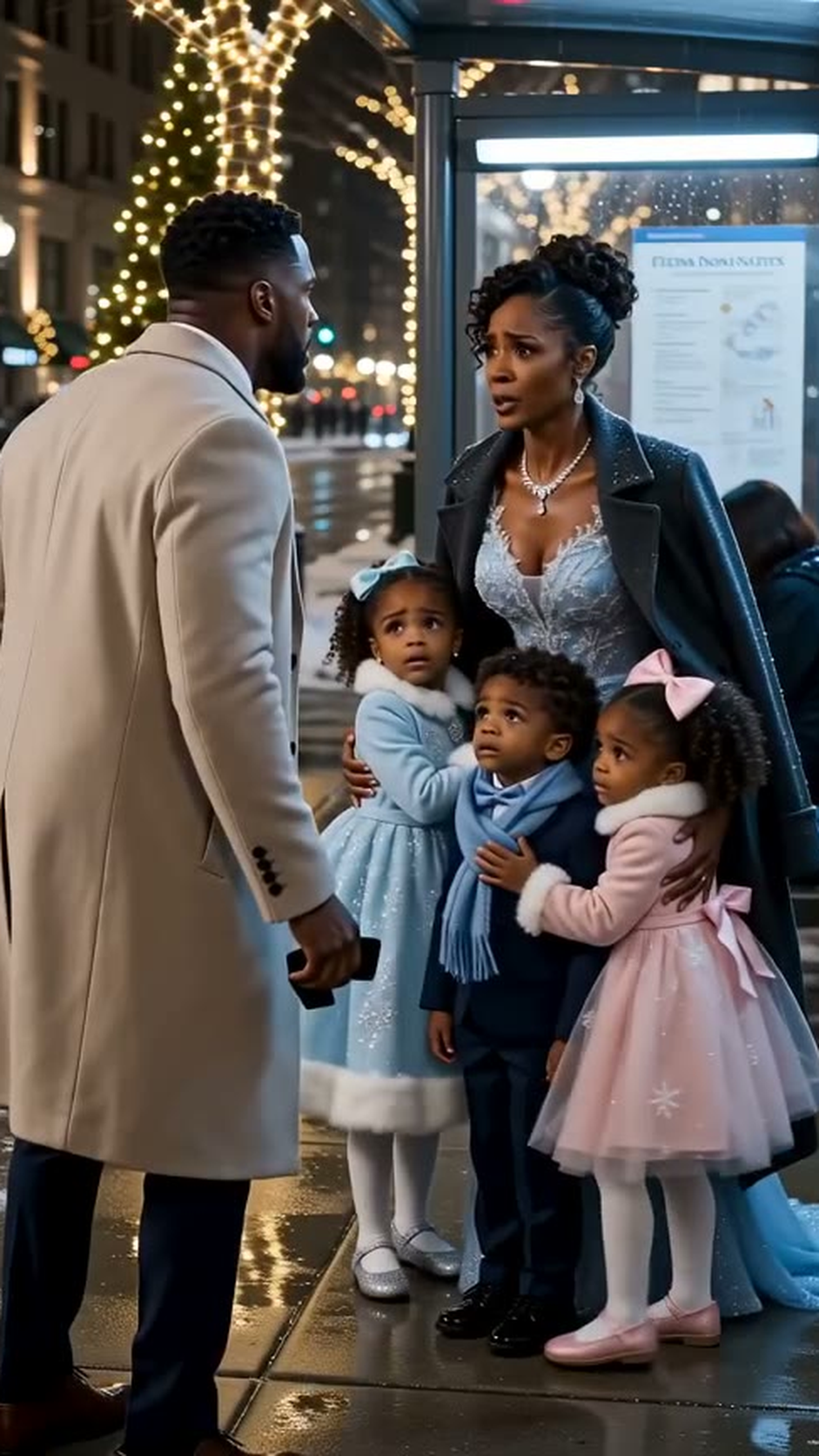
Grace stood in the dark of her son's hospital room with the black velvet box in her palm — the box from the bus shelter, the box from the dining room upstairs in the Mercer Grand, the box built for Amelia Brooks's hand — and felt the floor of the new world tilt exactly the way it had tilted on a Tuesday, three years before, when an envelope came by hand to a penthouse.
She put the box back in his pocket, precisely where it had been. She took her hand off the rail of the bed. And she went out into the corridor, where the painted stars led away in both directions, and she did not know, for the first time in weeks, which way to walk.