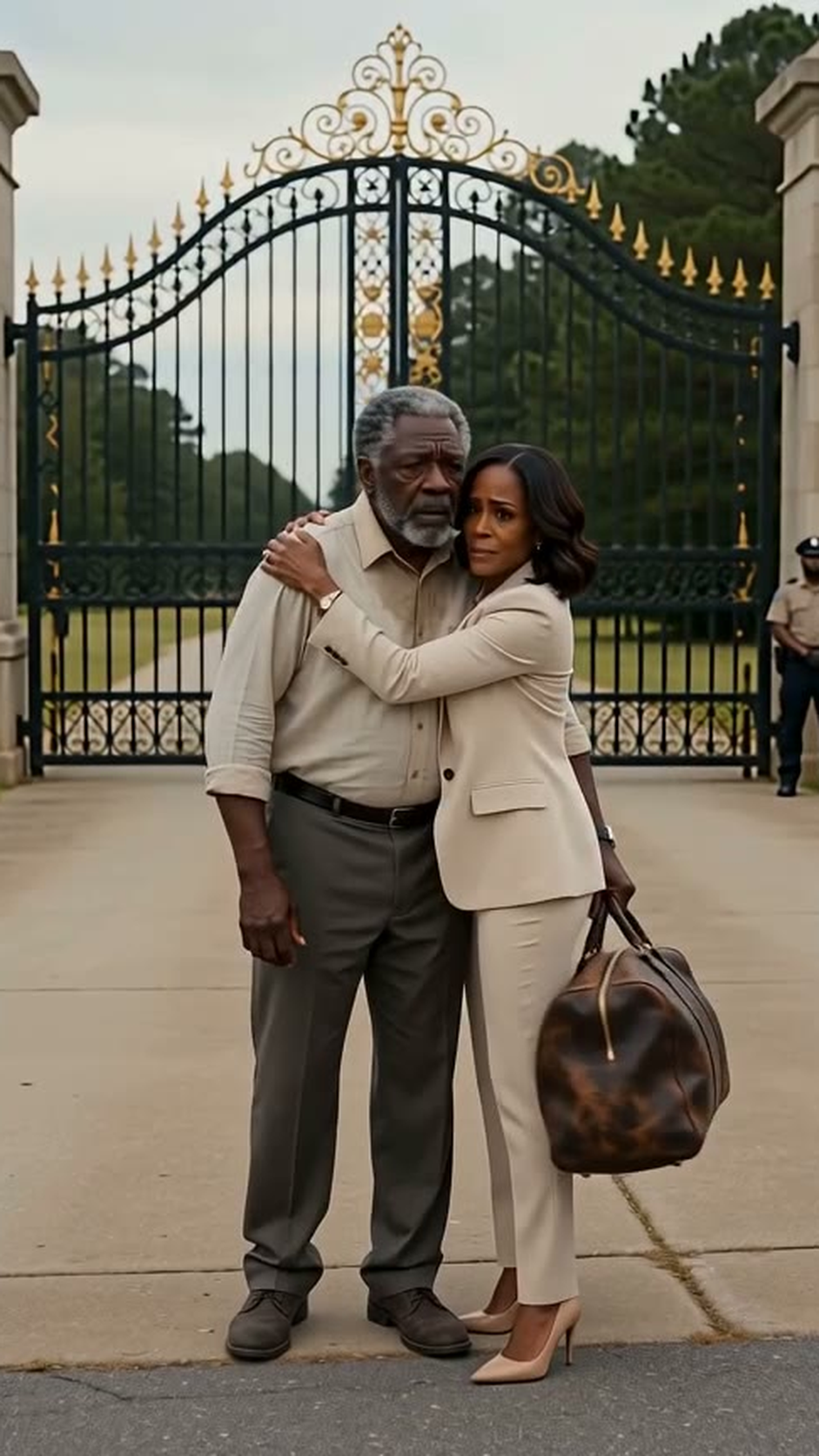
"He started with cards," Gerald said, to the windshield, twenty minutes into the detour, "and I want you to hear the whole shape of it before you judge any of us. Including me."
Melanie drove and let him.
Aaron Crawford at twenty-nine had been the family's joy and its weather system — brilliant with numbers, hopeless with limits, the boy who'd talk a room into laughing and then disappear out of it owing somebody money. Gerald put him in the Crawford Properties office the year he turned twenty-seven, bookkeeper, a salary, a desk with his name on it, a father's belief that structure could save a son from himself.
The gambling started small and did what it always does. By the spring of the fifth year ago, Aaron owed eighty thousand dollars to a man named Doyle Rusk, who was not a bank and did not send statements. And Aaron, with the keys to the kingdom in his pocket and terror in his chest, began moving money out of client escrow accounts — small transfers, documented, each one wearing Gerald's authorization stamp, because the stamp lived in the office and Aaron was the office. Three hundred and forty thousand dollars across one winter, every dollar of it fed into the hole of Doyle Rusk, and by the time the money was gone the debt was barely smaller, because that is the mathematics of men like Rusk.
"I found it on a Sunday," Gerald said. "I went in to check a closing file — I always checked closing files on Sundays, your mother said it was my religion — and there it was. My boy's handwriting. My stamp. Numbers that walked off the page when you looked at them too long."
He drove home and sat in his truck in his own driveway for an hour, watching the lights of his house. Then he went in and got Aaron out of his bed and put him at the kitchen table, and Aaron — thirty years old, shaking so hard the chair rattled — told him all of it, and begged him to call the police, and begged him not to, in the same breath, the way a drowning man grabs at both the rope and the water.
"The full shape of it came out of Aaron the way things come out of a man who has rehearsed honesty in front of mirrors: cards first, then the horses, then Rusk. Rusk's collector had started visiting the office after hours. Rusk had photographs — Aaron at the tables, Aaron signing markers. And in the last week, Rusk had stopped threatening Aaron, which Aaron understood too late was the most frightening thing a man like that can do.
"He said he'd start with the house," Aaron had told him, at that kitchen table, in a whisper that kept breaking. "He said, 'Old people fall, son. Houses catch fire with nobody home but a wife.' Dad — he meant Mom. He stood in our parking lot and he meant Mom."
"So I want it understood," Gerald told Melanie now, over the sound of the highway, "that my boy did not steal for pleasure. He stole the way a man pays a ransom. It doesn't acquit him. It never acquitted him in his own eyes, which is why he's spent five years paying strangers back in the dark. But when my children tell the story of their brother the thief, they leave out the man with the photographs, and they leave out the parking lot, because I made sure there was nothing left in the official story for them to find."
"He said, 'I'll tell them, Dad, I'll go in myself, I swear it.' And I looked at him—" Gerald's voice did something it had not done in Melanie's hearing, ever; it roughened and nearly went. "I looked at my boy and I did the arithmetic a father does. Thirty years old. A felony fraud record. He'd have gone in soft and come out ruined, if he came out. And I was sixty-three, with my life built and my name made, and a wife who could hold the family up without me." He turned his head and looked at her with the unbearable calm of a man reciting weather. "So I told him no. I told him the sin was going to have an owner, and the owner was going to be me."
What Gerald did next, he did at the kitchen table, through one whole night, with a legal pad and the company's books open like a body on a slab.
He reconstructed everything. Every transfer, every stamp, every lie — setting them in a row the way a man sets out tools for a job he already knows he's going to do. At three in the morning Margaret came down in her robe and stood in the kitchen doorway with two mugs of coffee, and she looked at the books, and at his face, and she did not ask him whose it was. She set his coffee down at his elbow and put one hand flat between his shoulder blades.
"How bad?" she said.
"All of it bad," he said. "Every page."
"Gerald." A wife of thirty-six years does not need the sentence finished. "Whose handwriting is that on the second ledger? Because it isn't yours. Yours leans left. That leans—" She stopped. The kitchen ticked. Somewhere in the house a grown son slept the sleep of the hunted, and both of them could feel him up there like a change in the air pressure.
"Don't," Gerald said quietly. "Don't make me say it out loud tonight, Margaret. If I say it tonight I'll lose my nerve, and the boy needs my nerve more than he needs my honesty."
She was silent a long time. Then she pulled out the chair beside him — her chair, the one nobody else in forty years had ever sat in at that table — and sat down, and picked up the second ledger, and began, in her schoolteacher's hand, to help him copy the numbers that would send him to prison.
"We'll carry him together," she said. "You in there. Me out here. And that is the last word on it, Gerald Crawford, so don't waste breath."
The bank's auditors found the transfers eleven days later. In the interval, Gerald Crawford — methodical as ever — reconstructed the accounts, documented the scheme as a one-man operation, and signed a statement in his own hand: he had directed the transfers, he had kept the money, his son the bookkeeper had processed paperwork without knowledge or suspicion. He made Aaron stand in that same kitchen and promise three things: run; never contact anyone while Gerald was inside, because eyes would be watching the family for years; and build a life so clean it would shame the devil.
"Your mother-in-law knew," Gerald said. "Margaret knew from the first night. It's the only thing in that whole year I never carried alone. She said—" He stopped. Started again. "She said, 'Then we'll carry him together, Gerald. You carry him in there, and I'll carry him out here, and we'll meet in the middle when it's done.' She died eighteen months in, Melanie. I have carried him alone ever since, and I am so tired."
Outside the car window, Mississippi went by in its late-November colors, and Melanie's hands were not steady on the wheel, and the only sound for a mile was the road.
"Does Kenneth know?" she managed at last. "Giselle?"
"No. They know their father is a thief and their brother is a coward, and they've built good clean lives on top of both those lies, and I let them, because the truth would have cost Aaron his one chance." He folded his hands in his lap like a man in church. "Aaron kept the promises. Every one. Pastor down at St. Mark's told Ellis — the boy's been working two jobs in Ellery for five years and sending money orders to a lawyer in Jackson, quiet as rain. He's paid back every cent he took, with interest. Every victim made whole. Nobody knows. He did it out of a loading dock and a rented room and never put his name to a single dollar of it." A ghost of something that was almost pride crossed the old man's face. "He just never believed I'd come. That's the one promise on his side of it. He set today as his finish line — if his father walked past him one more time, he'd get on the bus and be nobody forever."
"And if he won't stay?" Melanie asked. "If we get there and he looks at you and gets on the bus anyway, Dad. What then?"
"Then I buy a ticket too," Gerald said, without a flicker of hesitation, "and I ride with him as far as he'll let me ride, and I get off where he gets off, and I start again the next morning in whatever town that is. A father can be refused, Melanie. I've been refused by experts — I have a son who turned it into a profession and a daughter building a wedding out of it. Refused isn't the same as released." He looked at his hands. "I stopped being able to not show up for that boy somewhere around the second year. It isn't virtue. It's more like a limp. You just go."
She drove faster after that. Not recklessly — the way you drive when the road and the reason finally agree with each other.
"There's one more piece of him you ought to know before you meet him," Gerald said, as if he were telling her about weather coming. "In that letter — the one Ellis kept — he wrote about your mother-in-law. He's been driving to Jackson every year on her birthday. At night. Three hours each way in the dark, to stand at a grave in an empty cemetery and talk to his mother, and then drive back to a rented room and fix trucks in the morning." The old man shook his head slowly, wonderingly. "Kenneth put flowers on that grave twice a year with a florist's card. Aaron stood in the mud in February with his hat in his hands. I don't say it to weigh my children against each other, Melanie. God's done the weighing. I say it so you'll know what kind of lost he was. He wasn't out there being free. He was serving the same sentence I was. His just didn't have a gate to walk out of."
The Jackson exit went past on their right — their exit, home's exit, the one with the house and the wedding flowers and the shed in the garden — and neither of them looked at it.
—
They lost twenty-five minutes to a jackknifed feed truck outside Ellery, sitting in a line of cars with the engine idling and the dashboard clock performing its slow execution — 2:15, 2:30, 2:41 — while Gerald's hand went to his pocket, and away, and to his pocket again.
"Tell me about the shed," he said suddenly, at 2:33, in the tone of a man picking up a hot pan carefully, "so I can stop wondering how you knew."
Melanie's mouth opened. Closed.
"You touched the letter at that table, baby-girl," he said gently. "And nobody in that room but you has touched me gently since. Don't trouble yourself. A shed has a roof. I've slept under less, lately, and been glad of the roof." He looked out at the unmoving road. "I only ever wanted to see my children. The rest is furniture."
The traffic broke at 2:44 like a fever. Melanie drove the last four miles the way she'd run across the prison concrete — as if the distance had personally offended her — and brought the car slewing into the gravel lot of St. Mark's at 2:51, past the food pantry sign, past the sandwich board already being taken in.
Pastor June Calloway was locking the community hall door with a ring of keys the size of a tambourine. She took in the old man climbing stiffly out of the passenger side with his leather bag, and Melanie knew — knew from the woman's face — within one second.
"He left ten minutes ago," June said. "I'm so sorry. He waited until the very last minute, Mr. Crawford — he stood right where you're standing. He said if a man came carrying a leather bag, I was to tell him he was sorry, and it wasn't his father's fault, and not to look for the bus." Her keys stilled. "The county depot, honey. The northbound leaves at three-forty."
Melanie was already back in the car.