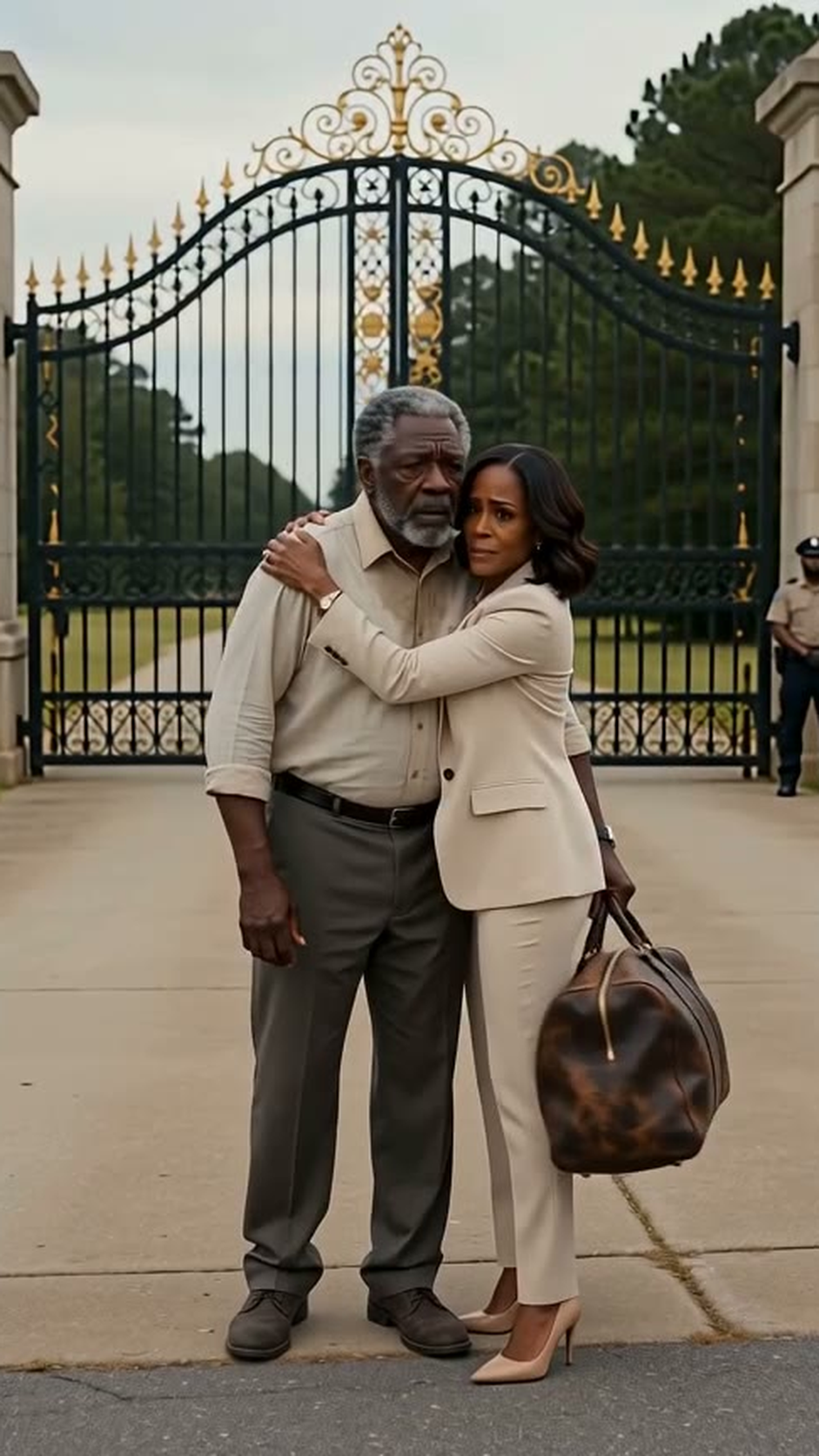
The county bus depot in Ellery was a concrete box with a tin roof and a bench for every decade of its life, and at three-oh-nine in the afternoon it held exactly six people: a woman asleep upright with her purse in her lap, two teenagers welded to their phones, a driver eating a sandwich in the doorway of the idling northbound, and a man standing at the ticket window counting out ones and fives from a worn envelope with the concentration of a person defusing his own life.
The clerk at the window was a woman of seventy with reading glasses on a beaded chain, and she asked the question clerks in bus depots have asked since there have been buses: "One way or round trip, hon?"
The man at the window did not answer at once. Melanie, not yet through the door, watched his hand — the one holding the envelope — rise half an inch and stop, and she understood that in Aaron Crawford's entire five years of planning, with the money counted and the letter sent and the finish line drawn in red, he had never once rehearsed saying the words one way out loud to another human being.
"One way," he said at last, quietly. "There's not going to be a— one way."
She turned away from the window with her glasses in her hand and wiped her eyes with the brisk annoyance of a woman who has seen a great many leavings. "Three-forty northbound, bay two. Don't you go wandering off now."
Twice while they watched — Gerald had come in behind Melanie and stopped just inside the door, bag in hand, letting her eyes adjust before his did — he took something out of the inside pocket of the jacket and looked at it and put it away again, quick, like a man touching a hot stove to make sure it's still there. The third time, Melanie was close enough to see: a photograph, old, its corners gone soft as cloth — a lake, a boat, a family with its arms around itself, twenty years of sun ago. He had carried his whole family in the pocket over his heart through five years of being nobody, and he was about to get on a bus and carry them out of the state forever, because even Aaron Crawford's exile was a thing he intended to do thoroughly.
He was thinner than his father's memory of him, and older in the shoulders, and his hair was cut short and practical, and there was a scar through one eyebrow now that Gerald did not know the story of. He wore a mechanic's jacket with the name patch torn off — Cole, by the ghost of the stitching — and he was buying a one-way ticket north with money counted like it had names.
"Aaron."
Gerald said it the way you set down something breakable.
The envelope stilled. The man's whole back went rigid inside the jacket. For a moment — Melanie would remember it later as the longest moment of her life — her brother-in-law stood absolutely motionless at that window, and she understood he was deciding, one final time, whether to turn around or to become nobody forever.
He turned around.
Five years fell off him in a second and left a thirty-five-year-old man standing there looking sixteen and lost, and his eyes went to his father and filled so fast it was indecent, and his mouth worked, and the first word out of it was not a greeting.
"You weren't supposed to—" He stopped. Swallowed. "Pastor June said— they said you got out at ten. I waited until the hall closed. I stood there until she locked the door, I swear to God, Dad, I waited—"
"I'm here." Gerald took a step, and the leather bag swung against his leg, and he set it down on the depot floor with immense care, like a man clearing his hands for the only work left to him. "Son. I'm here. Traffic. A feed truck. I'm here."
"Don't." Aaron backed toward the window, both palms up, envelope crushed in one fist. "Don't come any closer. I wrote it all down for Ellis — I told June — you were never supposed to have to see me. That was the DEAL, Dad. I stay gone, you come home, everybody—" His voice cracked down the middle. "I'm the punishment, remember? That's the arrangement. I disappear, and the family gets to be a family."
"The family voted to put me in a shed, Aaron."
It stopped him like a wall. Gerald's voice was quiet and terrible and kind.
"There's no family standing where you left it, son. There's a wedding on Saturday with my name left off it, and a son who can't say 'father' without tasting something sour, and a daughter who'd rather hide me in the yard than explain me to her new people. We did your arrangement. Five years of it." He took another step. "You paid back every dollar. You know how I know? Because a chaplain told a pastor told a broken old man in a chapel, like a secret too heavy for any one honest person to hold. You kept every promise. Now I'm going to keep mine, and mine was that I'd meet you in the middle when it was done."
"It's DONE?" Aaron laughed, one wild note. "It's never done! I let you go to prison in my place! I let Mom die thinking—" He choked. "I let her die while you were in a cell for a crime with my name on it, and I fixed Buicks, Dad. I fixed Buicks and sent money orders and told myself it was the same thing as courage."
The bus driver folded his sandwich wrapper with excruciating neutrality. The northbound sighed on its brakes. Over the depot speakers, a woman's recorded voice announced the 3:40 for Memphis, boarding in twenty minutes, in the tone of weather arriving whether or not anyone was ready.
Aaron looked at the bus. Gerald looked at Aaron. And Gerald Crawford, who had not raised his voice in five years of cells and counts and men shouting, raised it now — not in anger, in command, the voice that had once run a company and a household and three children's whole world:
"Aaron Crawford. I did not buy your life at the price of mine so you could spend it standing in bus stations. Look at me."
Aaron looked at him. He was crying without any attempt to stop it now, this stranger with his brother's face and his father's eyes, and he said the thing he had been driving toward for five years like a man finally reaching a shore:
"It was me. The money, the accounts — it was me, the whole time. It was never him. It was me."
Gerald covered the last of the distance between them the way a man crosses a river — committed, all at once, no testing the depth. He took his youngest son by the shoulders, and Aaron made a sound like the ground had shifted, and then he was down — not fallen, folded — forehead against his father's shoulder, both fists clenched in the back of the faded beige shirt, shaking apart in a concrete bus depot at twenty-nine minutes past three in the afternoon, and Gerald held him up with arms that had waited five years and expected, frankly, to die waiting.
"I got you," Gerald said into his hair, over and over, like a man mending something by saying it. "I got you. I got you, son. You're not cargo. You're not a debt. You're my boy. I got you."
"I let you—" Aaron said. "Dad, I let you—"
"I know what you let me do," Gerald said. "I was there. I remember whose idea it was. Now stand up. Stand up, Aaron. Men in this family have done enough kneeling in strange places."
Aaron stood up. He wiped his face with the heel of his hand, furious at it and grateful in the same gesture, and he picked up the leather bag before his father could reach for it, and that was the configuration in which Melanie would remember them forever: the old man empty-handed at last, the lost son carrying the weight, both of them out of breath and entirely ruined and somehow, for the first time in five years, upright.
Melanie heard the depot door open behind her. She heard it in the specific way you hear weather change.
She turned.
Kenneth stood in the doorway with his keys in his hand and his good blue shirt dark with sweat down the back — she'd find out later about the prison clerk, the emergency-contact call, the little blue dot of her shared location crawling across a map toward a town he had no business knowing — and he had a face on him that Melanie, in eleven years, had never seen: the face of a man watching the floor of his life come up through the soles of his shoes.
He looked at the stranger at the ticket window. He looked at his father, standing beside a leather bag in a bus station with his hand half-raised. His voice, when it came, was a boy's voice, small and scraped raw:
"It was you?"
"Where?" Kenneth said. "Where have you BEEN, Aaron? Five years. Five years — Mom died. Mom died and you—"
"I know," Aaron said. "February. Second Tuesday. I was there, Ken. I stood in the trees at the back of the cemetery till the cars left, and then I went and talked to her till the groundskeeper made me leave. Every year. I'm not asking you to—" He stopped, and set the bag down again with great care, and faced his brother with his hands open at his sides, empty, a man done running in every way that mattered. "Say what you need to say. I drove three hours to stand here and hear it. Say it all."
Kenneth laughed once — a terrible, cracked sound with no humor anywhere in it. "You're fixing Buicks. He's got a bag with his whole life in it and you're standing there with five years of money orders and a haircut, and I'm supposed to—" His voice gave out. He pressed the heels of both hands into his eyes like a man trying to hold something in his skull by force.
Aaron flinched. Kenneth took one step into the depot, and another, and the words started coming out of him like things being torn:
"All this time. All this time — we buried him, Aaron. We buried him standing up. Mom's portrait, the papers, Giselle's whole life, I have told people my father was a thief for five years, I told my wife—" He swung on Gerald, and the grief turned a corner into fury so bright it lit the room. "And YOU. You let us. You sat in that place and you LET US— what kind of man lets his own children—"
"Kenneth." Melanie moved. She got her body between her husband and the bag on the floor without deciding to, the way she'd gotten her body between Gerald and an empty road. "Kenneth. Look at me. Look at me."
He looked at her. His phone was buzzing in his fist — had been buzzing, she realized, for some time — and he raised it slowly, the way you raise something radioactive, and turned the screen toward her.
GISSELLE, the phone said. Twelve missed calls.
And beneath her name, in the preview of the message, was a photograph — a tall black gate, a woman in a cream suit running with her arms out, an old man turning toward her with a leather bag swinging — and a single line of text from his sister that Melanie read three times before it would hold still:
Harlan Pierce has seen it. Julian's father is at the house. Get home. NOW.
Kenneth's phone rang again in his fist — not buzzing now, ringing, Giselle's name and face filling the screen, and something in the quality of that sound in the bus depot air, on top of everything else, finally exceeded what strategy could hold. Melanie took the phone out of her husband's hand, put it on speaker, and set it on top of the leather bag, and her sister-in-law's voice came out of it shredded beyond recognition by terror:
"—told them it's not true, I told Harlan it's a lookalike, a coincidence, I LIED to my own— Melanie, where ARE you, there's a photographer at the end of the street and Julian is shouting at his father in the driveway and I can't— I can't keep them all—"
"Giselle." Gerald's voice. Calm as lake water, from three feet away, and the voice on the phone stopped as if a hand had closed over it. "Giselle, baby. It's your father. Listen to me. You are not to lie for me one more time — not one more time, do you hear me? Whatever it costs. We are done purchasing this family's comfort with counterfeit, all of us, starting now."
From the phone, very small: "Dad?"
"We're coming home," Gerald said. "All of us. It's a longer ride than you were planning on. Put the coffee on."
He ended the call himself, with one careful thumb, like a man closing a book he intends to finish later.
"All of us," Kenneth repeated, to the room, like he was checking the words for weight. He looked at his brother — the first time he'd looked at him as something other than an apparition since walking in. "You heard the man. Get your bag, Aaron."
"It's his bag," Aaron said.
"Then carry your father's bag," Kenneth said, "and get in the car," and turned for the door before the moment could get away from any of them.