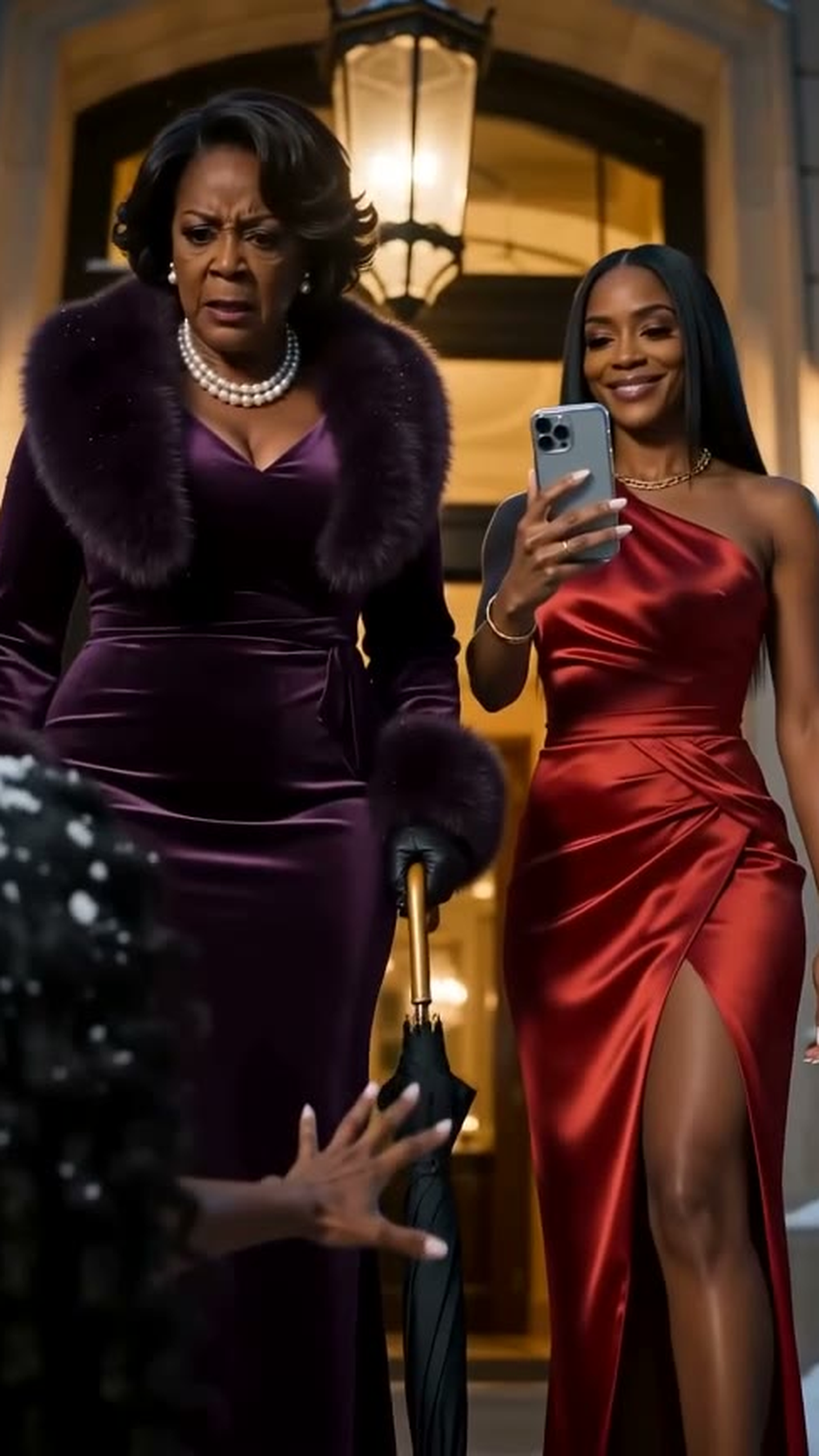
On the night of the gala, the Ashford Sterling Hotel wore its wealth the way Vivian Ashford wore her pearls: completely, and as a warning.
Snow fell through the light of the porte-cochère as the cars arrived — black, gleaming, disgorging senators and surgeons, heiresses and hospital board chairs, everyone who mattered in the city's long winter of charity. Inside, the ballroom blazed. A forty-foot tree rose at its center dressed in white and gold. The foundation's numbers for the year were printed in the program in triumphant type: $38 million raised. Homes. Wings. Scholarships. Vivian Ashford stood at the ballroom door receiving her city, and the city, as always, received her — kissing the air beside her powdered cheek, murmuring her name like a password.
Tessa did her duty in the lobby in the silver gown. She greeted. She smiled. She asked after grandchildren and hip replacements and the market. And all the while, beneath the performance, her mind ticked like a second heart: Four days since the phone call. Four days of her mother being sweet — terrifyingly sweet, sending flowers to her office, asking after her sleep — the way a spider is sweet to the fly it has decided not to eat yet. Tessa had not slept properly since the mirror. She had spoken to Bridget twice, in whispers, from a phone Bridget had given her. The box stayed in the vault. The protocol held. Tessa had only to survive the gala, smile through the gala, and on Monday, with the quarter's filings complete, Bridget would file everything with the attorney general, quietly, cleanly, from a position of safety.
Only survive the gala. It sounded, in the golden lobby, almost possible.
At nine o'clock, Emma found her.
Her younger sister materialized out of the crowd in her red gown like a drop of blood on snow, a glass of champagne in one hand and her phone in the other, and her smile had that particular shine it got when she knew something Tessa didn't. Emma had been beautiful since she was six years old and cruel since she was nine, and the family had always treated both facts as weather: unavoidable, and faintly their mother's pride.
"Mother wants you," Emma said.
"I'm greeting guests."
"Mother wants you upstairs. The family suite." Emma's eyes glittered. "She says it's time for your talk." She tilted her head, studying her sister with open, leisurely enjoyment. "You look pale. Are you nervous? You should be nervous."
Tessa set down her untouched glass. Her hands, she was pleased to note, were steady. Inside her chest, everything was not steady at all. "Where's Dad?"
"Dad does what Mother says." Emma shrugged one bare shoulder. "Like the rest of us. Unlike you, apparently." She leaned close, and her perfume was expensive and her voice was honey. "Whatever you've been doing, Tessa — she knows. She's known for days. I'd start thinking about what you're going to say."
Her father arrived at nine-fifteen, to a small ripple of welcome, and for a while Tessa let herself watch him work the room — he had been good at rooms once, before the empire's center of gravity settled permanently into his wife — shaking hands, remembering names, laughing in the right places with a warmth that reached his eyes only about half the time. When he reached Tessa, he kissed her cheek and said, "You look lovely, darling. Your mother's taste, as always," and she heard, or imagined she heard, the apology buried in it: the dress was not her choice; they both knew; they would both pretend. She wanted to seize the moment — the quartet, the crowd, a hundred witnesses — and say it here, say all of it, pour the ledger out on the marble like a smashed glass. It was the fantasy that had carried her through four sleepless days. But she had Bridget's discipline in her ear, and she understood, looking at her father's arranged face, that truth announced at a party is just a scene, and scenes were her mother's native country. Her mother would survive a scene. She would feed on it. The filing would not be a scene. The filing would be arithmetic.
At nine-thirty, Vivian took the small stage at the ballroom's heart and gave the speech she gave every year, and the room hushed the way rooms hush for weather. She spoke of her grandmother, who had scrubbed floors in a hotel not unlike this one. She spoke of stewardship, of the sacred trust of other people's generosity, of the hospital wing rising in Cleveland — the wing whose money sat in the Caymans, in an account initialed with her own name — and donors wept, actually wept, at the sacredness of it, and Tessa stood at the edge of the light with her hands folded and thought: she believes it. That was the final horror and the final clarity. Her mother was not a hypocrite in her own mind. She was a queen distributing alms, and if some of the coins stuck to the royal fingers, that was not theft; that was the toll of the crown. You could not shame a woman like that. You could only out-document her.
The applause was still rolling when Emma found her, and delivered the summons, and the evening narrowed to its point.
The family suite occupied the top floor, a private apartment of rooms above the hotel her family owned, all cream and gold and views of the falling snow. Vivian was waiting in the sitting room with the door open, seated, composed, her purple gown arranged around her like a throne's drapery. Richard stood at the window with a drink he wasn't drinking, looking out at the weather. He did not turn when Tessa entered.
"Close the door, darling," her mother said.
Tessa closed it. The sound it made was soft and absolute, the sound of the gala receding to another planet.
"Sit."
"I'll stand, thank you."
Vivian's smile thinned by a degree. "You've been in my archive," she said, without preamble, the way one might mention the time. "Three nights. Security footage. Financial archives. The foundation's restricted ledgers." She folded her hands. "Did you think I wouldn't notice? Did you think anything in this building happens that I don't notice? Tessa. I built this building."
"I noticed some irregularities," Tessa said, and her voice came out level, which surprised her. "In the foundation's disbursements. Meridian Facilitation Group. Harlow and Venn. Mama, $1.9 million went out of the hospital wing fund to companies that don't exist. I was doing my job. The job you gave me."
"The job I gave you," Vivian said softly, "was to smile at donors and sign where you were told to sign."
The room went very quiet. From the window, Richard said nothing. The snow went down past the glass in silence.
"Who else knows?" her mother asked. "Who have you told? What have you taken?"
"Nothing," Tessa lied. "I took nothing. I only looked."
"No." Vivian rose — slowly, the way royalty rises, the fur of her wrap settling around her shoulders — and crossed the carpet until she stood close enough that Tessa could smell her perfume, the same perfume of every childhood Christmas and every punishment. "You never were a good liar. I told you that on the phone." Her voice dropped to something almost intimate. "Whatever you copied, wherever you've put it, you will bring it to me. And then you will sign a statement for our lawyers — a full account of your confusion, your drinking, your… instability these past months. The doctors are very sympathetic, Tessa. The family will take care of you. A rest. Treatment. Somewhere quiet, where you can recover from all these paranoid ideas."
It arrived then, with the force of a door slamming in her mind: this was the plan. Not argument. Not even anger. Erasure, with paperwork. A daughter declared unwell, a story swallowed by a diagnosis, a signature turned into a confession. Bridget's voice came back to her across four days: She doesn't argue with a threat. She destroys its credibility so completely that no one will ever listen to it again.
"No," Tessa said.
The word surprised all three of them.
"No," she said again, stronger. "I won't sign anything. And you know what I found, Mama, so let's not pretend. I found the accounts. I found the transfers. I found Dwayne Pell on the loading dock cameras, and I found the man you were talking to, and I know what happened to him the week after." Her voice was shaking now, but it was hers. "You stole from sick children and called it charity. Whatever happens to me — you did that. Not me. You."
Her mother's face did not change. That was the worst of it. Rage would have been human. Instead there was only a slow, cold recalculation, the look of an accountant closing a book.
"Emma," Vivian said, still watching Tessa, "call downstairs. Tell them Miss Ashford is unwell. She's been drinking. She's confused and upset and we're taking her out for air before she makes a scene in front of the donors."
"I'm not—" Tessa started.
"Richard." Her mother's voice cut like a wire. "Your coat."
And her father — Richard Ashford, who had carried her on his shoulders, who had taught her to skate on the pond behind the house holding both her hands — set down his untouched drink, and took his charcoal overcoat from the chair, and held the door for his wife, and did not look at his daughter at all.
"You're frightening her, Vivian."
It was the first thing Richard Ashford had said in ten minutes, and he said it to the window, to the snow, to anyone but the two women. But it was something. It was a crack, and Tessa — who had been raised on his cracks, who had survived her childhood on the hope encoded in them — felt her whole heart lurch toward it the way it had when she was nine and he would almost, almost intervene.
"Am I?" her mother said pleasantly. "Tessa. Am I frightening you?"
Her father turned then. Just his head. His eyes found Tessa's across the cream-colored room, and in them she saw the entire architecture of her childhood: the love, which was real; the terror, which was also real; and the transaction he had been making between them for forty years, love spent by the spoonful, terror paid by the pound. Say it, she begged him silently. Say one true thing in this room and I will carry it with me through whatever happens next. Say it and I will know I was somebody's daughter.
"She's overwrought," Richard said to his wife, quietly, like a man filing a report. "She's been working too hard. Perhaps a rest, as you say. Somewhere quiet."
"There," Vivian said, with terrible gentleness. "You see? Even your father can see it."
It was, Tessa understood later, the moment the thing actually happened — not the umbrella, not the ice, not the alley. Those were weather. The moment itself was small and silent and took place in a warm room: the last door in her father's face closing, from the inside, by his own hand. She felt something in her finish — not break, finish, the way a song finishes, with a sense of an ending that had been composed long before. She stopped being afraid in that room. The fear had been made of hope, and the hope was spent, and what remained was very clear and very cold and entirely her own.
"You should know," she said to her mother, and her voice had stopped shaking, and she saw Vivian register it — the first small recalculation of the evening, a flicker, quickly mastered. "You should know what kind of daughter you actually raised. I didn't look at the archive because I was confused. I looked because a transfer didn't reconcile, and I kept looking because I have your mind, Mama. You made sure of it. You taught me to read a ledger the way other mothers teach their daughters to read music." She let out a breath that was almost a laugh. "Whatever happens tonight — you built the woman who's going to end you. I just wanted you to know that. Professionally."
For the first time in Tessa's memory, Vivian Ashford had nothing arranged on her face. For one second the portrait hung crooked, and underneath it was a stranger: older, startled, and — Tessa saw it, and would treasure the seeing on the pavement and in the alley and for the rest of her life — afraid.
Then the mask came down like a shutter. "Emma," her mother said. "Call downstairs."
They took her down in the service elevator, because the family suite had its own, because the Ashfords had planned for every kind of discretion. Emma walked beside her with her phone already in her hand, and Tessa understood with a clarity that felt like falling that the phone was not for calling anyone. In the lobby's golden roar, nobody noticed the family group moving toward the side entrance — the mother regal, the father silent, the younger daughter filming, the elder daughter very pale, walking between them like something being escorted out of its own life.
The side door opened. The winter night rushed in, blue and bitter.
Outside, the pavement was wet black ice under a skin of new snow, and the lanterns burned above the porte-cochère, and Tessa's shoes — silver evening shoes, chosen to photograph beautifully — found no purchase at all.