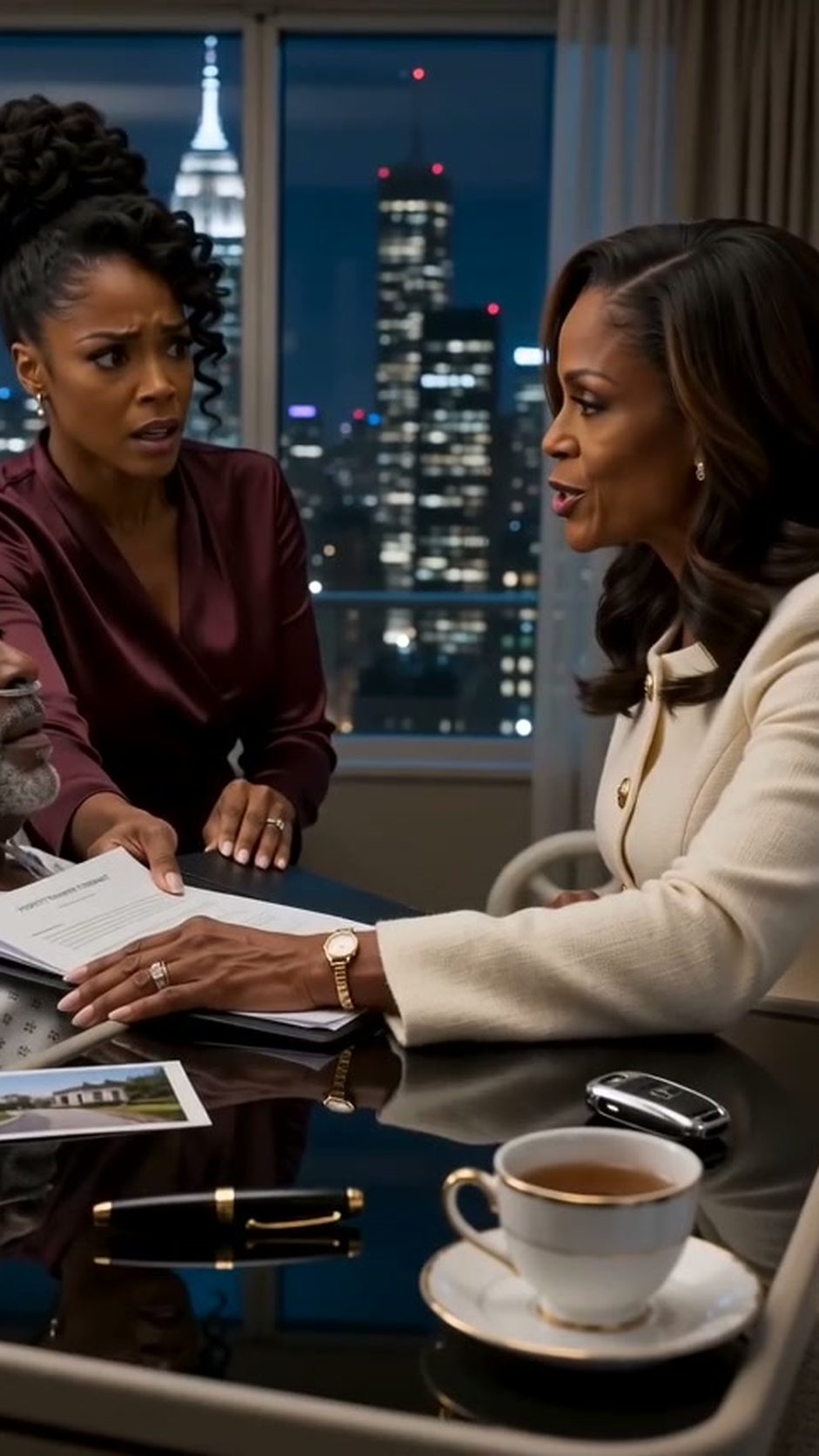
To understand what Vanessa did for thirteen years, you first have to understand what had been done to her in the eight years before them — gently, legally, and in front of applauding guests.
She met Raymond Calloway when she was twenty-seven and he was thirty-eight, a project manager at Hart Development with sawdust on his cuffs and a laugh that made boardrooms lean toward him. Her father saw it instantly. Charles Hart had not survived forty years of construction wars by misreading men, and he told her, in the kitchen of the house on Alder Lane, with the blueprints of the Harborview towers spread between them like a map of the future: "That one loves the view from the top of the building, Vanessa. Make sure he remembers whose land it's built on."
She married him anyway. She married him joyfully, in a garden, in June, with her father's hand shaking slightly in hers as he gave her away — the only time she ever saw it shake. At the reception, Margaret made the first toast, standing straight as a yardstick in beige silk, her glass raised toward the head table and the skyline beyond it. "To the Calloway line," she announced, to her son, to the room, to God. "May it be long, and loud, and carried far."
The applause had not finished when Charles Hart rose — slowly, the way big structures do everything — and lifted his own glass, and looked not at his new son-in-law but at his daughter.
"To the ground it stands on," he said.
Three hundred guests laughed and drank, hearing a builder's sentiment, a pleasantry about foundations. Raymond laughed loudest of all and clapped his father-in-law on the shoulder with the fond, careless strength of a man who has just been handed a kingdom and has not yet looked under it. Only Pierce, at the lawyers' table, did not laugh, because Pierce had drafted the ground, and knew it was not a metaphor.
She remembered that toast at intervals for the rest of her life — at ribbon-cuttings, at board dinners, in the Rosewood parking lot — the way you remember a knock at the door long before you understand who was standing outside it.
And because Charles Hart loved his daughter more than he trusted any man alive, he did the thing Raymond never knew about and would have raged against if he had: he placed the beating heart of the empire — the land, the eight waterfront and hillside properties, the controlling fifty-one percent of the company's voting shares — into the Hart Family Trust, with Vanessa as its beneficiary and, one day, its trustee. Raymond would run the company. Raymond would have the title, the office, the magazine profiles, the name on the tower.
Raymond would own almost nothing.
"The boy has talent," Charles told Pierce, in the conversation Pierce would repeat to Vanessa thirteen years later, word for word. "Let him think the kingdom is his. Kings behave better when they believe the crown fits. But the ground stays Hart ground. If he ever forgets what a husband is, the ground is what my daughter stands on."
Raymond's mother never forgave Vanessa for existing incorrectly. Margaret Calloway had raised her son in a two-room apartment over a laundromat and regarded his marriage the way generals regard treaties — as a pause between campaigns. She wanted a grandson. She announced this at dinners, at holidays, in the receiving line of their wedding's second hour. When, in the fourth year of the marriage, Vanessa lost a baby at eleven weeks and then a second at nine, and a kind-faced specialist finally used the words "unlikely ever," Margaret's grief expressed itself as arithmetic. "A wife who cannot give a son," she said at Christmas, not quite quietly enough, "is a house with no heir in it."
Raymond held Vanessa's hand under the table. In those years, he still did. That is what made the arithmetic of the later years so obscene: he had not been a monster at the start. He had been a man who was slowly, pleasurably taught by success that the rules were furniture — things arranged for other people to walk around.
Charles Hart died in the sixth year of the marriage. Raymond wept at the funeral with what appeared to be genuine sorrow, took the chairman's office within the quarter, and within two years had rebranded Hart Development as Calloway Properties in letters of brushed gold. The trust, Pierce noted in his files, said nothing. Trusts are patient that way.
And then came the Rosewood Hotel, and the burgundy dress, and the hand on the belly.
* * *
Pierce's advice, delivered over the following weeks in the flat tone of a man discussing weather, became the architecture of Vanessa's second life.
"One affair is a divorce," he said. "A pattern is a verdict. Your father's trust has a clause, Vanessa — he called it his 'cold-weather clause,' God rest him. If the managing spouse commits adultery and diverts trust-connected assets to sustain it, over a demonstrable period, the trust's protections don't merely hold. They accelerate. Every protection he built wakes up at once. But 'demonstrable' is the whole ballgame. Photographs can be explained. Receipts can be explained. Thirteen explanations, stacked in order, with dates — that is not an explanation problem anymore. That is a biography."
"How long?" Vanessa asked.
"As long as it takes to be undeniable." Pierce closed the folder. "Can you smile at him across a dinner table, knowing?"
She thought of the hand on the belly. "Watch me."
So she became two women in one body, and she was magnificent at it, and it cost her exactly what you would imagine.
By day she was Mrs. Calloway: hostess of the Harborview galas, patron of the children's hospital, the wife in the ivory suit in the front row of every ribbon-cutting, applauding her husband's genius with her hands while her eyes memorized the guest lists. She learned the business the way spies learn languages — totally, and for use. She sat in on board meetings she was "only decoratively attending." She made a friend of Ruth Delgado, the chief accountant, a Hart Development lifer who had typed Charles Hart's first payroll and had never once, in thirty years, called Raymond anything but "Mr. Calloway" in a tone usually reserved for weather delays.
By night she was the archivist of her own betrayal.
The investigator's name was Deke Morris, ex-police, expensive and unshockable. His reports arrived monthly in plain envelopes that Pierce held at the office. The brownstone across the river: purchased through a Calloway subsidiary, "executive housing." The woman's name: Sabrina Cole, twenty-three, a former receptionist at a Calloway leasing office. The due date: calculated, confirmed, circled in Deke's neat hand. And then, one April morning, the report Vanessa had been waiting for and dreading in identical measure:
Subject delivered a son at St. Aurelia Private, 2:14 a.m. Subject's companion present throughout. Name registered: Owen Cole. Father's name on certificate: blank.
She read it at Pierce's desk. She read it twice. She thought about the two small, unfinished lives she had lost in quiet hospital rooms with Raymond holding her hand, and about Margaret's Christmas arithmetic, and about the word blank, and she felt the grief arrive — it always arrived — and she let it pass through her like weather through a house she no longer lived in.
"File it," she said.
"Vanessa—"
"File it, Jonathan. Box one."
The hardest evidence was never the money. The hardest evidence was the boy learning to walk.
Deke's third-year file contained a photograph she had not requested and could not unknow: Owen at eighteen months, in a small park across the river, holding both of Sabrina's hands and stamping his feet in a puddle with the concentrated ecstasy of a small emperor. Sabrina was laughing down at him. The photograph was — and this was the obscenity of it, the thing no one in the whole apparatus of the lie had intended — lovely. A mother and a child in the rain light, entirely innocent of the uses to which their happiness was being put by everyone else in the story.
Vanessa kept that one photograph out of the box for a week. She kept it in the drawer beneath the foundation accounts, next to the other ledger, and each evening before dinner she would look at it for exactly as long as it took to refuse two temptations at once: the temptation to hate a toddler, which she declined as beneath her father's daughter; and the temptation to pick up the telephone and end everything that night, which she declined as beneath her father's strategist.
What she felt instead, she recorded in the ledger, because the ledger was where feelings were allowed to live:
Year three. He walks. He has her laugh and someone's grin. I am the only person alive who knows the whole shape of his life, and I am the person it is being used against. Guard the boy from the reckoning. When it comes, aim carefully.
At the end of the week she filed the photograph in box three, between the brownstone deed and the car insurance, and went downstairs to ask her husband about his day.
Over the years the boxes multiplied — a fireproof row of them in a storage facility rented under her maiden name. Photographs. Bank trails. The deed to the brownstone. Sabrina's car — a luxury SUV, replaced every two years like a phone — bought by the company, insured by the company, fueled by the company. Owen's private school tuition, routed through a "foundation scholarship" that Ruth Delgado flagged with a paperclip and a note in handwriting so dry it was practically a desert: Third such scholarship. Only recipient. Ever.
Vanessa paid for none of it with tears anymore. She paid for it with patience, which is more expensive.
In the sixth year she met Sabrina Cole face to face for the first time, at a leasing office reception the company threw for its brokers — Sabrina restored by then to a "consultant's" contract, the way ivy returns to a wall. They were introduced beside the drinks table by a man who knew nothing, and Sabrina — twenty-nine, polished, glowing with the health of a woman whose bills are all paid by other people's architecture — took Vanessa's hand in both of hers and said, with enormous, practiced sincerity, "Mrs. Calloway. I just want you to know how much I admire you. Your marriage is what I tell my friends a marriage should be."
"Is it?" Vanessa said, smiling. "How kind. Hold on to that standard, Sabrina. A woman should always know exactly what a marriage is worth — to the dollar, and to the year. It concentrates the mind so."
Sabrina laughed, delighted, understanding nothing, and moved on toward the canapés, and Vanessa stood a moment with her glass untouched, savoring the private arithmetic of it: that she had just told her husband's mistress the entire truth, in public, in a complete sentence, and been thanked for the compliment.
And once a year, on the anniversary of the afternoon at the Rosewood, she allowed herself one honest hour. She would drive to her father's grave with coffee gone cold in the holder, and she would tell the headstone everything — the boy's height now, the woman's new handbag, the exact current balance of the lie — and then she would ask the question she never asked any living soul.
"How long, Daddy?"
The headstone, being marble and Hart, offered the family answer: as long as it takes to be undeniable.
In the fifth year, Ruth's paperclips brought her something new: a ledger of transfers into an account Vanessa had never seen, in a bank two states away, in amounts just under the reporting thresholds. Not Sabrina money. Not household money. Escape money — a man quietly building a second lifeboat and stocking it in the dark.
Vanessa carried the ledger to Pierce herself. He read it standing up, the way men read casualty lists.
"This is no longer an affair, Vanessa," he said at last. "This is a man preparing to leave you with the building and take the ground. If we move now — today — we can stop the bleeding. You would win. But it would be a war, and he would keep his name, his company seat, and half of everything the law can't trace to the trust. He would land on his feet, with her, and raise that boy in one of your father's houses."
"And if I wait?"
Pierce looked at the five boxes lined along his office wall, and then at the woman across from him, who had learned to smile at gala dinners twelve feet from her husband's mistress and had never once, not once, let her hand shake on the stem of her glass.
"If you wait," he said, "he convicts himself. Count by count. Until there's nothing left to argue about." He paused. "But Vanessa — waiting is the hardest sentence I know how to hand a client."
She stood, smoothed her blazer, and picked up her handbag.
"Then it's a good thing," she said, "that I have so much practice."