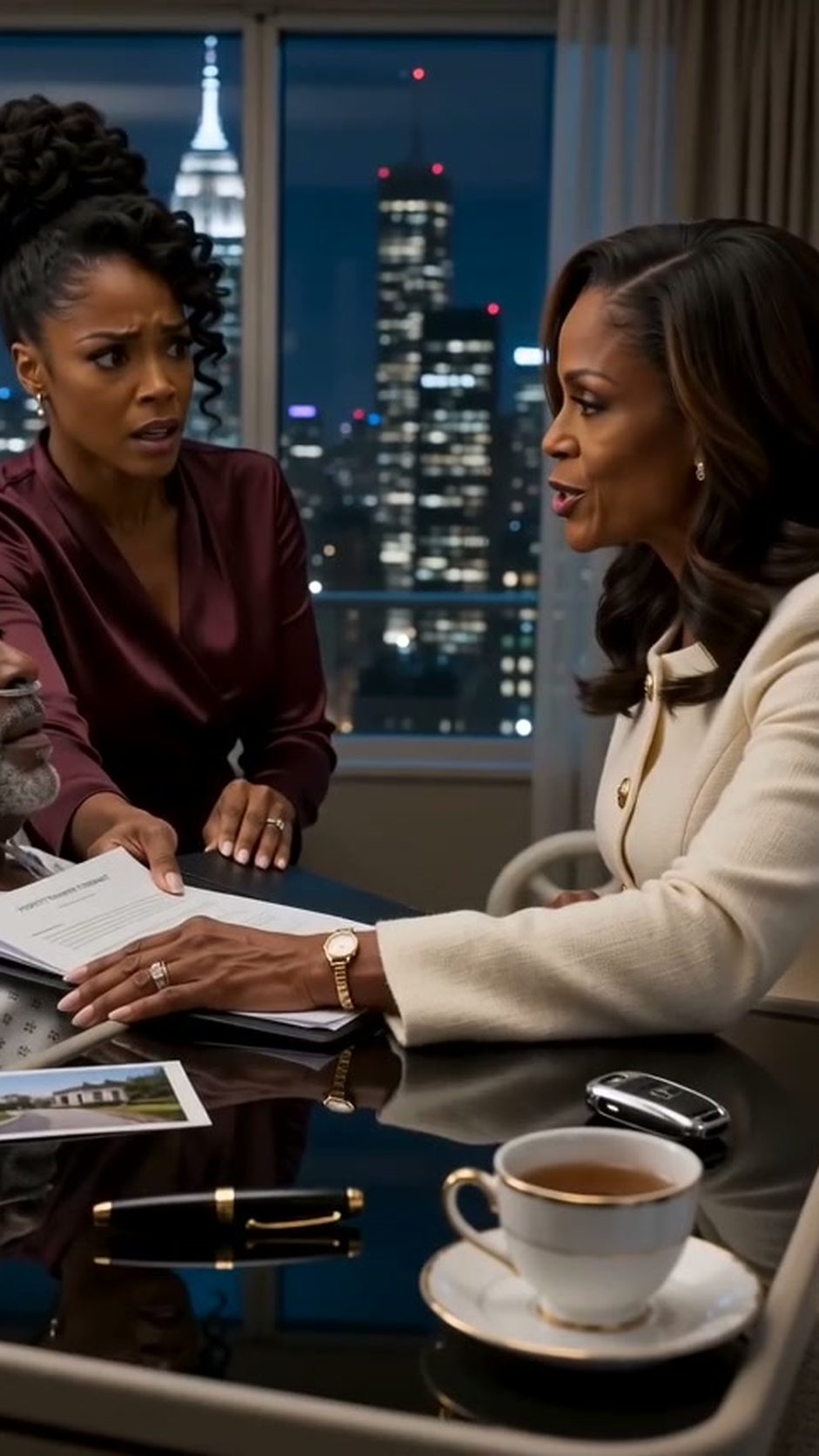
The last document was the thickest one.
Raymond Calloway's hand shook above it — the hand that had signed a thousand contracts, that had built an empire out of other people's money and his own magnificent confidence — and for a moment Vanessa thought it might fail him entirely. The transparent oxygen tube trembled against his cheek. The monitor beside the bed kept its patient green rhythm, indifferent, counting out the seconds of a life that had come down to a signature.
His trembling finger pressed onto the final page of the PROPERTY TRANSFER AGREEMENT, holding his place the way a drowning man holds a rope, while the attorney's hand hovered, waiting to slide the folder away and make it law.
Eight properties. Three luxury cars. Twenty-one years of marriage, converted into paper.
Sabrina moved first. Of course she did. Thirteen years of practice had made her quick where other people's property was concerned. Her manicured hand closed on the edge of the folder and pulled it toward herself with a soft, greedy scrape of paper across the polished black table — impatient, the way a woman reaches for a crown she believes has already been measured for her head.
Vanessa's hand came down on the documents.
Not a slap. Not a snatch. A settling — palm flat, fingers spread, the quiet finality of a judge's gavel wrapped in silk. The folder stopped dead. The paper bent faintly between the two women's hands and then lay still, and the only sound in the luxury ICU suite was the monitor, and Raymond's breath, which had changed.
Sabrina's smile vanished. She looked up, startled — actually startled, as though the furniture had spoken — and then toward Raymond, for reassurance, for rescue, for the version of this night she had rehearsed.
But Raymond was no longer looking at her.
His eyes were fixed on his wife with an attention she had not seen in them for a decade, and Vanessa held that gaze the way she had held everything else in this marriage: completely, and without blinking. She leaned closer to the bed, close enough that he would feel the words more than hear them, and her voice, when it came, was barely a whisper.
"Thirteen years, Raymond."
A single sharp beep cracked out of the monitor — one hard, wrong note in the rhythm — and Raymond froze. His confident, dying man's smile, the one he had worn through the entire ceremony of his own betrayal, began to come apart at the edges, the way ice comes apart in spring: silently, and then all at once.
No one explained anything. That was the point. In that room full of paper and pearls and medical light, with the whole glittering city spread out below the windows, the four of them understood, in four different ways, that the night had just changed owners.
Sabrina tried once more — she could not help herself; reaching was her religion. She tugged at the folder. Vanessa's palm did not move, and the paper flexed and held, and somewhere in the struggle a luxury car key fob skittered sideways across the tabletop and struck the black-and-gold fountain pen with a small, bright, metallic click that sounded, in that silence, like a lock turning.
Margaret Calloway rose abruptly from her chair.
The pearls at her throat shifted. One hand pressed hard onto the edge of the bedside table, and the miniature mansion — the little architectural model of the main house, brought to the hospital like a talisman, like proof — trembled from the impact and stayed upright. Her eyes went from her son to the woman in burgundy to the woman in ivory, and her voice, when it came, was cold enough to fog glass.
"He's Raymond's blood."
Vanessa turned to her mother-in-law slowly. No anger. Just a small, knowing expression — the look of a woman who has read the last page of a book everyone else is still pretending to be surprised by — and Margaret's certainty, thirteen years in the building, began to weaken around the eyes.
"The boy deserves his father's name," Margaret said, but it came out thinner this time. "His father's house. Everything should go to the blood."
"Say something."
Raymond's voice, weak, scraped out of him — a command wearing the costume of a plea. His fingers had found the edge of the hospital blanket and were worrying it, tightening, the fabric wrinkling under a grip that had nothing else left to hold.
Vanessa calmly set down her untouched cup of tea. Her hand was steady as stone. She leaned in again, closer than before, her expression almost affectionate, and watched his eyes follow her mouth.
"I kept a secret, too."
His fingers convulsed around the blanket. His breathing went shallow and fast. Somewhere under the bed rail his other hand was searching for purchase, for a version of the world in which his wife was the woman he had filed her as: patient, decorative, blind.
"You don't know what you gave away," Vanessa whispered.
And then — while Raymond stared at her with the first true fear she had ever put in him, while Sabrina's face drained of thirteen years of confidence in a single second, while Margaret stood motionless among the ruins of her certainty — Vanessa Calloway reached into her beige designer handbag and drew out, just far enough for the light to catch its edge, a sealed envelope.
Raymond's desperate eyes locked onto her hand.
The monitor beeped again, urgent and quickening.
She began to open it—
* * *
Thirteen years earlier, Vanessa Calloway was still a woman who believed surprises were a form of love.
She was thirty-seven years old, eight years married, and on that October afternoon she was carrying a paper bag from the little Italian place on Mercer Street — Raymond's favorite, the one with the hand-cut pasta — because his assistant had mentioned he would be working through lunch at the Callaway Properties office, closing the Harborview deal. She remembered the bag swinging against her leg. She remembered being happy. That is the part she would return to, later, in the worst hours: she had been happy, in the elevator, with the sun coming through the glass, an ordinary wife on an ordinary errand of love.
Raymond's car was not at the office.
His assistant — a new girl, nervous — said he had left at eleven for a "site visit." Vanessa smiled and left the pasta on his desk and drove, on an instinct she would spend thirteen years learning to trust, past the Harborview site. His car was not there either. It was parked, an hour later, in the side lot of the Rosewood Hotel, in the space nearest the private entrance, the way a man parks when he has parked there often enough to have a favorite space.
She sat in her car for a long time. She was not a fool — she had been raised by Charles Hart, who built half the waterfront and trusted no one's smile — but she was a wife, and wives are trained to manufacture innocence the way the body manufactures breath. A meeting, she told herself. A client. The Rosewood had conference rooms. She would wait, and he would come out with investors, and she would drive home ashamed of her own heart.
Raymond came out alone, at dusk, with his hand resting on the small of a young woman's back.
The woman was beautiful — even then, through the windshield, through the first cracking of the world, Vanessa registered it honestly: early twenties, warm brown skin, dark curls piled high, laughing up at him with the unguarded joy of a woman who has never once been lied to by the man beside her. Burgundy dress. Heels. And beneath the burgundy silk, unmistakable even at forty feet, the gentle, rounded beginning of a pregnancy.
His hand moved — Vanessa watched it move — from the small of the woman's back to the curve of her belly, and rested there. A husband's gesture. A father's.
Vanessa did not scream. She did not drive home and pack, or drive to her mother's grave and weep, or any of the things the woman she had been that morning would have done. Something in her — her father's daughter, rising at last — went very quiet and very cold and began, with terrible clarity, to take notes. She noted the hotel. The hour. The dress. The way Raymond laughed, throwing his head back like a young man, like the man who had once carried her over the threshold of a house her father's money had bought.
She started her car and followed them — not close, not reckless — to a brownstone across the river, where Raymond used his own key on the front door.
Then Vanessa Hart Calloway drove to the offices of Pierce & Alden, where her father's attorney had kept the same corner room for thirty years, and she walked in without an appointment, sat down across from Jonathan Pierce, folded her hands in her lap, and said the sentence that would govern the next thirteen years of her life.
"My husband has another woman. She's pregnant. I need to know everything — and then I need you to help me make sure that when this ends, it ends on my terms."
Pierce studied her for a long moment. Then he opened a drawer, took out a yellow legal pad, and reached, with the deliberation of a man laying out instruments for surgery, for his pen.
"Your father was a careful man, Vanessa," he said. "Raymond has signed a great many documents over the years. I am not entirely sure he has read all of them."
"What does that mean?"
"It means," Pierce said, "that if you are patient — truly patient — your husband may spend years building a gallows out of his own paperwork, and never hear the hammering."
She drove home the way a sleepwalker drives, perfectly and without memory of the road, and she was standing in her own kitchen with her coat still on when the second thought arrived — the one beneath the grief, the one that would feed her for thirteen years.
There had been a trust. She had always half-known it. Her father, signing papers at this very counter in the months before the wedding, saying, "A man can lose a company, sweetheart. He can lose a fortune, a name, a war. The one thing he cannot lose is the ground, if the ground was never his to carry." She had laughed and called him a feudal lord. He had smiled the smile that meant the papers were already filed.
Raymond came home at nine, smelling of rain and office, and kissed her cheek with the ease of a man whose conscience had its own private entrance. "You left pasta on my desk," he said, delighted. "Marry me again. The Harborview papers are nearly there — three more signatures and your father's towers are the jewel of my empire." His empire. He took her hand across the island and turned it over, palm up, the way he had done since they were dating, and traced the line of her life with his thumb like a man reading a document he believed he had authored.
"Long life," he announced. "Says so right here."
"Whose?" Vanessa asked, and smiled, and watched the joke land as a joke.
She served dinner. She asked about the deal, the bankers, the weather over the river. She was — this is the thing she would tell no one, the thing that shamed and steadied her in equal measure for thirteen years — good at it. Not frantic. Not brittle. She sat across from her husband with the knowledge sitting beside her like a third guest, and she poured his wine, and laughed in the right places, and when he went up to shower she sat alone in the dining room among the plates and understood, with a clarity that felt almost like peace, that she could do this for as long as it took. That the woman who had carried pasta across the city that morning was gone, and that the woman who had replaced her was not weaker for the exchange. She was simply finished being unarmed.
Upstairs, she heard the shower run, and Raymond humming — he always hummed, old standards, off-key — and she opened the drawer of her desk and took out the notebook she had used for the foundation's accounts, and on a fresh page she wrote the first entry of the other ledger, in her neat, gala-program hand:
October. Rosewood Hotel, side lot, private entrance. 6:40 p.m. Woman, burgundy dress, pregnant. His hand on her belly. Brownstone across the river — his own key.
She looked at it for a long moment. Then she closed the notebook, put it back beneath the foundation accounts, and went upstairs to be a wife.
Outside the window, the city lights burned steady now, row upon row, like witnesses who had taken their seats and intended to stay for the whole trial.